
Dual-chamber peptide cartridges: how the system works
Dual-chamber peptide cartridges combine two things that are normally supplied separately: a chamber containing lyophilized research material and a second chamber containing a predetermined volume of diluent. The two components remain physically isolated during storage and transportation and are combined only when the cartridge is activated in its compatible device.
This distinction matters. A dual-chamber cartridge is not simply a peptide that has been premixed and placed in a pen cartridge. Before activation, the peptide remains in its dry, freeze-dried state.
Why are peptides usually supplied lyophilized?
Lyophilization, also called freeze-drying, removes water from a formulation under controlled conditions. It is widely used for peptides, proteins and other sensitive biological materials when a liquid formulation would not provide suitable long-term stability.
Once a peptide is dissolved, its stability becomes much more dependent on temperature, time, light, agitation, concentration, pH and the composition of the diluent. Keeping the material dry until it is required avoids transporting it as an already reconstituted solution. This is the principal stability advantage shared by conventional lyophilized vials and dual-chamber cartridges.
Why not transport peptides as premixed solutions?
A premixed product begins its post-reconstitution period as soon as it is manufactured. By the time it reaches the researcher, it may already have been exposed to days of transport, temperature variation and mechanical stress.
The actual effect depends on the individual peptide and formulation, but a premixed solution generally presents more variables than a sealed lyophilized product. It also requires a validated cold chain throughout storage and delivery. The common “cold patch inside a foam box” that often gets presented as cold chain delivery is not suitable for reconstituted peptide shipping as it gets to environment temperatures withing hours and is subjected to repeated mechanical stress from courier handling and transportation.
A dual-chamber cartridge takes a different approach:
- the peptide remains lyophilized during transportation;
- the liquid remains in a separate sealed chamber;
- the components do not mix if the cartridge has not been activated;
- reconstitution takes place close to the point of research use.
This reduces the period for which the peptide exists as a solution before it is required.
What is inside a dual-chamber cartridge?
A dual-chamber cartridge contains the following components:
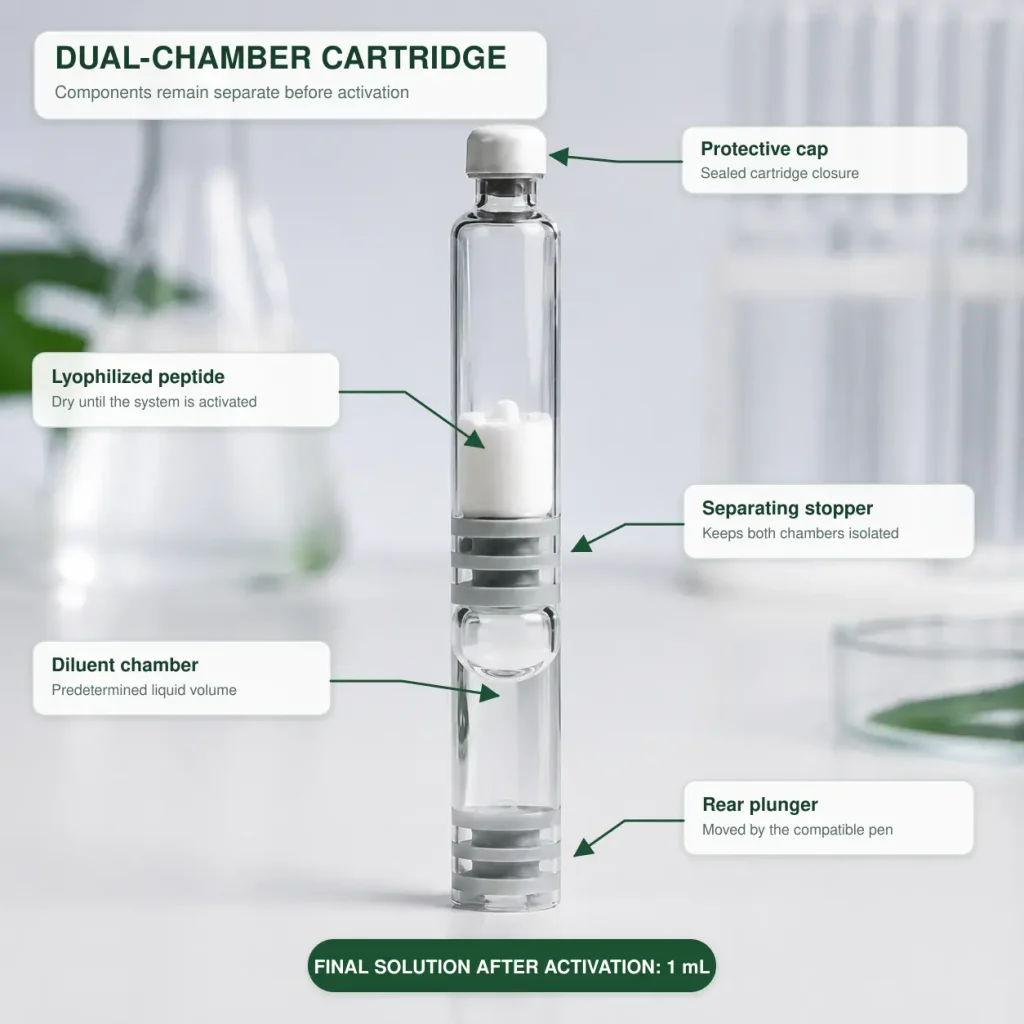
Lyophilized-material chamber
The front chamber contains the freeze-dried peptide. It remains separated from the diluent during storage and transport.
Diluent chamber
The rear chamber contains a defined volume of liquid selected for the product. Because the volume is predetermined, the resulting concentration can be stated in advance.
Separating stopper
An internal elastomeric stopper forms the barrier between the dry and liquid chambers. Before activation, it prevents contact between the two components.
Bypass channel
A narrow bypass is formed in the cartridge wall. When the separating stopper reaches this position during activation, the liquid can move around it and enter the chamber containing the lyophilized material.
Rear plunger
The compatible device advances the rear plunger. This creates the controlled movement needed to bring the separating stopper to the bypass and transfer the diluent between chambers.
How does activation work?
The cartridge is placed into its specifically compatible reusable device. As the device is operated, the rear plunger moves forward and displaces the diluent chamber. The separating stopper then reaches the bypass section, opening a path around the stopper.
The liquid travels through the bypass and enters the chamber containing the lyophilized peptide. The material can then dissolve inside the closed cartridge without a separate transfer from another container.
The design therefore combines storage and reconstitution in one primary container. A compatible device is essential: matching external dimensions alone does not establish compatibility with an ordinary insulin pen. The available plunger travel, bypass position and activation mechanism must also match the cartridge.
What problem does the system solve?
With a conventional vial, laboratory preparation normally requires a separate diluent container, selection of the intended volume and transfer of that liquid into the peptide vial. Each extra action introduces another variable.
The dual-chamber system reduces those steps by providing:
- one cartridge containing both components separately;
- a predetermined diluent volume;
- reconstitution inside the closed cartridge – less handling between separate containers;
- a defined final concentration after activation.
This may reduce transfer loss, unintended dilution and unnecessary agitation. It does not remove the need for correct calculations, appropriate handling or suitable volumetric resolution.
Understanding the 1 mL final volume
LIFE dual-chamber cartridges use a final volume of 1 mL. The resulting concentration depends on the quantity of peptide in the cartridge.
For example, a cartridge containing 10 mg in 1 mL has a concentration of:
10 mg ÷ 1 mL = 10 mg/mL
This is twice the concentration of a conventional 10 mg vial prepared with 2 mL, which produces 5 mg/mL.
| Preparation | Final concentration | Quantity in 0.1 mL |
| 10 mg in 1 mL | 10 mg/mL | 1 mg |
| 10 mg in 2 mL | 5 mg/mL | 0.5 mg |
Calculations prepared for a 2 mL dilution cannot be transferred directly to a 1 mL cartridge. For the same peptide quantity, the corresponding liquid volume is half as large in the 1 mL format.
The smaller total volume can be convenient when a compact research preparation is required. However, the higher concentration also makes measurement errors more significant: an error of 0.01 mL represents 0.1 mg at 10 mg/mL, compared with 0.05 mg at 5 mg/mL. Suitable measurement resolution therefore remains important.
Dual-chamber cartridge versus conventional vial
| Caracteristică | Conventional vial | Dual-chamber cartridge |
| Peptide before preparation | Lyophilized | Lyophilized |
| Diluent | Separate container | Separate internal chamber |
| Premixed during transport | Nu | Nu |
| Liquid-transfer step | Required | Integrated into activation |
| Final volume | Selected during preparation | Predetermined |
| Compatible reusable device | Not required | Required |
| Concentration flexibility | Greater | Fixed by product configuration |
The cartridge is therefore not universally better than a conventional vial. It prioritizes a simpler and more consistent workflow, while the conventional vial offers greater freedom to select the diluent and final volume for a particular research design.
Storage before and after activation
Before activation, the peptide remains lyophilized and should be stored according to the conditions stated for the individual product. Refrigerated storage at 2–8°C is generally the preferred conservative approach for long-term storage unless batch-specific data support another condition. Excessive heat and unnecessary temperature cycling should still be avoided.
After activation, the peptide is in solution and should be stored in general at 2–8°C.
Întrebări frecvente
Is a dual-chamber cartridge a premixed peptide?
No. The peptide and liquid remain in separate chambers until activation. The peptide is transported in lyophilized form. A dual-chamber cartridge is not a peptide in a pen as usually described.
Does the cartridge eliminate reconstitution?
No. Reconstitution still takes place, but it occurs inside the cartridge rather than through manual transfer from a separate diluent vial.
Can any reusable pen be used?
No. The cartridge requires a device designed for its dimensions, bypass position and activation travel. Compatibility should be explicitly confirmed rather than inferred from cartridge capacity alone.
Is the cartridge stable at room temperature?
Lyophilized material is more suitable for transportation than an already reconstituted solution.
Is 1 mL easier to calculate than 2 mL?
It provides a simple concentration when the quantity is 10 mg: 10 mg/mL. However, the concentration is twice that of 10 mg in 2 mL, so older calculations must be adjusted and smaller liquid volumes require adequate measurement precision.
A different format, not a different peptide
The dual-chamber system changes how the lyophilized material and diluent are stored and combined. It does not change the identity of the peptide itself. For researchers, the main advantages are delayed reconstitution, fewer separate preparation steps and a known final concentration. The trade-offs are a fixed diluent volume and the requirement for a specifically compatible device.
Compare the dual-chamber option with the conventional vial format on each eligible product page under “available format”.
—
Research-use notice: Products described are intended strictly for laboratory and analytical research. They are not intended for human or veterinary use, diagnosis or therapeutic application.
Referințe
- Stevanato Group. Dual Chamber Cartridges for Lyophilized and Sensitive Drugs.
- SCHOTT Pharma. Cartridges Double Chamber.
- Cheng Y, et al. Practical advice in the development of a lyophilized protein drug product. 2024.
- Kasper JC, Friess W. The freezing step in lyophilization: physico-chemical fundamentals, freezing methods and consequences on process performance and quality attributes of biopharmaceuticals. 2011.