Beschreibung
KPV (Lys-Pro-Val) ist ein natürlich vorkommendes Dreiaminosäurenfragment des α-Melanozyten-stimulierenden Hormons (α-MSH). Trotz seiner geringen Größe behält es einen Großteil des Hormons des Ausgangshormons bei entzündungshemmende Wirkung während die Pigmentierungseffekte, die mit α-MSH in voller Länge verbunden sind, fehlen.
Im Gegensatz zu vielen immunmodulierenden Peptiden scheint KPV entzündliche Signalwege regulieren, ohne die Immunfunktion umfassend zu unterdrücken. Dies hat es zu einem der interessantesten Peptide für die Forschung im Bereich von Entzündungskrankheiten, Epithelbarrierefunktion und Mukosaimmunität gemacht.
Möchten Sie KPV in Europa kaufen? Life Peptide liefert hochreines KPV für die Laborforschung mit zuverlässigem Versand in die gesamte EU.
Warum KPV so intensiv erforscht wird
In veröffentlichten Forschungsarbeiten wurde KPV in Bezug auf folgende Aspekte untersucht:
- Immunregulation
- entzündliche Signalübertragung
- Forschung zur Darmgesundheit
- Darmbarrierefunktion
- Hautentzündung
- Epithelbiologie
- Wundheilung
- Schleimhautimmunität
- NF-κB-Signalweg
Aufgrund seiner geringen Größe und seines einzigartigen Wirkmechanismus hat sich KPV zu einem der bekanntesten Forschungspepptide entwickelt, das eher auf Entzündungswege als auf die strukturelle Gewebereparatur abzielt.
So funktioniert KPV
Im Gegensatz zu BPC-157 oder TB-500 wird KPV in erster Linie hinsichtlich seiner Auswirkungen auf Immunsignale anstatt der Geweberegeneration.
Veröffentlichte Forschung hat dessen Zusammenhang untersucht mit:
Entzündungssignale
KPV wurde umfassend auf seine Fähigkeit untersucht, die Aktivierung von Entzündungswegen, darunter NF-κB, zu hemmen, was in Versuchsmodellen zu einer geringeren Produktion verschiedener proinflammatorischer Mediatoren führte.
Darmbarriere-Forschung
Einer der größten Forschungsschwerpunkte liegt auf Darmepithelzellen und experimentellen Modellen für entzündliche Darmerkrankungen, bei denen KPV Auswirkungen auf die Epithelintegrität und die Entzündungssignalwege gezeigt hat.
Hautbiologie
Aufgrund seiner Wirkung auf Epithelgewebe haben Forscher KPV auch in Modellen für entzündliche Hauterkrankungen und die Wundheilung untersucht.
Immunmodulation
Aktuelle Erkenntnisse deuten darauf hin, dass KPV die Immunantworten moduliert, anstatt eine allgemeine Immunsuppression hervorzurufen, was es zu einem interessanten Kandidaten für Untersuchungen zur physiologischen Entzündungsregulation macht.
Warum KPV immer wichtiger wird
Das Interesse an KPV hat in den letzten Jahren deutlich zugenommen, da es einen anderen Ansatz in der Entzündungsforschung darstellt.
Anstatt sich in erster Linie auf die Reparatur von Strukturgewebe zu konzentrieren, wie BPC-157 oder systemische Regeneration wie TB-500, KPV untersucht die Signalwege, die Entzündungen auslösen und aufrechterhalten.
Aufgrund dieser ergänzenden biologischen Eigenschaften erfreut sich KPV zunehmender Beliebtheit in der Forschung zu entzündlichen Darmerkrankungen, zur Hautbiologie und zur Funktion der Epithelbarriere.
Menschliche und präklinische Forschung
Die meisten veröffentlichten Erkenntnisse zu KPV stammen aus Zellkulturen und Tiermodellen.
In der Forschung wurden die Entzündungssignale im Darm, in der Haut, in der Lunge und im Epithelgewebe bereits umfassend untersucht, doch liegen bislang nur begrenzte klinische Erkenntnisse beim Menschen vor. Obwohl die präklinischen Daten vielversprechend sind, sind weitere Studien am Menschen erforderlich, bevor Schlussfolgerungen hinsichtlich klinischer Anwendungen gezogen werden können.
Veröffentlichte Sicherheitsbeobachtungen
Der derzeitige Wissensstand zu KPV basiert überwiegend auf Labor- und präklinischen Untersuchungen. Veröffentlichte Studien berichten im Allgemeinen von einer guten Verträglichkeit in Versuchsmodellen, doch liegen nach wie vor nur begrenzte kontrollierte klinische Daten beim Menschen vor. Wie bei vielen neuen Forschungspeptiden sind weitere Studien erforderlich, um die langfristige Wirksamkeit und Sicherheit umfassend zu charakterisieren.
Produkteigenschaften
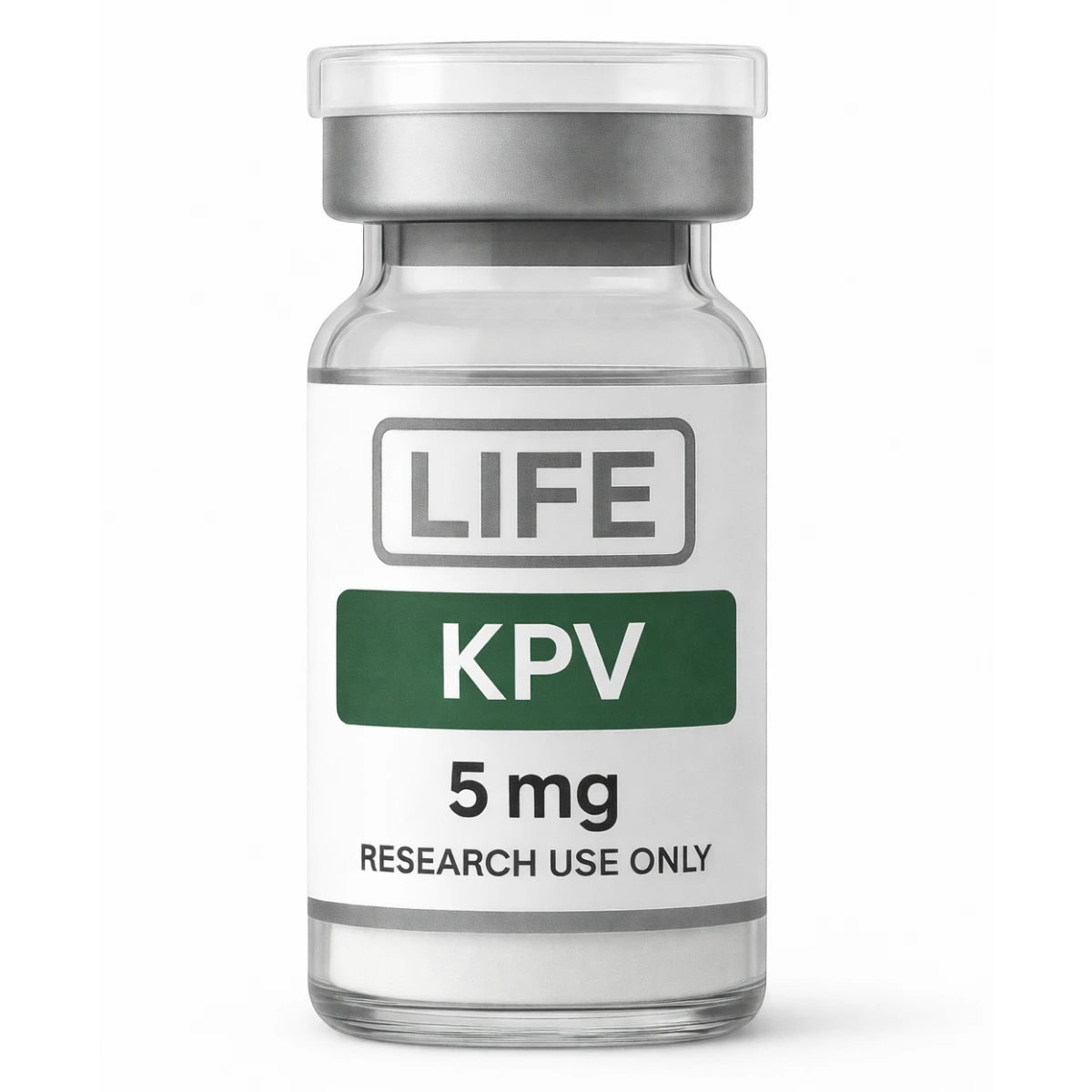
Anwendung: Labor- und analytische Forschung
Verwendungseinschränkung: Nicht zum menschlichen Verzehr bestimmt; nicht für medizinische, veterinärmedizinische oder kosmetische Zwecke
Hergestellt in GMP-konformen Anlagen unter strengen Qualitätskontrollprotokollen.
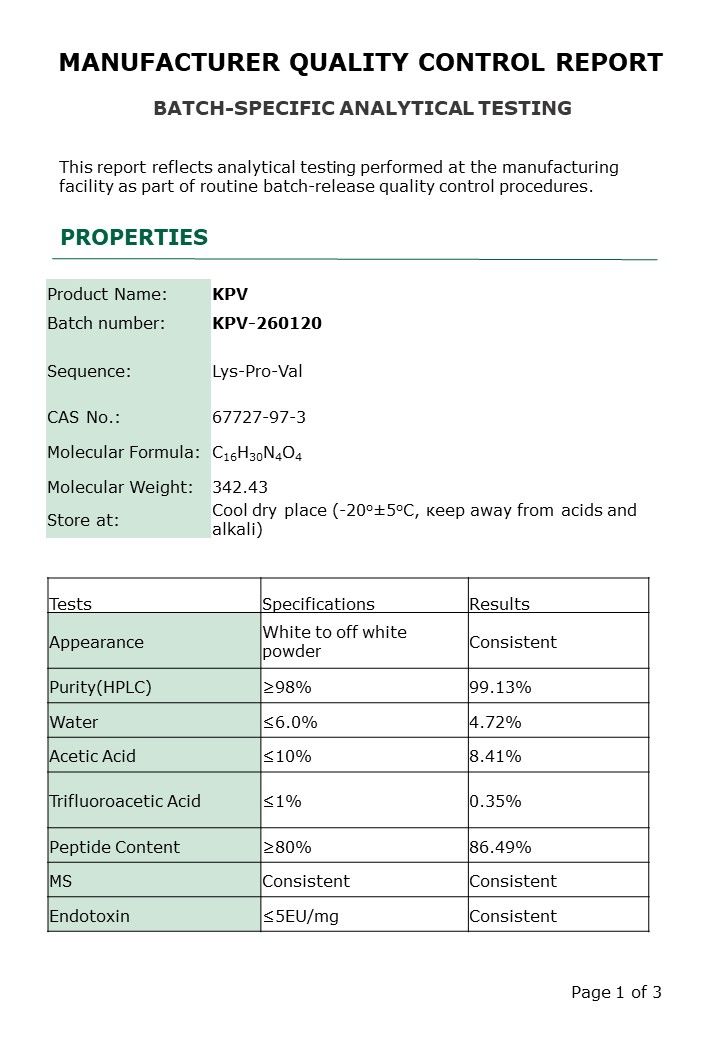
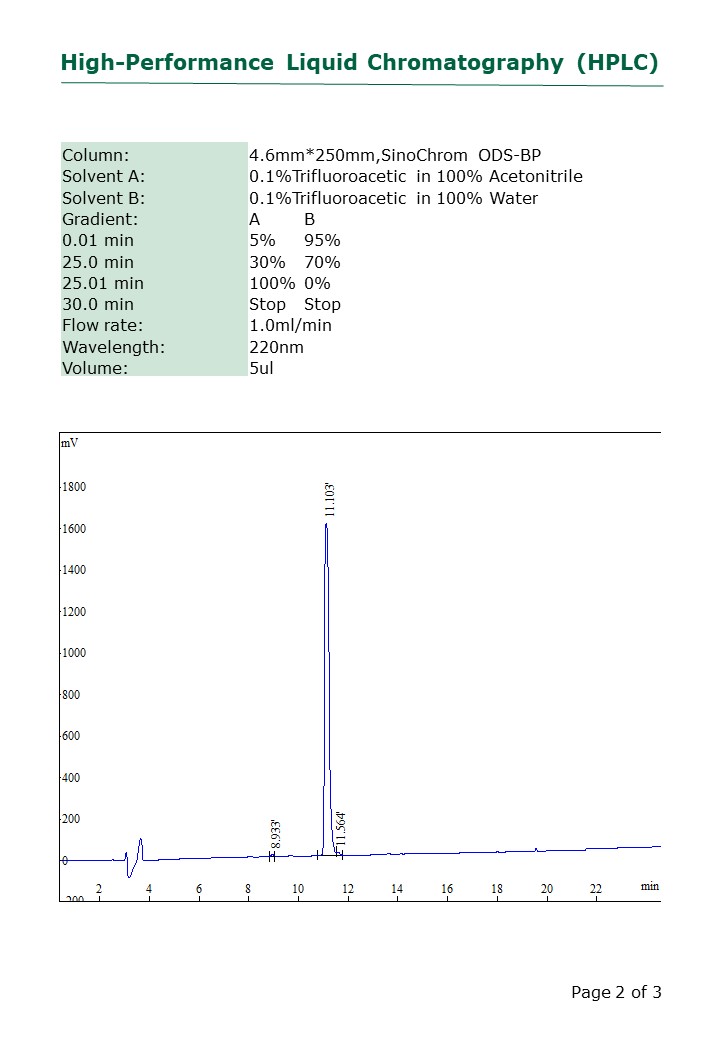
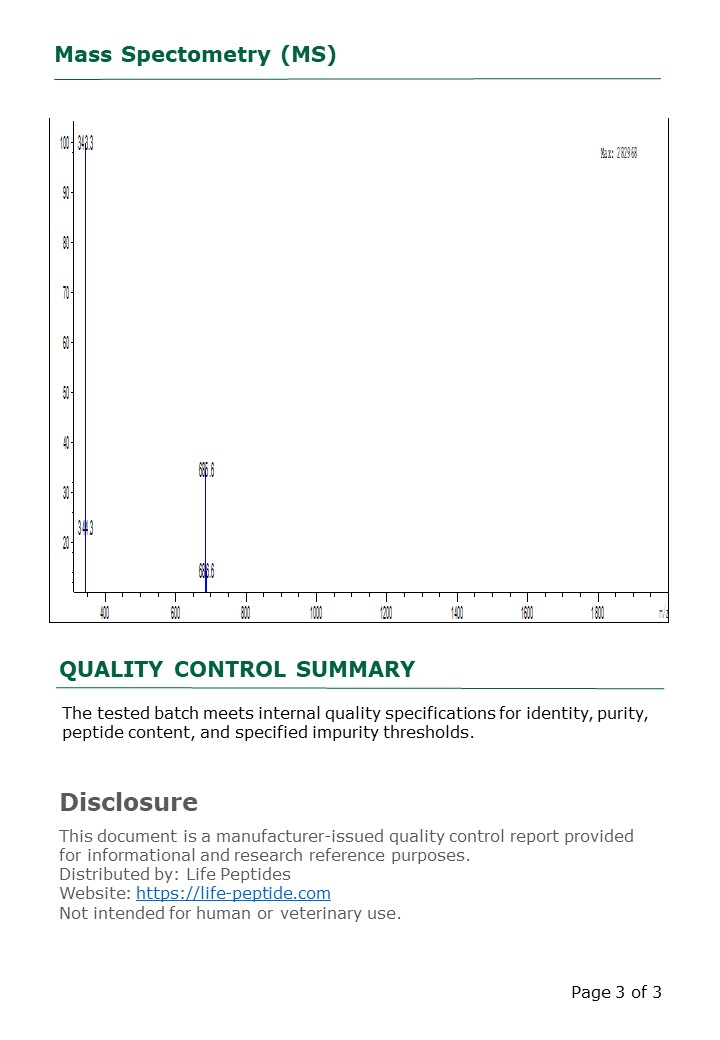
Jede Charge wird nach der Produktion sorgfältig im Labor getestet (das Analysezertifikat finden Sie unter den Produktbildern).
Gefriergetrocknet (lyophilisiert) für maximale Stabilität und längere Haltbarkeit.
Steril in Fläschchen abgefüllt, bereit zur Rekonstitution.
Reinheit: ≥99,1 % (HPLC-geprüft)
Aussehen: Lyophilisiertes weißes/weißliches Pulver
Summenformel: C16H30N4O4
Molekulargewicht: 342,43
Lys-Pro-Val
Speicherungeöffnete gefriergetrocknete Vials werden am besten gelagert gekühlte Lagerung bei 2–8°C, welche die von unserem Fertigungspartner bestätigte Lagerungsmethode ist und sich für bis zu 24 Monate eignet. Kühlung wird bevorzugt, da sie unnötige Gefrier-Tau-Zyklen bei routinemäßiger Handhabung minimiert. Wenn eine deutlich längerfristige Lagerung erforderlich ist, können auch ungeöffnete gefriergetrocknete Vials gefroren aufbewahrt werden. Nach der Rekonstitution immer bei 2–8 °C lagern und nicht einfrieren.
Rekonstitution und Handhabung
KPV wird als lyophilisiertes Vial geliefert und sollte unter Verwendung von Standard-Peptidrekonstitutionsverfahren gehandhabt werden, die für die Forschungsumgebung geeignet sind. Muss rekonstituiert werden mit Bakteriostatisches Wasser Vor Gebrauch. Um die strukturelle Integrität zu erhalten, geben Sie das gewählte Lösungsmittel langsam an der Innenwand des Fläschchens hinzu und nicht direkt auf den Peptidkuchen, und vermeiden Sie kräftiges Schütteln. Sanftes Schwenken ist im Allgemeinen ausreichend, sobald sich das Peptid vollständig gelöst hat. Standardmäßige Laborpraxis beinhaltet auch, gekühlte Fläschchen Raumtemperatur erreichen zu lassen, bevor sie rekonstituiert werden, um die Kondensation im Fläschchen zu minimieren.
Für weitere Informationen zur Lösungsmittelauswahl, zur Konzentrationsplanung und zur Lagerung siehe das vollständige Leitfaden zur Peptidrekonstitution und Rekonstitutionsrechner.
Ausgewählte Referenzen
- Dalmasso G. et al. Die durch PepT1 vermittelte Aufnahme des Tripeptids KPV verringert Entzündungen im Darm, Molecular Therapy, 2011
Eine bahnbrechende Studie, die die epitheliale Aufnahme von KPV und eine verminderte Entzündungssignalübertragung bei experimenteller Darmentzündung nachweist.
- Kannengiesser K. et al. KPV schützt vor experimenteller Colitis durch Modulation von Entzündungswegen, Gastroenterology Research, 2017
Untersuchungen, die die schützenden Wirkungen von KPV in experimentellen Modellen von chronisch-entzündlichen Darmerkrankungen demonstrieren.
- Brzoska T, Luger TA, et al. Alpha-MSH und das C-terminale Tripeptid KPV bei Entzündungen, Journal of Investigative Dermatology, 2003
Eine grundlegende Übersicht, die erklärt, warum das KPV-Fragment trotz des Fehlens der vollständigen $\alpha$-MSH-Sequenz eine starke entzündungshemmende Aktivität behält.
- Merlin D, et al. KPV und epitheliale Immunregulation, Verschiedene Publikationen
Eine Reihe von Studien zur Untersuchung des KPV-Transports durch PepT1 und der Regulation epithelialer Entzündungssignale.
Häufig gestellte Fragen
Was ist KPV?
KPV ist ein natürlich vorkommendes Tripeptid, das von Alpha-Melanozyten-stimulierendem Hormon ($\alpha$-MSH) abgeleitet ist. Es wird intensiv im Hinblick auf Immunregulation, entzündliche Signalwege und die Forschung an der Epithelbarriere untersucht.
Warum unterscheidet sich KPV von BPC-157?
Obwohl beide Peptide in der Erholungsforschung häufig diskutiert werden, wird BPC-157 primär zur Gewebereparatur untersucht, während sich KPV auf die Immunregulation und Entzündungssignale konzentriert. Ihre biologischen Zielstrukturen sind eher ergänzend als identisch.
Warum wird KPV mit der Forschung zur Darmgesundheit in Verbindung gebracht?
Ein Großteil der veröffentlichten Literatur hat KPV in intestinalen Epithelzellen und experimentellen Modellen chronisch-entzündlicher Darmerkrankungen aufgrund seiner Wirkungen auf entzündliche Signalwege und die epitheliale Barrierefunktion untersucht.
Welche Forschungsbereiche untersuchen KPV häufig?
Die aktuelle Forschung umfasst Immunregulation, Darmentzündungen, Epithelbiologie, Wundheilung, Hautentzündungen, Schleimhautimmunität und entzündliche Signalübertragung.
Wirkt KPV über Melanocortinrezeptoren?
Aktuelle Evidenz legt nahe, dass viele der entzündungshemmenden Wirkungen von KPV unabhängig von der klassischen Melanocortinrezeptor-Signalübertragung ablaufen, wodurch es sich mechanistisch von dem vollständigen α-MSH unterscheidet.
Kann ich KPV in Europa kaufen?
Ja. Wir versenden KPV mit zuverlässigen Kurierdiensten in die meisten europäischen Länder. Die verfügbaren Versandmethoden und Lieferzeiten werden Ihnen während des Bestellvorgangs basierend auf Ihrem Zielort angezeigt.
Ist dieses Produkt für den menschlichen Gebrauch bestimmt?
Hinweis: Das von Life Peptide gelieferte KPV ist ausschließlich für Labor- und Analysezwecke bestimmt. Es ist nicht für den menschlichen Verzehr, zur Diagnose, Behandlung oder Vorbeugung von Krankheiten vorgesehen. Alle Erörterungen veröffentlichter Studien fassen die wissenschaftliche Literatur zum KPV-Molekül zusammen und beziehen sich nicht auf den Verwendungszweck dieses Produkts.
Verwandter Forschungskontext
KPV gehört zur Heilungs- und Erholungspeptid-Forschung Kategorie, mit einem stärkeren Schwerpunkt auf entzündliche Signalübertragung und die Untersuchung epithelialer Signalwege. KPV wird häufig im Zusammenhang mit anderen Forschungspeptiden diskutiert, die Immunregulation, Gewebereparatur und Regeneration untersuchen:
BPC-157 – untersucht primär im Hinblick auf Gewebereparatur, Sehnenbiologie und Angiogenese.
TB-500 (Thymosin β4) – untersucht auf Zellmigration, Regeneration und Wundheilung.
Glow Blend – kombiniert GHK-Cu, BPC-157 und TB-500 für die Mehrweg-Erholungsforschung.
Wolverine Mischung – kombiniert BPC-157 und TB-500 für Studien zu Bindegewebe und Regeneration.
GHK-Cu – untersucht in der Hautbiologie, beim Umbau der extrazellulären Matrix und bei der Wundheilung.
Obwohl diese Peptide oft im Rahmen der Erholungsforschung zusammengefasst werden, hebt sich KPV dadurch ab, dass es sich primär auf die Immunregulation und Signalwege von Entzündungen konzentriert und nicht auf die strukturelle Geweberegeneration.
Für breiteren Kontext siehe die Leitfaden für Forschung zu Heilung und Genesung.
HINWEIS: Dies dient nur zu Bildungszwecken und stellt keine medizinische Beratung dar.
Haftungsausschluss
Dieses Produkt wird ausschließlich zu Forschungszwecken verkauft. Es ist nicht dazu bestimmt, Krankheiten zu diagnostizieren, zu behandeln, zu heilen oder zu verhindern. Der Käufer übernimmt die volle Verantwortung für die ordnungsgemäße Handhabung und Verwendung.