X

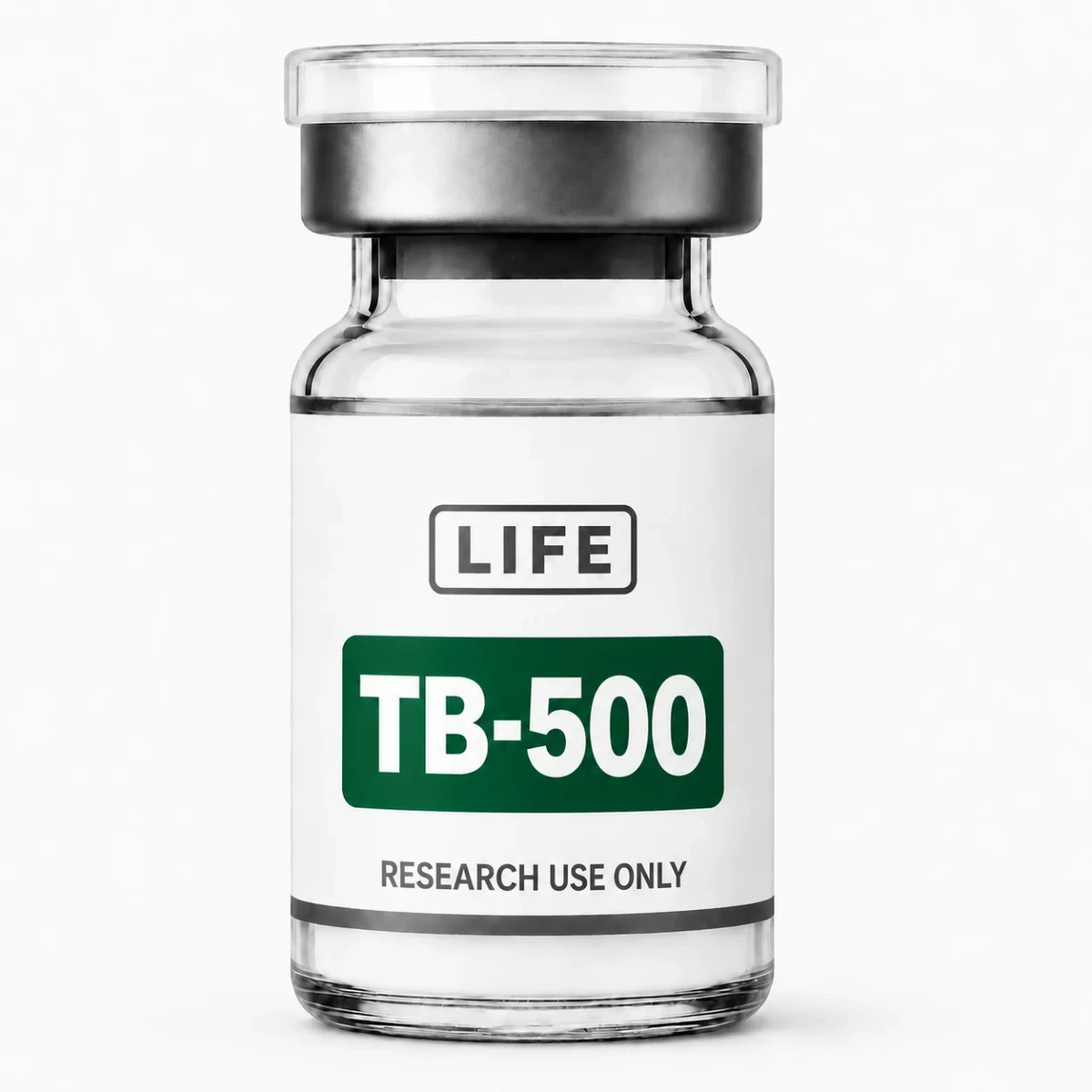
TB-500 (Thymosin β4 full sequence) / 5 mg

40,00 

TB-500 (Thymosin β4 Full Sequence) 5 mg is a research-grade regenerative peptide supplied in lyophilised form for laboratory use. Based on the complete 43-amino-acid Thymosin β4 sequence, it has become an important research tool in studies of tissue repair, cell migration, angiogenesis and regenerative biology.

Purity ≥99% | EU Shipping from €5 | Free shipping upgrades available | Card payments accepted  

En stock

Description

TB-500 is the name most commonly used within the research community for peptides derived from Thymosin β4 biology. Depending on the supplier and historical context, the term may refer to different peptide preparations. This product contains the complete Thymosin β4 (1–43) sequence, allowing researchers to investigate the full endogenous peptide rather than a shortened derivative.

Thymosin β4 is a naturally occurring 43-amino-acid peptide present in numerous human tissues. It plays important roles in actin regulation, cell migration, angiogenesis and tissue remodelling, making it one of the best-studied endogenous peptides in regenerative biology. Because TB-500 has become the dominant search term within the peptide community, the two names are frequently associated, even though they are not always scientifically identical.


Why TB-500 matters in regenerative research

TB-500 has become one of the most widely recognised regenerative peptides because published research on Thymosin β4 biology has demonstrated involvement in multiple repair-related processes rather than a single signalling pathway.

Research has investigated TB-500 / Thymosin β4 in relation to:

  • tissue repair
  • wound healing
  • angiogenesis
  • cell migration
  • actin dynamics
  • tendon and ligament biology
  • skeletal muscle repair
  • cardiac tissue research
  • corneal regeneration
  • inflammatory signalling

Unlike peptides that primarily target a single receptor, Thymosin β4 influences several interconnected biological processes involved in tissue maintenance and repair, making it relevant across multiple fields of regenerative research.

How TB-500 works

The biological activity associated with TB-500 originates from Thymosin β4, an endogenous peptide that binds G-actin, helping regulate cytoskeletal organisation and cellular movement.

Published research has linked Thymosin β4 to:

  • regulation of actin dynamics
  • cell migration
  • angiogenesis
  • extracellular matrix remodelling
  • inflammatory responses
  • tissue regeneration

Because successful tissue repair depends on coordinated cell migration and structural remodelling, Thymosin β4 has become an important experimental model in regenerative medicine and wound-healing research.


Human and preclinical research

Published studies investigating Thymosin β4 have explored its biological activity across numerous laboratory models together with several early-stage human clinical programmes.

Research has examined its role in:

  • dermal wound healing
  • corneal repair
  • myocardial injury
  • pressure ulcers
  • venous ulcers
  • musculoskeletal regeneration

While early clinical studies reported encouraging biological activity and favourable tolerability, the current evidence base remains substantially smaller than that available for approved therapeutic agents. Consequently, TB-500 / Thymosin β4 continues to be investigated primarily as a research peptide rather than an established medicine.


Understanding TB-500 and full-sequence Thymosin β4

Although TB-500 is by far the most widely recognised name within the peptide community, the scientific literature primarily investigates Thymosin β4, the naturally occurring endogenous peptide.

This product contains the complete Thymosin β4 (1–43) sequence, consisting of all 43 amino acids found in the native human peptide.

This distinction matters because:

  • many published mechanistic and clinical studies investigated the full-length peptide
  • the term TB-500 has been used inconsistently by different suppliers over the years
  • not every product marketed as TB-500 necessarily represents the complete endogenous sequence

For researchers seeking to align experimental work with the published Thymosin β4 literature, using the full-sequence peptide provides the closest match to the molecule investigated in most biological studies while still matching the terminology most researchers search for online.

How TB-500 differs from BPC-157 and GHK-Cu

Although TB-500, BPC-157 and GHK-Cu are frequently grouped together as regenerative peptides, they represent distinct biological approaches.

TB-500 / Thymosin β4 is primarily associated with cell migration, actin dynamics and tissue remodelling, making it particularly relevant for studies of coordinated tissue repair.

BPC-157 is more commonly investigated in tendon, ligament, muscle and gastrointestinal injury models, with particular interest in angiogenesis and cytoprotective signalling.

GHK-Cu is a naturally occurring copper peptide studied for extracellular matrix biology, collagen turnover, skin physiology and broad gene-regulatory effects.

Rather than competing with one another, these peptides are often viewed as complementary research tools targeting different aspects of regenerative biology.


Published safety observations

Early human clinical studies investigating full-sequence Thymosin β4 have generally reported favourable tolerability under controlled research conditions.

Phase I clinical programmes evaluating intravenous administration found no dose-limiting toxicity within the investigated dose ranges, while subsequent studies continued to evaluate safety in cardiovascular, ophthalmic and tissue-repair settings.

Because published human data remain relatively limited and involve different formulations and research objectives, current safety findings should be interpreted within the context of each individual study.


Product characteristics

Application: laboratory and analytical research
Use restriction: not for human consumption; not for medical, veterinary or cosmetic use
Produced in GMP-compliant facilities under strict QC protocols.
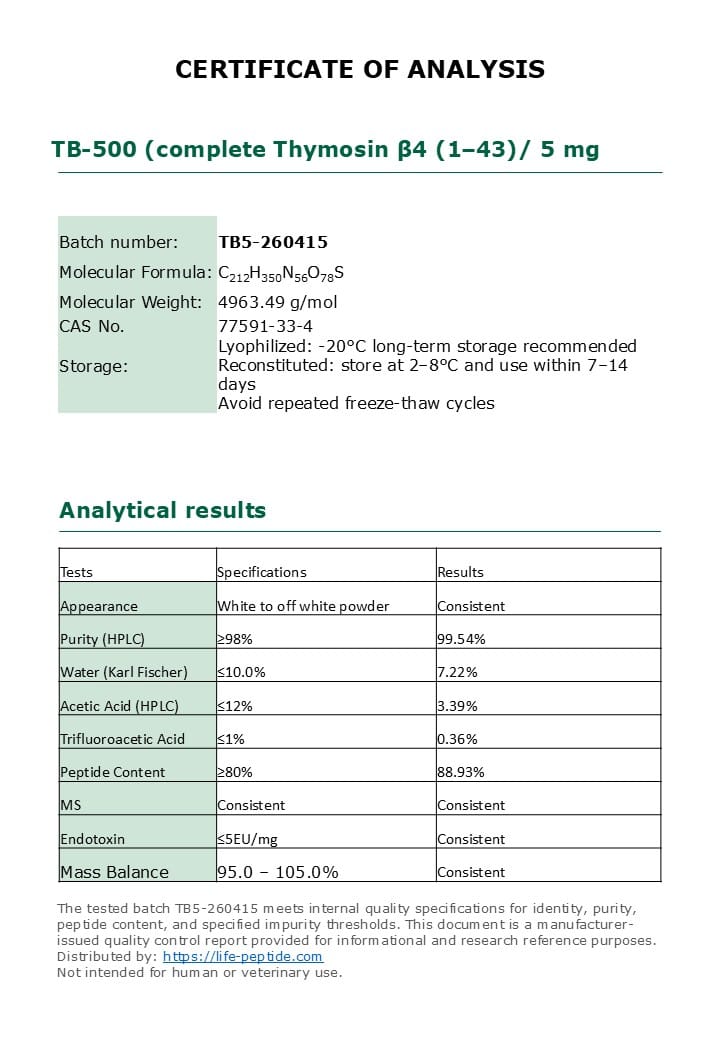
Each batch carefully lab tested after production (you can find Certificate of Analysis under product pictures).
Freeze-dried (lyophilized) for maximum stability and extended shelf life.
Sealed in sterile vials, ready for reconstitution.
Purity: ≥ 99% (HPLC)
Appearance: white lyophilized powder
Molecular formula: C212H350N56 O78S
Molecular weight: 4963.49
CAS No: 77591-33-4
Sequence: Ac-Ser-Asp-Lys-Pro-Asp-Met-Ala-Glu-Ile-Glu-Lys-Phe-Asp-Lys-Ser-Lys-Leu-Lys-Lys-Thr-Glu-Thr-Gln-Glu-Lys-Asn-Pro-Leu-Pro-Ser-Lys-Glu-Thr-Ile-Glu-Gln-Glu-Lys-Gln-Ala-Gly-Glu-Ser-OH
Storage: unopened lyophilized vials are best stored refrigerated at 2–8°C, which is the storage method confirmed by our manufacturing partner and suitable for up to 24 months. Refrigeration is preferred because it minimizes unnecessary freeze–thaw cycles during routine handling. If substantially longer-term storage is required, unopened lyophilized vials may also be kept frozen. Once reconstituted, always store at 2–8°C and do not freeze.

Reconstitution and handling

TB-500 is supplied as a lyophilised peptide and should be reconstituted using appropriate laboratory procedures suitable for peptide research. To help preserve structural integrity, add the chosen solvent slowly against the inside wall of the vial rather than directly onto the peptide cake, and avoid vigorous shaking. Gentle swirling is generally sufficient once the peptide has fully dissolved. Standard laboratory practice also includes allowing refrigerated vials to reach room temperature before reconstitution to minimise condensation inside the vial.

Most often TB-500 is reconstituted with bacteriostatic water before use. For sterile filtration of peptide solutions it is advised to use a 0.22 µm PES syringe filter. For other solvent selection, concentration planning and storage guidance, see the full Peptide Reconstitution Guide et Reconstitution Calculator.. These resources explain how different reconstitution volumes affect working concentration without recommending research protocols.


Key published studies

  • Goldstein AL, Kleinman HK. Thymosin β4: Structure, Function and Biological Properties Supporting Current and Future Clinical Applications. Annals of the New York Academy of Sciences, 2010.

A landmark review describing the biological functions of full-sequence Thymosin β4, including tissue repair, angiogenesis, inflammation and regenerative medicine.

  • Ruff D, Crockford D, Girardi G, et al. A Randomized, Placebo-Controlled, Single and Multiple Dose Study of Intravenous Thymosin β4 in Healthy Volunteers. Annals of the New York Academy of Sciences, 2010.

The first Phase I human study evaluating the safety, tolerability and pharmacological profile of full-sequence Thymosin β4.

  • Xing Y, Zhang Y, Li Y, et al. Progress on the Function and Application of Thymosin β4. International Journal of Molecular Sciences, 2021.

A comprehensive review covering actin regulation, angiogenesis, wound healing, inflammation and current directions in regenerative research.

  • Wang X, Liu L, Qi L, et al. A First-in-Human, Randomized, Double-Blind, Single- and Multiple-Dose Phase I Study of Recombinant Human Thymosin β4 in Healthy Chinese Volunteers. Journal of Cellular and Molecular Medicine, 2021.

A modern Phase I study describing safety, pharmacokinetics and tolerability of recombinant full-sequence Thymosin β4 in healthy volunteers.


FAQ

What is TB-500?

TB-500 is the name most commonly used within the peptide research community for peptides associated with Thymosin β4 biology. This product contains the complete Thymosin β4 (1–43) sequence, allowing researchers to investigate the full endogenous peptide.

Is TB-500 the same as Thymosin β4?

The names are often used interchangeably, but they are not always scientifically equivalent. Thymosin β4 is the naturally occurring 43-amino-acid peptide found in human tissues, while the term TB-500 has historically been applied to different research peptide preparations. This product contains the full-length Thymosin β4 sequence.

Why does the full sequence matter?

Many published mechanistic and clinical studies have investigated the complete endogenous Thymosin β4 molecule. Using the full 43-amino-acid sequence allows researchers to work with a peptide that most closely reflects the molecule described throughout the scientific literature.

What research areas commonly investigate TB-500?

Published studies have investigated Thymosin β4 biology in tissue repair, wound healing, angiogenesis, cell migration, tendon and ligament research, cardiac repair, corneal regeneration and regenerative medicine.

How does TB-500 differ from BPC-157?

Although both peptides are widely studied in regenerative research, TB-500 is primarily associated with actin regulation, cell migration and tissue remodelling, whereas BPC-157 is more commonly investigated in soft-tissue injury models, angiogenesis and cytoprotective signalling.

Is this product intended for human use?

No. TB-500 (Full Sequence Thymosin β4) supplied by LIFE Peptide is provided strictly for laboratory and analytical research. It is not intended for human consumption, diagnosis, treatment or prevention of disease. Any discussion of published studies summarises the scientific literature relating to the peptide rather than the intended use of this product.


Related research context

Thymosin β4 belongs to the healing & recovery peptide research cluster, focused on tissue signaling, cellular repair mechanisms, and inflammatory pathway modulation.
Researchers studying these pathways may also examine:

BPC-157 – tissue signaling peptide
GHK-Cu – copper peptide complex
KPV – anti-inflammatory peptide fragment
ARA-290 – erythropoietin-derived peptide
SS-31 – investigated for mitochondrial function and cellular energy production.

For broader context, see the Healing & recovery research guide.
Browse all compounds in the Healing & recovery research category.

NOTE: This is for educational reference only and does not constitute medical advice.
This product is supplied as full-sequence Thymosin β4 (1–43)
Not labeled or marketed as “TB-500” to avoid ambiguity
Intended strictly for controlled laboratory environments

Disclaimer
This product is sold for research purposes only. It is not intended to diagnose, treat, cure, or prevent any disease. Buyer assumes full responsibility for proper handling and use.

Avis

Il n’y a pas encore d’avis.

Soyez le premier à laisser votre avis sur “TB-500 (Thymosin β4 full sequence) / 5 mg”

Votre adresse e-mail ne sera pas publiée. Les champs obligatoires sont indiqués avec *

Produits similaires