Beschreibung
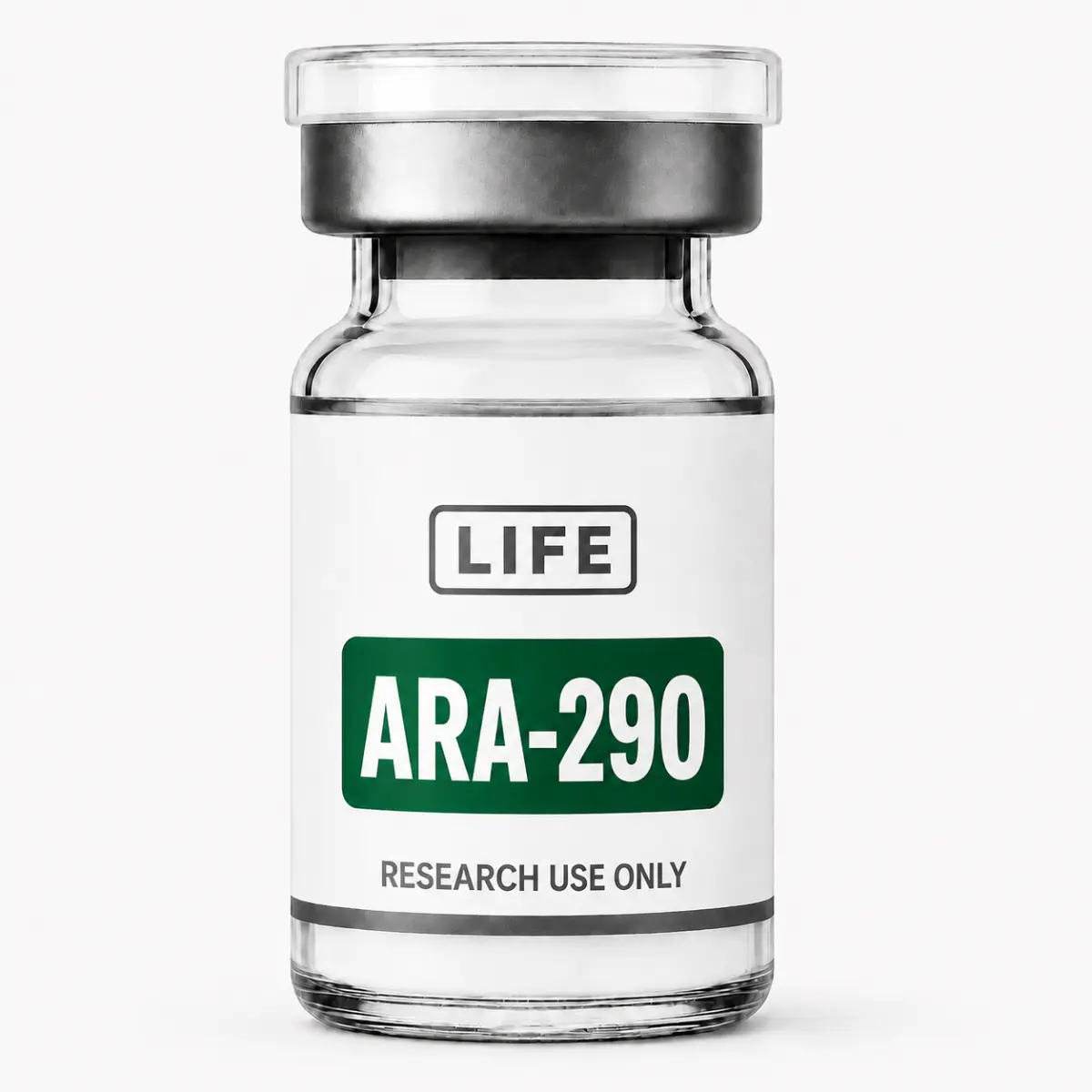
ARA-290, auch bekannt als Cibinetide, ist ein synthetisches 11-Aminosäuren-Peptid, das von der gewebeschützenden Region von Erythropoietin (EPO) abgeleitet ist.
Anstatt die Produktion roter Blutkörperchen wie EPO zu stimulieren, aktiviert ARA-290 selektiv den angeborenen Reparaturrezeptor (IRR), einen Rezeptorkomplex, der nach Gewebeverletzung, Entzündung oder metabolischer Stress. Dies macht es zu einem der wenigen Forschungspetptide, die speziell dafür entwickelt wurden die natürliche Heilungs- und Reparaturreaktion des Körpers untersuchen, ohne die Hämatopoese zu beeinträchtigen.
Aufgrund dieses einzigartigen Mechanismus hat ARA-290 in der Forschung erhebliche Aufmerksamkeit erregt, bei der periphere Nervenverletzung, entzündliche Erkrankungen, Gewebeschutz und chronische Schmerzen.
Möchten Sie ARA-290 in Europa kaufen? Life Peptide liefert hochreines ARA-290 für die Laborforschung mit zuverlässigem Versand in die gesamte EU..
Warum ARA-290 intensiv untersucht wird
Veröffentlichte Forschung hat ARA-290 untersucht im Zusammenhang mit:
- Nervenreparatur
- Heilungsbiologie
- Gewebeschutz
- entzündliche Signalübertragung
- periphere Neuropathie
- Small-Fiber-Neuropathie
- autonome Dysfunktion
- Stoffwechselschaden
- angeborene Reparaturmechanismen
Im Gegensatz zu vielen Peptiden zur Regeneration, die primär die Wiederherstellung des Bindegewebes untersuchen, konzentriert sich ARA-290 auf die Aktivierung der körpereigenen Reparatursysteme, insbesondere nach entzündlichen oder neurologischen Verletzungen.
Wie ARA-290 wirkt
ARA-290 verfügt über einen der markantesten Mechanismen unter den Heilungspeptiden.
Aktivierung des angeborenen Reparaturrezeptors
Anstatt den klassischen Erythropoietin-Rezeptor zu binden, aktiviert ARA-290 selektiv den angeborenen Reparaturrezeptor (Innate Repair Receptor, IRR), einen Rezeptorkomplex, der aus dem Erythropoietin-Rezeptor und CD131 gebildet wird. Wichtig ist, dass dieser Rezeptor hauptsächlich nach Gewebeschäden oder entzündlichem Stress exprimiert wird, was es Forschern ermöglicht, biologische Reparaturprozesse zu untersuchen, die spezifisch bei Verletzungen aktiviert werden.
Unterstützung des Gewebeschutzes
Die Aktivierung des IRR wurde in experimentellen Modellen mit reduzierten entzündlichen Signalwegen, vermindertem Zelltod und einer verbesserten Gewebewiderstandsfähigkeit in Verbindung gebracht. Im Gegensatz zu Wachstumsfaktoren, die die Zellproliferation stimulieren, scheint ARA-290 die körpereigenen Reparaturmechanismen zu unterstützen, indem es die Gewebehomöostase nach einer Verletzung wiederherstellt.
Forschung zur Nervenregeneration
Eines der stärksten Forschungsgebiete betrifft die Small-Fiber-Neuropathie, bei der ARA-290 in frühen klinischen Studien Verbesserungen der neuropathischen Symptome zusammen mit Hinweisen auf eine Regeneration kleiner Nervenfasern gezeigt hat. Dies hat ARA-290 zu einem der führenden experimentellen Peptide für die Nervenreparaturforschung gemacht.
Immun- und Entzündungsregulation
Aktuelle Erkenntnisse deuten zudem darauf hin, dass die Aktivierung des angeborenen Reparaturrezeptors überschüssige Entzündungssignale reduzieren und gleichzeitig den Übergang von Gewebeverletzungen zu physiologischer Reparatur fördern kann.
Warum sich ARA-290 von anderen Heilungspedptiden unterscheidet
Viele heilende Peptide werden untersucht wie Gewebe regenerieren.
ARA-290 untersucht wie beschädigtes Gewebe die Reparatur einleitet.
Anstatt in erster Linie die Angiogenese, die Kollagenproduktion oder die Zellmigration zu stimulieren, konzentriert sich ARA-290 auf Aktivierung der körpereigenen Reparaturreaktion über den angeborenen Reparaturrezeptor. Diese einzigartige Biologie hat sie besonders interessant gemacht für die Forschung im Bereich neurologische Verletzung, chronische Entzündung und periphere Nervenerkrankungen, wo beeinträchtigte Reparaturmechanismen zur langfristigen Dysfunktion beitragen können.
Menschliche und präklinische Forschung
ARA-290 wird von beiden unterstützt umfangreiche präklinische Forschung und frühe klinische Studien am Menschen.
Veröffentlichte Untersuchungen haben sich auf die mit Sarkoidose und Typ-2-Diabetes verbundene Small-Fiber-Neuropathie konzentriert, bei der über Verbesserungen der neuropathischen Symptome, der autonomen Funktion und Hinweise auf eine Regeneration der Hornhautnervenfasern berichtet wurde.
Forscher haben ARA-290 auch in Modellen ischämischer Verletzungen, entzündlicher Erkrankungen und Stoffwechselerkrankungen untersucht, was die breite biologische Rolle des Rezeptors für angeborene Reparaturprozesse widerspiegelt.
Obwohl die Ergebnisse ermutigend sind, bleiben größere placebokontrollierte Studien erforderlich, um dessen klinisches Potenzial weiter zu definieren.
Veröffentlichte Sicherheitsbeobachtungen
Eines der Hauptziele bei der Entwicklung von ARA-290 war es, die gewebeschützenden Eigenschaften von Erythropoietin zu erhalten und gleichzeitig seine Wirkung auf die Produktion roter Blutkörperchen zu eliminieren.
Frühe klinische Studien haben im Allgemeinen über eine günstige Verträglichkeit ohne Anstieg des Hämatokrits oder Hämoglobins berichtet. Größere und längerfristige Humanstudien sind jedoch weiterhin erforderlich, um sein Sicherheitsprofil vollständig zu charakterisieren.
Produkteigenschaften
Anwendung: Labor- und analytische Forschung
Verwendungseinschränkung: Nicht zum menschlichen Verzehr bestimmt; nicht für medizinische, veterinärmedizinische oder kosmetische Zwecke
Hergestellt in GMP-konformen Anlagen unter strengen Qualitätskontrollprotokollen.
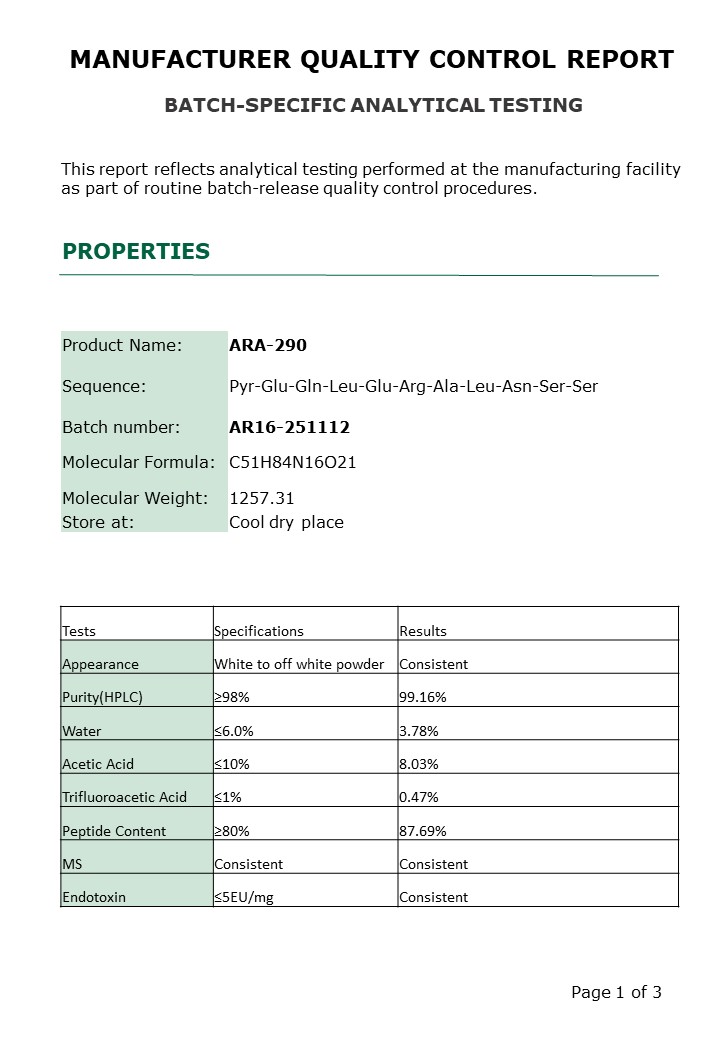
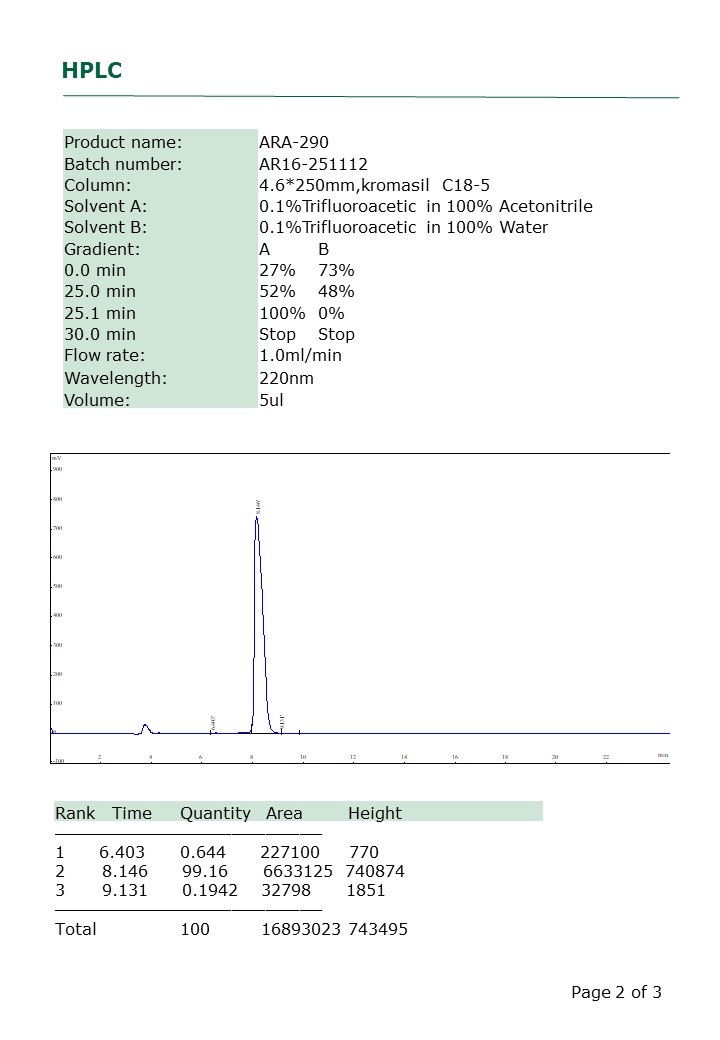
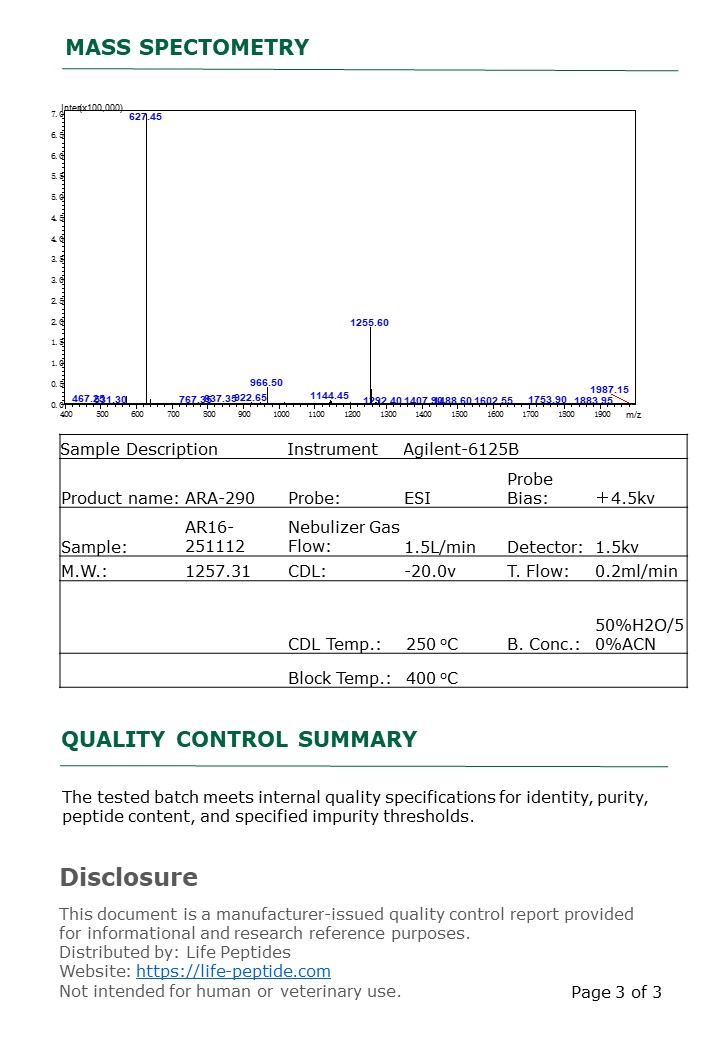
Jede Charge wird nach der Produktion sorgfältig im Labor getestet (das Analysezertifikat finden Sie unter den Produktbildern).
Gefriergetrocknet (lyophilisiert) für maximale Stabilität und längere Haltbarkeit.
Steril in Fläschchen abgefüllt, bereit zur Rekonstitution.
Reinheit: ≥99% (HPLC-geprüft)
Aussehen: Lyophilisiertes weißes/weißliches Pulver
Summenformel: C51H84N16O21
Molekulargewicht: 1257,31
Sequenz: Pyr-Glu-Gln-Leu-Glu-Arg-Ala-Leu-Asn-Ser-Ser
Speicherungeöffnete gefriergetrocknete Vials werden am besten gelagert gekühlte Lagerung bei 2–8°C, welche die von unserem Fertigungspartner bestätigte Lagerungsmethode ist und sich für bis zu 24 Monate eignet. Kühlung wird bevorzugt, da sie unnötige Gefrier-Tau-Zyklen bei routinemäßiger Handhabung minimiert. Wenn eine deutlich längerfristige Lagerung erforderlich ist, können auch ungeöffnete gefriergetrocknete Vials gefroren aufbewahrt werden. Nach der Rekonstitution immer bei 2–8 °C lagern und nicht einfrieren.
Rekonstitution und Handhabung
ARA-290 wird als lyophilisiertes Fläschchen geliefert und sollte unter Verwendung von Standard-Peptid-Rekonstitutionsverfahren gehandhabt werden, die für die Forschungsumgebung geeignet sind. Muss unter Anwendung geeigneter Labortechnik rekonstituiert werden. Aufgrund seiner physikochemischen Eigenschaften erfordert ARA-290 eine Rekonstituierung mit gepufferte Kochsalzlösung. Unangemessene pH-Bedingungen oder unsachgemäße Handhabung können zu einer unvollständigen Auflösung oder einem weißlichen/opaleszenten Aussehen führen. Um die strukturelle Integrität zu wahren, geben Sie das gewählte Lösungsmittel langsam an der Innenwand des Vials entlang hinzu, anstatt es direkt auf den Peptidkuchen zu geben, und vermeiden Sie kräftiges Schütteln. Ein sanftes Schwenken ist im Allgemeinen ausreichend, sobald sich das Peptid vollständig gelöst hat. Zu den Standardlaborpraktiken gehört es zudem, gekühlte vials vor der Rekonstitution auf Raumtemperatur kommen zu lassen, um Kondenswasser im Inneren des Vials zu minimieren.
Für weitere Informationen zur Lösungsmittelauswahl, zur Konzentrationsplanung und zur Lagerung siehe das vollständige Leitfaden zur Peptidrekonstitution und Rekonstitutionsrechner.
Ausgewählte Referenzen
- Brines M, Cerami A. Der angeborene Reparaturrezeptor: Ein neues Ziel für Gewebeschutz und -reparatur. Pharmacology & Therapeutics (2015).
Die wegweisende Übersichtsarbeit, die die Biologie des angeborenen Reparaturrezeptors und die Entwicklung von ARA-290 als gewebeschützendes Peptid beschreibt.
- Heij L, et al. Ansteuerung des angeborenen Reparaturrezeptors zur Behandlung von Neuropathie. Neural Regeneration Research (2018).
Eine Übersicht über präklinische und klinische Evidenz zur Unterstützung von ARA-290 in der Forschung zu peripherer Nervenreparatur und Neuropathie.
- Brines M, et al. ARA-290 verbessert die Symptome bei Patienten mit Sarkoidose-assoziierter Small-Fiber-Neuropathie. Molecular Medicine (2011).
Eine der ersten klinischen Studien, die eine Verbesserung neuropathischer Symptome nach einer Behandlung mit ARA-290 zeigte.
- Aktuelle Bewertungen (2023–2025)
Moderne Studien untersuchen weiterhin ARA-290 bei entzündlichen Erkrankungen, Stoffwechselstörungen und neurologischer Regeneration, was das wachsende Interesse an der Biologie der angeborenen Reparaturrezeptoren (Innate Repair Receptor Biology) unterstreicht.
Häufig gestellte Fragen
Was ist ARA-290?
ARA-290 (Cibinetide) ist ein aus Erythropoietin abgeleitetes Peptid mit 11 Aminosäuren. Es wird häufig als heilendes Peptid zur Nervenreparatur, zum Gewebeschutz und für angeborene Reparatursignale untersucht.
Warum wird ARA-290 als ein Heilungspellet angesehen?
Im Gegensatz zu Peptiden, die hauptsächlich die Geweberegeneration stimulieren, untersucht ARA-290 die biologischen Signalwege, die die körpereigene Reparaturreaktion nach einer Verletzung aktivieren. Dies hat es zu einem wichtigen Forschungswerkzeug im Bereich des Gewebeschutzes und der Genesung gemacht.
Warum unterscheidet sich ARA-290 von Erythropoietin?
ARA-290 aktiviert den angeborenen Reparaturrezeptor selektiv, ohne den Erythropoetinrezeptor zu aktivieren, der für die Bildung roter Blutkörperchen verantwortlich ist. Dies ermöglicht es Forschern, den Gewebeschutz unabhängig von der Erythropoese zu untersuchen.
Wie unterscheidet sich ARA-290 von BPC-157?
Obwohl beide Heilungspeptide sind, untersucht BPC-157 in erster Linie die Reparatur von Bindegewebe und Angiogenese, während sich ARA-290 auf Nervenreparatur, Gewebeschutz und die Aktivierung angeborener Reparaturwege konzentriert. Ihre Mechanismen sind eher ergänzend als sich überschneidend.
Welche Forschungsgebiete untersuchen üblicherweise ARA-290?
Die aktuelle Forschung umfasst Verletzungen peripherer Nerven, kleine Nervenfaserneuropathie, entzündliche Signalwege, Gewebeschutz, autonomeDysfunktion und metabolische Schäden.
Kann man ARA-290 in Europa kaufen?
Ja. Wir versenden ARA-290 mit zuverlässigen Kurierdiensten in die meisten europäischen Länder. Die verfügbaren Versandmethoden und Lieferzeiten werden Ihnen während des Bestellvorgangs basierend auf Ihrem Zielort angezeigt.
Ist dieses Produkt für den menschlichen Gebrauch bestimmt?
Nein. Das von Life Peptide gelieferte Produkt ARA-290 ist ausschließlich für Labor- und Analysezwecke bestimmt. Es ist nicht für den menschlichen Verzehr, zur Diagnose, Behandlung oder Vorbeugung von Krankheiten vorgesehen.
Verwandter Forschungskontext
ARA-290 wird häufig zusammen mit anderen Heilungspetitden diskutiert, die Genesung, Gewebereparatur und Entzündungen untersuchen, obwohl jedes Peptid auf einen anderen Aspekt des Heilungsprozesses abzielt.
BPC-157 – primär untersucht im Hinblick auf Bindegewebsheilung, Sehnenbiologie, Angiogenese und gastrointestinale Regeneration.
TB-500 (Thymosin β4) – untersucht auf Zellmigration, Regeneration und Wundheilung.
KPV – konzentriert sich auf Immunregulation und entzündliche Signale, insbesondere in Darm- und Epithelgeweben.
GHK-Cu – untersucht auf extrazellulären Matrixumbau, H1-Reparatur und Geweberegeneration.
Wolverine Mischung – kombiniert BPC-157 und TB-500 für die Erforschung der mehrwegigen Wiederherstellung des Bindegewebes.
SS-31 – untersucht zum Schutz der Mitochondrien und zur zellulären Widerstandskraft.
Während diese Peptide alle zur Heilungsforschung beitragen, hebt sich ARA-290 durch seine selektive Aktivierung des angeborenen Reparaturrezeptors und seinen starken Fokus auf Nervenreparatur und Gewebeschutz ab.
Für breiteren Kontext siehe die Leitfaden für Forschung zu Heilung und Genesung.
HINWEIS: Dies dient nur zu Bildungszwecken und stellt keine medizinische Beratung dar.
Haftungsausschluss
Dieses Produkt wird ausschließlich zu Forschungszwecken verkauft. Es ist nicht dazu bestimmt, Krankheiten zu diagnostizieren, zu behandeln, zu heilen oder zu verhindern. Der Käufer übernimmt die volle Verantwortung für die ordnungsgemäße Handhabung und Verwendung.