Beschreibung
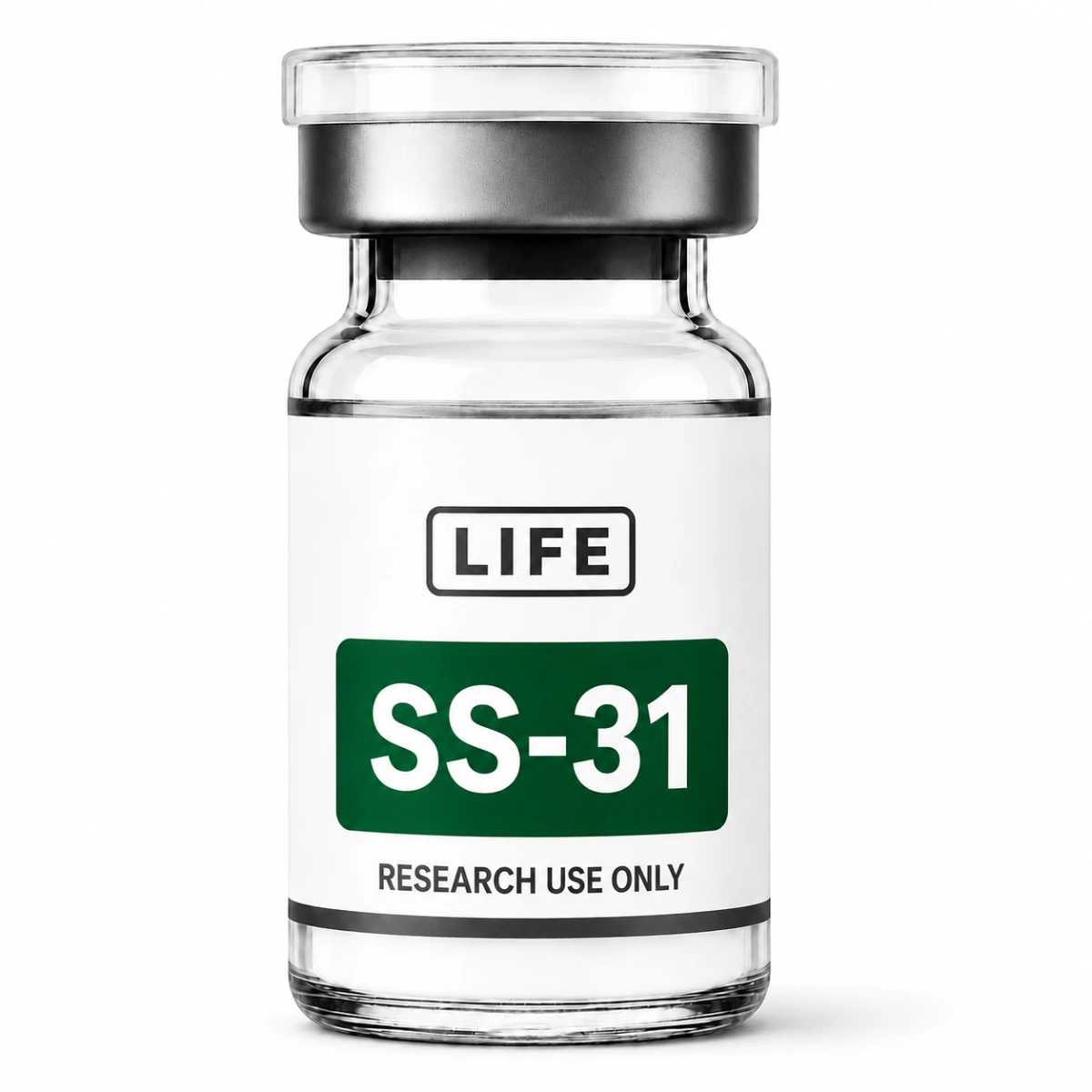
SS-31, auch bekannt als Elamipretid, MTP-131 oder Bendavia, ist ein synthetisches Mitochondrien-gerichtetes Tetrapeptid.
Im Gegensatz zu den meisten Peptiden interagiert SS-31 nicht primär mit einem zelloberflächengebundenen Rezeptor. Stattdessen dringt es schnell in Zellen ein und reichert sich selektiv in Mitochondrien an, wo es an Cardiolipin bindet, einen für die innere Mitochondrienmembran einzigartigen Phospholipiden.
Da Cardiolipin für die Aufrechterhaltung der mitochondrialen Architektur und der effizienten ATP-Produktion unerlässlich ist, hat sich SS-31 zu einem der führenden Untersuchungspetide für die Forschung auf dem Gebiet der Mitochondriale Dysfunktion, oxidativer Stress und zellulärer Energiestoffwechsel.
Möchten Sie SS-31 in Europa kaufen? Life Peptide liefert hochreines SS-31 für die Laborforschung mit zuverlässigem Versand in die gesamte EU.
Warum SS-31 weitreichend untersucht wird
Veröffentlichte Forschung hat SS-31 in Bezug auf Folgendes untersucht:
- Mitochondriale Reparatur
- Zelluläre Energieproduktion
- ATP-Synthese
- Oxidativer Stress
- Muskelphysiologie
- gesundes Altern
- Herz-Kreislauf-Forschung
- Neurodegeneration
- Mitochondriale Erkrankung
Im Gegensatz zu metabolischen Peptiden, die die zelluläre Signalübertragung regulieren, zielt SS-31 direkt auf die physikalische Struktur von Mitochondrien ab, was es unter modernen Forschungspetiden einzigartig macht.
Wie SS-31 funktioniert
Kardiolipinstabilisierung
SS-31 bindiert selektiv an Cardiolipin, ein essenzielles Phospholipid, das sich in der inneren Mitochondrienmembran befindet.
Cardiolipin spielt eine entscheidende Rolle bei der Aufrechterhaltung der Struktur der mitochondrialen Cristae und der Unterstützung der Elektronentransportkette. Unter oxidativen Stressbedingungen wird Cardiolipin geschädigt, was die mitochondriale Effizienz verringert. Veröffentlichte Forschungsergebnisse deuten darauf hin, dass SS-31 zur Stabilisierung dieser Membranumgebung und zur Erhaltung der mitochondrialen Funktion beiträgt.
Zelluläre Energieproduktion
Durch die Erhaltung der mitochondrialen Struktur wurde SS-31 auf seine verbesserte Effizienz der oxidativen Phosphorylierung und ATP-Produktion untersucht. Anstatt Mitochondrien zur Produktion von mehr Energie anzuregen, scheint SS-31 dysfunktionellen Mitochondrien zu helfen, Energie effizienter zu produzieren.
Oxidativer Stress
Zahlreiche präklinische Studien haben SS-31 zur Reduzierung von mitochondrialen reaktiven Sauerstoffspezies (ROS) und zur Begrenzung oxidativer Schäden, die mit einer beeinträchtigten Mitochondrienfunktion einhergehen, untersucht.
Gewebeschutz
Da Mitochondrien praktisch jedes Organsystem beeinflussen, wurde SS-31 in der Herz-Kreislauf-, neurologischen, Nieren- und Skelettmuskelforschung untersucht, was es zu einem der breitesten mitochondrialen Peptide macht, die derzeit verfügbar sind.
Warum unterscheidet sich SS-31 von anderen mitochondrialen Peptiden
Nicht alle mitochondrialen Peptide untersuchen die gleiche Biologie.
MOTS-c untersucht, wie Zellen den Energiestoffwechsel durch Aktivierung adaptiver Stoffwechselsignalwege regulieren.
SS-31 untersucht, wie Mitochondrien Energie physisch produzieren, indem sie die innere Mitochondrienmembran stabilisieren und die Funktion der Elektronentransportkette erhalten.
Anstatt die metabolische Signalgebung zu verändern, konzentriert sich SS-31 auf den Erhalt der mitochondrialen Maschinerie selbst.
Diese Unterscheidung hat SS-31 zu einem der wichtigsten experimentellen Peptide für die mitochondriale Biologie und die Erforschung des gesunden Alterns gemacht.
Menschliche und präklinische Forschung
SS-31 hat in der klinischen Entwicklung mehr Fortschritte gemacht als viele Forschungspetide.
Menschliche Studien haben SS-31 in primäre mitochondriale Erkrankung, Barth-Syndrom, Herzinsuffizienz, Nierenverletzung und ophthalmologische Störungen, während umfangreiche präklinische Forschung seine Auswirkungen auf Skelettmuskeln, neurodegenerative Erkrankungen, ischämie-Reperfusionsschäden und altersbedingte mitochondriale Dysfunktion untersucht hat.
Obwohl die klinischen Ergebnisse je nach Indikation variierten, bleibt SS-31 eines der am besten charakterisierten Mitochondrien-zielgerichteten Peptide, die derzeit untersucht werden.
Veröffentlichte Sicherheitsbeobachtungen
SS-31 hat mehrere klinische Studien in verschiedenen Krankheitsbereichen durchlaufen.
Veröffentlichte Studien haben im Allgemeinen eine günstige Verträglichkeit berichtet, wobei unerwünschte Ereignisse typischerweise mild bis moderat waren. Die klinische Wirksamkeit variierte je nach der untersuchten Erkrankung, was die Komplexität von mitochondrialen Erkrankungen und die Notwendigkeit weiterer Forschung unterstreicht.
Produkteigenschaften
Anwendung: Labor- und analytische Forschung
Verwendungseinschränkung: Nicht zum menschlichen Verzehr bestimmt; nicht für medizinische, veterinärmedizinische oder kosmetische Zwecke
Hergestellt in GMP-konformen Anlagen unter strengen Qualitätskontrollprotokollen.
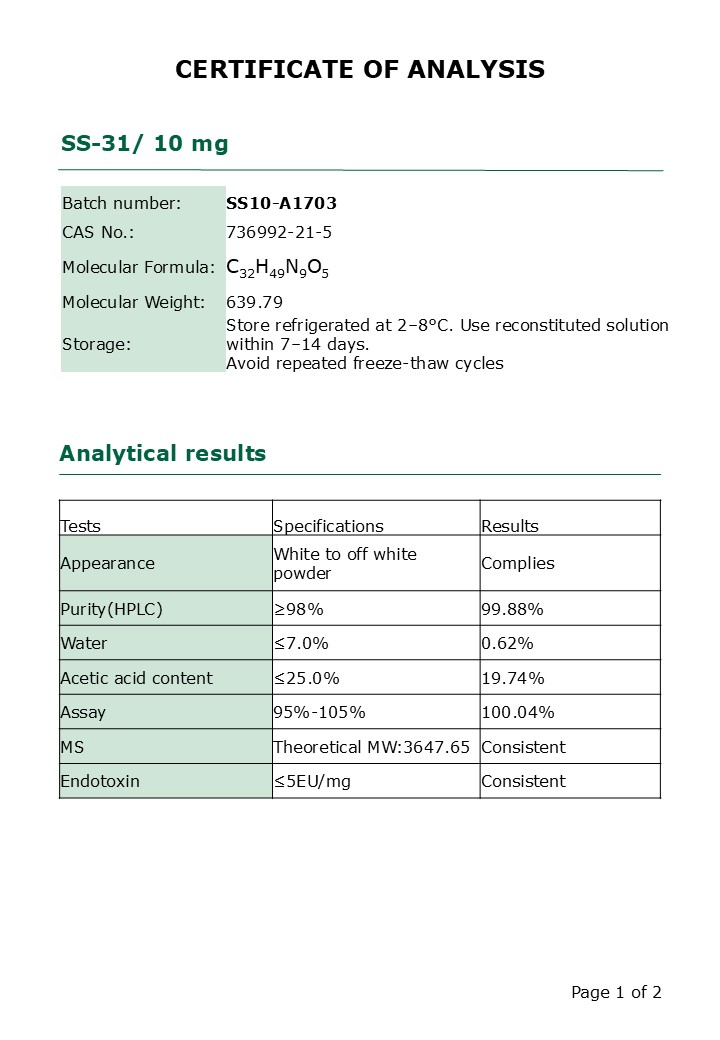
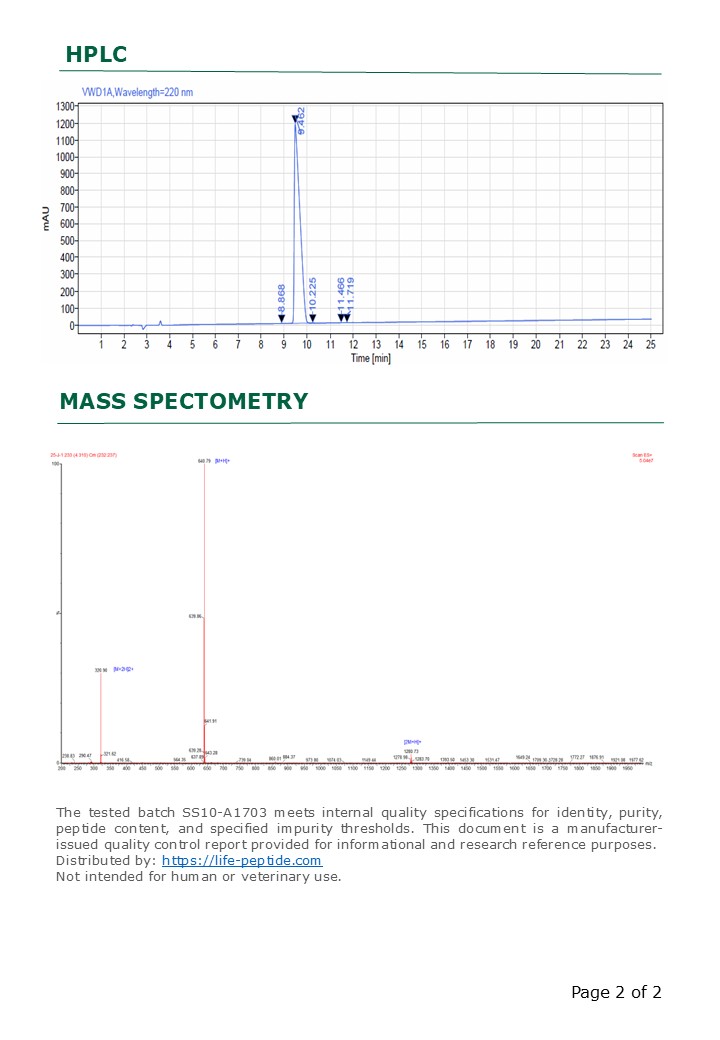
Jede Charge wird nach der Produktion sorgfältig im Labor getestet (das Analysezertifikat finden Sie unter den Produktbildern).
Gefriergetrocknet (lyophilisiert) für maximale Stabilität und längere Haltbarkeit.
Steril in Fläschchen abgefüllt, bereit zur Rekonstitution.
Reinheit: ≥ 99,881 TP4T, mittels HPLC geprüft.
Aussehen: weißes lyophilisiertes Pulver
Summenformel: C32H49N9O5
Molekulargewicht: 639,79
Speicherungeöffnete gefriergetrocknete Vials werden am besten gelagert gekühlte Lagerung bei 2–8°C, welche die von unserem Fertigungspartner bestätigte Lagerungsmethode ist und sich für bis zu 24 Monate eignet. Kühlung wird bevorzugt, da sie unnötige Gefrier-Tau-Zyklen bei routinemäßiger Handhabung minimiert. Wenn eine deutlich längerfristige Lagerung erforderlich ist, können auch ungeöffnete gefriergetrocknete Vials gefroren aufbewahrt werden. Nach der Rekonstitution immer bei 2–8 °C lagern und nicht einfrieren.
Rekonstitution und Handhabung
SS-31 wird in einer lyophilisierten Durchstechflasche geliefert und sollte gemäß den Standardverfahren zur Rekonstitution von Peptiden, die in der Forschungsumgebung üblich sind, gehandhabt werden. Muss rekonstituiert werden mit Bakteriostatisches Wasser Vor Gebrauch. Um die strukturelle Integrität zu erhalten, geben Sie das gewählte Lösungsmittel langsam an der Innenwand des Fläschchens hinzu und nicht direkt auf den Peptidkuchen, und vermeiden Sie kräftiges Schütteln. Sanftes Schwenken ist im Allgemeinen ausreichend, sobald sich das Peptid vollständig gelöst hat. Standardmäßige Laborpraxis beinhaltet auch, gekühlte Fläschchen Raumtemperatur erreichen zu lassen, bevor sie rekonstituiert werden, um die Kondensation im Fläschchen zu minimieren.
Für weitere Informationen zur Lösungsmittelauswahl, zur Konzentrationsplanung und zur Lagerung siehe das vollständige Leitfaden zur Peptidrekonstitution und Rekonstitutionsrechner.
Ausgewählte Referenzen
- Wang Y, et al. Elamipretid: Eine Übersicht über seine Struktur, Wirkungsweise und sein therapeutisches Potenzial, Life, 2025
Eine umfassende Übersicht über den Mechanismus von SS-31, die Bindung an Cardiolipin, die mitochondriale Bioenergetik und die klinische Entwicklung.
- Liu Y, et al. Anwendungsforschung des neuartigen Peptid-Mitochondrien-zielenden Antioxidans SS-31 zur Minderung von Mitochondrien-Dysfunktion, Redox Report, 2024
Eine detaillierte Überprüfung der Mechanismen von SS-31 und die Analyse von 18 klinischen Studien bei mitochondrialen und verwandten Erkrankungen.
- Chatfield KC, et al. Elamipretid verbessert die mitochondriale Funktion im insuffizienten menschlichen Herzen, JACC: Basic to Translational Science, 2019
Demonstriert Verbesserungen der Mitochondrienfunktion in menschlichem Herzgewebe und unterstützt den kardiiolipin-gezielten Mechanismus von SS-31.
Häufig gestellte Fragen
Was ist SS-31?
SS-31 (Elamipretid) ist ein synthetisches Tetrapeptid, das selektiv auf Mitochondrien abzielt, indem es Cardiolipin in der inneren Mitochondrienmembran bindet. Es wird intensiv für die mitochondriale Reparatur, die zelluläre Energieproduktion und die Erforschung des gesunden Alterns untersucht.
Warum wird SS-31 als mitochondriales Reparaturpeptid bezeichnet?
Im Gegensatz zu den meisten Peptiden, die zelloberflächengebundene Rezeptoren aktivieren, zielt SS-31 direkt auf die innere Mitochondrienmembran ab. Forschungen deuten darauf hin, dass es hilft, die Mitochondrienstruktur zu erhalten, die Bioenergetik zu verbessern und oxidativen Stress in dysfunktionalen Mitochondrien zu reduzieren.
Wie unterscheidet sich SS-31 von MOTS-c?
Beide untersuchen die mitochondriale Biologie, wobei MOTS-c hauptsächlich die metabolische Signalgebung reguliert, während SS-31 sich auf die physische Integrität und Effizienz der energiegewinnenden Maschinerie der Mitochondrien konzentriert. Sie untersuchen komplementäre Aspekte der mitochondrialen Funktion.
Die Hauptforschungsgebiete, die sich mit SS-31 befassen, sind:* **Herz-Kreislauf-Erkrankungen:** Dies ist wahrscheinlich das Hauptaugenmerk, da SS-31 vielversprechende Ergebnisse bei der Behandlung von ischämischer Herzkrankheit, Herzinsuffizienz und Arrhythmien gezeigt hat. * **Neurologische Erkrankungen:** Es gibt ein wachsendes Interesse an der potenziellen Rolle von SS-31 bei neurodegenerativen Erkrankungen wie Alzheimer und Parkinson, da es die mitochondriale Funktion und die Reduzierung von oxidativem Stress nachweislich verbessert. * **Stoffwechselstörungen:** Forschung untersucht die Auswirkungen von SS-31 auf Krankheiten wie Diabetes und metabolische Syndrome, insbesondere im Hinblick auf seine Fähigkeit, die Insulinempfindlichkeit und die mitochondriale Gesundheit zu verbessern. * **Entzündliche Erkrankungen:** SS-31 hat entzündungshemmende Eigenschaften gezeigt, was es zu einem Kandidaten für die Behandlung von chronisch entzündlichen Zuständen macht. * **Alternde und Langlebigkeit:** Aufgrund seiner Auswirkungen auf die mitochondriale Funktion, die Reduzierung von oxidativem Stress und seine schützenden Wirkungen auf verschiedene Gewebe wird SS-31 auch im Zusammenhang mit Anti-Aging-Strategien und der Erhaltung der Gewebefunktion im Alter untersucht. * **Regenerative Medizin:** Seine zellschützenden und reparativen Eigenschaften machen es zu einem interessanten Molekül für Anwendungen in der regenerativen Medizin, um Gewebeschäden zu reparieren. * **Pathologien der Atemwege:** Es gibt auch einige Forschungen zu seiner Rolle bei Lungenerkrankungen wie COPD oder Lungenfibrose.Zusammenfassend lässt sich sagen, dass die Forschung zu SS-31 stark auf die Erhaltung und Wiederherstellung der mitochondrialen Funktion und die Reduzierung des oxidativen Stresses ausgerichtet ist, was es zu einem breiten Spektrum von Krankheiten macht, die durch diese Mechanismen beeinflusst werden.
Aktuelle Forschung umfasst mitochondriale Erkrankungen, Herz-Kreislauf-Physiologie, Skelettmuskelfunktion, Neurodegeneration, Nierenverletzungen, Stoffwechselstörungen und gesundes Altern.
Ist SS-31 eines der klinisch besser untersuchten Peptide?
Ja. Im Vergleich zu vielen Forschungspetiden ist SS-31 in mehrere klinische Programme der Phase 2 und Phase 3 für verschiedene mitochondriale Erkrankungen vorgerückt, was es zu einem der am besten untersuchten mitochondrialen Peptide macht, die derzeit verfügbar sind.
Kann ich SS-31 in Europa kaufen?
Ja. Wir versenden SS-31 in die meisten europäischen Länder mit zuverlässigen Kurierdiensten. Die verfügbaren Versandmethoden und Lieferzeiten werden während des Bestellvorgangs basierend auf Ihrem Zielort angezeigt.
Ist dieses Produkt für den menschlichen Gebrauch bestimmt?
Das von Life Peptide gelieferte Produkt Nr. SS-31 ist ausschließlich für Labor- und Analysezwecke bestimmt. Es ist nicht für den menschlichen Verzehr, zur Diagnose, Behandlung oder Vorbeugung von Krankheiten vorgesehen.
Verwandter Forschungskontext
SS-31 wird häufig neben anderen Forschungspetiden diskutiert, die sich mit zellulärer Energie, Regeneration und gesundem Altern befassen, obwohl jedes eine andere Ebene der Zellphysiologie anspricht.
MOTS-c – untersucht für metabolische Signalübertragung, Trainingsanpassung und mitochondriale Kommunikation.
Epitalon – studiert für Telomerbiologie, zirkadiane Regulation und gesundes Altern.
GHK-Cu – untersucht für Gewebereparatur, Umbau der extrazellulären Matrix und regenerative Biologie.
ARA-290 – konzentriert sich auf die angeborene Gewebereparatur, Entzündungssignalisierung und Nervenregeneration.
CJC-1295 mit DAC – wegen anhaltender Wachstumshormon- und IGF-1-Signalübertragung, die eine anabole Physiologie unterstützt, untersucht.
Obwohl diese Peptide häufig mit der Langlebigkeits- und Regenerationsforschung in Verbindung gebracht werden, unterscheidet sich SS-31 durch seine direkte Wirkung auf die Mitochondrienstruktur und die Bioenergetik von hormonellen oder metabolischen Signalwegen.
ANMERKUNGDies dient ausschließlich zu Bildungszwecken und stellt keine medizinische Beratung dar.
Haftungsausschluss
Dieses Produkt wird ausschließlich zu Forschungszwecken verkauft. Es ist nicht dazu bestimmt, Krankheiten zu diagnostizieren, zu behandeln, zu heilen oder zu verhindern. Der Käufer übernimmt die volle Verantwortung für die ordnungsgemäße Handhabung und Verwendung.