Beschreibung
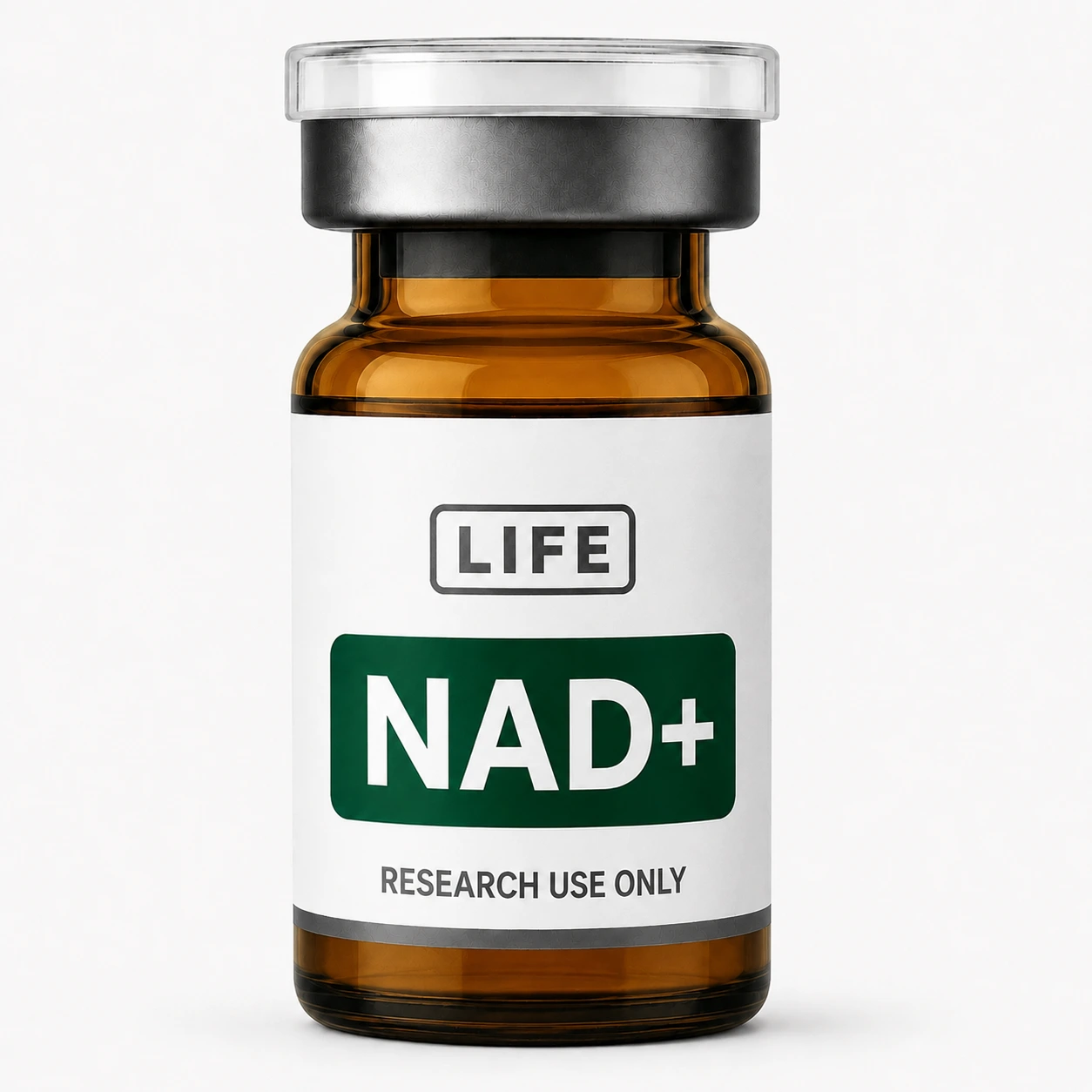
NAD+ (Nicotinamid-Adenindinukleotid) ist ein natürlich vorkommendes Coenzym, das in jeder lebenden Zelle gefunden wird. Anstatt als Peptid oder Hormon zu fungieren, ist NAD+ ein essentieller Elektronenträger in Hunderten von Stoffwechselreaktionen und spielt eine zentrale Rolle bei ATP-Produktion, mitochondriale Funktion und zelluläre Reparatur.
Da der NAD+-Spiegel mit dem Alter und metabolischem Stress natürlich abnimmt, ist es zu einem der am intensivsten untersuchten Moleküle in der Forschung über Altern, Energiestoffwechsel und mitochondriale Biologie.
Möchten Sie NAD+ in Europa kaufen? Life Peptide liefert hochreines NAD+ für die Laborforschung mit zuverlässigem Versand in die gesamte EU.
Warum NAD+ weit verbreitet erforscht wird
Veröffentlichte Forschung hat NAD+ in Bezug auf Folgendes untersucht:
- Zelluläre Energieproduktion
- mitochondriale Funktion
- gesundes Altern
- DNA-Reparatur
- Oxidativer Stress
- Metabolische Gesundheit
- Kognitive Funktion
- Muskelphysiologie
- Sirtuin-Biologie
Im Gegensatz zu mitochondrialen Peptiden dient NAD+ als fundamentaler metabolischer Kofaktor, der für die normale Zellfunktion in praktisch jedem Gewebe benötigt wird.
Wie NAD+ funktioniert
Zelluläre Energieproduktion
NAD+ spielt eine zentrale Rolle bei der Umwandlung von Nährstoffen in nutzbare Zellenergie. Es überträgt Elektronen während der Glykolyse, des Citratzyklus und der oxidativen Phosphorylierung, wodurch Mitochondrien effizient ATP erzeugen können.
Mitochondriale Funktion
Gesunde Mitochondrien sind für einen normalen Energiestoffwechsel auf eine ausreichende NAD+-Verfügbarkeit angewiesen. Die Forschung hat untersucht, wie sinkende NAD+-Spiegel die mitochondriale Leistung während des Alterns und bei metabolischem Stress beeinflussen.
DNA-Reparatur
NAD+ dient als essenzielles Substrat für Enzyme, die an der DNA-Reparatur beteiligt sind, einschließlich PARPs, die auf DNA-Schäden reagieren, indem sie zur Aufrechterhaltung der genomischen Stabilität beitragen.
Sirtuin-Aktivierung
NAD+ wird auch von Sirtuinen benötigt, einer Familie von Enzymen, die an zellulären Stressreaktionen, dem Stoffwechsel und gesundem Altern beteiligt sind. Diese Beziehung hat NAD+ zu einem zentralen Fokus der Langlebigkeitsforschung gemacht.
Warum NAD+ anders ist als mitochondriale Peptide
Obwohl sie häufig zusammen diskutiert werden, untersuchen NAD+, SS-31 und MOTS-c unterschiedliche Aspekte der mitochondrialen Biologie.
NAD+ liefert ein essenzielles Coenzym, das für den zellulären Energiestoffwechsel benötigt wird.
SS-31 untersucht die Integrität der mitochondrialen Membran und die ATP-Produktion.
MOTS-c untersucht metabolische Signalwege und adaptive zelluläre Reaktionen.
Zusammen stellen diese komplementäre Bereiche der zellulären Energieforschung dar und nicht konkurrierende Mechanismen.
Menschliche und präklinische Forschung
NAD+ wurde sowohl im Labor als auch in klinischen Studien umfassend untersucht.
Aktuelle Forschung untersucht seine Rolle in Alterung, Stoffwechselstörungen, Neurodegeneration, Herz-Kreislauf-Physiologie und mitochondriale Erkrankungen. Ein Großteil dieser Arbeiten konzentriert sich auch auf Strategien zur Erhöhung des intrazellulären NAD+-Spiegels durch Vorläufer wie NMN und Nicotinamid-Ribosid, was die Bedeutung der NAD+-Homöostase für die menschliche Physiologie widerspiegelt.
Obwohl die biologische Bedeutung von NAD+ gut etabliert ist, bleiben viele therapeutische Anwendungen Gegenstand intensiver Forschung.
Veröffentlichte Sicherheitsbeobachtungen
Als natürlich vorkommendes zelluläres Coenzym ist NAD+ Gegenstand umfangreicher biologischer Forschung.
Klinische Untersuchungen haben im Allgemeinen eine gute Verträglichkeit bei einer Reihe von Studiendesigns berichtet, obwohl die Forschung weiterhin die optimalen Verabreichungsformen, die Pharmakokinetik und mögliche Anwendungen bei altersbedingten Krankheiten bewertet.
Produkteigenschaften
Anwendung: Labor- und analytische Forschung
Verwendungseinschränkung: Nicht zum menschlichen Verzehr bestimmt; nicht für medizinische, veterinärmedizinische oder kosmetische Zwecke
Hergestellt in GMP-konformen Anlagen unter strengen Qualitätskontrollprotokollen.
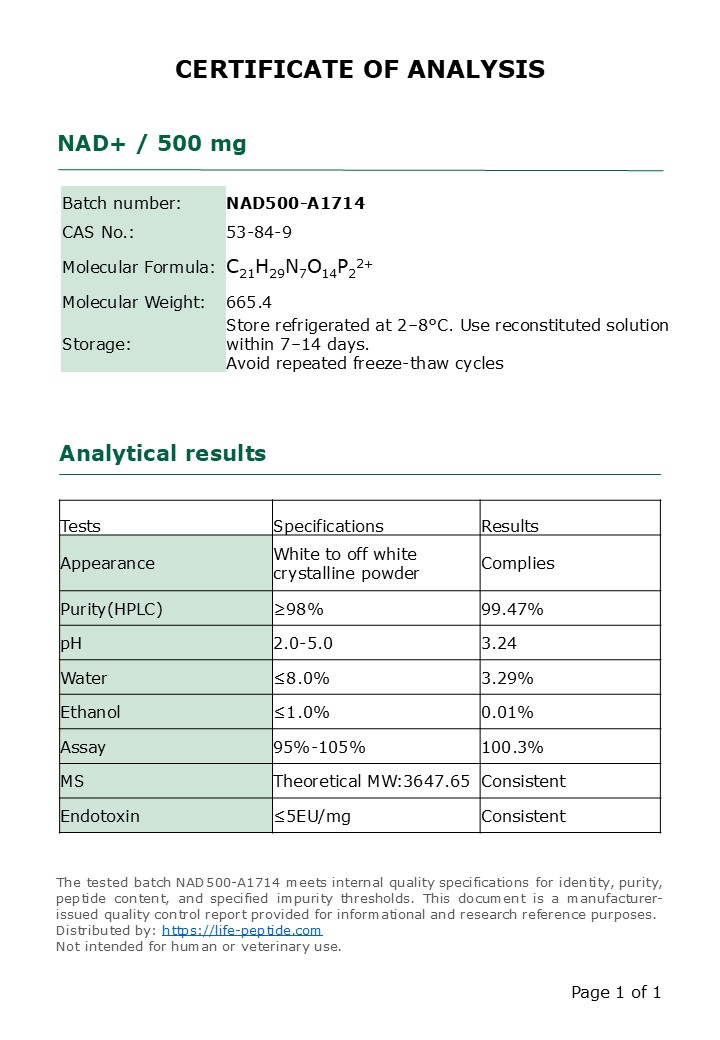
Jede Charge wird nach der Produktion sorgfältig im Labor getestet (das Analysezertifikat finden Sie unter den Produktbildern).
Gefriergetrocknet (lyophilisiert) für maximale Stabilität und längere Haltbarkeit.
Steril in Fläschchen abgefüllt, bereit zur Rekonstitution.
Reinheit: ≥ 99,471 TP4T, mittels HPLC geprüft
Aussehen: weißes lyophilisiertes Pulver
Summenformel: C21H29N7O14P22+
Molekulargewicht: 665,4
Speicherungeöffnete gefriergetrocknete Vials werden am besten gelagert gekühlte Lagerung bei 2–8°C, welche die von unserem Fertigungspartner bestätigte Lagerungsmethode ist und sich für bis zu 24 Monate eignet. Kühlung wird bevorzugt, da sie unnötige Gefrier-Tau-Zyklen bei routinemäßiger Handhabung minimiert. Wenn eine deutlich längerfristige Lagerung erforderlich ist, können auch ungeöffnete gefriergetrocknete Vials gefroren aufbewahrt werden. Nach der Rekonstitution immer bei 2–8 °C lagern und nicht einfrieren.
Rekonstitution und Handhabung
NAD+ wird in einer lyophilisierten Durchstechflasche geliefert und sollte unter Verwendung von Standardverfahren für die Rekonstitution von Peptiden, die für das Forschungsumfeld geeignet sind, gehandhabt werden. Muss rekonstituiert werden mit Bakteriostatisches Wasser Vor Gebrauch. Um die strukturelle Integrität zu erhalten, geben Sie das gewählte Lösungsmittel langsam an der Innenwand des Fläschchens hinzu und nicht direkt auf den Peptidkuchen, und vermeiden Sie kräftiges Schütteln. Sanftes Schwenken ist im Allgemeinen ausreichend, sobald sich das Peptid vollständig gelöst hat. Standardmäßige Laborpraxis beinhaltet auch, gekühlte Fläschchen Raumtemperatur erreichen zu lassen, bevor sie rekonstituiert werden, um die Kondensation im Fläschchen zu minimieren.
Für weitere Informationen zur Lösungsmittelauswahl, zur Konzentrationsplanung und zur Lagerung siehe das vollständige Leitfaden zur Peptidrekonstitution und Rekonstitutionsrechner.
Ausgewählte Referenzen
- Covarrubias AJ, Perrone R, Grozio A, Verdin E. NAD+-Metabolismus und seine Rollen in zellulären Prozessen während des Alterns, Nature Reviews Molecular Cell Biology, 2021.
Eine umfassende Übersicht über NAD+-Biologie, Altern, Stoffwechsel und Mitochondrienfunktion.
- Yoshino J, Baur JA, Imai SI. NAD+-Intermediate: Die Biologie und das therapeutische Potenzial von NMN und Nicotinamid-Ribosid, Cell Metabolism, 2018.
Ein wegweisender Übersichtsartikel, der den NAD+-Stoffwechsel und Strategien zur Wiederherstellung des intrazellulären NAD+ zusammenfasst.
- Rajman L, Chwalek K, Sinclair DA. Therapeutisches Potenzial von NAD+-steigernden Molekülen, Nature Reviews Drug Discovery, 2018.
Eine detaillierte Übersicht über die NAD+-Biologie und die aktuelle therapeutische Forschung.
Häufig gestellte Fragen
Was ist NAD+?
NAD+ (Nicotinamid-Adenin-Dinukleotid) ist ein natürlich vorkommendes Coenzym, das für die zelluläre Energieproduktion, die mitochondriale Funktion und die DNA-Reparatur unerlässlich ist.
Ist NAD+ ein Peptid?
Nein. NAD+ ist kein Peptid. Es ist ein natürlich vorkommendes Coenzym, das in jeder lebenden Zelle vorkommt und eine zentrale Rolle im Energiestoffwechsel spielt.
Warum ist NAD+ wichtig für Mitochondrien?
NAD+ fungiert als Elektron.
Wie unterscheidet sich NAD+ von MOTS-c?
Obwohl beide die mitochondriale Biologie untersuchen, fungiert NAD+ als essentielles metabolisches Coenzym, während MOTS-c als mitochondriales Signalpeptid wirkt, das den zellulären Stoffwechsel reguliert.
Wie unterscheidet sich NAD+ von SS-31?
SS-31 untersucht die strukturelle Integrität von Mitochondrien, indem es die innere Mitochondrienmembran anpeilt, während NAD+ als grundlegendes Coenzym für die zelluläre Energieproduktion dient.
Kann ich NAD+ in Europa kaufen?
Ja. Wir versenden NAD+ in die meisten europäischen Länder über zuverlässige Kurierdienste. Verfügbare Versandmethoden und Lieferzeiten werden während des Bestellvorgangs basierend auf Ihrem Zielort angezeigt.
Ist dieses Produkt für den menschlichen Gebrauch bestimmt?
Nein. Das von Life Peptide gelieferte NAD+ ist ausschließlich für Labor- und Analysezwecke bestimmt. Es ist nicht für den menschlichen Verzehr, zur Diagnose, Behandlung oder Vorbeugung von Krankheiten vorgesehen.
Verwandter Forschungskontext
NAD+ wird häufig im Zusammenhang mit anderen Forschungssubstanzen diskutiert, die sich mit zellulärer Energie, mitochondrialer Biologie und gesundem Altern befassen, obwohl jede unterschiedliche biologische Mechanismen anspricht.
SS-31 (Elamipretid) – untersucht zur mitochondrialen Reparatur und zellulären Energieproduktion.
MOTS-c – studiert für metabolische Signalübertragung und Trainingsanpassung.
Epitalon – untersucht für Telomerbiologie und Forschung zum gesunden Altern.
GHK-Cu – wurde für Geweberegeneration und zelluläre Reparatur untersucht.
CJC-1295 mit DAC – zur Untersuchung der anhaltenden GH- und IGF-1-Signalgebung.
ANMERKUNGDies dient ausschließlich zu Bildungszwecken und stellt keine medizinische Beratung dar.
Haftungsausschluss
Dieses Produkt wird ausschließlich zu Forschungszwecken verkauft. Es ist nicht dazu bestimmt, Krankheiten zu diagnostizieren, zu behandeln, zu heilen oder zu verhindern. Der Käufer übernimmt die volle Verantwortung für die ordnungsgemäße Handhabung und Verwendung.