Περιγραφή
Το KPV (Lys-Pro-Val) είναι μια φυσικά απαντώμενη τμήμα τριών αμινοξέων της α-μελανοκυτταροδιεγερτικής ορμόνης (α-MSH). Παρά το μικρό του μέγεθος, διατηρεί μεγάλο μέρος από τη μητρική ορμόνη αντιφλεγμονώδης δράση ενώ δεν παρουσιάζει τα φαινόμενα χρωματισμού που συνδέονται με την α-MSH πλήρους μήκους.
Σε αντίθεση με πολλά ανοσοτροποποιητικά πεπτίδια, το KPV φαίνεται να ρύθμιση της φλεγμονώδους σηματοδότησης χωρίς την ευρεία καταστολή της ανοσοποιητικής λειτουργίας. Αυτό το έχει καταστήσει ένα από τα πιο ενδιαφέροντα υπό διερεύνηση πεπτίδια για έρευνα που αφορά φλεγμονώδεις νόσους, τη λειτουργία του επιθηλιακού φραγμού και τη βλεννογονική ανοσία.
Θέλετε να αγοράσετε KPV στην Ευρώπη; Η Life Peptide προμηθεύει KPV υψηλής καθαρότητας για εργαστηριακή έρευνα, με αξιόπιστη αποστολή σε όλη την ΕΕ.
Γιατί η KPV ερευνάται ευρέως
Η δημοσιευμένη έρευνα έχει διερευνήσει το KPV σε σχέση με:
- ανοσολογική ρύθμιση
- φλεγμονώδης σηματοδότηση
- έρευνα για την υγεία του εντέρου
- λειτουργία του εντερικού φραγμού
- φλεγμονή του δέρματος
- επιθηλιακή βιολογία
- επούλωση τραύματος
- βλεννογονική ανοσία
- Σηματοδότηση NF-κB
Λόγω του μικρού του μεγέθους και του μοναδικού του μηχανισμού, το KPV έχει γίνει ένα από τα πιο γνωστά ερευνητικά πεπτίδια που στοχεύουν φλεγμονώδεις οδούς αντί για την αποκατάσταση δομικών ιστών.
Πώς λειτουργεί το KPV
Σε αντίθεση με τα BPC-157 ή TB-500, το KPV μελετάται κυρίως για τις επιδράσεις του σε ανοσολογική σηματοδότηση παρά στην αναγέννηση ιστών.
Η δημοσιευμένη έρευνα έχει εξερευνήσει τη σχέση του με:
Φλεγμονώδης σηματοδότηση
Το KPV έχει μελετηθεί εκτενώς για την ικανότητά του να μειώνει την ενεργόποίηση φλεγμονωδών οδών, συμπεριλαμβανομένου του NF-κB, με αποτέλεσμα τη χαμηλότερη παραγωγή πολλαπλών προφλεγμονωδών μεσολαβητών σε πειραματικά μοντέλα.
Έρευνα για τον εντερικό φραγμό
Ένας από τους μεγαλύτερους τομείς έρευνας επικεντρώνεται στα εντερικά επιθηλιακά κύτταρα και σε πειραματικά μοντέλα φλεγμονώδους νόσου του εντέρου, όπου το KPV έχει αποδείξει επιδράσεις στην επιθηλιακή ακεραιότητα και στα φλεγμονώδη σηματοδοτικά μονοπάτια.
Βιολογία του δέρματος
Οι ερευνητές έχουν επίσης εξετάσει το KPV σε μοντέλα φλεγμονωδών παθήσεων του δέρματος και επούλωσης τραυμάτων λόγω των επιδράσεών του στους επιθηλιακούς ιστούς.
Ανοσοτροποποίηση
Τα τρέχοντα στοιχεία υποδεικνύουν ότι το KPV ρυθμίζει τις ανοσολογικές αποκρίσεις αντί να προκαλεί ευρεία ανοσοκαταστολή, καθιστώντας το έναν ενδιαφέροντα υποψήφιο για μελέτες της φυσιολογικής φλεγμον3ικής ρύθμισης.
Γιατί η KPV γίνεται όλο και πιο σημαντική
Το ενδιαφέρον για την KPV έχει αυξηθεί σημαντικά τα τελευταία χρόνια, επειδή αντιπροσωπεύει μια διαφορετική προσέγγιση στην έρευνα για τη φλεγμονή.
Παρά το να εστιάζει κυρίως στην επιδιορθωση δομικών ιστών, όπως ΒΡC-157 ή συστηματική αναγέννηση όπως TB-500, η KPV ερευνά το οδός σηματοδότησης που πυροδοτούν και συντηρούν τη φλεγμονή.
Αυτή η συμπληρωματική βιολογία έχει κάνει το KPV όλο και πιο δημοφιλές σε έρευνες που αφορούν τη φλεγμονώδη νόσο του εντέρου, τη βιολογία του δέρματος και τη λειτουργία του επιθηλιακού φραγμού.
Ανθρώπινη και προκλινική έρευνα
Το μεγαλύτερο μέρος των δημοσιευμένων επιστημονικών δεδομένων για το KPV προέρχεται από καλλιέργειες κυττάρων και ζωικά μοντέλα.
Η έρευνα έχει εξετάσει συστηματικά τη φλεγμονώδη σηματοδότηση στο έντερο, το δέρμα, τους πνεύμονες και τους επιθηλιακούς ιστούς, ενώ τα ανθρώπινα κλινικά δεδομένα παραμένουν περιορισμένα. Αν και τα προκλινικά δεδομένα είναι ενθαρrudυντικά, απαιτείται πρόσθετη έρευνα σε ανθρώπους προτού εξαχθούν συμπεράσματα σχετικά με τις κλινικές εφαρμογές.
Δημοσιευθείσες παρατηρήσεις ασφαλείας
Η τρέχουσα γνώση για το KPV προέρχεται κυρίως από εργαστηριακή και προκλινική έρευνα. Οι δημοσιευμένες μελέτες γενικά αναφέρουν ευνοϊκή ανεκτικότητα σε πειραματικά μοντέλα, αλλά τα ελεγχόμενα κλινικά δεδομένα σε ανθρώπους παραμένουν περιορισμένα. Όπως συμβαίνει με πολλά αναδυόμενα ερευνητικά πεπτίδια, απαιτούνται πρόσθετες μελέτες για τον πλήρη χαρακτηρισμό της μακροπρόθεσμης αποτελεσματικότητας και ασφάλειας.
Χαρακτηριστικά προϊόντος
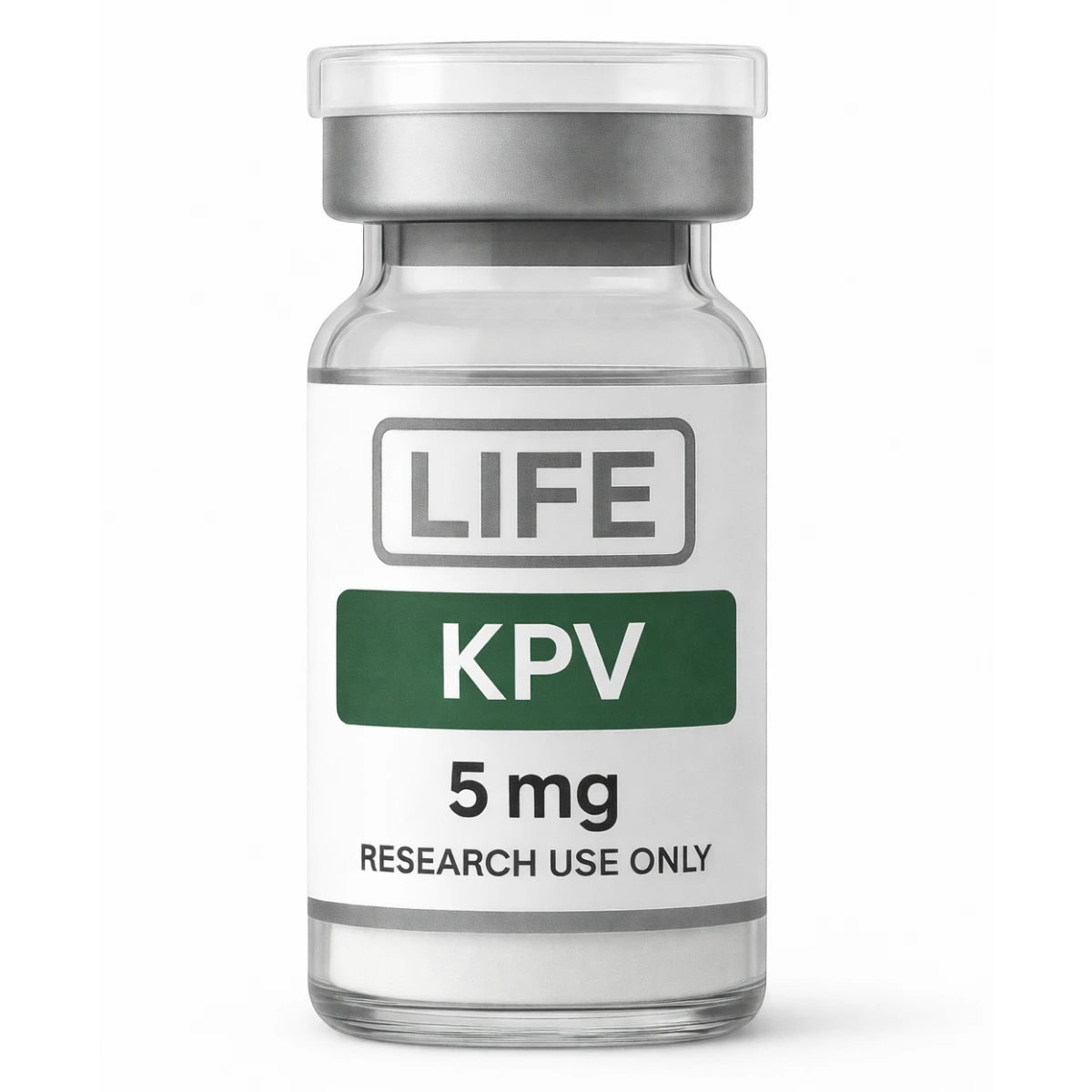
Εφαρμογή: εργαστηριακή και αναλυτική έρευνα
Χρήση περιορισμού: όχι για ανθρώπινη κατανάλωση· όχι για ιατρική, κτηνιατρική ή καλλυντική χρήση
Παράγεται σε εγκαταστάσεις που συμμορφώνονται με τις ΟGMP υπό αυστηρά πρωτόκολλα ΠΚ.
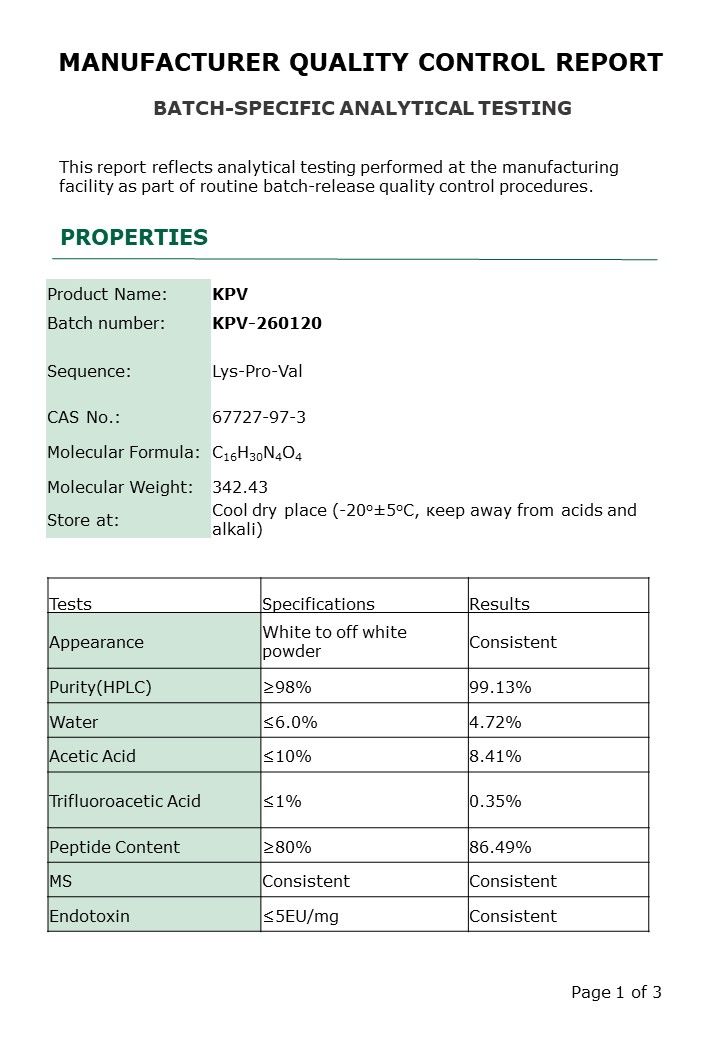
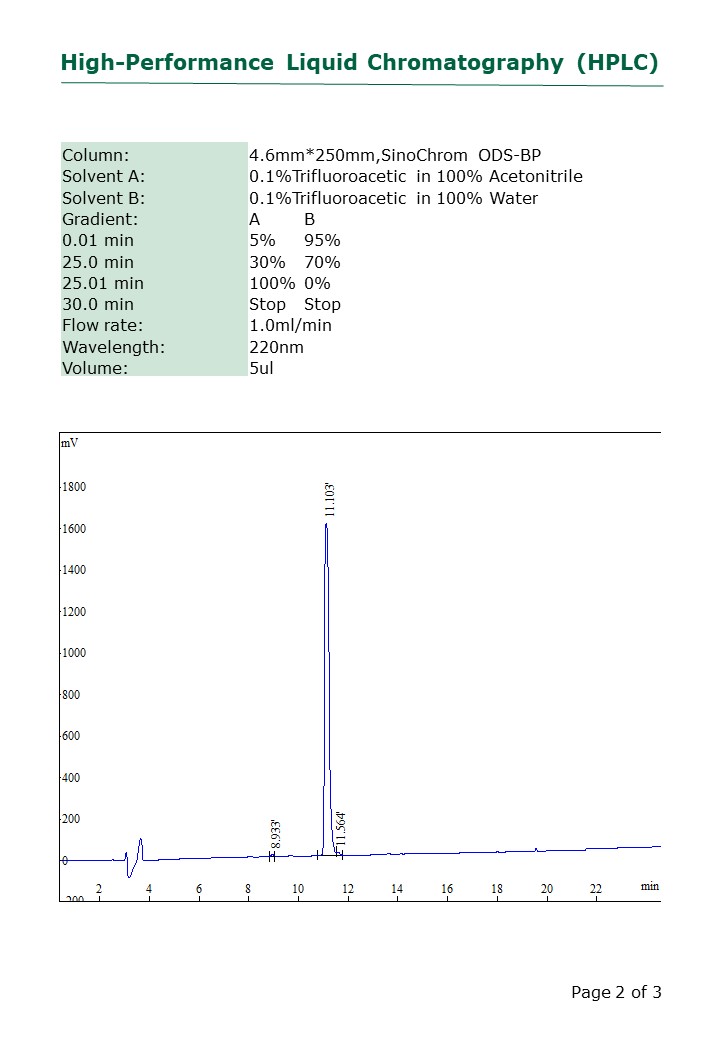
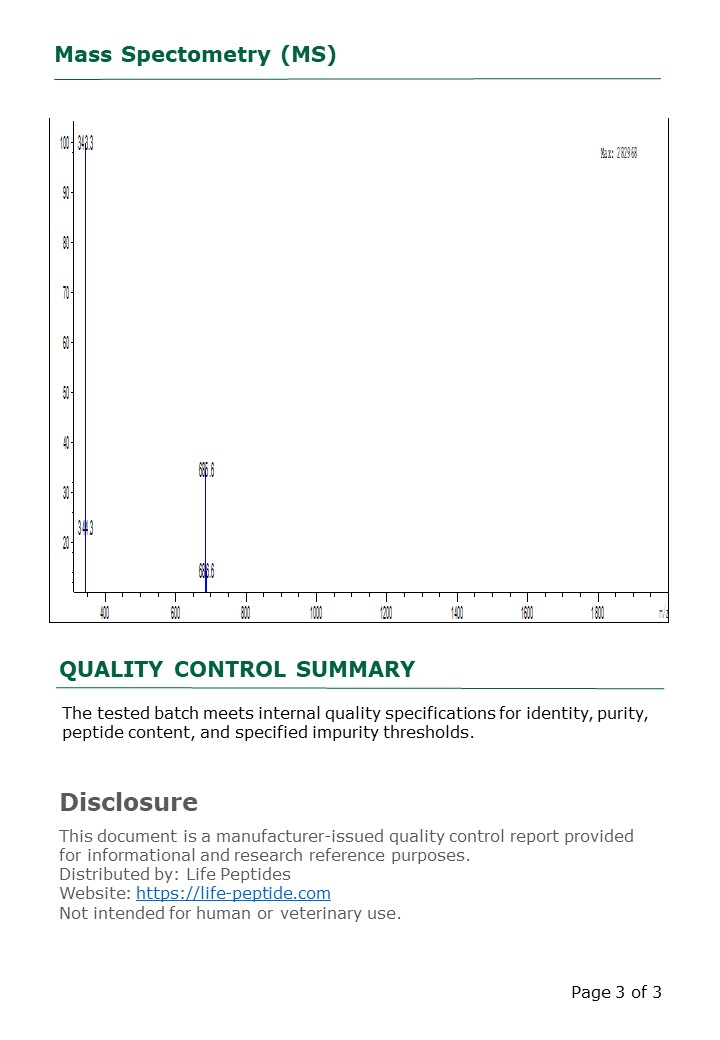
Κάθε παρτίδα ελέγχεται προσεκτικά στο εργαστήριο μετά την παραγωγή (μπορείτε να βρείτε το Πιστοποιητικό Ανάλυσης κάτω από τις εικόνες του προϊόντος).
Κατάψυξη-αποξήρανση (λυσόφιλη) για μέγιστη σταθερότητα και παρατεταμένη διάρκεια ζωής.
Σφραγισμένα σε αποστειρωμένες φιάλες, έτοιμα για ανασύσταση.
Καθαρότητα: ≥99% (ελέγχθηκε με HPLC)
Εμφάνιση: Λυοφιλοποιημένη λευκή/υπόλευκη σκόνη
Μοριακός τύπος: C16H30N4O4
Μριακό βάρος: 342,43
Αλληλουχία: Λυσ-Προ-Βαλ
Αποθήκευση: τα αφυδατωμένα σε ξηρή ψύξη, σφραγισμένα φιαλίδια φυλάσσονται καλύτερα συντήρηση στους 2–8°C, η οποία είναι η μέθοδος αποθήκευσης που επιβεβαιώθηκε από τον συνεργάτη παραγωγής μας και είναι κατάλληλη για έως και 24 μήνες. Η ψύξη προτιμάται επειδή ελαχιστοποιεί τους περιττούς κύκλους ψύξης-απόψυξης κατά τον συνήθη χειρισμό. Εάν απαιτείται σημαντικά μακροχρόνια αποθήκευση, τα σφραγισμένα λυοφιλοποιημένα φιαλίδια μπορούν επίσης να διατηρηθούν κατεψυγμένα. Μόλις ανασυσταθεί, αποθηκεύετε πάντα σε 2–8°C και μην καταψύχετε.
Ανα
Το KPV παρέχεται ως λυοφιλοποιημένο φιαλίδιο και πρέπει να χειρίζεται σύμφωνα με τις τυπικές διαδικασίες ανασυστασης πεπτιδίων που είναι κατάλληλες για το ερευνητικό περιβάλλον. Πρέπει να ανασυσταθεί με Βακτηριοστατικό νερό πριν τη χρήση. Για να διατηρηθεί η δομική ακεραιότητα, προσθέστε το επιλεγμένο διαλύτη αργά στο εσωτερικό τοίχωμα του φιαλιδίου αντί απευθείας στη μάζα του πεπτιδίου, και αποφύγετε το έντονο ανακίνημα. Η απαλή περιστροφή είναι γενικά επαρκής μόλις το πεπτίδιο διαλυθεί πλήρως. Η τυπική εργαστηριακή πρακτική περιλαμβάνει επίσης την αναμονή των ψυχόμενων φιαλιδίων να φτάσουν σε θερμοκρασία δωματίου πριν από την ανασύσταση για να ελαχιστοποιηθεί η συμπύκνωση στο εσωτερικό του φιαλιδίου.
Για την επιλογή άλλων διαλυτών, σχεδιασμό συγκεντρώσεων και οδηγίες αποθήκευσης, δείτε το πλήρες Οδηγός Ανασύστασης Πεπτιδίων και Υπολογιστής Απεικόνισης.
Επιλεγμένες ερευνητικές αναφορές
- Dalmasso G, et al. Η μεσολαβούμενη από τον PepT1 πρόσληψη του τριπεptıδίου KPV μειώνει την εντερική φλεγμονή, Molecular Therapy, 2011
Μια ορόσημη μελέτη που καταδεικνύει την επιθηλιακή πρόσληψη του KPV και τη μειωμένη φλεγμονώδη σηματοδότηση σε πειραματική εντερική φλεγμονή.
- Kannengiesser K, et al. Το KPV προστατεύει από την πειραματική κολίτιδα μέσω της ρύθμισης των φλεγμονωδών μονοπατιών, Gastroenterology Research, 2017
Έρευνα που αποδεικνύει τις προστατευτικές επιδράσεις του KPV σε πειραματικά μοντέλα φλεγμονώδους νόσου του εντέρου.
- Μπρζόσκα Τ, Λούγκερ ΤΑ, κ.ά. Άλφα-MSH και το C-Τελικό Τριππετίδιο KPV στη Φλεγμονή, Journal of Investigative Dermatology, 2003
Μ μια θεμελιώδης ανασκόπηση που εξηγεί γιατί το θραύσμα KPV διατηρεί ισχυρή αντιφλεγμονώδη δράση παρά το γεγονός ότι του λείπει η πλήρης αλληλουχία της α-MSH.
- Merlin D, κ.ά. KPV και Επιθηλιακή Ανοσορύθμιση, Διάφορες δημοσιεύσεις
Μia σειρά μελετών που διερευνούν τη μεταφορά του KPV μέσω του PepT1 και τη ρύθμιση της επιθηλιακής φλεγμονώδους σηματοδότησης.
Συχνές Ερωτήσεις
Τι είναι το KPV;
Το KPV είναι ένα φυσικό τριπεπτίδιο που προέρχεται από την α-μελανοτροφικό ορμόνη (α-MSH). Μελετάται ευρέως για τη ρύθμιση του ανοσοποιητικού, τη φλεγμονώδη σηματοδότηση και την έρευνα για τον επιθηλιακό φραγμό.
Γιατί το KPV διαφέρει από το BPC-157;
Παρόλο που και τα δύο πεπτίδια συζητούνται συχνά στην έρευνα αποκατάστασης, το BPC-157 μελετάται κυρίως για την αποκατάσταση των ιστών, ενώ το KPV εστιάζει στη ρύθμιση του ανοσοποιητικού και στα φλεγμονώδη σήματα. Οι βιολογικοί τους στόχοι είναι συμπληρωματικοί και όχι πανομοιότυποι.
Γιατί το KPV συνδέεται με την έρευνα για την υγεία του εντέρου;
Μεγάλο μέρος της δημοσιευμένης βιβλιογραφίας έχει διερευνήσει το KPV σε εντερικά επιθηλιακά κύτταρα και πειραματικά μοντέλα φλεγμονώδους νόσου του εντέρου λόγω των επιδράσεών του στη φλεγμονώδη σηματοδότηση και στη λειτουργία του επιθηλιακού φραγμού.
Ποιες ερευνητικές περιοχές μελετούν συνήθως το KPV;
Η τρέχουσα έρευνα περιλαμβάνει ανοσολογική ρύθμιση, φλεγμονή του εντέρου, επιθηλιακή βιολογία, επούλωση τραυμάτων, φλεγμονή του δέρματος, βλεννογονική ανοσία και φλεγμονώδη σηματοδότηση.
Λειτουργεί το KPV μέσω των υποδοχέων μελανοκορτίνης;
Τα τρέχοντα στοιχεία υποδεικνύουν ότι πολλές từ αντιφλεγμονώδεις επιδράσεις του KPV εμφανίζονται ανεξάρτητα από την κλασική σηματοδότηση των μελανοκορτινικών υποδοχέων, καθιστώντας το μηχανιστικά διαφορετικό από την πλήρους μήκους α-MSH.
Μπορώ να αγοράσω KPV στην Ευρώπη;
Ναι. Στέλνουμε KPV στις περισσότερες ευρωπαϊκές χώρες χρησιμοποιώντας αξιόπιστες υπηρεσίες ταχυμεταφορών. Οι διαθέσιμοι τρόποι αποστολής και οι χρόνοι παράδοσης εμφανίζονται κατά την ολοκλήρωση της παραγγελίας με βάση τον προορισμό σας.
Αυτό το προϊόν προορίζεται για ανθρώπινη χρήση;
Το προϊόν KPV που διανέμεται από την Life Peptide προορίζεται αποκλειστικά για εργαστηριακή και αναλυτική έρευνα. Δεν προορίζεται για ανθρώπινη κατανάλωση, διάγνωση, θεραπεία ή πρόληψη ασθενειών. Οποιαδήποτε αναφορά σε δημοσιευμένες μελέτες αποτελεί σύνοψη της επιστημονικής βιβλιογραφίας που αφορά το μόριο KPV και όχι την προβλεπόμενη χρήση του παρόντος προϊόντος.
Σχετικό ερευνητικό πλαίσιο
Το KPV ανήκει στο Έρευνα πεπτιδίων για θεραπεία και αποκατάσταση, με μεγαλύτερη έμφαση στη σηματοδότηση της φλεγμονής και στη διερεύνηση των επιθηλιακών μονοπατιών. Το KPV συζητείται συχνά παράλληλα με άλλα ερευνητικά πεπτίδια που διερευνούν τη ρύθμιση του ανοσοποιητικού, την επιδιορθώσεις των ιστών και την αποκατάσταση:
ΒΡC-157 – διερευνάται κυρίως για την αποκατάσταση ιστών, τη βιολογία των τενόντων και την αγγειογένεση.
TB-500 (Θυμοσίνη β4) – μελετήθηκε για τη μετανάστευση κυττάρων, την αναγέννηση και την επούλωση πληγών.
Glow Blend – συνδυάζει τα GHK-Cu, BPC-157 και TB-500 για έρευνα αποκατάστασης πολλαπλών μονοπατιών.
Wolverine Blend – συνδυάζει τα BPC-157 και TB-500 για μελέτες συνδετικού ιστού και αναγέννησης.
GHK-Cu – διερευνήθηκε στη βιολογία του δέρματος, την αναμόρφωση της εξωκυττάριας θεμέλιας ουσίας και την επούλωση τραυμάτων.
Παρόλο που αυτά τα πεπτίδια ομαδοποιούνται συχνά στην έρευνα για την αποκατάσταση, το KPV ξεχωρίζει εστιάζοντας κυρίως στη ρύθμιση του ανοσοποιητικού και στη φλεγμονώδη σηματοδότηση παρά στην αναγέννηση δομικών ιστών.
Για ευρύτερο πλαίσιο, δείτε το Οδηγός έρευνας για την επούλωση και την ανάρρωση.
ΣΗΜΕΙΩΣΗ: Αυτό γίνεται αποκλειστικά για εκπαιδευτικούς σκοπούς και δεν συνιστά ιατρική συμβουλή.
Αποποίηση ευθύνης:
Αυτό το προϊόν πωλείται αποκλειστικά για ερευνητικούς σκοπούς. Δεν προορίζεται για τη διάγνωση, θεραπεία, ίαση ή πρόληψη οποιασδήποτε ασθένειας. Ο αγοραστής αναλαμβάνει πλήρως την ευθύνη για τον σωστό χειρισμό και τη χρήση.