
Descripción
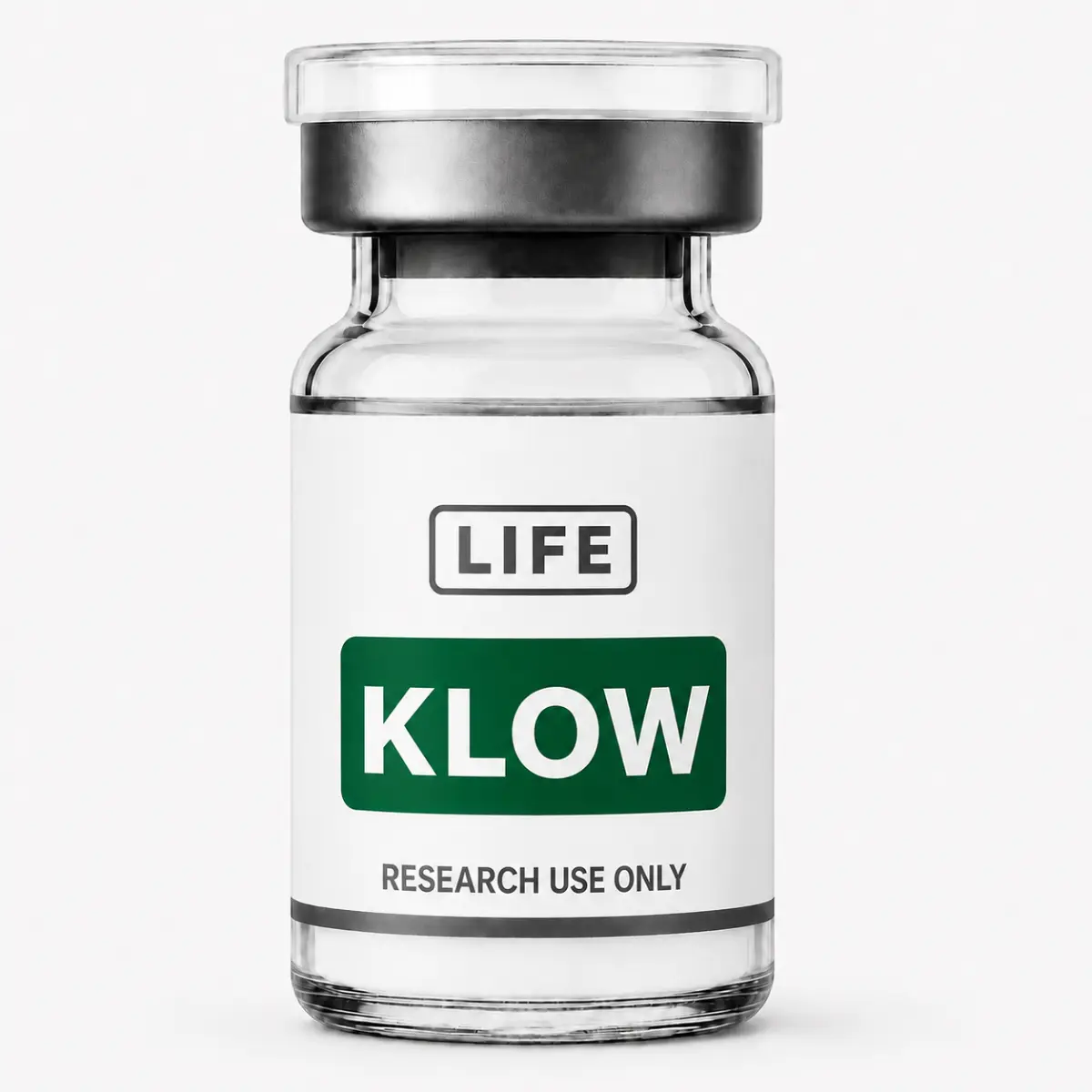
KLOW Blend is a pre-formulated four-peptide research blend that combines:
GHK-Cu – 50 mg
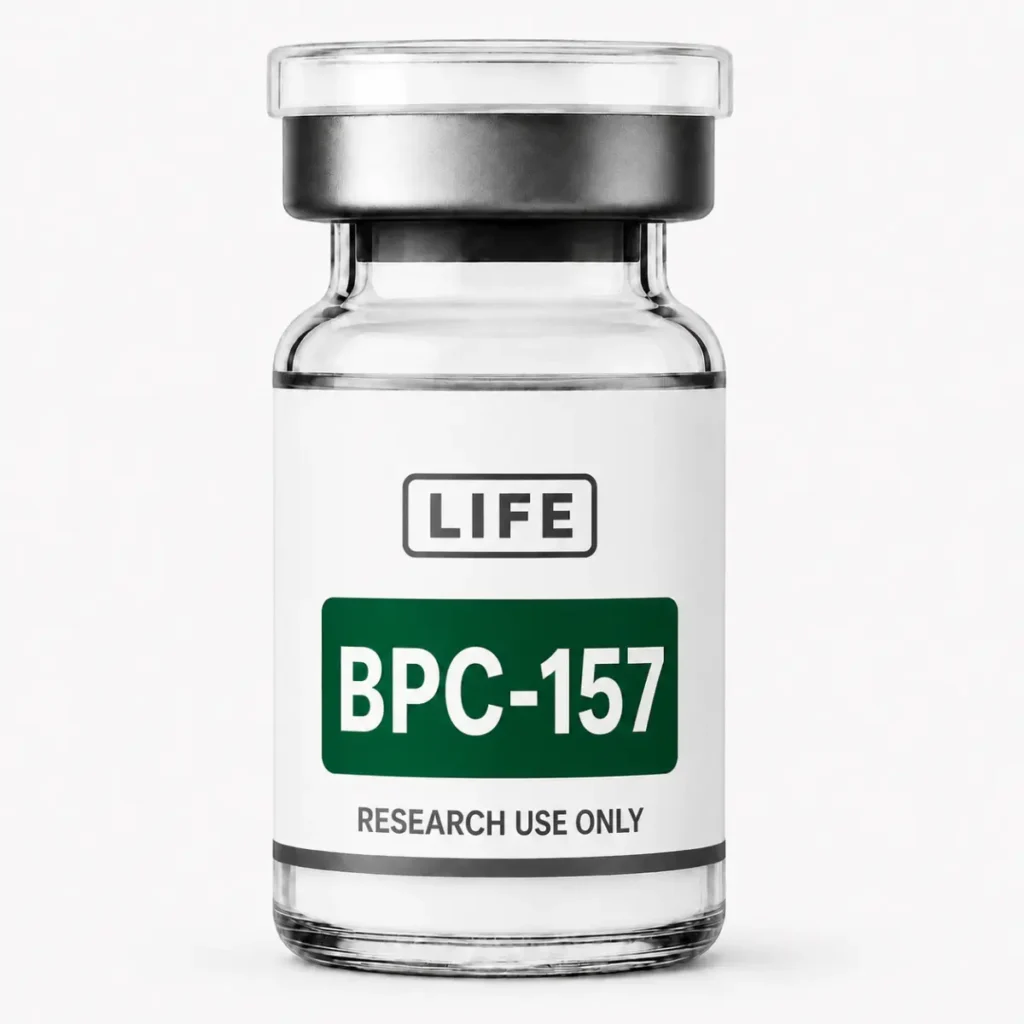
BPC-157 – 10 mg
TB-500 – 10 mg
KPV – 10 mg
Unlike a single research peptide, KLOW is designed to allow investigation of several complementary biological pathways within one formulation. Each component has been independently studied in published research for different aspects of regenerative biology, including extracellular matrix regulation, soft-tissue repair, cell migration and inflammatory signalling.
Why KLOW matters in regenerative research
Complex tissue repair rarely depends on a single biological pathway. For this reason, researchers frequently investigate peptides that influence different aspects of regeneration rather than focusing on one mechanism alone.
KLOW combines four widely recognised research peptides with complementary areas of investigation:
GHK-Cu — extracellular matrix biology, collagen regulation and tissue remodelling.
BPC-157 — tendon, ligament, muscle and gastrointestinal research.
TB-500 — actin dynamics, cell migration and regenerative signalling.
KPV — inflammatory pathway modulation and immune-related research.
Rather than replacing the individual peptides, KLOW provides a convenient research blend for laboratories investigating how these complementary biological systems relate to one another.
The four components of KLOW
GHK-Cu (50 mg)
The largest component of the blend, GHK-Cu is an endogenous copper-binding tripeptide investigated for extracellular matrix regulation, collagen biology, angiogenesis and tissue remodelling.
BPC-157 (10 mg)
A stable gastric pentadecapeptide widely investigated in tendon, ligament, muscle, gastrointestinal and angiogenesis research.
TB-500 (10 mg)
A peptide associated with Thymosin β4 biology and commonly investigated for cell migration, actin regulation and tissue repair.
KPV (10 mg)
A tripeptide derived from α-MSH that has attracted research interest for inflammatory signalling, cytokine regulation and epithelial biology.
Each component contributes a different area of investigation, making KLOW a broad regenerative research formulation rather than a single-mechanism peptide.
Why KLOW is widely investigated in tissue repair research
KLOW has become increasingly popular because it combines four peptides commonly discussed in regenerative research without requiring researchers to prepare multiple individual formulations.
Published research on the individual components spans:
- Biología de tendones y ligamentos
- investigación del músculo esquelético
- connective tissue remodelling
- curación de heridas
- angiogénesis
- extracellular matrix regulation
- inflammatory signalling
- fisiología de la piel
- gastrointestinal biology
Because these pathways frequently overlap in experimental models of tissue repair, multi-peptide formulations such as KLOW have attracted growing interest in laboratory research. However, published evidence relates primarily to the individual components, and the blend itself should not be assumed to produce additive or synergistic effects unless specifically demonstrated in future studies.
Why KLOW differs from GLOW
Although the names are similar, the two blends have different research emphasis.
KLOW Blend
- GHK-Cu 50 mg
- BPC-157 10 mg
- TB-500 10 mg
- KPV 10 mg
broader inflammatory pathway coverage
GLOW Blend
- GHK-Cu 50 mg
- BPC-157 10 mg
- TB-500 10 mg
no KPV
The addition of KPV makes KLOW particularly relevant for researchers interested in combining regenerative and inflammation-related pathways within a single experimental formulation.
Investigación humana y preclínica
There are currently no large published clinical studies evaluating KLOW as a combined four-peptide formulation. Instead, the scientific rationale for the blend is based on the individual evidence base of each component.
Published literature includes:
- extensive preclinical work on BPC-157
- regenerative and dermatological research involving GHK-Cu
- mechanistic and regenerative studies of Thymosin β4/TB-500 biology
- laboratory investigations of KPV in inflammatory and epithelial models
Accordingly, KLOW should be viewed as a research blend that combines individually investigated peptides rather than as a molecule with its own independent clinical evidence base.
Consideraciones de seguridad publicadas
Because KLOW combines four peptides, published safety information is derived from the available literature on each individual component rather than from dedicated studies of the blend itself. Researchers should therefore interpret findings in the context of the individual peptides and avoid assuming that observations made for one component automatically apply to the combined formulation.
Características del producto
Aplicación: investigación de laboratorio y análisis
Uso restringido: no apto para consumo humano; no apto para uso médico, veterinario o cosmético
Producido en instalaciones que cumplen con GMP bajo estrictos protocolos de control de calidad.
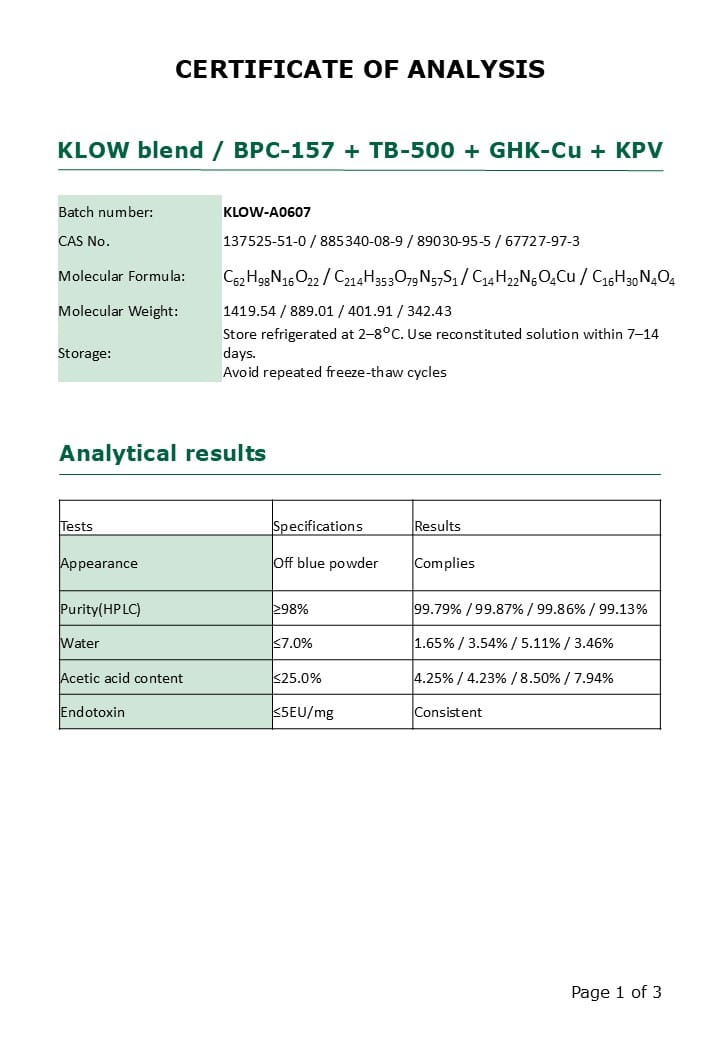
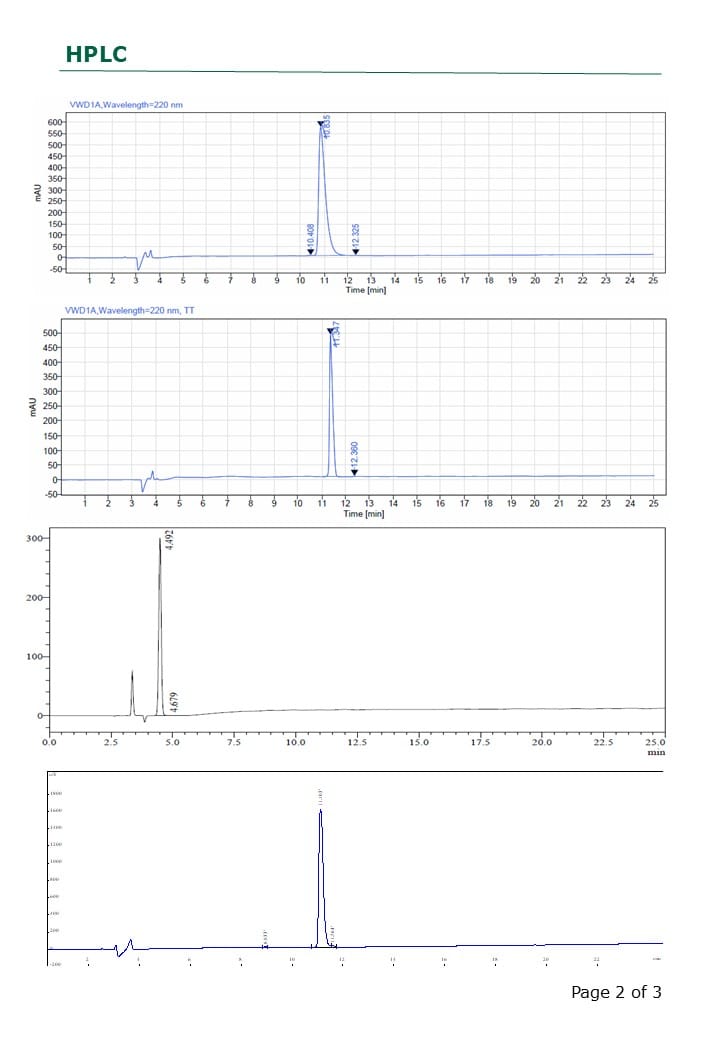
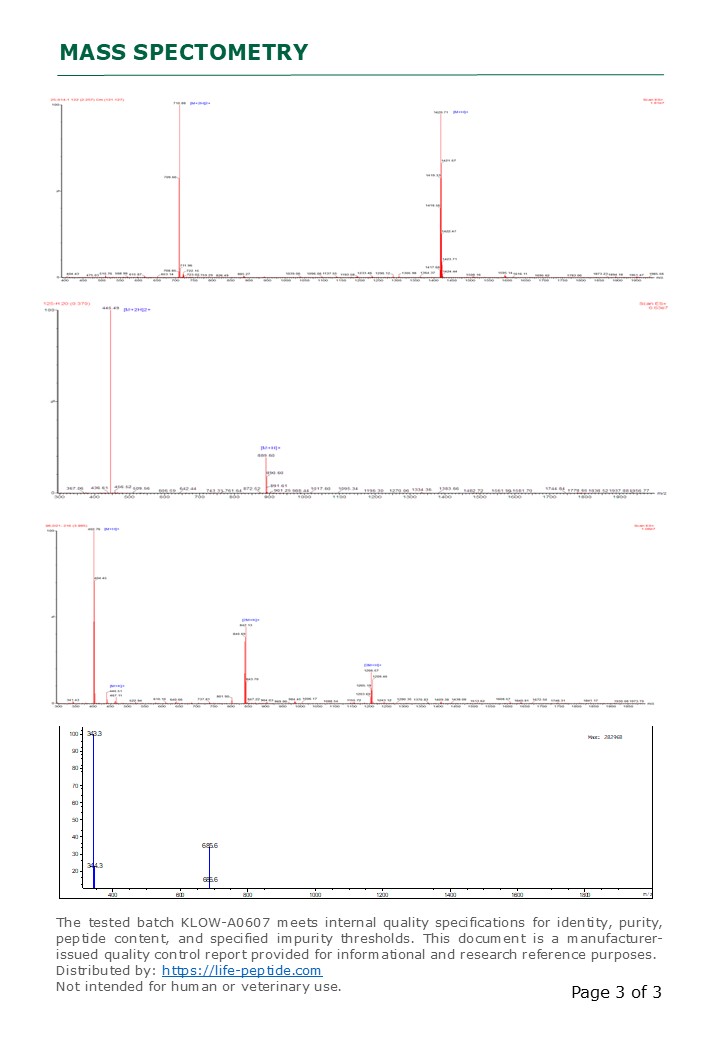
Cada lote se somete a pruebas de laboratorio exhaustivas después de la producción (puede encontrar el Certificado de Análisis debajo de las imágenes del producto).
Liofilizado (liofilizado) para máxima estabilidad y vida útil prolongada.
Sellado en viales estériles, listo para la reconstitución.
Peptide content per vial:
GHK-Cu – 50 mg
BPC-157 – 10 mg
TB-500 – 10 mg
KPV – 10 mg
Purity: ≥ 99% (HPLC)
Appearance: off-blue lyophilized powder
Molecular formula GHK-Cu: C14H22N6O4Cu
CAS No. GHK-Cu: 89030-95-5
Molecular formula BPC-157: C62H98N16O22
CAS No. BPC-157: 137525-51-0
Molecular formula TB-500: C38H68N10O14
CAS No. TB-500: 885340-08-9
Molecular formula KPV: C16H30N4O4
CAS No. KPV: 67727-97-3
Almacenamiento: los viales liofilizados sin abrir se almacenan mejor refrigerar a 2–8 °C, que es el método de almacenamiento confirmado por nuestro socio de fabricación y adecuado para hasta 24 meses. Se prefiere la refrigeración porque minimiza los ciclos innecesarios de congelación y descongelación durante la manipulación rutinaria. Si se requiere un almacenamiento a más largo plazo, los viales liofilizados sin abrir también pueden mantenerse congelados. Una vez reconstituidos, almacene siempre a 2–8 °C y no congele.
Reconstitución y manipulación
KLOW se suministra en un vial liofilizado y debe manipularse utilizando los procedimientos estándar de reconstitución de péptidos apropiados para el entorno de investigación. Debe reconstituirse con agua bacteriostática antes de usar. Para ayudar a preservar la integridad estructural, agregue el disolvente elegido lentamente contra la pared interior del vial en lugar de directamente sobre el péptido en polvo, y evite agitar vigorosamente. La agitación suave suele ser suficiente una vez que el péptido se ha disuelto por completo. La práctica estándar de laboratorio también incluye permitir que los viales refrigerados alcancen la temperatura ambiente antes de la reconstitución para minimizar la condensación dentro del vial.
Para otras guías sobre selección de solventes, planificación de concentraciones y almacenamiento, consulte el completo Guía de Reconstitución de Péptidos y Calculadora de Reconstitución.
Estudios clave publicados
- Pickart L, Margolina A. Acciones Regenerativas y Protectoras del Péptido GHK-Cu a la Luz de Nuevos Datos Genéticos. International Journal of Molecular Sciences, 2018.
A landmark review describing GHK-Cu biology, extracellular matrix regulation and tissue remodelling.
- Sikiric P, Seiwerth S, Rucman R, et al. Péptido Gástrico Estable BPC 157 de Quince Aminoácidos: Terapia Novedosa en el Tracto Gastrointestinal. Current Pharmaceutical Design, 2011.
The foundational review of BPC-157 covering gastrointestinal biology, angiogenesis and regenerative research.
- Goldstein AL, Kleinman HK. Timósina β4: Estructura, Función y Propiedades Biológicas que Respaldan Aplicaciones Clínicas Actuales y Futuras. Anales de la Academia de Ciencias de Nueva York, 2010.
The landmark review on Thymosin β4 biology, cell migration, angiogenesis and tissue repair.
- Getting SJ. Targeting the Melanocortin System: KPV and Anti-inflammatory Signalling. Pharmacology & Therapeutics, 2006.
A key review discussing melanocortin-derived peptides, including KPV, and their role in inflammatory pathway research.
Preguntas Frecuentes
What is KLOW Blend?
KLOW Blend is a research formulation combining four peptides in a single lyophilised vial: GHK-Cu (50 mg), BPC-157 (10 mg), TB-500 (10 mg) and KPV (10 mg). Each peptide has been independently investigated in published research for different aspects of regenerative biology, including extracellular matrix remodelling, soft-tissue repair, cell migration and inflammatory signalling. The blend brings these complementary research areas together in one formulation for laboratory investigation.
Which peptides are included in KLOW?
Each 80 mg vial contains:
- GHK-Cu – 50 mg
- BPC-157 – 10 mg
- TB-500 (Secuencia Completa de Timosina β4) – 10 mg
- KPV – 10 mg
Together, these peptides represent four distinct areas of regenerative research, ranging from connective tissue biology and angiogenesis to inflammation-related signalling and tissue remodelling.
Why are GHK-Cu, BPC-157, TB-500 and KPV combined?
The four peptides were selected because published research has investigated each of them in different but complementary biological pathways. GHK-Cu is associated with extracellular matrix regulation, BPC-157 with soft-tissue and gastrointestinal research, TB-500 with cell migration and tissue remodelling, and KPV with inflammatory pathway research. Combining them allows researchers to investigate multiple aspects of regenerative biology within a single experimental formulation. However, the published evidence primarily relates to the **individual peptides**, not to the blend itself.
What research areas commonly investigate KLOW Blend?
Because KLOW combines four well-known regenerative peptides, it is relevant to research involving tissue repair, tendon and ligament biology, connective tissue remodelling, angiogenesis, inflammatory signalling, skin physiology, musculoskeletal research and wound-healing models. These research areas are derived from the published literature on the individual components rather than from dedicated studies of the combined formulation.
How does KLOW differ from GLOW Blend?
Both blends contain **GHK-Cu, BPC-157 and TB-500**, but **KLOW also includes KPV**, a peptide investigated for inflammatory signalling and immune-related pathways. As a result, KLOW is designed for researchers interested in combining regenerative and inflammation-focused biology, whereas GLOW focuses primarily on tissue remodelling and recovery.
Can findings from the individual peptides be applied directly to KLOW Blend?
Not necessarily. Each peptide included in KLOW has its own published research profile, but there are currently no large clinical studies evaluating the complete four-peptide blend. For this reason, findings reported for GHK-Cu, BPC-157, TB-500 or KPV should not automatically be assumed to apply to the combined formulation. The scientific rationale for KLOW is based on the complementary mechanisms of its individual components.
¿Está este producto destinado al uso humano?
No. KLOW Blend supplied by LIFE Peptide is provided strictly for laboratory and analytical research. It is not intended for human consumption, diagnosis, treatment or prevention of disease. Any discussion of published studies on this page summarises the current scientific literature relating to the individual peptide components rather than the intended use of this product.
Contexto de investigación relacionado
KLOW sits within the Healing & recovery category, but its composition gives it a broader profile than many standard recovery blends.
It combines:
• BPC-157 → recovery and tissue signaling research
• TB-500 → repair, migration, and regeneration-related signaling
• KPV → inflammatory pathway and barrier-related research
• GHK-Cu → copper-peptide biology, tissue remodeling, and skin-related regenerative research
This makes KLOW a useful fit for researchers looking at multi-layered tissue support models rather than a single isolated pathway.
Prefer a formulation focused on the three core regenerative peptides? See GLOW Blend.
NOTA: Esto es solo para fines de referencia educativa y no constituye asesoramiento médico.
Descargo de responsabilidad
Este producto se vende únicamente para fines de investigación. No está destinado a diagnosticar, tratar, curar ni prevenir ninguna enfermedad. El comprador asume toda la responsabilidad por su manipulación y uso adecuados.


Valoraciones
No hay valoraciones aún.