Description
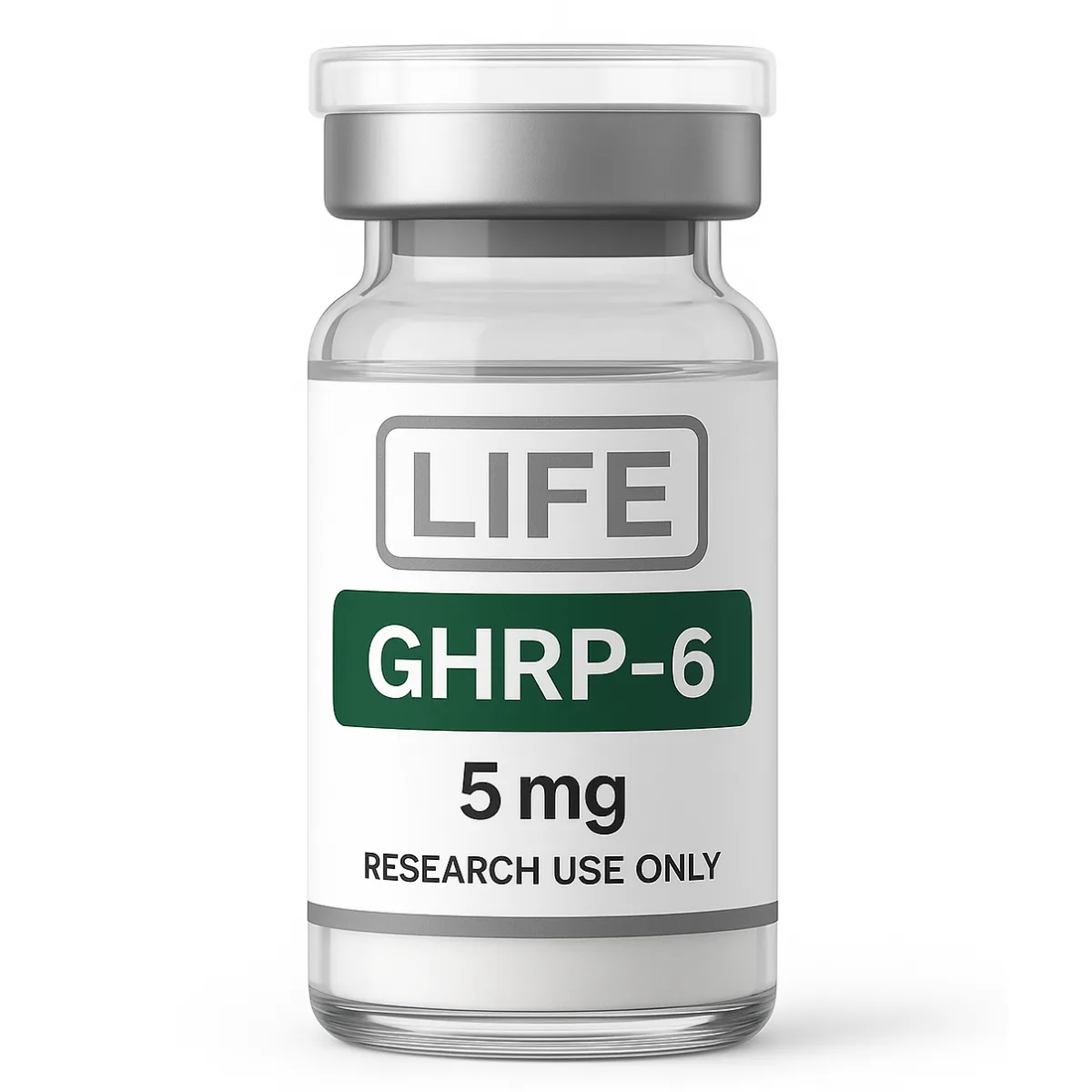
GHRP-6 (Growth Hormone Releasing Peptide-6) est un hexapeptide synthétique et l'un des membres originaux de la famille des sécrétagogues de l'hormone de croissance (GHS). Contrairement aux analogues de la GHRH tels que le CJC-1295, le GHRP-6 stimule l'hormone de croissance publié par l'activation du récepteur de la ghréline plutôt que le récepteur du GHRH (GHSR-1a).
Au-delà de ses effets endocriniens, la GHRP-6 est devenue bien connue dans la recherche parce que l'activation du récepteur de la ghréline influence également appétit, physiologie gastro-intestinale et balance énergétique. Ce profil biologique plus large le distingue des sécrétagogues plus récents qui se concentrent principalement sur la libération de l'hormone de croissance.
Vous souhaitez acheter du GHRP-6 en Europe ? Life Peptide propose du GHRP-6 de haute pureté destiné à la recherche en laboratoire, avec une livraison fiable dans toute l'Union européenne.
Pourquoi le GHRP-6 est important dans la recherche endocrinienne
L'une des caractéristiques déterminantes du GHRP-6 est qu'il reproduit de nombreux aspects de signalisation naturelle de la ghréline.
Les recherches publiées ont étudié le GHRP-6 en relation avec :
- sécrétion pulsatile de l'hormone de croissance
- biologie du récepteur de la ghréline
- régulation de l'appétit
- apport alimentaire
- physiologie endocrinienne
- signalisation de l'IGF-1
- motilité gastro-intestinale
- bilan énergétique
Étant donné que la ghréline régule bien plus que la seule sécrétion de l'hormone de croissance, le GHRP-6 demeure un outil de recherche important pour étudier le système de signalisation de la ghréline dans son ensemble.
Comment fonctionne le GHRP-6
Contrairement aux analogues du GHRH, le GHRP-6 agit en stimuler le récepteur des sécrétagogues de l'hormone de croissance (GHSR-1a), désormais reconnu comme le récepteur de la ghréline.
Les recherches publiées ont exploré sa relation avec :
Sécrétion d'hormone de croissance
Stimulation de la libération pulsatile de GH par l'activation des récepteurs de la ghréline.
Régulation de l'appétit
Le GHRP-6 est l'un des sécrétagogues les plus largement étudiés pour la signalisation orexigène et la recherche sur la prise alimentaire.
Physiologie gastro-intestinale
Des études expérimentales ont examiné la vidange gastrique, la motilité gastro-intestinale et la régulation digestive.
Homéostasie énergétique
La recherche a également examiné les interactions entre la signalisation de la ghréline, la composition corporelle et la régulation métabolique.
Pourquoi le GHRP-6 fait l'objet de nombreuses recherches dans l'étude de l'appétit
Parmi les sécrétagogues de l'hormone de croissance classiques, Le GHRP-6 est particulièrement reconnu pour ses effets sur la signalisation liée à l'appétit.
Comme la ghréline est la principale hormone de la faim de l'organisme, l'activation du récepteur de la ghréline est devenue un domaine de recherche important dans :
- régulation de l'appétit
- apport alimentaire
- physiologie de la nutrition
- recherche sur la cachexie
- bilan énergétique
Cela rend le GHRP-6 particulièrement intéressant pour les chercheurs étudiant la régulation endocrinienne au-delà de la seule sécrétion de l'hormone de croissance.
Recherche humaine et préclinique
Le GHRP-6 fait l'objet de recherches depuis plusieurs décennies, tant en laboratoire que chez l'humain.
Des études publiées ont exploré :
- physiologie endocrinienne
- libération de l'hormone de croissance
- régulation de l'appétit
- fonction gastro-intestinale
- signalisation métabolique
Bien qu'une grande partie de l'attention actuelle se soit tournue vers des sécrétagogues plus récents tels que l'Ipamórelin, le GHRP-6 reste l'un des composés fondamentaux dans la recherche sur les récepteurs de la ghréline et continue d'être largement référencé dans les études sur la biologie du GHSR.
En quoi le GHRP-6 diffère des autres sécrétagogues de GH
GHRP-6
- Puissant agoniste des récepteurs de la ghréline
- Dégagement GH robuste
- Signalisation de l'appétit
- Recherche gastro-intestinale
- Puissant sécrétagogue de l'GH
- Moins de stimulation de l'appétit
- Physiologie endocrinienne
- Ipamorelin
- Agoniste des récepteurs de la ghréline hautement sélectif
- Effets minimes sur l'appétit
- Profil endocrinien plus sain
- Analogue de la GHRH
- Voie de récepteur différente
- Souvent étudié en même temps que les GHRP
Plutôt que de se substituer les uns aux autres, ces peptides représentent différentes approches pour étudier la physiologie de l'hormone de croissance et la signalisation de la ghréline.
Observations de sécurité publiées
Les études cliniques publiées ont généralement décrit le GHRP-6 comme produisant des augmentations transitoires de la sécrétion d'hormone de croissance ainsi que des réponses endocriniennes mesurables cohérentes avec l'activation du récepteur de la ghréline. Comme pour les autres sécrétagogues de l'hormone de croissance, stimulation de l'appétit et augmentations de la prolactine ou du cortisol ont également été signalés dans certains contextes expérimentaux.
Caractéristiques du produit
Application : recherche de laboratoire et analytique
Utilisation restreinte : non destiné à la consommation humaine ; non destiné à un usage médical, vétérinaire ou cosmétique
Produit dans des installations conformes aux BPF dans le cadre de protocoles de CQ stricts.
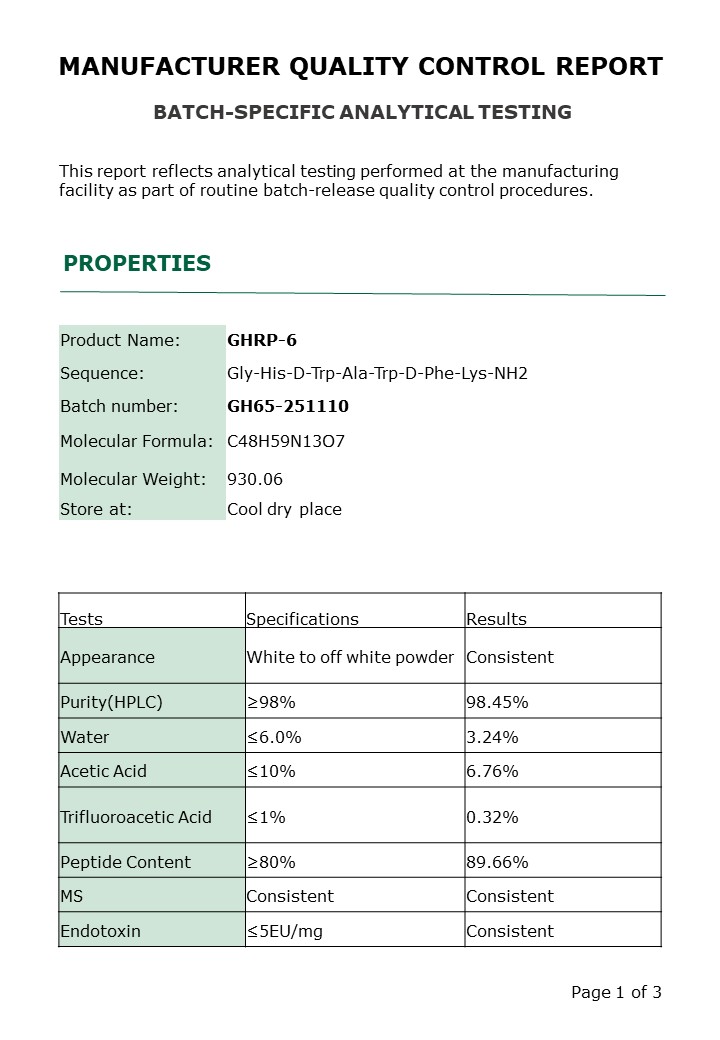
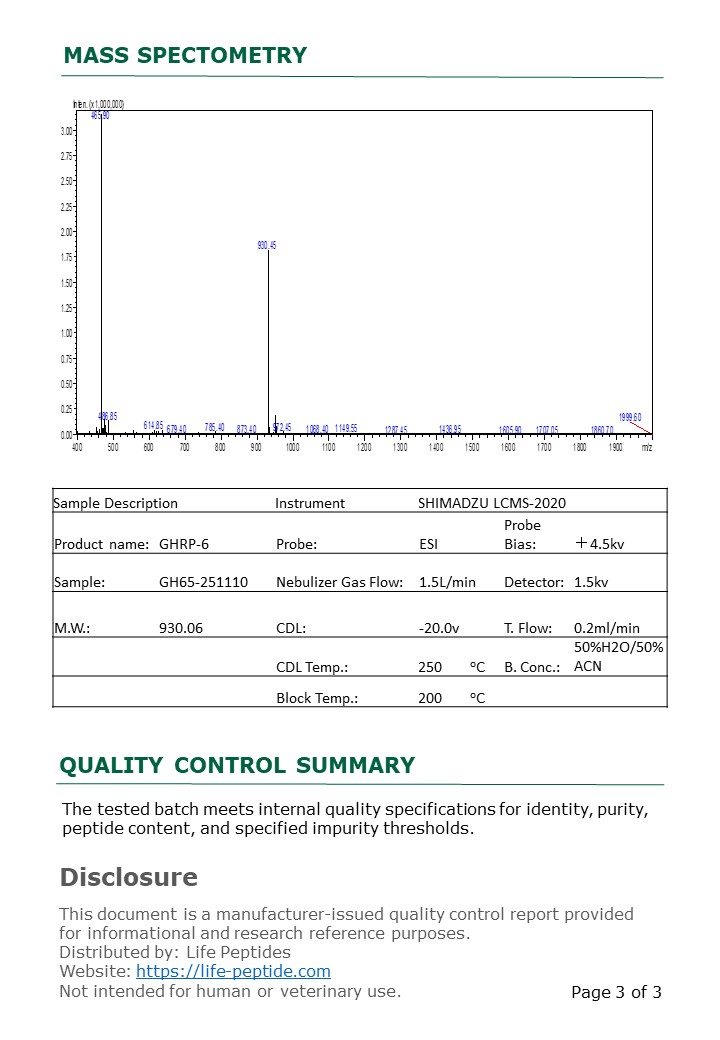
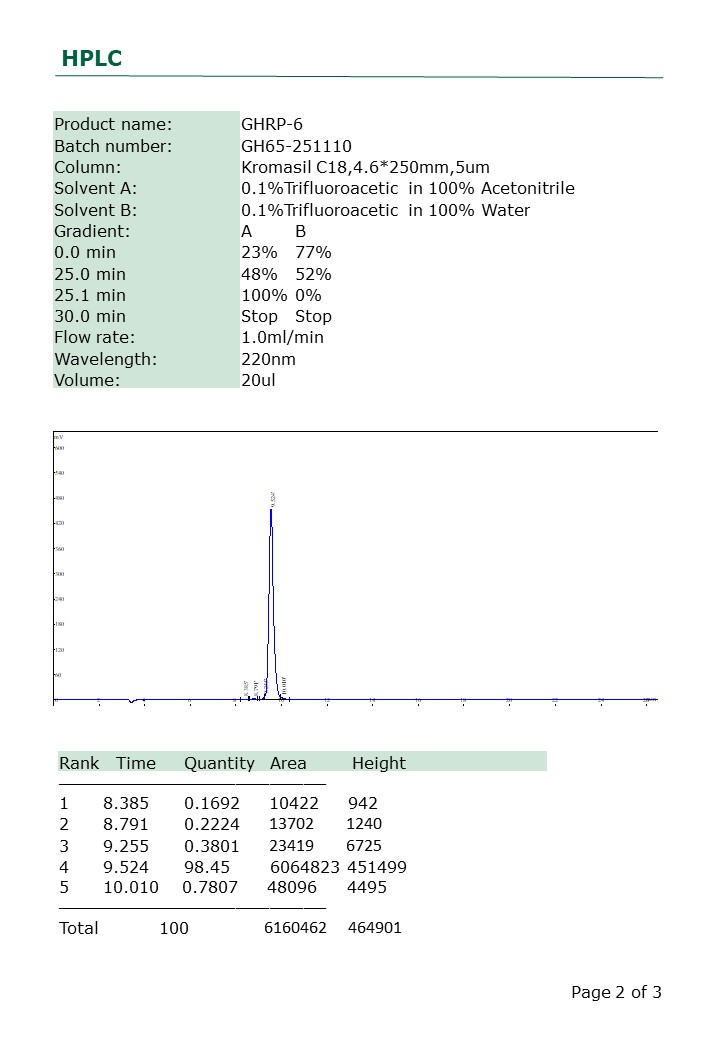
Chaque lot est soumis à des tests rigoureux en laboratoire après production (vous trouverez le certificat d'analyse sous les photos du produit).
Lyophilisé (séché par congélation) pour une stabilité et une durée de conservation maximales.
Scellés dans des flacons stériles, prêts à être reconstitués.
Pureté : ≥98% (testée par HPLC)
Aspect : Poudre blanche/blanc cassé lyophilisée
Formule moléculaire : C48H59N13O7
Poids moléculaire : 930,06
Séquence : Gly-His-D-Trp-Ala-Trp-D-Phe-Lys-NH2
Stockage: les flacons lyophilisés non ouverts sont mieux conservés réfrigéré à 2–8 °C, qui est la méthode de stockage confirmée par notre partenaire de fabrication et adaptée jusqu'à 24 mois. La réfrigération est préférable car elle minimise les cycles de congélation-décongélation inutiles lors de la manipulation de routine. Si un stockage à plus long terme est nécessaire, les flacons lyophilisés non ouverts peuvent également être conservés congelés. Une fois reconstituées, toujours conserver à 2-8°C et ne pas congeler.
Reconstitution et manipulation
Le GHRP-6 est fourni sous forme de flacon lyophilisé et doit être manipulé en utilisant les procédures standard de reconstitution des peptides adaptées au cadre de la recherche. Doit être reconstitué avec eau bactériostatique avant utilisation. Pour aider à préserver l'intégrité structurelle, ajoutez le solvant choisi lentement contre la paroi intérieure du flacon plutôt que directement sur le précipité peptidique, et évitez les secousses vigoureuses. Un léger mouvement de rotation suffit généralement une fois que le peptide est complètement dissous. Les pratiques courantes de laboratoire comprennent également le fait de laisser les flacons réfrigérés atteindre la température ambiante avant la reconstitution afin de minimiser la condensation à l'intérieur du flacon.
Pour d'autres choix de solvant, une planification de la concentration et des conseils de stockage, consultez le guide complet Guide de reconstitution des peptides et Calculateur de reconstitution.
Études clés publiées
- Bowers CY, et al. Peptides libérateurs de l'hormone de croissance et leurs analogues. Frontiers in Neuroendocrinology, 1998
Une revue fondamentale présentant la biologie des GHRP et différenciant la voie des GHS de celle de la GHRH.
- Lengyel AMJ, et al. Peptides libérateurs de l'hormone de croissance et ghréline. Brazilian Journal of Medical and Biological Research, 2006
Une revue complète du GHRP-6, de la biologie du récepteur de la ghréline et des mécanismes endocriniens.
- Berlanga-Acosta J, et al. Peptides de libération de l'hormone de croissance synthétiques (GHRP). Science clinique, 2017
Une revue générale couvrant la pharmacologie du GHRP-6, son développement clinique et la recherche thérapeutique.
- Yin Y, Li Y, Zhang W. Le récepteur des sécrétagogues de l'hormone de croissance : sa signalisation intracellulaire et sa fonction physiologique. Journal international des sciences moléculaires, 2014
Une revue autorisée de la signalisation du GHSR, de la biologie de la ghréline et de la pharmacologie des sécrétagogues.
Questions fréquemment posées
Qu'est-ce que le GHRP-6 ?
Le GHRP-6 est un hexapeptide synthétique qui active le récepteur de la ghréline (GHSR-1a). Il fait l'objet de nombreuses recherches concernant la sécrétion pulsatile de l'hormone de croissance, la régulation de l'appétit et la physiologie endocrinienne.
En quoi le GHRP-6 diffère-t-il de l'ipamoréline ?
Tous deux activent le récepteur de la ghréline, mais le GHRP-6 est beaucoup plus fortement associé à la signalisation de l'appétit, tandis que l'ipamoréline est généralement étudiée pour une libération de GH plus sélective avec une activité orexigène moindre.
En quoi le GHRP-6 diffère-t-il du GHRP-2 ?
Les deux appartiennent à la même famille de peptides et stimulent la libération de GH par l'intermédiaire du GHSR-1a. Le GHRP-6 est généralement reconnu pour une stimulation de l'appétit plus forte, tandis que le GHRP-2 est souvent considéré comme le sécretagogue endocrinien le plus puissant.
Pourquoi le GHRP-6 est-il associé à la recherche sur l'appétit ?
Le GHRP-6 imite la ghréline, la principale hormone orexigène de l'organisme. Cela en a fait un outil de recherche important pour la régulation de l'appétit, la prise alimentaire et l'homéostasie énergétique.
Quels domaines de recherche étudient couramment le GHRP-6 ?
Des études publiées étudient le GHRP-6 dans la sécrétion de l'hormone de croissance, la biologie des récepteurs de la ghréline, la régulation de l'appétit, la physiologie gastro-intestinale, la signalisation endocrine et la balance énergétique.
Puis-je acheter du GHRP-6 en Europe ?
Oui. Nous expédions du GHRP-6 vers la plupart des pays européens en utilisant des services de messagerie fiables. Les méthodes d'expédition disponibles et les délais de livraison sont affichés lors du paiement en fonction de votre destination.
Ce produit est-il destiné à un usage humain ?
Non. Le GHRP-6 fourni par Life Peptide est destiné exclusivement à la recherche en laboratoire et à des fins d'analyse. Il n'est pas destiné à la consommation humaine, ni au diagnostic, au traitement ou à la prévention de maladies. Toute référence à des études publiées résume la littérature scientifique relative à la molécule GHRP-6 et non l'usage prévu de ce produit.
Contexte de recherche connexe
Le GHRP-6 appartient à la classe des sécrétagogues de l'hormone de croissance, un groupe de peptides étudiés pour leur rôle dans la signalisation de l'hormone de croissance, la modulation endocrinienne et la libération pulsatile d'hormones.
Les chercheurs qui étudient la dynamique de l'axe GH peuvent également examiner :
Ipamorelin – peptide libérant de la hormone de croissance sélectif
CJC-1295 (sans DAC) – analogue de la GHRH à courte durée d'action
Tesamorelin – Analogue peptidique à base de GHRH
GHRP-2 – peptide libérateur de GH puissant
Parcourir tous les composés dans le Catégorie des sécrétagogues de l'hormone de croissance ou explorer des voies de signalisation endocriniennes plus larges dans le Guide de recherche sur les peptides de l'hormone de croissance.
REMARQUE : Ces informations sont fournies à titre purement informatif et ne constituent en aucun cas un avis médical.
Avis de non-responsabilité :
Ce produit est vendu à des fins de recherche uniquement. Il n'est pas destiné à diagnostiquer, traiter, guérir ou prévenir une maladie. L'acheteur assume la pleine responsabilité de sa manipulation et de son utilisation appropriées.