Description
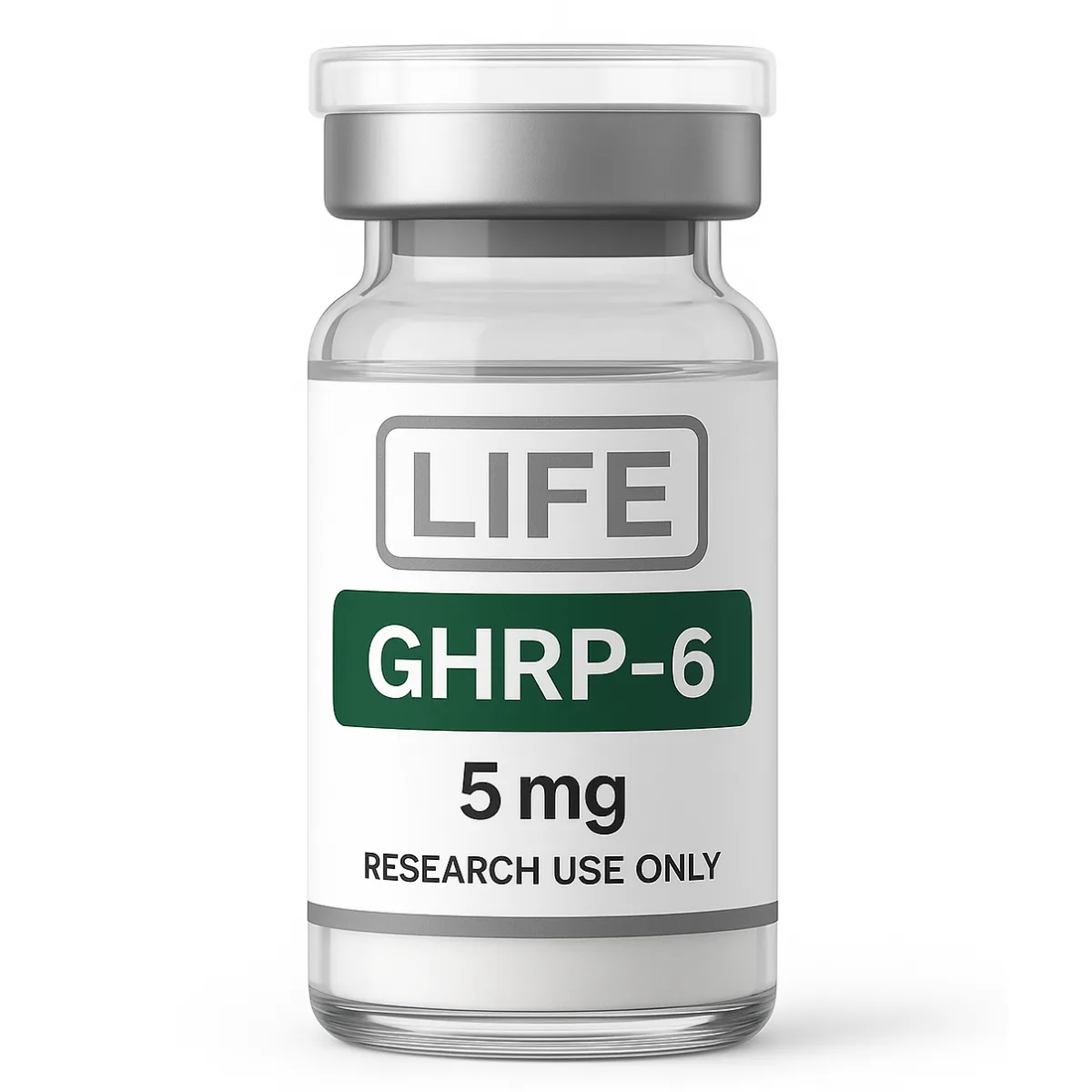
GHRP-6 (Growth Hormone Releasing Peptide-6) is a synthetic hexapeptide and one of the original members of the growth hormone secretagogue (GHS) family. Unlike GHRH analogues such as CJC-1295, GHRP-6 stimulates growth hormone release by activating the ghrelin receptor (GHSR-1a) rather than the GHRH receptor.
Beyond its endocrine effects, GHRP-6 has become well known in research because ghrelin receptor activation also influences appetite, gastrointestinal physiology and energy balance. This broader biological profile distinguishes it from newer secretagogues that focus primarily on growth hormone release.
Looking to buy GHRP-6 in Europe? LIFE Peptide supplies high-purity GHRP-6 for laboratory research with reliable EU-wide shipping.
Why GHRP-6 matters in endocrine research
One of GHRP-6’s defining characteristics is that it reproduces many aspects of natural ghrelin signalling.
Published research has investigated GHRP-6 in relation to:
- pulsatile growth hormone secretion
- ghrelin receptor biology
- appetite regulation
- food intake
- endocrine physiology
- IGF-1 signalling
- gastrointestinal motility
- energy balance
Because ghrelin regulates far more than growth hormone secretion alone, GHRP-6 remains an important research tool for studying the broader ghrelin signalling system.
How GHRP-6 works
Unlike GHRH analogues, GHRP-6 acts by stimulating the growth hormone secretagogue receptor (GHSR-1a), now recognised as the ghrelin receptor.
Published research has explored its relationship with:
Growth hormone secretion
Stimulation of pulsatile GH release through ghrelin receptor activation.
Appetite regulation
GHRP-6 is one of the most extensively investigated secretagogues for orexigenic signalling and food intake research.
Gastrointestinal physiology
Experimental studies have investigated gastric emptying, gastrointestinal motility and digestive regulation.
Energy homeostasis
Research has also examined interactions between ghrelin signalling, body composition and metabolic regulation.
Why GHRP-6 is widely investigated in appetite research
Among the classic growth hormone secretagogues, GHRP-6 is particularly recognised for its effects on appetite-related signalling.
Because ghrelin is the body’s principal hunger hormone, activation of the ghrelin receptor has become an important area of investigation in:
- appetite regulation
- food intake
- nutritional physiology
- cachexia research
- energy balance
This makes GHRP-6 especially interesting for researchers studying endocrine regulation beyond growth hormone secretion alone.
Human and preclinical research
GHRP-6 has been investigated for several decades in both laboratory and human research.
Published studies have explored:
- endocrine physiology
- growth hormone release
- appetite regulation
- gastrointestinal function
- metabolic signalling
Although much of today’s attention has shifted toward newer secretagogues such as Ipamorelin, GHRP-6 remains one of the foundational compounds in ghrelin receptor research and continues to be widely referenced in studies of GHSR biology.
How GHRP-6 differs from other GH secretagogues
GHRP-6
- Strong ghrelin receptor agonist
- Robust GH release
- Appetite signalling
- Gastrointestinal research
- Strong GH secretagogue
- Less appetite stimulation
- Endocrine physiology
- Ipamorelin
- Highly selective ghrelin receptor agonist
- Minimal appetite effects
- Cleaner endocrine profile
- GHRH analogue
- Different receptor pathway
- Often investigated alongside GHRPs
Rather than replacing one another, these peptides represent different approaches to investigating growth hormone physiology and ghrelin signalling.
Published safety observations
Published human studies have generally described GHRP-6 as producing transient increases in growth hormone secretion together with measurable endocrine responses consistent with ghrelin receptor activation. As with other growth hormone secretagogues, appetite stimulation and increases in prolactin or cortisol have also been reported in some experimental settings.
Product characteristics
Application: laboratory and analytical research
Use restriction: not for human consumption; not for medical, veterinary or cosmetic use
Produced in GMP-compliant facilities under strict QC protocols.
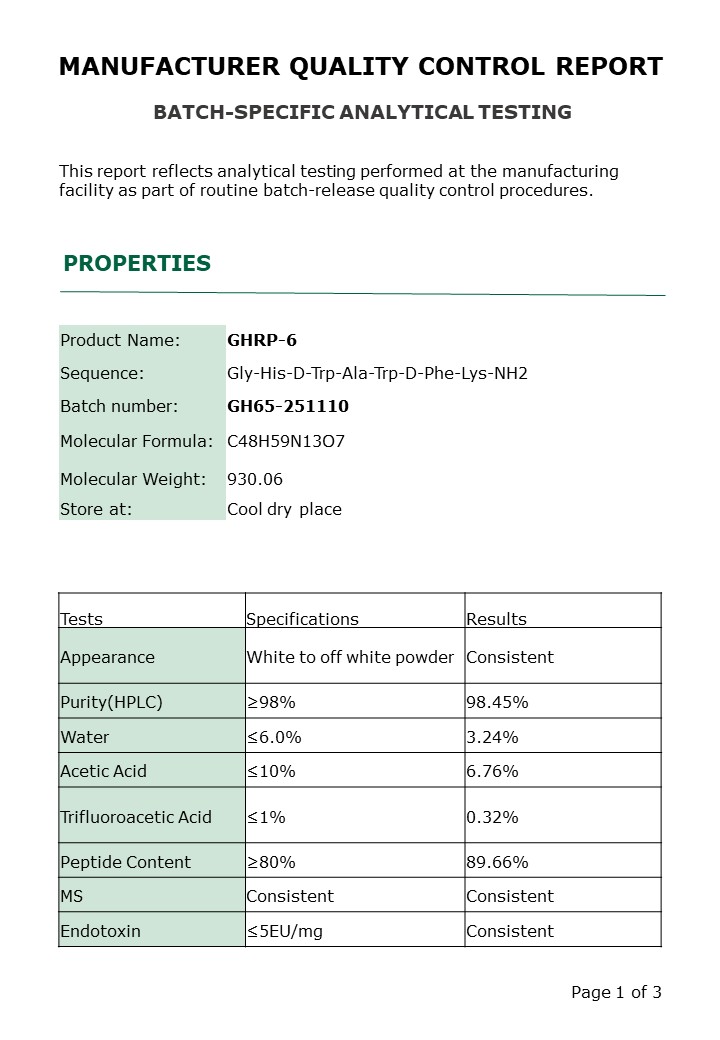
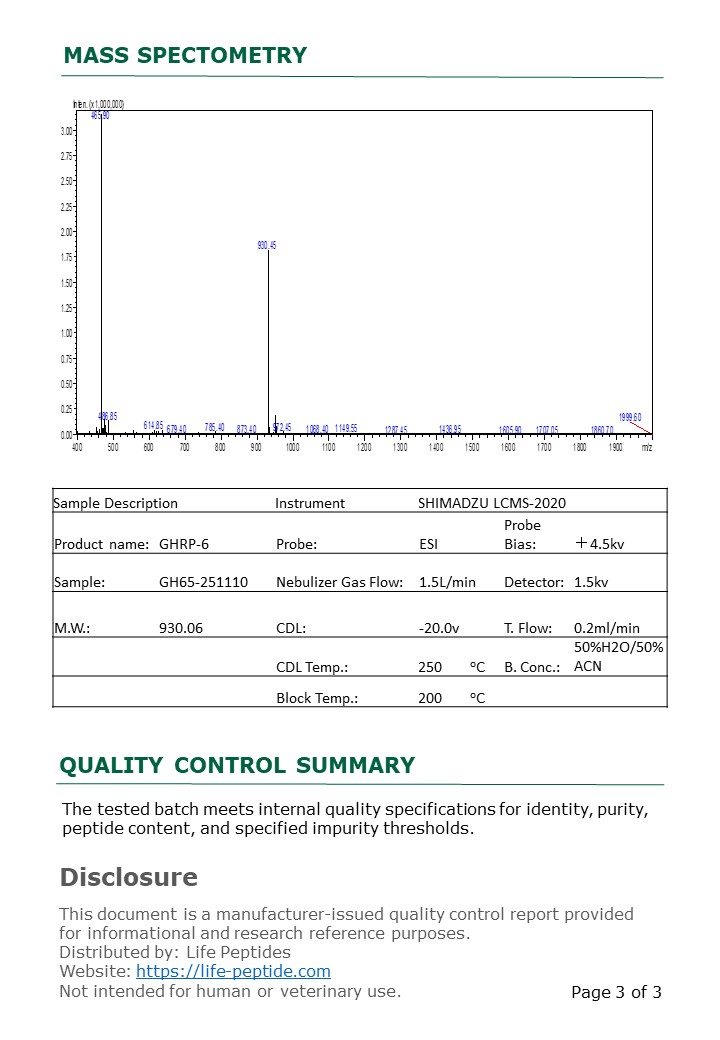
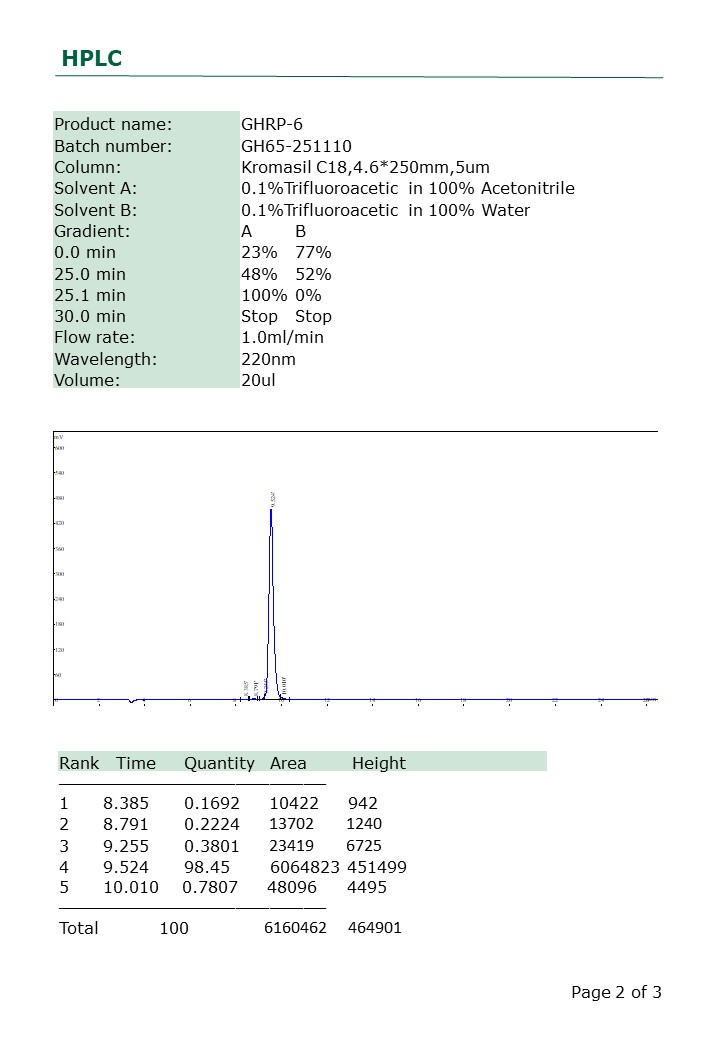
Each batch carefully lab tested after production (you can find Certificate of Analysis under product pictures).
Freeze-dried (lyophilized) for maximum stability and extended shelf life.
Sealed in sterile vials, ready for reconstitution.
Purity: ≥98% (HPLC-tested)
Appearance: Lyophilized white/off-white powder
Molecular formula: C48H59N13O7
Molecular weight: 930.06
Sequence: Gly-His-D-Trp-Ala-Trp-D-Phe-Lys-NH2
Storage: unopened lyophilized vials are best stored refrigerated at 2–8°C, which is the storage method confirmed by our manufacturing partner and suitable for up to 24 months. Refrigeration is preferred because it minimizes unnecessary freeze–thaw cycles during routine handling. If substantially longer-term storage is required, unopened lyophilized vials may also be kept frozen. Once reconstituted, always store at 2–8°C and do not freeze.
Reconstitution and handling
GHRP-6 is supplied as a lyophilised vial and should be handled using standard peptide reconstitution procedures appropriate to the research setting. Must be reconstituted with bacteriostatic water before use. To help preserve structural integrity, add the chosen solvent slowly against the inside wall of the vial rather than directly onto the peptide cake, and avoid vigorous shaking. Gentle swirling is generally sufficient once the peptide has fully dissolved. Standard laboratory practice also includes allowing refrigerated vials to reach room temperature before reconstitution to minimise condensation inside the vial.
For other solvent selection, concentration planning and storage guidance, see the full Peptide Reconstitution Guide and Reconstitution Calculator.
Key published studies
- Bowers CY, et al. Growth Hormone-Releasing Peptides and Their Analogs. Frontiers in Neuroendocrinology, 1998
A foundational review introducing GHRP biology and differentiating the GHS pathway from GHRH.
- Lengyel AMJ, et al. Growth Hormone-Releasing Peptides and Ghrelin. Brazilian Journal of Medical and Biological Research, 2006
A comprehensive review of GHRP-6, ghrelin receptor biology and endocrine mechanisms.
- Berlanga-Acosta J, et al. Synthetic Growth Hormone-Releasing Peptides (GHRPs). Clinical Science, 2017
A broad review covering GHRP-6 pharmacology, clinical development and therapeutic research.
- Yin Y, Li Y, Zhang W. The Growth Hormone Secretagogue Receptor: Its Intracellular Signalling and Physiological Function. International Journal of Molecular Sciences, 2014
An authoritative review of GHSR signalling, ghrelin biology and secretagogue pharmacology.
Frequently Asked Questions
What is GHRP-6?
GHRP-6 is a synthetic hexapeptide that activates the ghrelin receptor (GHSR-1a). It is widely investigated for pulsatile growth hormone secretion, appetite regulation and endocrine physiology.
How does GHRP-6 differ from Ipamorelin?
Both activate the ghrelin receptor, but GHRP-6 is much more strongly associated with appetite signalling, whereas Ipamorelin is generally investigated for more selective GH release with less orexigenic activity.
How does GHRP-6 differ from GHRP-2?
Both belong to the same peptide family and stimulate GH release through GHSR-1a. GHRP-6 is generally recognised for stronger appetite stimulation, while GHRP-2 is often considered the more potent endocrine secretagogue.
Why is GHRP-6 associated with appetite research?
GHRP-6 mimics ghrelin, the body’s primary orexigenic hormone. This has made it an important research tool for appetite regulation, food intake and energy homeostasis.
What research areas commonly investigate GHRP-6?
Published studies investigate GHRP-6 in growth hormone secretion, ghrelin receptor biology, appetite regulation, gastrointestinal physiology, endocrine signalling and energy balance.
Can I buy GHRP-6 in Europe?
Yes. We ship GHRP-6 to most European countries using reliable courier services. Available shipping methods and delivery times are shown during checkout based on your destination.
Is this product intended for human use?
No. GHRP-6 supplied by LIFE Peptide is provided strictly for laboratory and analytical research. It is not intended for human consumption, diagnosis, treatment or prevention of disease. Any discussion of published studies summarises the scientific literature relating to the GHRP-6 molecule rather than the intended use of this product.
Related research context
GHRP-6 belongs to the growth hormone secretagogue class, a group of peptides studied for their role in GH signaling, endocrine modulation, and pulsatile hormone release.
Researchers studying GH-axis dynamics may also examine:
Ipamorelin – selective GH-releasing peptide
CJC-1295 (no DAC) – short-acting GHRH analogue
Tesamorelin – GHRH-based peptide analogue
GHRP-2 – strong GH-releasing peptide
Browse all compounds in the Growth hormone secretagogues category or explore broader endocrine signaling pathways in the Growth hormone peptides research guide.
NOTE: This is for educational reference only and does not constitute medical advice.
Disclaimer:
This product is sold for research purposes only. It is not intended to diagnose, treat, cure, or prevent any disease. Buyer assumes full responsibility for proper handling and use.