Description
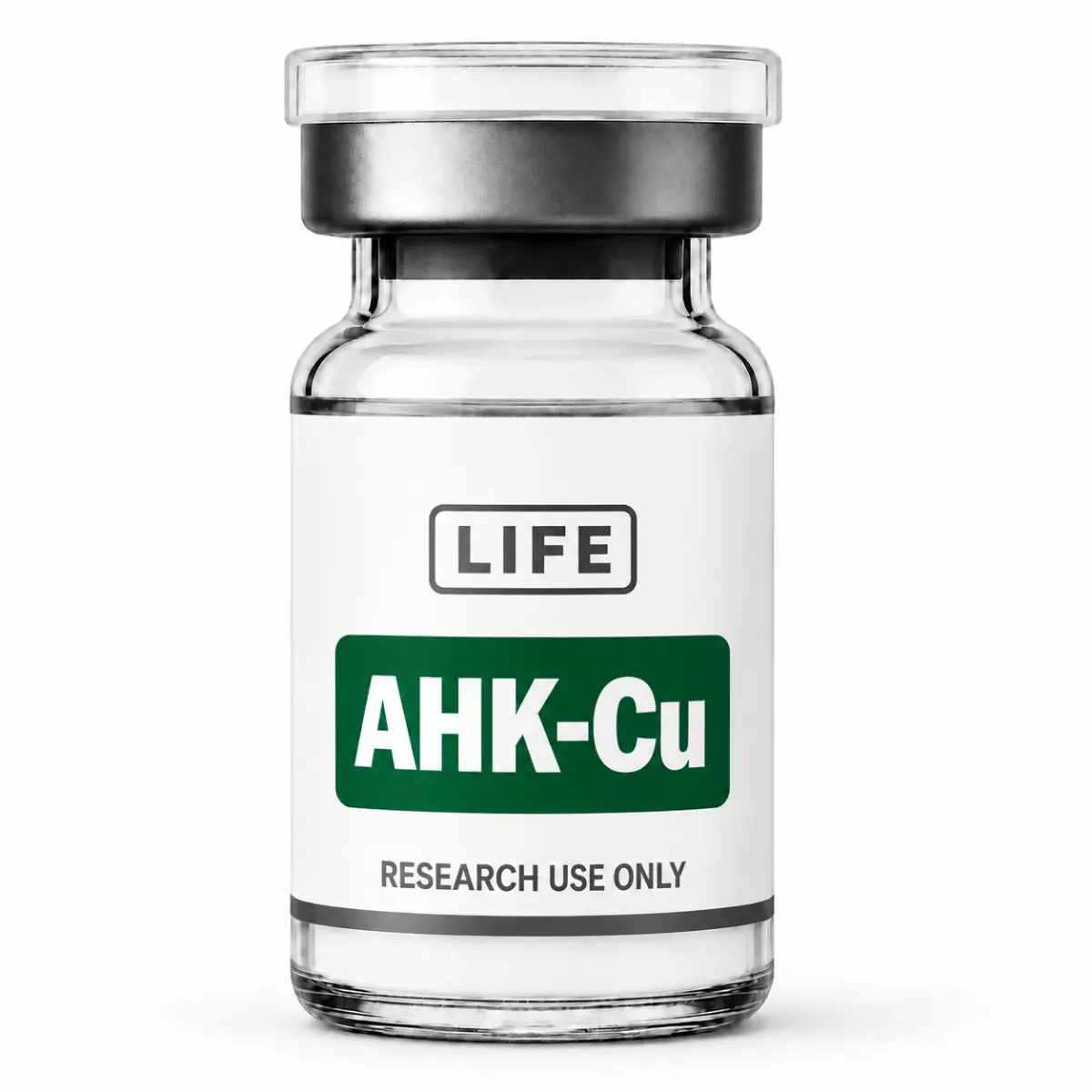
AHK-Cu in Europe | LIFE supplies high-purity AHK-Cu as a lyophilised research peptide with batch documentation. Orders are shipped from within the EU, with Economy, Standard Courier and Air Express options available depending on destination.
Copper peptide for hair-follicle and dermal research
AHK-Cu is a small copper-binding peptide made from three amino acids: alanine, histidine and lysine. It belongs to the same family of copper tripeptides as the better-known GHK-Cu, but has developed its own research interest, particularly in hair-follicle biology.
Published laboratory research has examined AHK-Cu for its effects on human hair follicles and dermal papilla cells — specialised cells located at the base of the hair follicle that play an important role in controlling follicle growth. In experimental models, AHK-Cu has been associated with increased hair-follicle elongation and increased proliferation of dermal papilla cells.
This makes AHK-Cu particularly interesting for research involving:
- hair-follicle biology
- dermal papilla cells
- cellular proliferation
- follicle growth signalling
- copper-peptide activity
- fibroblast biology
- tissue and skin research
While AHK-Cu is structurally related to GHK-Cu, the two peptides are not identical. AHK-Cu has a considerably smaller direct research literature, with its most notable published work focused specifically on hair-follicle and dermal papilla models.
Looking to buy AHK-Cu in Europe? LIFE supplies high-purity AHK-Cu for laboratory research with reliable EU-wide shipping.
What is AHK-Cu?
AHK-Cu stands for Alanyl-Histidyl-Lysine Copper. The peptide consists of only three amino acids:
Alanine – Histidine – Lysine (Ala-His-Lys)
These form a complex with copper ions, producing the copper tripeptide known as AHK-Cu. Copper-binding peptides are of particular interest because copper participates in many biological processes involving cellular signalling, extracellular matrix biology, enzymes and tissue remodelling.
AHK-Cu is closely related to GHK-Cu. The difference is small at the molecular level: AHK begins with alanine, while GHK begins with glycine. That small structural difference, however, means they should be treated as separate research compounds rather than interchangeable versions of the same peptide.
AHK-Cu research has concentrated particularly on hair follicles and dermal papilla cells.
Why AHK-Cu matters in hair-follicle research
The dermal papilla is a small group of specialised cells located at the base of the hair follicle. These cells play an important role in controlling follicle development, growth and cycling. Because of this, compounds that influence dermal papilla cell activity are of considerable interest in experimental hair research.
One of the principal published studies of AHK-Cu investigated both isolated human hair follicles and cultured human dermal papilla cells. Researchers reported that AHK-Cu:
- stimulated elongation of human hair follicles ex vivo
- increased proliferation of dermal papilla cells
- influenced cellular pathways associated with apoptosis
- increased the Bcl-2/Bax ratio
- reduced cleaved caspase-3 and PARP in the experimental model
These findings made AHK-Cu particularly interesting among copper peptides for researchers studying the cellular biology of hair follicles.
Importantly, these results come from laboratory and ex vivo research rather than clinical treatment trials in humans.
How AHK-Cu works
AHK-Cu does not work through a single receptor pathway. Instead, research suggests that its activity is connected with the interaction between the copper-peptide complex and cells involved in follicular and dermal biology.
Dermal papilla cell proliferation
Dermal papilla cells are central to hair-follicle growth and cycling. Published laboratory research found that AHK-Cu increased proliferation of cultured human dermal papilla cells.
Hair-follicle elongation
In isolated human hair follicles maintained ex vivo, AHK-Cu increased follicle elongation across the concentrations investigated. This is one of the main reasons AHK-Cu has become associated with hair-follicle research.
Cell-survival signalling
Researchers also investigated whether AHK-Cu influenced apoptosis — the programmed process through which cells are removed. AHK-Cu altered several markers associated with this process, including Bcl-2/Bax, caspase-3 and PARP.
Copper-dependent biological activity
Copper itself is an important biological trace element and participates in numerous enzymes and signalling processes. Binding copper to a small peptide provides researchers with a different model for studying copper transport and copper-dependent cellular responses than using simple copper salts.
Together, these properties make AHK-Cu an interesting research compound for studying follicular growth signalling and copper-peptide biology.
Published research findings on AHK-Cu
The best-known AHK-Cu study examined its effect on human hair growth using isolated human hair follicles and cultured dermal papilla cells.
AHK-Cu concentrations between 10⁻¹² and 10⁻⁹ M stimulated elongation of human hair follicles ex vivo. The researchers also observed increased proliferation of cultured dermal papilla cells. At 10⁻⁹ M, AHK-Cu was associated with changes in several markers involved in cell survival and apoptosis. The Bcl-2/Bax ratio increased, while cleaved caspase-3 and PARP levels decreased.
The researchers proposed that stimulation of dermal papilla cell proliferation and reduced apoptotic signalling could contribute to the observed follicle-growth effect.
| Research model | AHK-Cu finding |
| Human hair follicles ex vivo | Increased follicle elongation |
| Human dermal papilla cells | Increased cellular proliferation |
| Apoptosis research | Changes in Bcl-2/Bax signalling |
| Cellular markers | Reduced cleaved caspase-3 and PARP |
| Main research area | Hair-follicle and dermal papilla biology |
The evidence should nevertheless be interpreted appropriately. Direct AHK-Cu research remains limited compared with GHK-Cu, and the principal findings come from laboratory models rather than controlled human clinical trials.
Published safety and tolerability findings
AHK-Cu does not currently have the type of human clinical safety dataset available for pharmaceutical peptides that have progressed through Phase 1, 2 or 3 trials. The main published AHK-Cu hair research was performed using isolated human follicles and cultured dermal papilla cells.
It therefore provides useful information about cellular activity but cannot establish clinical safety or tolerability in humans.
This distinction is important because AHK-Cu is sometimes discussed online alongside the much larger body of research surrounding GHK-Cu. Evidence from GHK-Cu should not automatically be attributed to AHK-Cu.
For this reason, LIFE supplies AHK-Cu strictly as a laboratory research material and not for human or veterinary use.
Published concentrations used in AHK-Cu research
Unlike many pharmaceutical research peptides, AHK-Cu does not have established human clinical dosing schedules.
The principal published hair-follicle study investigated AHK-Cu at laboratory concentrations ranging from:
10⁻¹² M to 10⁻⁹ M
Within this range, researchers reported stimulation of human hair-follicle elongation and dermal papilla cell proliferation.
A concentration of 10⁻⁹ M was also used to investigate cellular apoptosis-related markers.
| Experimental model | Concentration reported |
| Human hair-follicle culture | 10⁻¹² – 10⁻⁹ M |
| Dermal papilla cell research | 10⁻¹² – 10⁻⁹ M |
| Apoptosis-related experiments | 10⁻⁹ M |
These concentrations describe published laboratory experiments only. They are not dosing or administration instructions.
Why AHK-Cu is different
AHK-Cu occupies an interesting position among copper peptides because its direct published research has focused strongly on hair-follicle biology. Its extremely short three-amino-acid structure also makes it useful for controlled laboratory studies of copper-peptide interactions.
Key characteristics include:
- three-amino-acid copper-binding peptide
- sequence Ala-His-Lys
- structural relative of GHK-Cu
- investigated using human hair follicles
- investigated in human dermal papilla cells
- associated with follicle elongation in ex vivo research
- associated with dermal papilla cell proliferation in vitro
For researchers specifically interested in follicular models, this gives AHK-Cu a somewhat different research profile from the broader tissue-remodelling literature normally associated with GHK-Cu.
AHK-Cu vs GHK-Cu
AHK-Cu and GHK-Cu are closely related copper tripeptides, but they are distinct research compounds.
AHK-Cu
- Sequence: Ala-His-Lys
- Copper-binding tripeptide
- Direct research particularly focused on hair follicles
- Studied in human dermal papilla cells
- Much smaller published evidence base
- Sequence: Gly-His-Lys
- Copper-binding tripeptide
- Considerably larger research literature
- Widely investigated in skin, extracellular matrix and tissue-remodelling models
- Common reference compound in copper-peptide research
AHK-Cu may therefore be particularly relevant when the research objective is centred on hair-follicle and dermal papilla biology, while GHK-Cu offers a broader and much more extensively studied copper-peptide model.
The two should not be treated as interchangeable compounds.
Product characteristics
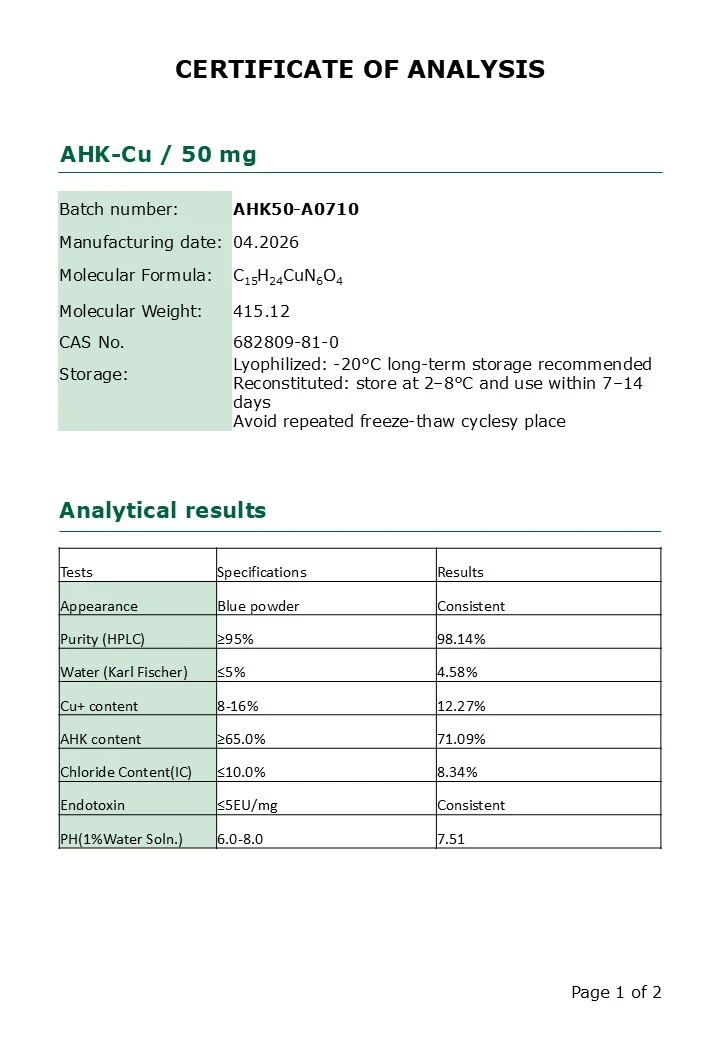
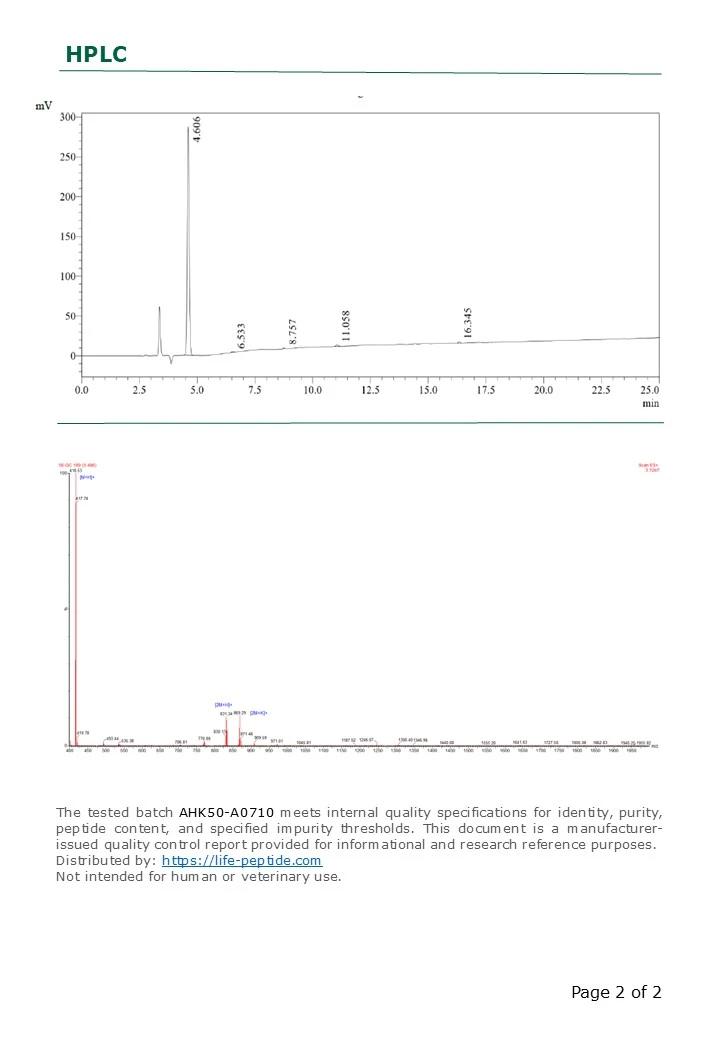
Purity: ≥ 99% (HPLC) with batch-specific COA
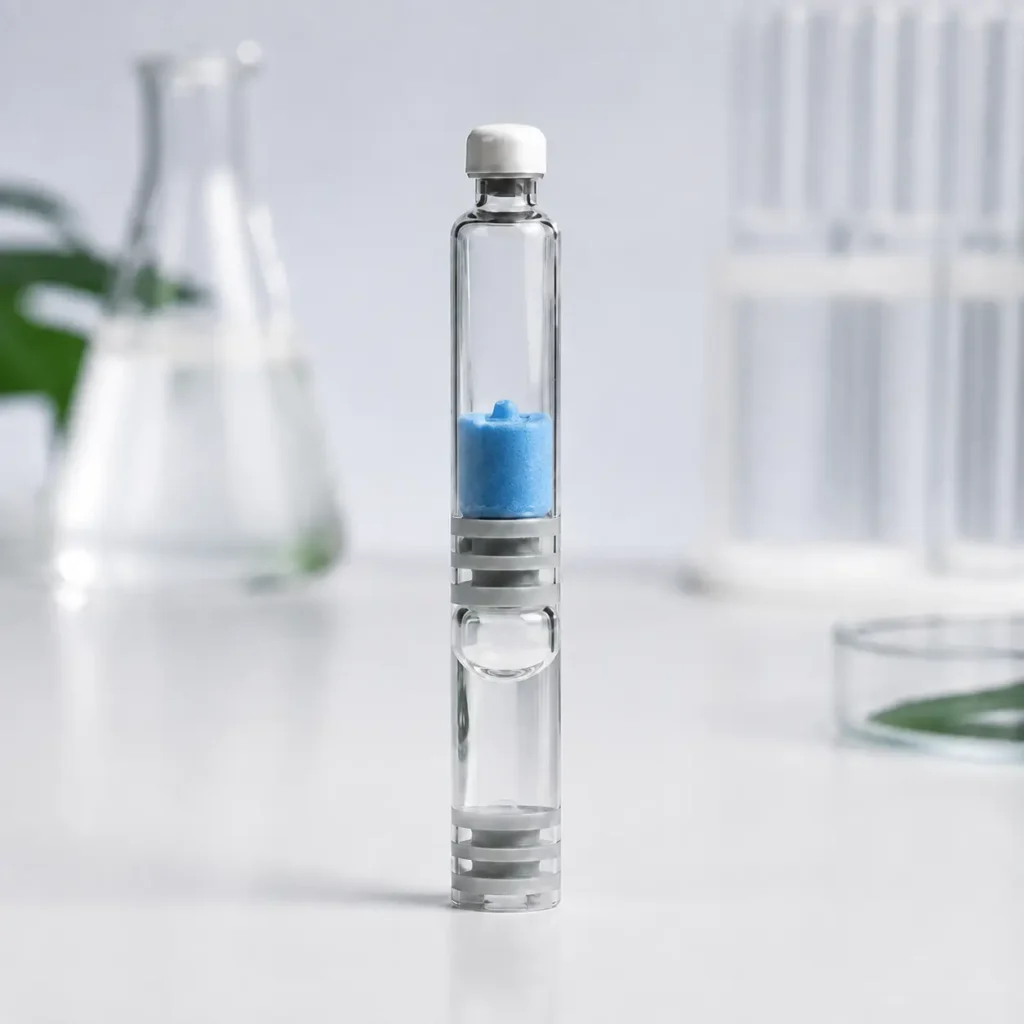
Appearance: blue lyophilized powder
Molecular formula: C15H24CuN6O4
Molecular weight: 415.12
Sequence: Ala-His-Lys-CU
Produced in GMP-compliant facilities under strict QC protocols.
Each batch carefully lab tested after production (you can find Certificate of Analysis under product pictures).
Freeze-dried (lyophilized) for maximum stability and extended shelf life.
Sealed in sterile vials, ready for reconstitution.
Application: laboratory and analytical research
Storage: unopened lyophilized vials are best stored refrigerated at 2–8°C, which is the storage method confirmed by our manufacturing partner and suitable for up to 24 months. Refrigeration is preferred because it minimizes unnecessary freeze–thaw cycles during routine handling. If substantially longer-term storage is required, unopened lyophilized vials may also be kept frozen. Once reconstituted, always store at 2–8°C and do not freeze.
Reconstitution and handling
AHK-Cu is supplied as a lyophilised vial and should be handled using standard peptide reconstitution procedures appropriate to the research setting. It must be reconstituted with bacteriostatic water before use.
For other solvent selection, concentration planning and storage guidance, see the full Peptide Reconstitution Guide and Reconstitution Calculator
Selected research references
- Pyo HK, Yoo HG, Won CH, et al. The effect of tripeptide-copper complex on human hair growth in vitro. Archives of Pharmacal Research. 2007.
- Trachy RE, Fors TD, Pickart L. The hair follicle-stimulating properties of peptide copper complexes. Results in C3H mice. Annals of the New York Academy of Sciences. 1991.
Frequently Asked Questions
What is AHK-Cu?
AHK-Cu is a copper complex of the tripeptide alanine-histidine-lysine. It is researched primarily in relation to hair follicles, dermal papilla cells and copper-peptide biology.
What does AHK stand for?
AHK represents the three amino acids that form the peptide: alanine (A), histidine (H) and lysine (K).
Why is AHK-Cu researched for hair follicles?
Published laboratory research found that AHK-Cu stimulated human hair-follicle elongation ex vivo and increased proliferation of cultured dermal papilla cells.
Is AHK-Cu the same as GHK-Cu?
No. Both are copper-binding tripeptides, but their sequences differ. AHK-Cu contains alanine-histidine-lysine, while GHK-Cu contains glycine-histidine-lysine.
Which has more research, AHK-Cu or GHK-Cu?
GHK-Cu has a substantially larger published research base. AHK-Cu has fewer direct studies, but its best-known research is particularly relevant to human hair-follicle and dermal papilla models.
Has AHK-Cu been studied in human hair follicles?
Yes. AHK-Cu has been investigated using isolated human hair follicles maintained ex vivo. This is human-derived tissue research, but it should not be confused with a clinical trial in living participants.
Does AHK-Cu have human clinical trials?
There is currently no substantial controlled human clinical-trial literature establishing AHK-Cu as a treatment for hair loss or other conditions. Its direct evidence is primarily laboratory and ex vivo research.
What research areas are associated with AHK-Cu?
AHK-Cu is mainly associated with hair-follicle biology, dermal papilla cell proliferation, copper-peptide signalling, cellular survival pathways and related dermal research.
Why is copper bound to the peptide?
Histidine-containing peptides can coordinate copper ions. The resulting copper-peptide complex provides a useful research model for studying copper-dependent cellular processes and peptide-mediated copper interactions.
Can I buy AHK-Cu in Europe?
Yes. AHK-Cu is available from LIFE for laboratory research purposes. Orders are dispatched from within the EU, with delivery available to most European destinations. Each batch includes analytical documentation.
Is this product intended for human use?
No. This product is supplied strictly for research use only and is not intended for human consumption, therapeutic use or veterinary use.
Related research context
AHK-Cu belongs to the copper-peptide research family and is particularly relevant to experimental work involving hair follicles and dermal papilla cells. Researchers interested in related tissue, skin and regeneration pathways may also examine:
GHK-Cu – the most extensively researched copper tripeptide
BPC-157 – peptide used in tissue-repair research
TB-500 / Thymosin Beta-4 – studied in tissue regeneration and cellular migration
KPV – researched in inflammatory signalling models
Browse all compounds in our Healing & recovery research category.
NOTE: This is for educational reference only and does not constitute medical advice.
Disclaimer
This product is sold for research purposes only. It is not intended to diagnose, treat, cure, or prevent any disease. Buyer assumes full responsibility for proper handling and use.