
Description
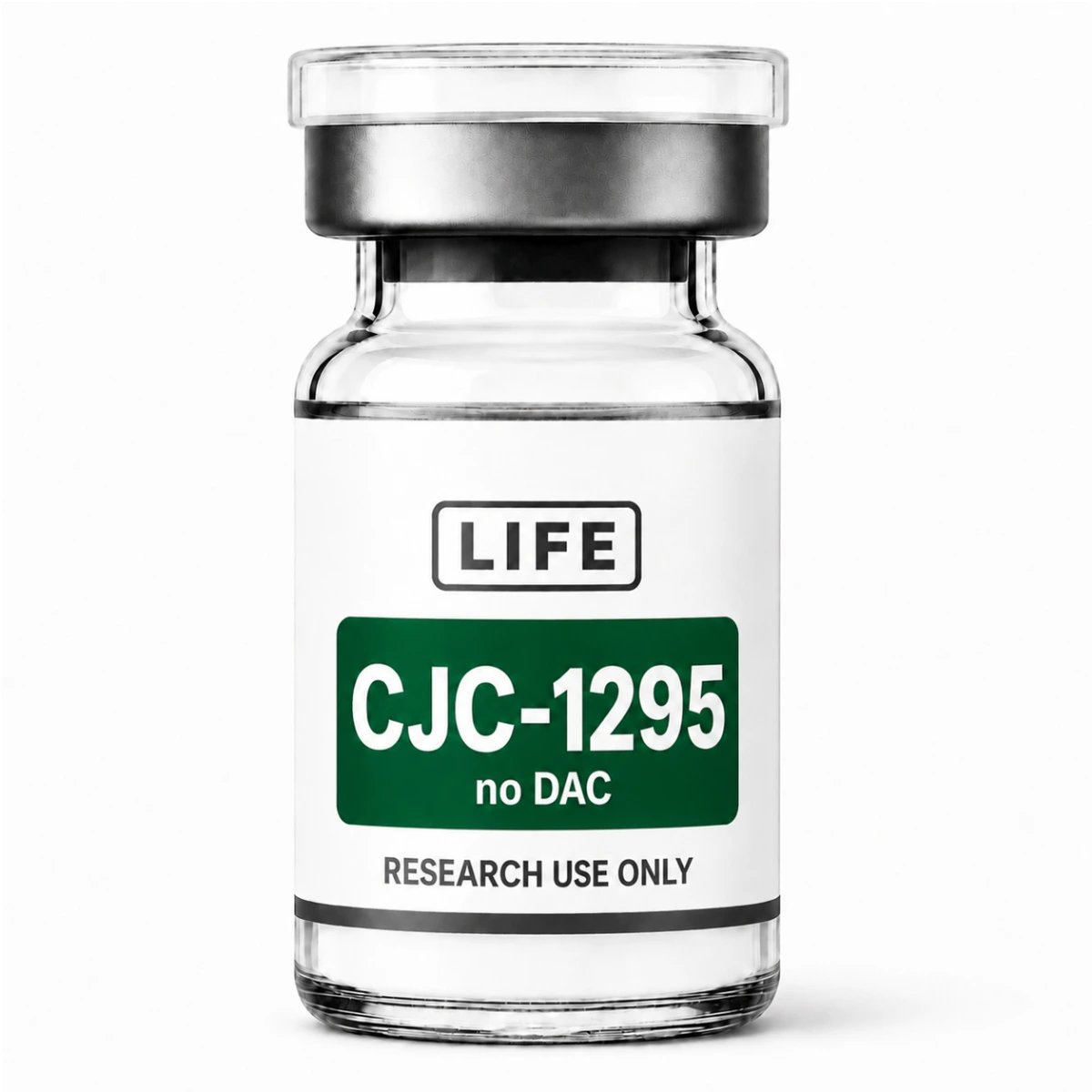
CJC-1295 No DAC, also known as Modified GRF (1-29), is a synthetic analogue of human growth hormone-releasing hormone (GHRH). Unlike the DAC version of CJC-1295, it does not contain the Drug Affinity Complex responsible for prolonged albumin binding.
As a result, CJC-1295 No DAC has a much shorter duration of action, allowing researchers to investigate physiological pulsatile growth hormone release rather than prolonged stimulation of the GH/IGF-1 axis. This distinction makes the No DAC version a separate research tool with its own applications in endocrine physiology.
Why CJC-1295 No DAC matters in GH axis research
Unlike long-acting GHRH analogues, CJC-1295 No DAC is primarily investigated for its ability to reproduce the body’s natural pulsatile secretion of growth hormone.
Published research has investigated Modified GRF (1-29) in relation to:
- physiological GH pulsatility
- GHRH receptor signalling
- endocrine physiology
- IGF-1 regulation
- pituitary function
- sleep-associated GH secretion
- body composition research
- GH axis regulation
Because endogenous growth hormone is naturally released in pulses rather than continuously, this physiological profile has made CJC-1295 No DAC one of the most recognised GHRH analogues in endocrine research.
How CJC-1295 No DAC works
Unlike GHRP peptides, CJC-1295 No DAC activates the growth hormone-releasing hormone receptor (GHRHR).
Published research has explored its relationship with:
Physiological GH pulsatility
The short half-life allows transient activation of the GHRH receptor, closely resembling natural growth hormone release.
GHRH receptor signalling
Researchers use Modified GRF (1-29) to investigate pituitary GHRH receptor activation and downstream GH secretion.
IGF-1 regulation
Repeated physiological GH pulses have been investigated for their effects on circulating IGF-1 and endocrine adaptation.
GH axis physiology
CJC-1295 No DAC remains one of the principal experimental tools for studying the normal regulation of the growth hormone axis.
Why CJC-1295 No DAC is frequently investigated with Ipamorelin
One of the defining characteristics of CJC-1295 No DAC is that it acts through the GHRH receptor, whereas Ipamorelin activates the ghrelin receptor (GHSR-1a).
Because these pathways regulate growth hormone release through different physiological mechanisms, researchers frequently investigate them together when studying endogenous GH pulsatility.
This complementary biology explains why the CJC-1295 No DAC and Ipamorelin combination has become one of the most widely recognised research models within the GH secretagogue category. Although the mechanistic rationale is well established, dedicated clinical trials specifically evaluating the combination remain limited.
Human and preclinical research
Compared with Tesamorelin, direct clinical evidence for Modified GRF (1-29) is more limited.
However, the pharmacology of GHRH receptor activation is well characterised, and CJC-1295 No DAC has become widely used in endocrine research because of its short-acting physiological profile. Much of the current understanding is supported by studies of the broader GHRH analogue class together with mechanistic investigations of Modified GRF (1-29).
How CJC-1295 No DAC compares with other GH axis peptides
CJC-1295 No DAC
- Short-acting GHRH analogue
- Physiological GH pulses
- GHRH receptor activation
- Frequently investigated with GHRPs
- GHRH analogue
- Extensive clinical evidence
- Metabolic research
- Regulatory approval history
- Ghrelin receptor agonist
- Selective GH secretagogue
- Minimal appetite signalling
- Potent ghrelin receptor agonist
- Robust GH release
- Endocrine physiology
- Ghrelin receptor agonist
- Appetite and GH research
- Gastrointestinal physiology
- Published safety observations
Published data on Modified GRF (1-29) are considerably more limited than for Tesamorelin or CJC-1295 with DAC. Available research suggests that short-acting GHRH analogues produce endocrine responses consistent with physiological GHRH receptor activation, while dedicated long-term safety data for the No DAC formulation remain limited.
CJC-1295 No DAC vs CJC-1295 with DAC
Although they share a similar name, CJC-1295 No DAC (Modified GRF 1-29) and CJC-1295 with DAC are designed for different research objectives.
| CJC-1295 No DAC | CJC-1295 with DAC |
|---|---|
| Modified GRF (1-29) | CJC-1295 with Drug Affinity Complex |
| Short-acting | Long-acting |
| Physiological GH pulses | Sustained GH stimulation |
| Short receptor activation | Extended albumin binding |
| Frequently investigated with Ipamorelin | Often investigated as a standalone long-acting GHRH analogue |
Researchers generally select CJC-1295 No DAC when studying physiological pulsatile growth hormone secretion that more closely resembles normal endocrine function. In contrast, CJC-1295 with DAC is investigated when prolonged GHRH receptor activation and sustained stimulation of the GH/IGF-1 axis are the primary research objectives.
Although both peptides belong to the GHRH analogue family, they should be considered distinct research tools rather than interchangeable formulations because the Drug Affinity Complex substantially alters their pharmacokinetic profile.
Published safety observations
Published data on Modified GRF (1-29) are considerably more limited than for Tesamorelin or CJC-1295 with DAC. Available research suggests that short-acting GHRH analogues produce endocrine responses consistent with physiological GHRH receptor activation, while dedicated long-term safety data for the No DAC formulation remain limited.
Product characteristics
Application: laboratory and analytical research
Use restriction: not for human consumption; not for medical, veterinary or cosmetic use
Produced in GMP-compliant facilities under strict QC protocols.
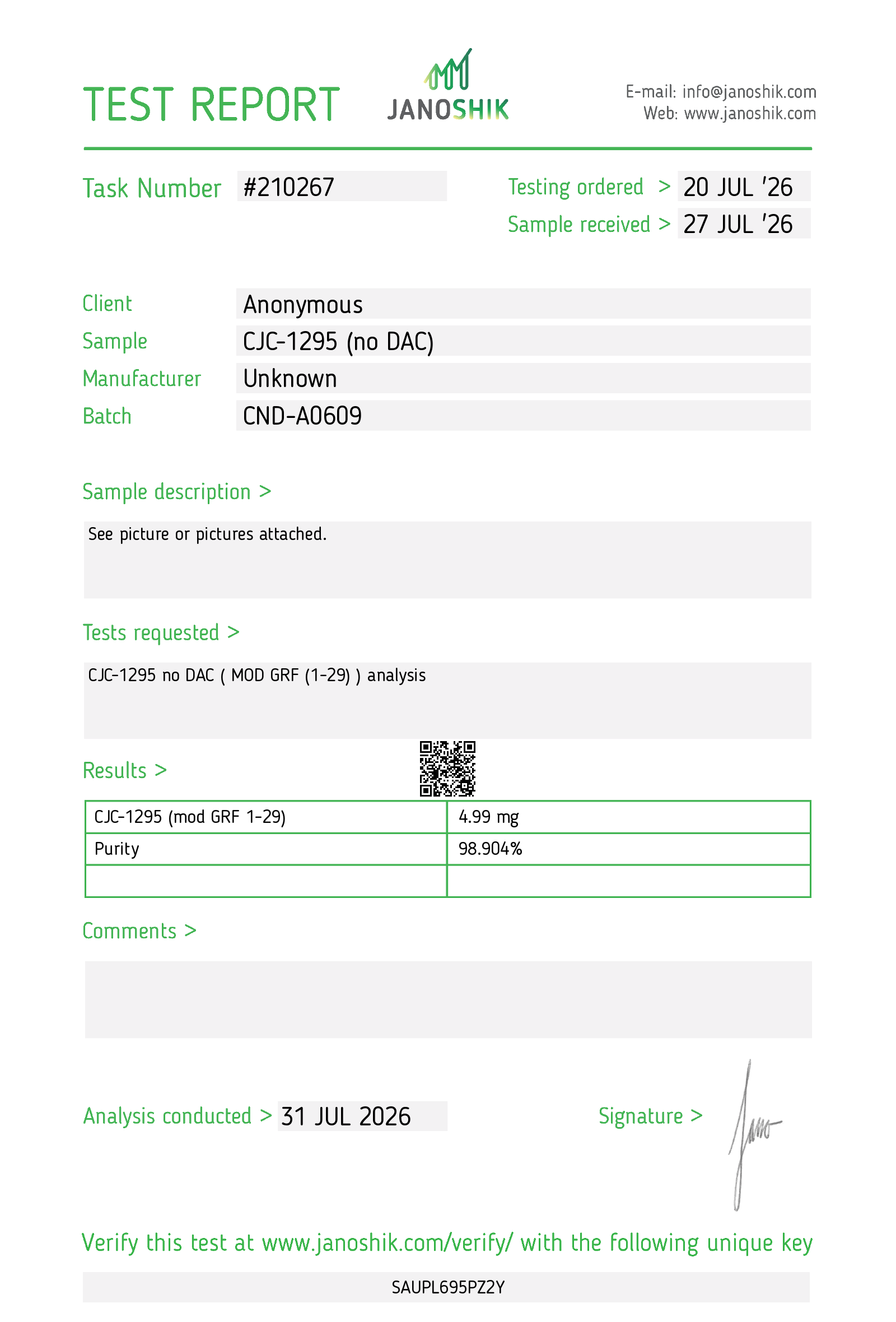
Each batch carefully lab tested after production (you can find Certificate of Analysis under product pictures).
Freeze-dried (lyophilized) for maximum stability and extended shelf life.
Sealed in sterile vials, ready for reconstitution.
Purity: ≥ 98% (HPLC)
Appearance: white lyophilized powder
Molecular formula: C154H255N45O43
Molecular weight: 3424.95
Sequence: Gly-Tyr-D-Ala-Asp-Ala-Ile-Phe-Thr-Gln-Ser-Tyr-Arg-Lys-Val-Leu-Ala-Gln-Leu-Ser-Ala-Arg-Lys-Leu-Leu-Gln-Asp-Ile-Leu-Ser-Arg-NH2
Storage: unopened lyophilized vials are best stored refrigerated at 2–8°C, which is the storage method confirmed by our manufacturing partner and suitable for up to 24 months. Refrigeration is preferred because it minimizes unnecessary freeze–thaw cycles during routine handling. If substantially longer-term storage is required, unopened lyophilized vials may also be kept frozen. Once reconstituted, always store at 2–8°C and do not freeze.
Reconstitution and handling
CJC-1295 is supplied as a lyophilised vial and should be handled using standard peptide reconstitution procedures appropriate to the research setting. Must be reconstituted with bacteriostatic water before use. To help preserve structural integrity, add the chosen solvent slowly against the inside wall of the vial rather than directly onto the peptide cake, and avoid vigorous shaking. Gentle swirling is generally sufficient once the peptide has fully dissolved. Standard laboratory practice also includes allowing refrigerated vials to reach room temperature before reconstitution to minimise condensation inside the vial.
For other solvent selection, concentration planning and storage guidance, see the full Peptide Reconstitution Guide and Reconstitution Calculator.
Key published studies
- Teichman SL, et al. Prolonged Stimulation of Growth Hormone and IGF-1 Following Administration of CJC-1295. Journal of Clinical Endocrinology & Metabolism, 2006.
The landmark study describing GHRH analogue pharmacology and GH pulsatility. (Although performed with the DAC molecule, it established the underlying CJC-1295 platform.)
- Yin Y, Li Y, Zhang W. The Growth Hormone Secretagogue Receptor: Its Intracellular Signalling and Physiological Function. International Journal of Molecular Sciences, 2014.
A comprehensive review of GH-axis regulation and the complementary biology of GHRH and ghrelin signalling.
- Muller EE, et al. Growth Hormone-Releasing Hormone and Growth Hormone Secretagogues. Endocrine Reviews, 1999.
A foundational review describing GHRH physiology and its interaction with GHS pathways.
- Devesa J, et al. The GH/IGF-1 Axis Revisited. Endocrine, 2023.
A modern review of physiological GH regulation and the role of GHRH analogues in endocrine research.
Frequently Asked Questions
What is CJC-1295 No DAC?
CJC-1295 No DAC, also known as Modified GRF (1-29), is a synthetic analogue of growth hormone-releasing hormone (GHRH). It is widely investigated in endocrine research involving physiological growth hormone secretion, GH pulsatility, pituitary function and IGF-1 regulation.
How does CJC-1295 No DAC differ from CJC-1295 with DAC?
The key difference is the Drug Affinity Complex (DAC). CJC-1295 with DAC binds to albumin and remains active for much longer, resulting in sustained GH and IGF-1 elevation. CJC-1295 No DAC lacks this modification, giving it a much shorter half-life that more closely mimics natural pulsatile GHRH signalling. For this reason, the two molecules are often considered distinct research tools rather than interchangeable versions of the same peptide.
How does CJC-1295 No DAC differ from Tesamorelin?
Both peptides are GHRH analogues that activate the same receptor. Tesamorelin has an extensive clinical evidence base and regulatory approval history, while CJC-1295 No DAC is primarily an experimental research peptide valued for its short-acting physiological GH pulse profile.
Why is CJC-1295 No DAC frequently investigated with Ipamorelin?
CJC-1295 No DAC stimulates the GHRH receptor, whereas Ipamorelin activates the ghrelin receptor (GHSR-1a). Because these pathways regulate growth hormone secretion through complementary mechanisms, researchers frequently investigate the combination when studying endogenous GH pulsatility and GH axis physiology.
What research areas commonly investigate CJC-1295 No DAC?
Published research investigates CJC-1295 No DAC in growth hormone pulsatility, GHRH receptor signalling, pituitary physiology, IGF-1 regulation, endocrine biology, body composition research and GH axis regulation.
Why do researchers choose the No DAC version?
The No DAC formulation is selected when the research objective is to investigate short-duration, physiological GH pulses rather than prolonged stimulation of the GH/IGF-1 axis. This distinction makes it particularly useful for studies focused on normal endocrine physiology.
Is this product intended for human use?
No. CJC-1295 No DAC supplied by LIFE Peptide is provided strictly for laboratory and analytical research. It is not intended for human consumption, diagnosis, treatment or prevention of disease. Any discussion of published studies summarises the scientific literature relating to the CJC-1295 No DAC molecule rather than the intended use of this product.
Related research context
CJC-1295 belongs to the GHRH analogue and growth hormone signaling research class, which includes peptides investigated for endocrine regulation, GH-axis modulation, and pulsatile hormone release mechanisms.
For a broader overview of GH signaling pathways and comparative peptide mechanisms, see our Growth hormone peptides research guide.
Researchers studying GH-axis interaction may also examine:
Ipamorelin
GHRP-2
GHRP-6
Tesamorelin
Browse all compounds in the Growth hormone secretagogues category.
Researchers investigating endocrine regulation may also explore compounds in the Metabolic research category, including GLP-1 and multi-pathway incretin agonists.
NOTE: This is for educational reference only and does not constitute medical advice.
Disclaimer
This product is sold for research purposes only. It is not intended to diagnose, treat, cure, or prevent any disease. Buyer assumes full responsibility for proper handling and use.



Reviews
There are no reviews yet.