

Description
Semax is a synthetic heptapeptide originally developed from the ACTH(4–7) fragment and modified with a Pro-Gly-Pro extension to improve stability while eliminating the hormonal activity associated with the parent hormone. Unlike ACTH itself, Semax is investigated primarily for its effects on cognitive function, neuroplasticity and neuroprotective signalling rather than endocrine activity.
Over the past two decades, Semax has become one of the best-known research peptides in cognitive neuroscience. Published studies have investigated its role in learning, attention, memory, neurotrophin regulation and recovery following neurological injury. Compared with Selank, which is primarily associated with anxiety and stress regulation, Semax is more commonly investigated for cognitive performance and neuronal plasticity.
Looking to buy Semax in Europe? LIFE Peptide supplies high-purity Semax for laboratory research with reliable EU-wide shipping.
Why Semax matters in cognitive neuroscience
One of Semax’s distinguishing characteristics is its relationship with neurotrophic signalling, particularly pathways involving brain-derived neurotrophic factor (BDNF). Experimental studies have reported increased BDNF expression following Semax administration, making it an important research model for understanding synaptic plasticity, neuronal adaptation and learning.
Published research has investigated Semax in relation to:
- learning and memory
- attention
- neuroplasticity
- BDNF signalling
- NGF regulation
- neuroprotection
- stroke recovery research
- cognitive performance
- neuronal gene expression
Because these pathways are central to how the brain adapts and forms new connections, Semax has become one of the most recognised cognitive peptides in neuroscience research.
How Semax works
Unlike classical stimulants, Semax does not appear to produce its effects through a single neurotransmitter system. Instead, published research suggests that it influences several interconnected pathways involved in cognitive function and neuronal adaptation.
- Neurotrophin signalling
One of the best-studied mechanisms is the upregulation of BDNF and related neurotrophic pathways involved in neuronal survival, synaptic plasticity and memory formation. Experimental work has also reported increased TrkB activation following Semax exposure.
- Gene expression
Laboratory studies have demonstrated changes in the expression of genes associated with neuronal communication, stress responses and neuroplasticity, suggesting that Semax acts as a regulator of broader neuronal adaptation rather than a simple receptor agonist.
- Neurotransmitter modulation
Published research has also explored interactions with dopaminergic, serotonergic and glutamatergic systems, which may contribute to its investigation in learning, attention and executive function.
Why Semax is widely investigated for learning and memory research
Semax has become one of the best-known peptides in cognitive neuroscience because many published studies focus on learning, memory formation and neuroplasticity rather than general stimulation.
Experimental research has explored:
- memory acquisition
- learning performance
- attention
- executive function
- neuronal adaptation
- synaptic plasticity
- recovery after neurological injury
Unlike conventional stimulants, Semax is generally investigated for its ability to influence the biological processes underlying cognition rather than simply increasing alertness. This distinction has made it an important research tool in neurobiology and cognitive science.
Human and preclinical research
Compared with many research peptides, Semax has a relatively broad evidence base that includes laboratory investigations together with clinical research, much of it originating from Russia. Published studies have explored its effects in cognitive neuroscience, neuroprotection and stroke rehabilitation, while mechanistic work has focused on neurotrophin signalling, gene expression and synaptic plasticity.
Although these findings have generated substantial scientific interest, much of the clinical literature remains regional and would benefit from further large international studies.
What makes Semax different from other cognitive peptides?
Semax
- Learning and memory research
- BDNF and neuroplasticity
- Attention
- Neuroprotective signalling
- Cognitive performance
- Anxiety research
- Stress adaptation
- Emotional regulation
- GABA-related signalling
- Sleep physiology
- Circadian biology
- Neuroendocrine regulation
Although these peptides are often grouped within cognitive research, they represent different areas of neuroscience rather than interchangeable compounds.
Published safety observations
Published clinical investigations have generally reported favourable tolerability within the studied populations. Human research has primarily focused on neurological disorders and cognitive rehabilitation, while laboratory studies continue to investigate the molecular mechanisms underlying Semax’s neuroprotective and neuroplastic effects.
Product characteristics
Application: laboratory and analytical research
Use restriction: not for human consumption; not for medical, veterinary or cosmetic use
Produced in GMP-compliant facilities under strict QC protocols.
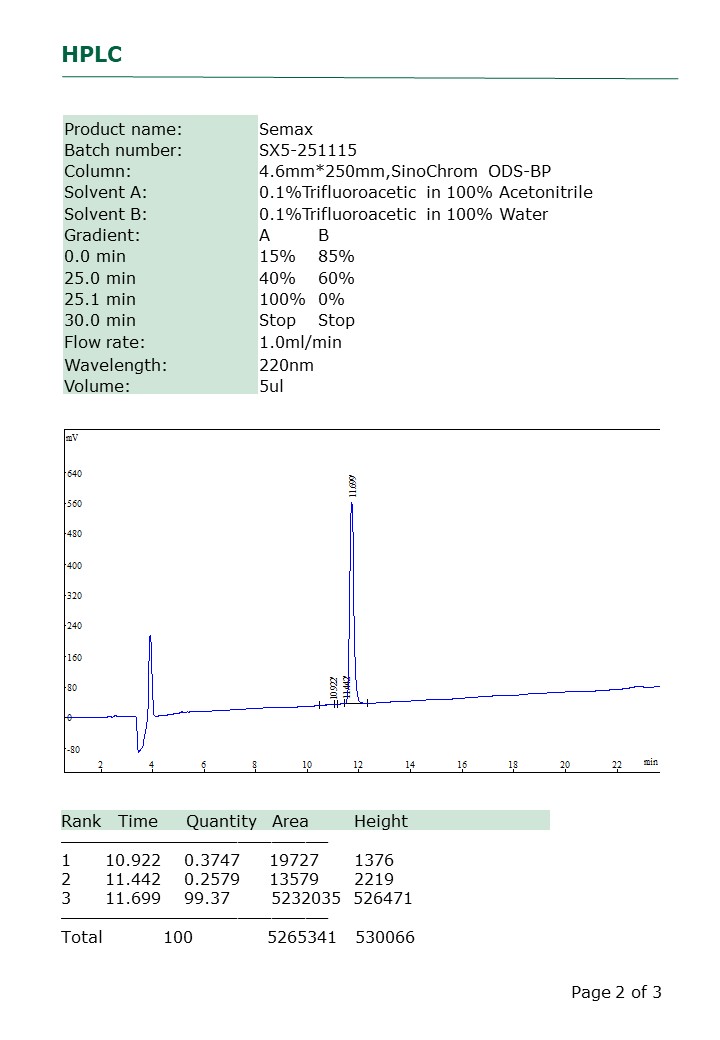
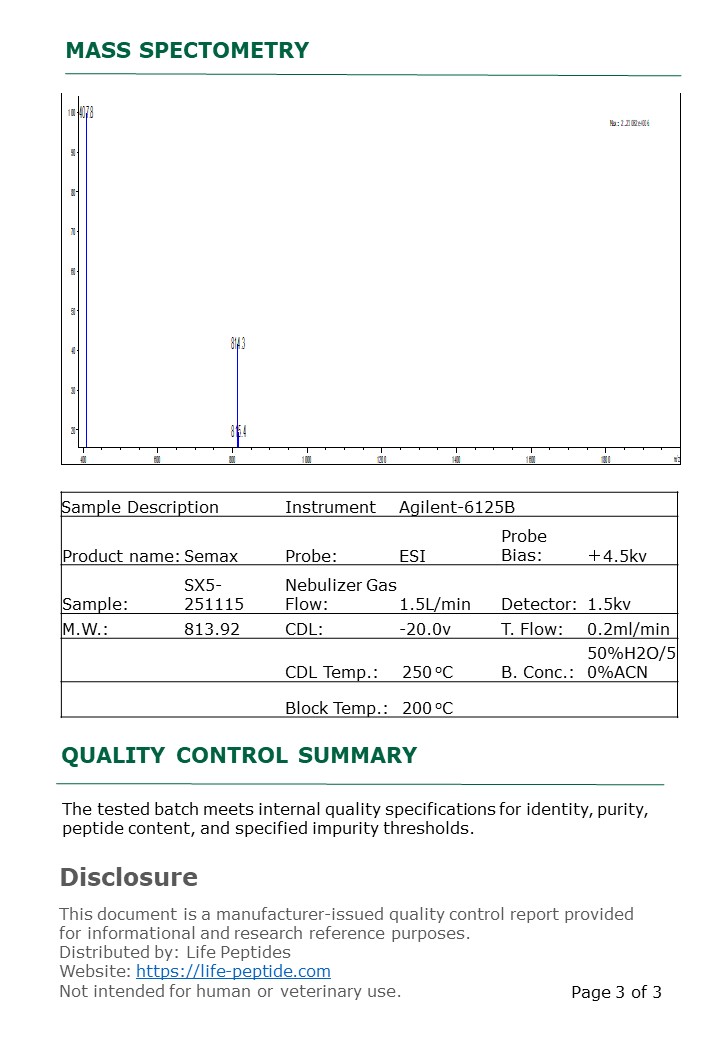
Each batch carefully lab tested after production (you can find Certificate of Analysis under product pictures).
Freeze-dried (lyophilized) for maximum stability and extended shelf life.
Sealed in sterile vials, ready for reconstitution.
Purity: ≥99% (HPLC-tested)
Appearance: Lyophilized white/off-white powder
Molecular formula: C37H51N9O10S1
Molecular weight: 813.92
Sequence: Met-Glu-His-Phe-Pro-Gly-Pro
Storage: unopened lyophilized vials are best stored refrigerated at 2–8°C, which is the storage method confirmed by our manufacturing partner and suitable for up to 24 months. Refrigeration is preferred because it minimizes unnecessary freeze–thaw cycles during routine handling. If substantially longer-term storage is required, unopened lyophilized vials may also be kept frozen. Once reconstituted, always store at 2–8°C and do not freeze.
Reconstitution and handling
Semax is supplied as a lyophilised vial and should be handled using standard peptide reconstitution procedures appropriate to the research setting. Must be reconstituted with bacteriostatic water or sterile saline before use. To help preserve structural integrity, add the chosen solvent slowly against the inside wall of the vial rather than directly onto the peptide cake, and avoid vigorous shaking. Gentle swirling is generally sufficient once the peptide has fully dissolved. Standard laboratory practice also includes allowing refrigerated vials to reach room temperature before reconstitution to minimise condensation inside the vial.
For other solvent selection, concentration planning and storage guidance, see the full Peptide Reconstitution Guide and Reconstitution Calculator.
Key published studies
- Dolotov OV, et al. Semax, an Analog of ACTH(4–10) with Cognitive Effects, Regulates BDNF and TrkB Expression in the Rat Hippocampus.Brain Research, 2006.
A landmark mechanistic study demonstrating increased BDNF expression and TrkB activation following Semax administration, providing one of the strongest experimental explanations for its effects on learning and neuroplasticity.
- Medvedeva EV, et al. The Peptide Semax Affects the Expression of Genes Related to the Immune and Nervous Systems Following Cerebral Ischaemia. BMC Genomics, 2014.
A key study investigating how Semax alters gene expression after cerebral ischaemia, supporting its role in neuroprotection and neuronal adaptation.
- Filippenkov IB, et al. Novel Insights into the Protective Properties of ACTH(4–7)PGP (Semax). Genes, 2020.
A comprehensive review summarising neuroprotective mechanisms, gene regulation, experimental stroke research and current understanding of Semax biology.
- Radchenko AI, et al. The Potential of the Peptide Drug Semax and Its Derivatives for Neurodegenerative Disorders. International Journal of Molecular Sciences, 2025.
A modern review discussing Semax in the context of neuroplasticity, BDNF signalling, cognitive function and future neuroscience research directions.
Frequently Asked Questions
What is Semax?
Semax is a synthetic heptapeptide derived from the ACTH(4–7) fragment and modified to improve stability without retaining hormonal activity. It is primarily investigated in cognitive neuroscience for learning, memory, neuroplasticity and neuroprotective signalling.
How does Semax differ from Selank?
Although both are cognitive research peptides, their primary areas of investigation differ. Semax is mainly studied for learning, memory, attention and neuroplasticity, while Selank is more closely associated with anxiety, stress regulation and emotional processing. They are often viewed as complementary rather than competing neuropeptides.
Why is Semax associated with BDNF?
Experimental studies have shown that Semax can increase the expression of brain-derived neurotrophic factor (BDNF) and related neurotrophic signalling pathways. Because BDNF plays a central role in neuronal survival, synaptic plasticity and learning, this mechanism has become one of the defining features of Semax research.
What research areas commonly investigate Semax?
Published research has investigated Semax in learning, memory, attention, neuroplasticity, BDNF signalling, stroke recovery research, neuroprotection and neuronal gene regulation. These areas form the core of the current Semax literature.
Can I buy Semax in Europe?
Yes. We ship Semax to most European countries using reliable courier services. Available shipping methods and delivery times are shown during checkout based on your destination.
Is Semax intended for human use?
No. Semax supplied by LIFE Peptide is provided strictly for laboratory and analytical research. It is not intended for human consumption, diagnosis, treatment or prevention of disease. Any discussion of published studies summarises the scientific literature relating to the Semax molecule rather than the intended use of this product.
Related research context
Semax belongs to the broader cognitive & neuroresearch peptide category, focusing on neuropeptide signaling and CNS regulatory pathway investigation.
Researchers exploring related neuroregulatory and neuroplasticity models may also examine:
Selank — anxiolytic and neuroregulatory peptide research
DSIP — stress and sleep research
For broader context, see the cognitive & neuroresearch category and peptide signaling research guides.
NOTE: This is for educational reference only and does not constitute medical advice.
Disclaimer:
This product is sold for research purposes only. It is not intended to diagnose, treat, cure, or prevent any disease. Buyer assumes full responsibility for proper handling and use.