

Description
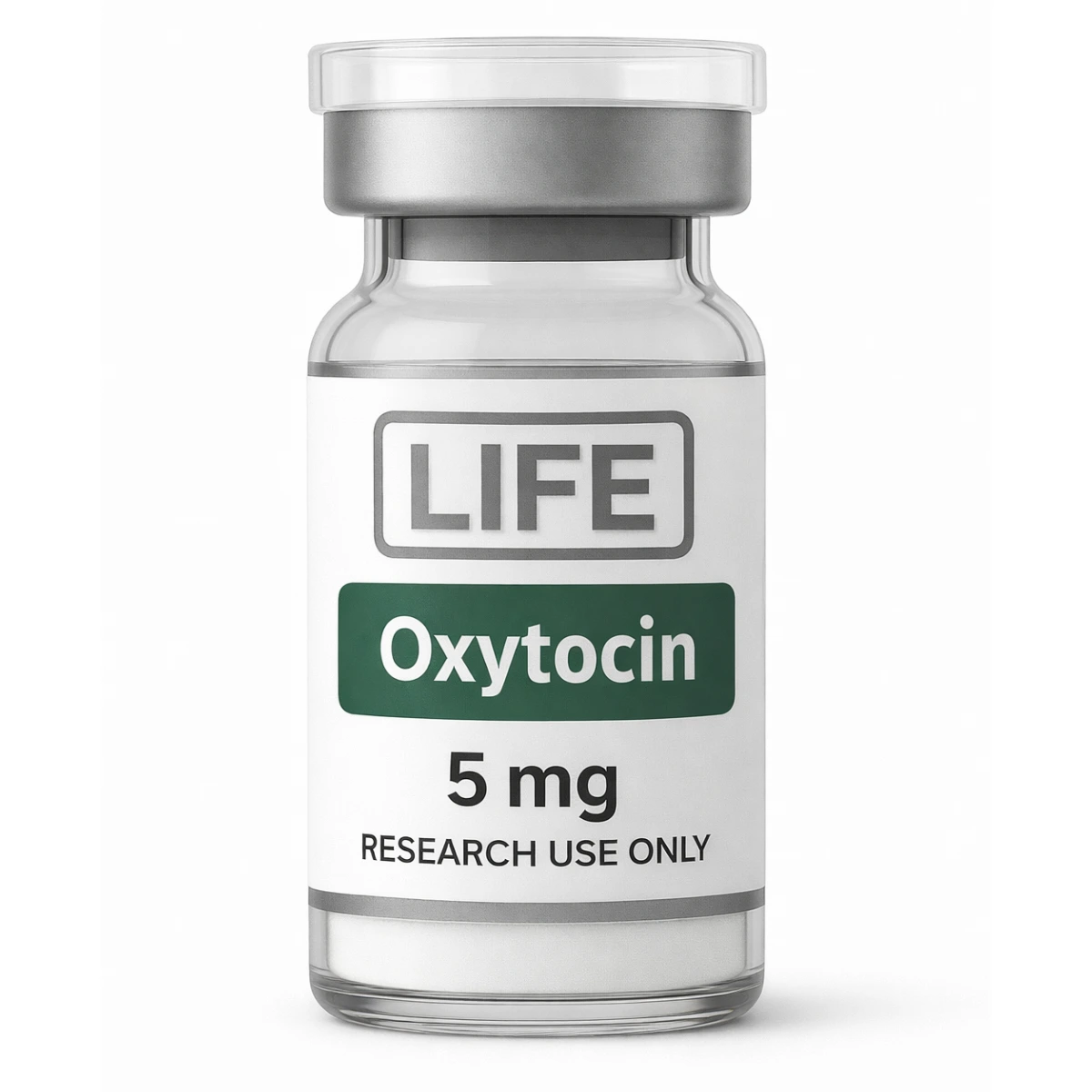
Oxytocin is a naturally occurring nine-amino-acid peptide hormone and neuropeptide produced in the hypothalamus and released by the posterior pituitary.
While it is widely recognised for its essential role in childbirth and lactation, modern research has shown that Oxytocin also plays a central role in social bonding, emotional processing, stress adaptation and interpersonal behaviour. Because of these diverse physiological functions, it has become one of the most extensively investigated neuropeptides in behavioural neuroscience and neuroendocrinology.
Looking to buy Oxytocin in Europe? LIFE Peptide supplies high-purity Oxytocin for laboratory research with reliable EU-wide shipping.
Why Oxytocin is widely investigated
Published research has investigated Oxytocin in relation to:
- social bonding
- trust and social cognition
- emotional processing
- stress regulation
- pair bonding
- parental behaviour
- social anxiety
- autonomic nervous system regulation
- neuroendocrine signalling
Unlike many neuropeptides, Oxytocin has been investigated across neuroscience, psychology, endocrinology and behavioural research, making it one of the best-characterised signalling molecules in social biology.
How Oxytocin works
Oxytocin acts through the oxytocin receptor (OXTR), which is widely distributed throughout both the brain and peripheral tissues.
Published research has explored its relationship with:
Social bonding
Oxytocin is one of the principal signalling molecules involved in social attachment, pair bonding and parental behaviour.
Emotional processing
Research has investigated how Oxytocin influences emotional recognition, facial expression processing and social communication.
Stress regulation
Oxytocin interacts with the body’s stress response systems and has been investigated for its influence on cortisol regulation and autonomic balance.
Neuroendocrine signalling
Studies continue to investigate how Oxytocin coordinates communication between the nervous system and endocrine system during both physiological and social challenges.
Why Oxytocin is important beyond social bonding
Although commonly referred to as the “bonding hormone”, modern research has shown that Oxytocin’s physiological role is considerably broader.
Published studies have investigated its involvement in:
- social learning
- emotional resilience
- stress adaptation
- pain perception
- maternal behaviour
- partner bonding
- autonomic regulation
Researchers now generally view Oxytocin as a peptide that modulates the importance of social information, rather than simply increasing trust or positive emotions. Its effects often depend on the surrounding environment and individual characteristics.
Human and preclinical research
Oxytocin has one of the largest human research programmes of any neuropeptide.
Clinical and experimental studies have investigated social cognition, emotional regulation, autism spectrum disorders, stress physiology, maternal behaviour, eating disorders and psychiatric conditions. Although many findings are promising, results remain variable across different populations and research settings, highlighting the complexity of Oxytocin biology.
Published safety observations
Published human studies have generally reported Oxytocin to be well tolerated under controlled research conditions. Reported adverse effects have included transient headache, nausea, flushing and nasal irritation in studies using intranasal administration. Researchers also emphasise that Oxytocin’s behavioural effects are highly context-dependent, meaning outcomes may differ according to social environment and individual characteristics.
Product characteristics
Application: laboratory and analytical research
Use restriction: not for human consumption; not for medical, veterinary or cosmetic use
Produced in GMP-compliant facilities under strict QC protocols.
Each batch carefully lab tested after production (you can find Certificate of Analysis under product pictures).
Freeze-dried (lyophilized) for maximum stability and extended shelf life.
Sealed in sterile vials, ready for reconstitution.
Purity: ≥99% (HPLC-tested)
Appearance: Lyophilized white/off-white powder
Molecular formula: C43H66N12O12S2
Molecular weight: 1007.2
Sequence: Cys-Tyr-Ile-Gln-Asn-Cys-Pro-Leu-Gly-NH2{Mono Disulfide bridge}
Storage: unopened lyophilized vials are best stored refrigerated at 2–8°C, which is the storage method confirmed by our manufacturing partner and suitable for up to 24 months. Refrigeration is preferred because it minimizes unnecessary freeze–thaw cycles during routine handling. If substantially longer-term storage is required, unopened lyophilized vials may also be kept frozen. Once reconstituted, always store at 2–8°C and do not freeze.
Reconstitution and handling
Oxytocin is supplied as a lyophilised vial and should be handled using standard peptide reconstitution procedures appropriate to the research setting. Must be reconstituted with bacteriostatic water or saline water before use. To help preserve structural integrity, add the chosen solvent slowly against the inside wall of the vial rather than directly onto the peptide cake, and avoid vigorous shaking. Gentle swirling is generally sufficient once the peptide has fully dissolved. Standard laboratory practice also includes allowing refrigerated vials to reach room temperature before reconstitution to minimise condensation inside the vial.
For other solvent selection, concentration planning and storage guidance, see the full Peptide Reconstitution Guide and Reconstitution Calculator.
Selected research references
- Lawson EA. Understanding Oxytocin in Human Physiology and Pathophysiology: A Path Towards Therapeutics, Comprehensive Physiology & Endocrinology, 2024
A comprehensive modern review covering Oxytocin physiology, receptor biology and therapeutic research.
- Uvnäs-Moberg K, et al. The Yin and Yang of the Oxytocin and Stress Systems, Frontiers in Endocrinology, 2024
A review examining the interaction between Oxytocin signalling, stress regulation and autonomic physiology.
- Wang Y, et al. Neuropeptides Affecting Social Behavior in Mammals: Oxytocin, Peptides, 2024
A modern review summarising Oxytocin’s role in social behaviour, bonding and neurobiology.
- Gimpl G, Fahrenholz F. The Oxytocin Receptor System: Structure, Function and Regulation, Physiological Reviews, 2001
A landmark review describing Oxytocin receptor biology and signalling mechanisms.
Frequently Asked Questions
What is Oxytocin?
Oxytocin is a naturally occurring peptide hormone and neuropeptide produced in the hypothalamus. It is widely investigated for social bonding, emotional processing, stress regulation and neuroendocrine signalling.
Why is Oxytocin called the bonding hormone?
Oxytocin is involved in pair bonding, parental behaviour and social attachment. However, modern research suggests its role is broader than simply promoting trust or affection. Instead, it appears to regulate how the brain processes socially relevant information.
What research areas commonly investigate Oxytocin?
Published studies investigate Oxytocin in social cognition, stress physiology, emotional regulation, pair bonding, maternal behaviour, autonomic nervous system function and behavioural neuroscience.
How does Oxytocin differ from PT-141?
Oxytocin primarily investigates social bonding and neuroendocrine signalling, whereas PT-141 primarily investigates melanocortin pathways involved in sexual desire and arousal. Although both influence aspects of human behaviour, they act through completely different biological systems.
How does Oxytocin differ from Kisspeptin-10?
Both are neuropeptides, but Kisspeptin-10 regulates reproductive hormone signalling through the HPG axis, whereas Oxytocin is primarily investigated for social behaviour, bonding and stress regulation.
Is Oxytocin only involved in childbirth?
No. Although Oxytocin is essential for labour and lactation, modern research has demonstrated important roles in social cognition, emotional regulation, stress physiology and autonomic nervous system function.
Can I buy Oxytocin in Europe?
Yes. We ship Oxytocin to most European countries using reliable courier services. Available shipping methods and delivery times are shown during checkout based on your destination.
Is this product intended for human use?
No. Oxytocin supplied by LIFE Peptide is provided strictly for laboratory and analytical research. It is not intended for human consumption, diagnosis, treatment or prevention of disease. Any discussion of published studies summarises the scientific literature relating to the Oxytocin molecule rather than the intended use of this product.
Related research context
Oxytocin is frequently discussed alongside other research peptides investigating social behaviour, emotional regulation, stress adaptation and neuroendocrine function.
Kisspeptin-10 – investigated primarily for reproductive hormone regulation and neuroendocrine control of the HPG axis.
PT-141 – studied for central melanocortin signalling related to sexual desire and arousal.
Selank – investigated in stress responses, anxiety-related behaviour and cognitive function.
Semax – focuses on cognition, neuroplasticity and neuroprotection.
DSIP – investigated in sleep physiology, stress adaptation and neuroendocrine regulation.
Although these peptides are sometimes discussed together, each investigates distinct neurobiological pathways and should not be considered interchangeable research compounds.
For broader context, browse the Cognitive рesearch пeptides category and related neuropeptide signaling guides.
NOTE: This is for educational reference only and does not constitute medical advice.
Disclaimer:
This product is sold for research purposes only. It is not intended to diagnose, treat, cure, or prevent any disease. Buyer assumes full responsibility for proper handling and use.