Description
Kisspeptin-10 is the shortest biologically active fragment of the endogenous kisspeptin peptide family and one of the most important signalling molecules in reproductive endocrinology.
Rather than acting directly on the testes or ovaries, Kisspeptin-10 stimulates the KISS1 receptor (GPR54) on hypothalamic neurons, initiating the release of gonadotropin-releasing hormone (GnRH). This activates the entire hypothalamic-pituitary-gonadal (HPG) axis, regulating luteinising hormone (LH), follicle-stimulating hormone (FSH) and downstream reproductive hormone production.
Because of this central role, Kisspeptin has become one of the most extensively investigated peptides in fertility research, reproductive endocrinology and neuroendocrine physiology.
Looking to buy Kisspeptin in Europe? LIFE Peptide supplies high-purity Kisspeptin for laboratory research with reliable EU-wide shipping.
Why Kisspeptin-10 matters in fertility research
Unlike compounds that directly replace hormones, Kisspeptin-10 works by activating the body’s natural reproductive hormone signalling pathway.
Published research has investigated Kisspeptin-10 in relation to:
- fertility research
- reproductive hormone regulation
- GnRH signalling
- LH and FSH secretion
- ovulation physiology
- male reproductive endocrinology
- female reproductive endocrinology
- puberty regulation
- hypothalamic-pituitary-gonadal (HPG) axis function
Because Kisspeptin sits at the top of the reproductive hormone cascade, it has become a cornerstone peptide in modern reproductive research.
How Kisspeptin-10 works
Unlike peptides that act directly on endocrine glands, Kisspeptin-10 functions through the KISS1 receptor, activating hypothalamic GnRH neurons.
Published research has explored its relationship with:
GnRH secretion
Kisspeptin is recognised as the primary physiological trigger for GnRH release and subsequent reproductive hormone signalling.
LH and FSH regulation
Activation of GnRH neurons leads to pulsatile secretion of luteinising hormone and follicle-stimulating hormone from the pituitary.
Puberty and reproductive maturation
Research has demonstrated that Kisspeptin signalling plays a central role in the onset of puberty and maintenance of reproductive function.
Neuroendocrine integration
Studies have investigated how Kisspeptin integrates nutritional status, metabolic signals and reproductive physiology within the hypothalamus.
Why Kisspeptin-10 is widely investigated in fertility research
Kisspeptin occupies a unique position because it regulates the reproductive hormone axis at its highest physiological level.
Published studies have explored:
- fertility
- assisted reproduction (IVF)
- reproductive hormone secretion
- ovulation induction
- fertility physiology
- male reproductive hormones
- female reproductive hormones
- hypothalamic amenorrhoea
- delayed puberty
- reproductive neuroendocrinology
More recently, researchers have also investigated the relationship between Kisspeptin signalling, sexual behaviour and emotional processing, expanding its role beyond classical reproductive endocrinology.
Human and preclinical research
Kisspeptin has one of the strongest human evidence bases among neuroendocrine peptides.
Clinical investigations have demonstrated predictable stimulation of reproductive hormones through physiological activation of the HPG axis, while more recent studies have examined its effects on neural processing related to attraction, emotional responses and sexual behaviour. Research continues to explore potential applications in reproductive disorders, infertility and neuroendocrine regulation.
How Kisspeptin-10 differs from other reproductive peptides
Kisspeptin-10
- Fertility and reproductive hormone regulation
- GnRH regulation
- HPG axis research
- Melanocortin receptor agonist
- Sexual arousal research
- Central nervous system signalling
- Social bonding
- Pair bonding
- Maternal behaviour
- Neuroendocrine signalling
Although these peptides are often discussed together, they regulate different aspects of reproductive biology. Kisspeptin primarily controls reproductive hormone signalling, while PT-141 influences sexual motivation, Oxytocin regulates social behaviour, and Melanotan II primarily affects pigmentation.
Published safety observations
Published human studies have generally reported Kisspeptin administration to be well tolerated within controlled research settings. Because it stimulates the physiological reproductive hormone cascade rather than directly replacing hormones, current investigations have focused on transient endocrine responses and neuroendocrine regulation. Ongoing research continues to evaluate its broader therapeutic potential.
Product characteristics
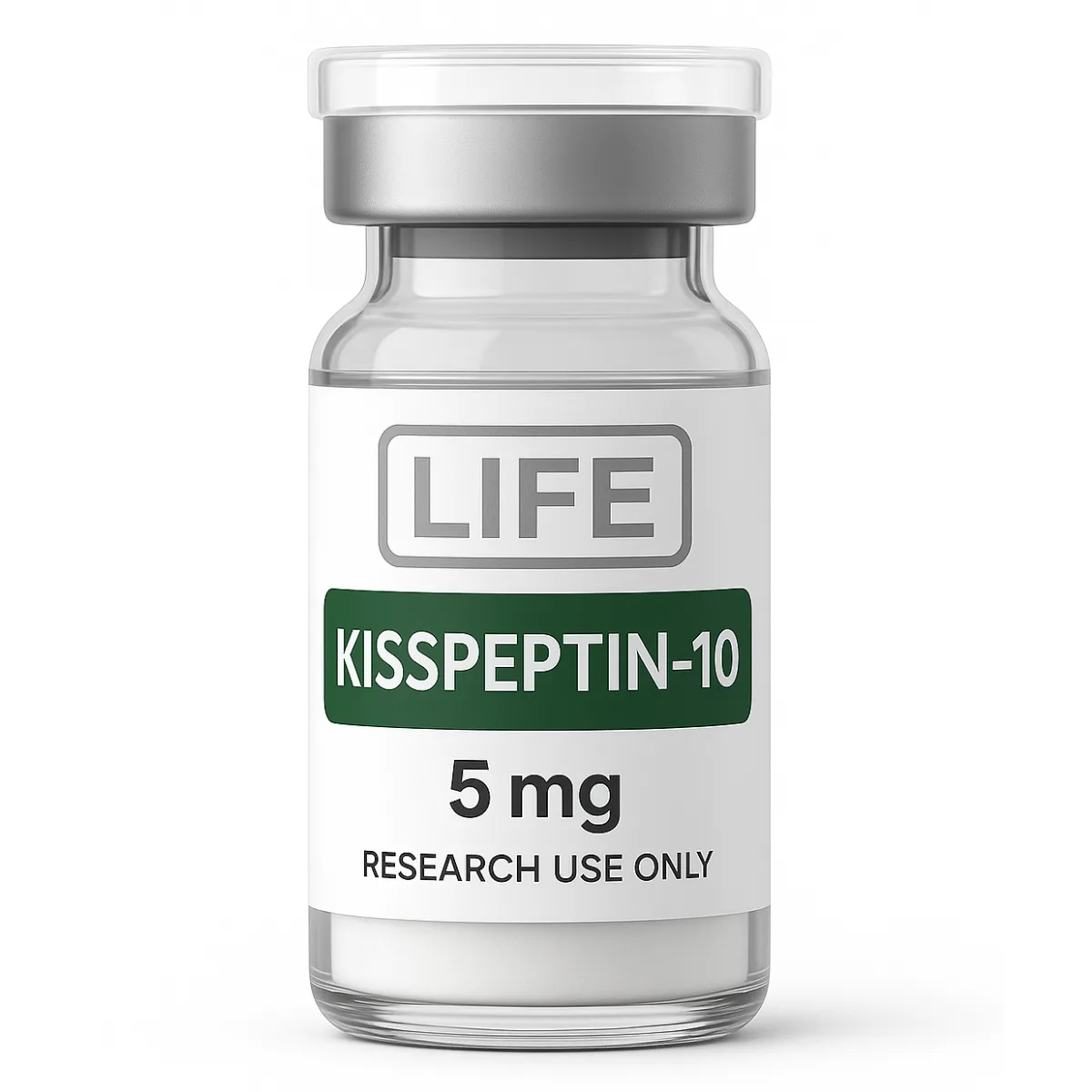
Application: laboratory and analytical research
Use restriction: not for human consumption; not for medical, veterinary or cosmetic use
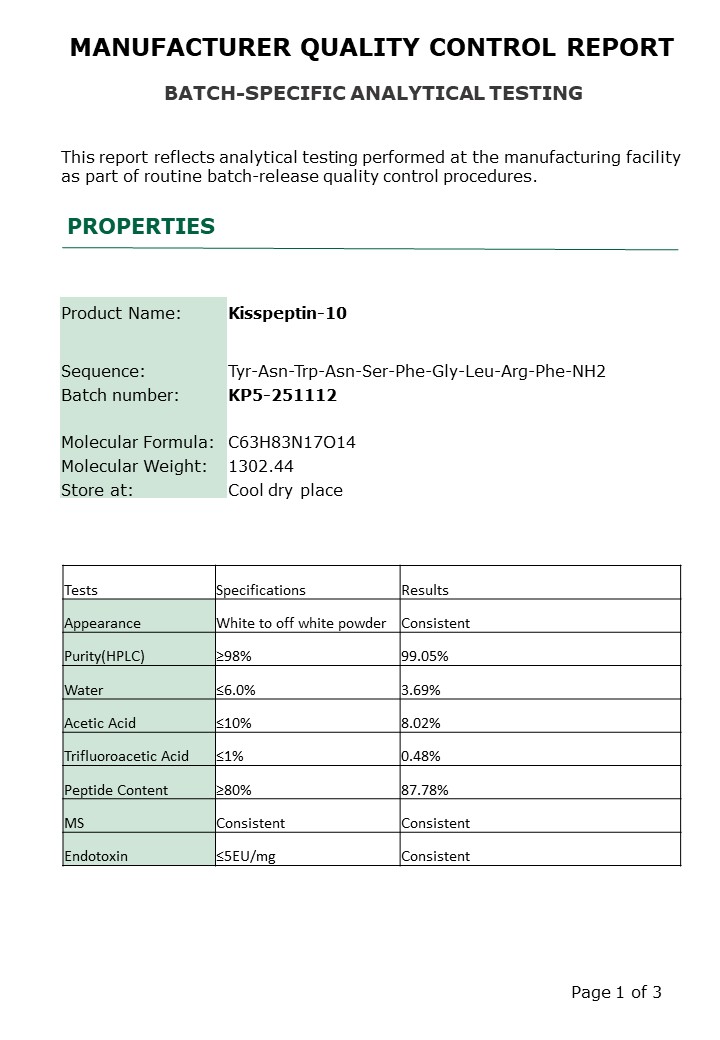
Produced in GMP-compliant facilities under strict QC protocols.
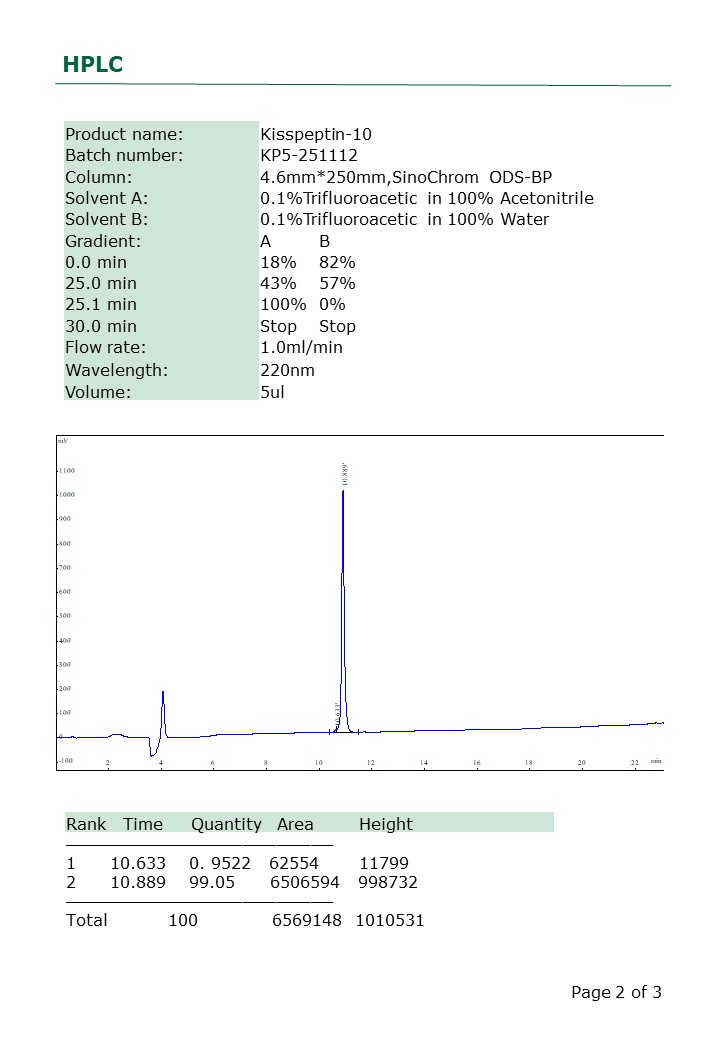
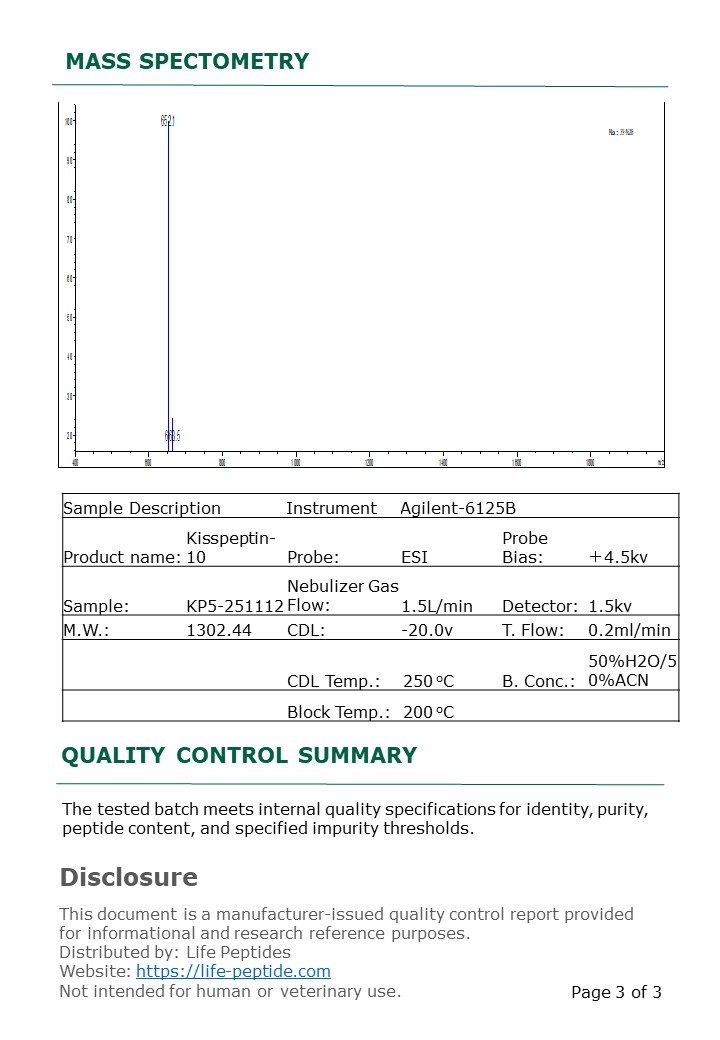
Each batch carefully lab tested after production (you can find Certificate of Analysis under product pictures).
Freeze-dried (lyophilized) for maximum stability and extended shelf life.
Sealed in sterile vials, ready for reconstitution.
Purity: ≥99% (HPLC-tested)
Appearance: Lyophilized white/off-white powder
Molecular formula: C63H83N17O14
Molecular weight: 1302.44
Sequence: Tyr-Asn-Trp-Asn-Ser-Phe-Gly-Leu-Arg-Phe-NH2
Storage: unopened lyophilized vials are best stored refrigerated at 2–8°C, which is the storage method confirmed by our manufacturing partner and suitable for up to 24 months. Refrigeration is preferred because it minimizes unnecessary freeze–thaw cycles during routine handling. If substantially longer-term storage is required, unopened lyophilized vials may also be kept frozen. Once reconstituted, always store at 2–8°C and do not freeze.
Reconstitution and handling
Kisspeptin is supplied as a lyophilised vial and should be handled using standard peptide reconstitution procedures appropriate to the research setting. Must be reconstituted with bacteriostatic water before use. To help preserve structural integrity, add the chosen solvent slowly against the inside wall of the vial rather than directly onto the peptide cake, and avoid vigorous shaking. Gentle swirling is generally sufficient once the peptide has fully dissolved. Standard laboratory practice also includes allowing refrigerated vials to reach room temperature before reconstitution to minimise condensation inside the vial.
For other solvent selection, concentration planning and storage guidance, see the full Peptide Reconstitution Guide and Reconstitution Calculator.
Key published studies
- Dhillo WS, Comninos AN, et al. Neuroendocrine Regulation of Reproductive Behavior and Emotional Control by Kisspeptin. Journal of Clinical Endocrinology & Metabolism, 2025.
A comprehensive review covering Kisspeptin’s role in reproductive endocrinology, emotional processing and sexual behaviour.
- Stoynev N, Kumanov P. Kisspeptin System – Physiology and Clinical Perspectives. Annales d’Endocrinologie, 2025.
A modern review of Kisspeptin physiology, reproductive endocrinology and emerging clinical applications.
- Chakraborty AP, Banerjee A. Kisspeptin Isoforms: Versatile Players in Reproduction and Beyond. Journal of Molecular Endocrinology, 2025.
A detailed review explaining Kisspeptin isoforms, receptor biology and regulation of the HPG axis.
- Comninos AN, et al. Kisspeptin Administration Stimulates Reproductive Hormones but Does Not Affect Anxiety in Humans. Journal of Clinical Endocrinology & Metabolism, 2025.
Human research examining endocrine responses and behavioural outcomes following Kisspeptin administration.
Frequently Asked Questions
What is Kisspeptin-10?
Kisspeptin-10 is the shortest biologically active fragment of the kisspeptin peptide family. It activates the KISS1 receptor (GPR54) and serves as the body’s natural trigger for GnRH release, making it one of the most important peptides in reproductive hormone research.
Why is Kisspeptin-10 important in fertility research?
Kisspeptin regulates the reproductive hormone cascade by stimulating GnRH secretion. This subsequently controls LH and FSH release, making Kisspeptin a central peptide in studies of fertility, ovulation and reproductive endocrinology.
How does Kisspeptin-10 differ from PT-141?
Although both peptides are investigated within reproductive research, they have different purposes. Kisspeptin-10 regulates reproductive hormone signalling through the HPG axis, whereas PT-141 primarily acts on melanocortin receptors involved in sexual desire and arousal.
Can Kisspeptin-10 influence testosterone or estrogen?
Kisspeptin does not directly stimulate testosterone or oestrogen production. Instead, it activates GnRH release, which subsequently regulates LH and FSH secretion and the downstream production of sex hormones through the body’s natural endocrine pathways.
What research areas commonly investigate Kisspeptin-10?
Published research includes fertility, reproductive hormone regulation, GnRH signalling, LH and FSH secretion, ovulation, puberty, reproductive endocrinology, hypothalamic amenorrhoea and neuroendocrine physiology.
Can Kisspeptin-10 influence brain function as well as reproductive hormones?
Yes. Recent studies have investigated the relationship between Kisspeptin signalling and emotional processing, attraction, mood and reproductive behaviour, expanding its research beyond classical reproductive endocrinology.
Can I buy Kisspeptin in Europe?
Yes. We ship Kisspeptin to most European countries using reliable courier services. Available shipping methods and delivery times are shown during checkout based on your destination.
Is this product intended for human use?
No. Kisspeptin-10 supplied by LIFE Peptide is provided strictly for laboratory and analytical research. It is not intended for human consumption, diagnosis, treatment or prevention of disease. Any discussion of published studies summarises the current scientific literature relating to the Kisspeptin-10 molecule rather than the intended use of this product.
Related research context
Kisspeptin-10 belongs to the broader neuroendocrine and peptide signaling research category, focusing on hypothalamic regulation and reproductive endocrine communication pathways.
Researchers exploring related neuroendocrine signaling models may also examine:
- PT-141 — melanocortin-mediated neuroendocrine signaling research
- Growth hormone secretagogues — hypothalamic and pituitary pathway interaction
- Cognitive & neuroresearch peptides — CNS peptide signaling models
NOTE: This is for educational reference only and does not constitute medical advice.
Disclaimer:
This product is sold for research purposes only. It is not intended to diagnose, treat, cure, or prevent any disease. Buyer assumes full responsibility for proper handling and use.