Descripción
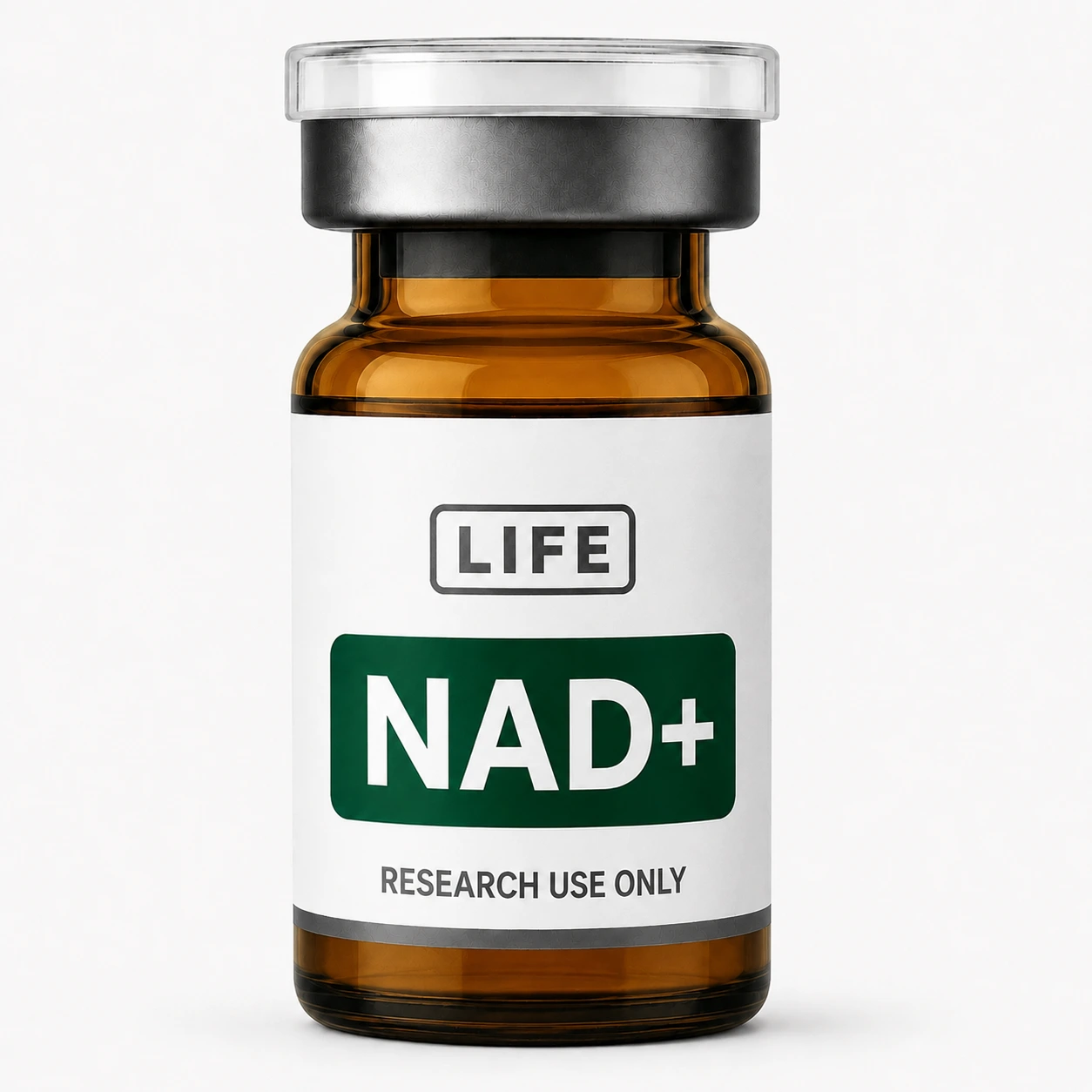
NAD+ (Nicotinamida Adenina Dinucleótido) es una coenzima natural que se encuentra en todas las células vivas. En lugar de actuar como un péptido señalizador o una hormona, el NAD+ funciona como un transportador de electrones esencial en cientos de reacciones metabólicas, desempeñando un papel central en Producción de ATP, función mitocondrial y reparación celular.
Debido a que los niveles de NAD+ disminuyen de forma natural con la edad y el estrés metabólico, se ha convertido en una de las moléculas más investigadas en la investigación sobre envejecimiento, metabolismo energético y biología mitocondrial.
¿Quieres comprar NAD+ en Europa? Life Peptide suministra NAD+ de alta pureza para investigación de laboratorio, con envíos fiables a toda la UE.
Por qué el NAD+ es ampliamente investigado
La investigación publicada ha investigado el NAD+ en relación con:
- producción de energía celular
- función mitocondrial
- envejecimiento saludable
- Reparación del ADN
- estrés oxidativo
- salud metabólica
- función cognitiva
- fisiología muscular
- biología de las sirtuinas
A diferencia de los péptidos mitocondriales, el NAD+ actúa como un cofactor metabólico fundamental requerido para la función celular normal en prácticamente todos los tejidos.
Cómo funciona el NAD+
Producción de energía celular
El NAD+ desempeña un papel central en la conversión de nutrientes en energía celular utilizable. Transfiere electrones durante la glucólisis, el ciclo del ácido cítrico y la fosforilación oxidativa, permitiendo que las mitocondrias generen ATP de manera eficiente.
Función mitocondrial
Las mitocondrias sanas dependen de una disponibilidad adecuada de NAD+ para respaldar el metabolismo energético normal. La investigación ha investigado cómo la disminución de los niveles de NAD+ influye en el rendimiento mitocondrial durante el envejecimiento y el estrés metabólico.
Reparación del ADN
NAD+ actúa como un sustrato esencial para las enzimas implicadas en la reparación del ADN, incluidas las PARP, que responden al daño en el ADN ayudando a mantener la estabilidad genómica.
Activación de sirtuinas
El NAD+ también es requerido por las sirtuinas, una familia de enzimas implicadas en las respuestas al estrés celular, el metabolismo y el envejecimiento saludable. Esta relación ha convertido al NAD+ en un foco central de la investigación sobre la longevidad.
Por qué el NAD+ es diferente de los péptidos mitocondriales
Aunque se discuten frecuentemente juntos, el NAD+, el SS-31 y el MOTS-c investigan diferentes aspectos de la biología mitocondrial.
NAD+ proporciona una coenzima esencial requerida para el metabolismo energético celular.
SS-31 investiga la integridad de la membrana mitocondrial y la producción de ATP.
MOTS-c estudia la señalización metabólica y las respuestas celulares adaptativas.
Juntos, estos representan áreas complementarias de la investigación sobre la energía celular en lugar de mecanismos competidores.
Investigación humana y preclínica
El NAD+ ha sido investigado exhaustivamente tanto en entornos de laboratorio como clínicos.
La investigación actual explora su papel en envejecimiento, trastornos metabólicos, neurodegeneración, fisiología cardiovascular y enfermedad mitocondrial. Mucho de este trabajo también se centra en estrategias para aumentar el NAD+ intracelular a través de precursores como el NMN y el ribósido de nicotinamida, lo que refleja la importancia de la homeostasis del NAD+ en la fisiología humana.
Aunque la importancia biológica del NAD+ está bien establecida, muchas aplicaciones terapéuticas siguen bajo investigación activa.
Observaciones de seguridad publicadas
Como coenzima celular de ocurrencia natural, el NAD+ ha sido objeto de una extensa investigación biológica.
Las investigaciones clínicas han informado en general de una tolerabilidad favorable en diversos diseños de estudios, aunque la investigación continúa evaluando los métodos de administración óptimos, la farmacocinética y las aplicaciones potenciales en enfermedades relacionadas con la edad.
Características del producto
Aplicación: investigación de laboratorio y análisis
Uso restringido: no apto para consumo humano; no apto para uso médico, veterinario o cosmético
Producido en instalaciones que cumplen con GMP bajo estrictos protocolos de control de calidad.
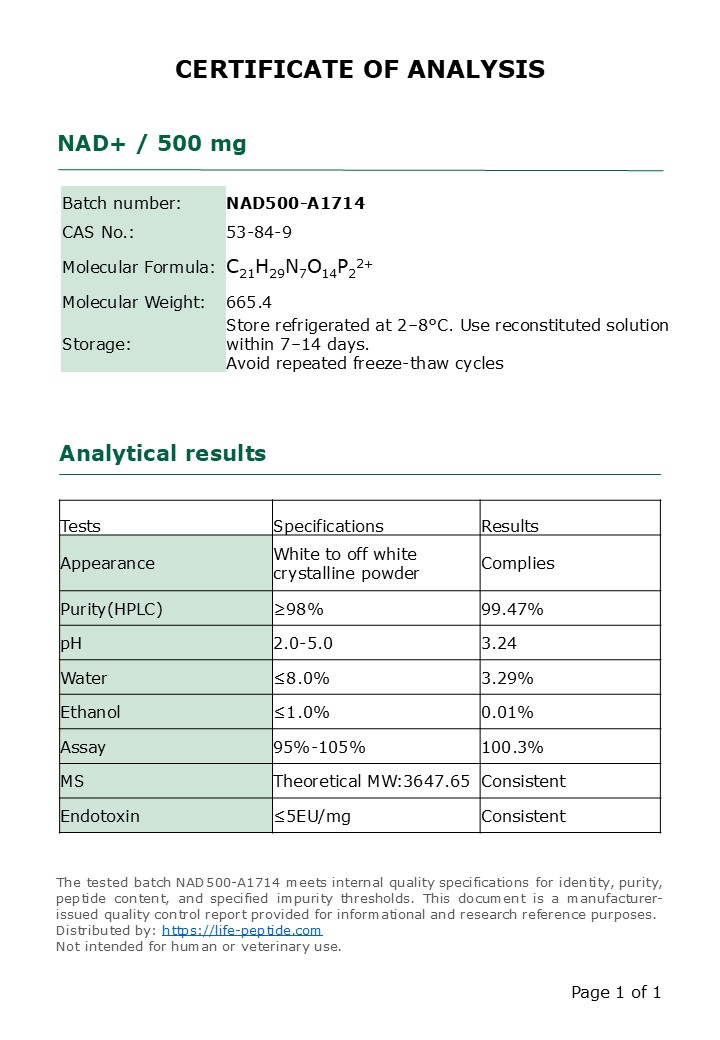
Cada lote se somete a pruebas de laboratorio exhaustivas después de la producción (puede encontrar el Certificado de Análisis debajo de las imágenes del producto).
Liofilizado (liofilizado) para máxima estabilidad y vida útil prolongada.
Sellado en viales estériles, listo para la reconstitución.
Pureza: ≥ 99,471 TP5T, analizada mediante HPLC
Apariencia: polvo blanco liofilizado
Fórmula molecular: C21H29N7O14P22+
Peso molecular: 665,4
Almacenamiento: los viales liofilizados sin abrir se almacenan mejor refrigerar a 2–8 °C, que es el método de almacenamiento confirmado por nuestro socio de fabricación y adecuado para hasta 24 meses. Se prefiere la refrigeración porque minimiza los ciclos innecesarios de congelación y descongelación durante la manipulación rutinaria. Si se requiere un almacenamiento a más largo plazo, los viales liofilizados sin abrir también pueden mantenerse congelados. Una vez reconstituidos, almacene siempre a 2–8 °C y no congele.
Reconstitución y manipulación
NAD+ se suministra en un vial liofilizado y debe manipularse utilizando los procedimientos estándar de reconstitución de péptidos apropiados para el entorno de investigación. Debe reconstituirse con agua bacteriostática antes de usar. Para ayudar a preservar la integridad estructural, agregue el disolvente elegido lentamente contra la pared interior del vial en lugar de directamente sobre el péptido en polvo, y evite agitar vigorosamente. La agitación suave suele ser suficiente una vez que el péptido se ha disuelto por completo. La práctica estándar de laboratorio también incluye permitir que los viales refrigerados alcancen la temperatura ambiente antes de la reconstitución para minimizar la condensación dentro del vial.
Para otras guías sobre selección de solventes, planificación de concentraciones y almacenamiento, consulte el completo Guía de Reconstitución de Péptidos y Calculadora de Reconstitución.
Referencias de investigación seleccionadas
- Covarrubias AJ, Perrone R, Grozio A, Verdin E. Metabolismo del NAD+ y sus funciones en los procesos celulares durante el envejecimiento, Nature Reviews Molecular Cell Biology, 2021.
Una revisión exhaustiva de la biología del NAD+, el envejecimiento, el metabolismo y la función mitocondrial.
- Yoshino J, Baur JA, Imai SI. Intermedios de NAD+: la biología y el potencial terapéutico del NMN y la nicotinamida ribósido, Cell Metabolism, 2018.
Una revisión fundamental que resume el metabolismo del NAD+ y las estrategias para restaurar el NAD+ intracelular.
- Rajman L, Chwalek K, Sinclair DA. Potencial terapéutico de las moléculas que potencian el NAD+, Nature Reviews Drug Discovery, 2018.
Una visión general detallada de la biología del NAD+ y la investigación terapéutica actual.
Preguntas Frecuentes
¿Qué es el NAD+?
NAD+ (Nicotinamida Adenina Dinucleótido) es una coenzima natural esencial para la producción de energía celular, la función mitocondrial y la reparación del ADN.
¿Es el NAD+ un péptido?
No. El NAD+ no es un péptido. Es una coenzima natural que se encuentra en todas las células vivas y desempeña un papel central en el metabolismo energético.
¿Por qué es importante el NAD+ para las mitocondrias?
El NAD+ actúa como transportador de electrones durante la respiración celular, lo que permite a las mitocondrias producir ATP de manera eficiente y mantener un metabolismo energético normal.
¿En qué se diferencia el NAD+ del MOTS-c?
Aunque ambos investigan la biología mitocondrial, el NAD+ funciona como una coenzima metabólica esencial, mientras que el MOTS-c actúa como un péptido de señalización mitocondrial que regula el metabolismo celular.
¿En qué se diferencia el NAD+ del SS-31?
SS-31 investiga la integridad estructural de las mitocondrias dirigiéndose a la membrana mitocondrial interna, mientras que el NAD+ actúa como una coenzima fundamental necesaria para la producción de energía celular.
¿Puedo comprar NAD+ en Europa?
Sí. Realizamos envíos de NAD+ a la mayoría de los países europeos utilizando servicios de mensajería confiables. Los métodos de envío disponibles y los plazos de entrega se muestran durante el proceso de pago según su destino.
¿Está este producto destinado al uso humano?
No. El NAD+ suministrado por Life Peptide está destinado exclusivamente a la investigación de laboratorio y analítica. No está destinado al consumo humano, ni al diagnóstico, tratamiento o prevención de enfermedades.
Contexto de investigación relacionado
El NAD+ se analiza con frecuencia junto con otros compuestos de investigación que investigan la energía celular, la biología mitocondrial y el envejecimiento saludable, aunque cada uno se dirige a mecanismos biológicos distintos.
SS-31 (Elamipretide): investigado para la reparación mitocondrial y la producción de energía celular.
MOTS-c – estudiado para la señalización metabólica y la adaptación al ejercicio.
Epitalón – investigado para la investigación de la biología de los telómeros y el envejecimiento saludable.
GHK-Cu – estudiado para la regeneración tisular y la reparación celular.
CJC-1295 con DAC – investigado por señalización sostenida de GH e IGF-1.
NOTA: Esto es solo para fines de referencia educativa y no constituye asesoramiento médico.
Descargo de responsabilidad
Este producto se vende únicamente para fines de investigación. No está destinado a diagnosticar, tratar, curar ni prevenir ninguna enfermedad. El comprador asume toda la responsabilidad por su manipulación y uso adecuados.