Περιγραφή
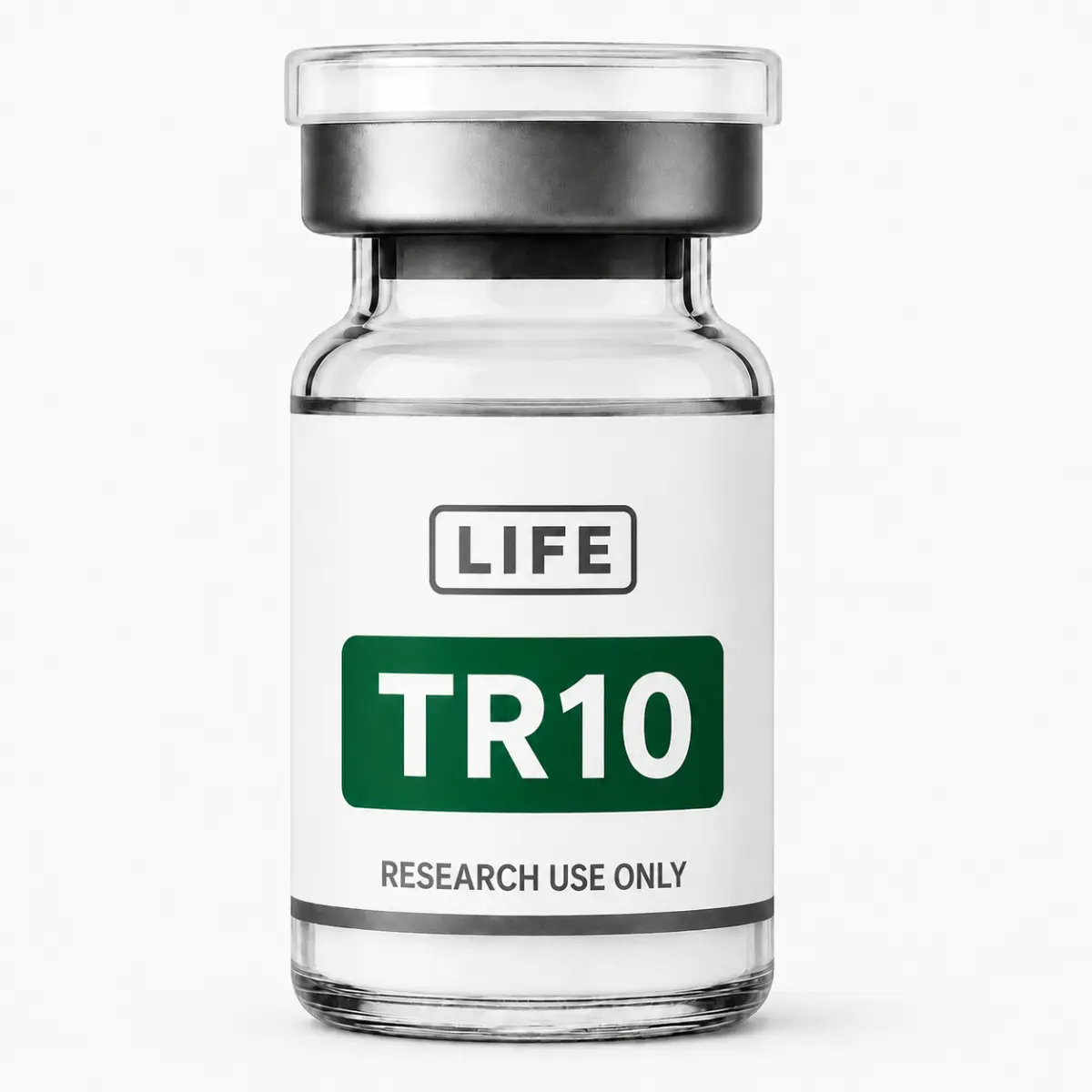
Τιρζεπατίδη 10 mg in Europe | Θέλετε να αγοράσετε Tirzepatide στην Ευρώπη; Η Life Peptide προμηθεύει Tirzepatide υψηλής καθαρότητας για εργαστηριακή έρευνα, με αξιόπιστη αποστολή σε όλη την ΕΕ.
Available in two formats
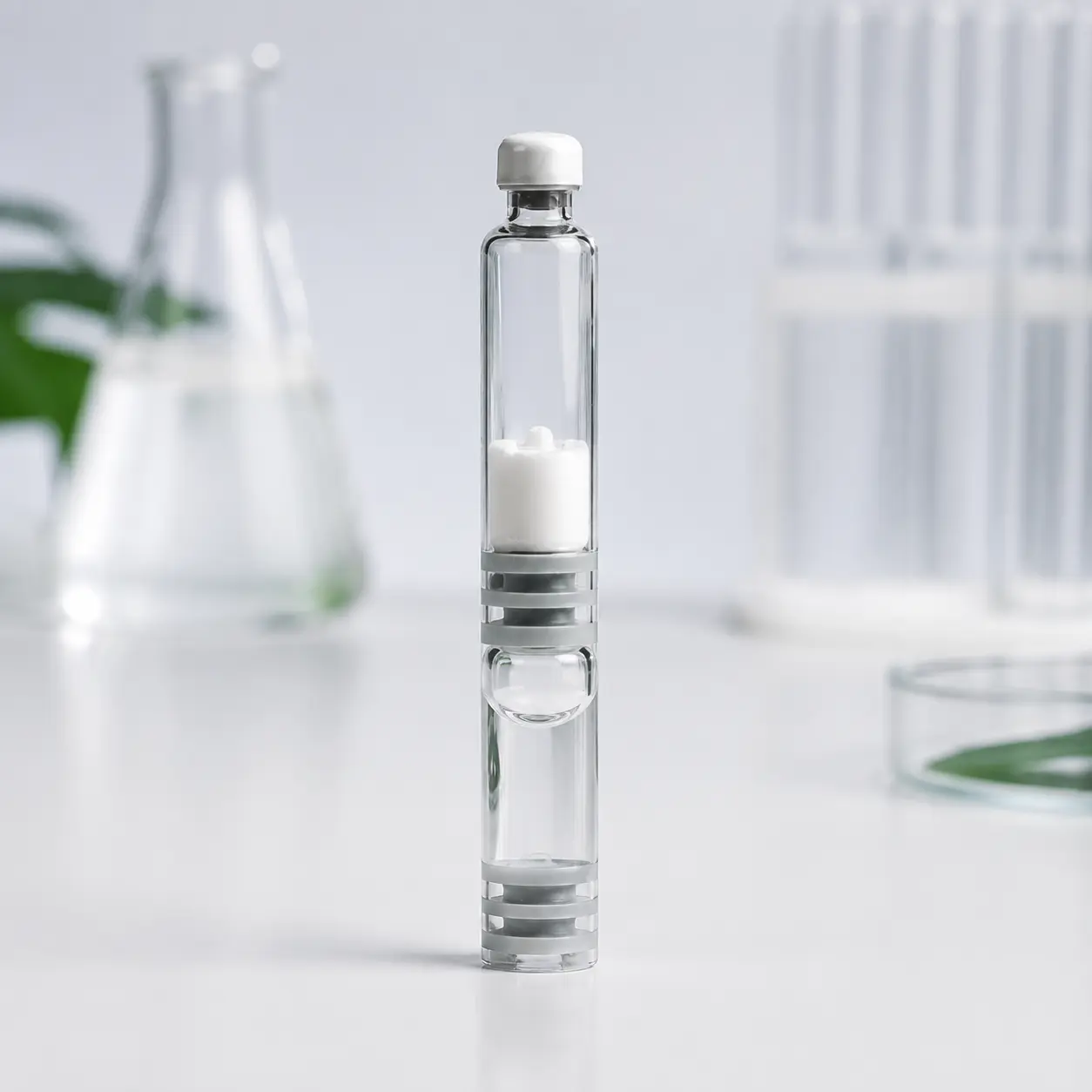
Choose between a conventional lyophilized vial and a dual-chamber cartridge.
The cartridge keeps Tirzepatide and its diluent in separate chambers until activation. This avoids transporting the peptide as a premixed solution and simplifies laboratory preparation by removing the separate liquid-transfer step. Final dual-chamber cartridge concentration: 10 mg in 1 mL. A compatible reusable device is required.
Η τιρζεπατίδη είναι ένας διπλός αγωνιστής ινκριτινών ερευνητικού βαθμού που παρέχεται σε λυοφιλοποιημένη μορφή για εργαστηριακή χρήση. Δρά επί τόσο οι υποδοχείς GLP-1 όσο και GIP και έχει γίνει μια κεντρική ένωση αναφοράς στη μεταβολική έρευνα, ειδικά σε μοντέλα της ρύθμιση της όρεξης, μεταβολή του σωματικού βάρους, γλυκαιμικός έλεγχος και σηματοδότηση της ινκριτίνης.
Η τιρζεπατίδη ανήκει σε μια νεότερη κατηγορία ερευνητικών μεταβολικών πεπτιδίων που έχουν σχεδιαστεί για να ενεργοποιούν περισσότερες από μία οδούς ινκριτινών ταυτόχρονα, παρά στοχεύοντας μόνο στο GLP-1. Αυτό το προφίλ διπλού υποδοχέα το καθιστά ιδιαίτερα σχετικό σε έρευνα που επικεντρώνεται στην παχυσαρκία, την ομοιοστασία της γλυκόζης, τη σηματοδότηση της ινσulinης, το ενεργειακό ισοζύγιο και τα μεταβολικά θεραπεuta επόμενης γενιάς. Η τιρζεπατίδη παρέχεται ως λυofilizμένο φιαλίδιο μόνο για εργαστηριακή και αναλυτική χρήση.
Τι είναι η τριζεπατίδη;
Η τιρζεπατίδη είναι υπό έρευνα αγωνιστής υποδοχέα διπλής ινκρετίνης σχεδιασμένο για να ενεργοποιεί δύο βασικά συστήματα υποδοχέων που εμπλέκονται στη μεταβολική ρύθμιση:
- Υποδοχέας GLP-1
- Υποδοχέας GIP
Αυτό το προφίλ υποδοχέων τοποθετεί την Τιρζεπατίδη ανάμεσα Semaglutide και Ρετατρουτίδη σε μηχανιστικό εύρος. Η σεμαγλουτίδη στοχεύει πρωτίστως μόνο στο GLP-1, ενώ η ρετατρουτίδη επεκτείνεται πέρα από το GLP-1/GIP σε αγωνισμός υποδοχέα γλυκαγόνης. Η τιρζεπατίδη καταλαμβάνει τη μέση οδό: ευρύτερη από τα κλασικά ανάλογα GLP-1, αλλά πιο εκλεκτική από τους τριπλούς αγωνιστές.
Λόγω αυτής της τοποθέτησης, η Τιρζεπατίδη έχει γίνει μία από τις πιο σημαντικές ενώσεις αναφοράς στη σύγχρονη μεταβολική έρευνα. Χρησιμοποιείται ευρέως ως σημείο σύγκρισης σε μελέτες που εξετάζουν στρατηγικές ινκρετινών μονού, διπλού και τριπλού υποδοχέα. Η Lilly και η αξιολογημένη από ομοτίμους κλινική βιβλιογραφία περιγράφουν σταθερά την Τιρζεπατίδη ως εβδομαδιαίος διπλός αγωνιστής υποδοχέων GIP/GLP-1 με ισχυρές επιδράσεις στα επίπεδα γλυκόζης και στο σωματικό βάρος σε μελέτες σε ανθρώπους.
Γιατί η Τιρζεπατίδη έχει σημασία στη μεταβολική έρευνα
Η τιρζεπατίδη είναι σημανφαντική επειδή συνδυάζει τη σηματοδότηση GLP-1 με τη δραστηριότητα του υποδοχέα GIP, δημιουργώντας ένα ευρύτερο προφίλ ινκριτινών από τους αγωνιστές GLP-1 μόνοι τους, παραμένοντας παράλληλα πιο εστιασμένη από τους τριπλούς αγωνιστές όπως η ρετατρουτίδη.
Στη βιβλιογραφία, η Τιρζεπατίδη έχει μελετηθεί σε σχέση με:
- ρύθμιση σωματικού βάρους και σηματοδότηση όρεξης
- μεταβολισμός γλυκόζης και γλυκαιμικοί δείκτες
- σηματοδότηση της ινσulίνης και διαχείριση θρεπτικών συστατικών
- ενεργειακό ισοζύγιο και συστηματική μεταβολική ρύθμιση
- συγκριτική έρευνα ινκριτινών σε μοντέλα GLP-1, διπλών αγωνιστών και τριπλών αγωνιστών
Για τους ερευνητές που κατασκευάζουν ένα μεταβολικό πάνελ πεπτιδίων, η Τιρζεπατίδη χρησιμεύει συχνά ως το κεντρικό μόριο σύγκρισης μεταξύ της Σεμαγлуτίδης και της Ρετατρουτίδης. Είναι ένα από τα πιο σαφή παραδείγματα του πώς η επέκταση από έναν αγωνιστή GLP-1 μονού μονοπατιού σε έναν διπλό αγωνιστή ινκριτινών μπορεί να αλλάξει το μεταβολικό προφίλ υπό εξέταση. Η τρέχουσα σελίδα σας δείχνει ήδη προς αυτή την κατεύθυνση· η διαφορά εδώ είναι ότι καθιστούμε τη λογική σύγκρισης και την επιφάνεια αναζήτησης πολύ πιο ρητή.
Πώς λειτουργεί η τιρζεπατίδη
Η τιρζεπατίδη έχει σχεδιαστεί για να ενεργοποιεί δύο συστήματα υποδοχέων που εμπλέκονται στον μεταβολικό έλεγχο.
Δραστηριότητα υποδοχέα GLP-1
Η σηματοδότηση GLP-1 συνδέεται με μείωση της όρεξης, καθυστέρηση της γαστρικής κένωσης και ινσουλινοεξαρτώμενη υποστήριξη της ινσουλίνης. Αυτή είναι η οδός που γνωρίζουν ήδη οι περισσότεροι ερευνητές από ενώσεις όπως η Σεμαγλουτίδη.
Δραστηριότητα του υποδοχέα GIP
Η σηματοδότηση του GIP θεωρείται ότι επηρεάζει την έκκριση ινσulins, τη διαχείριση των θρεπτικών συστατικών, τον μεταβολισμό του λιpώδους ιστού και τη συνολική ινκρετινική απόκριση στην πρόσληψη τροφής. Στην έρευνα διπλών αγωνιστών, η δράση του GIP είναι ένας από τους κύριους λόγους για τους οποίους η Τιρζεπατίδη είναι μηχανistisch ευρύτερη από τις ενώσεις που βασίζονται μόνο στο GLP-1.
Διπλό προφίλ ινκριτινών
Ο συνδυασμός της δράσης των GLP-1 και GIP προσδίδει στην Τιρζεπατίδη ένα διαφορετικό μεταβολικό προφίλ τόσο από τη Σεμαγλουτίδη όσο και από τη Ρετατρουτίδη. Σε σύγκριση με τη Σεμαγλουτίδη, διευρύνει το εύρος σηματοδότησης πέραν του GLP-1 και μόνο. Σε σύγκριση με τη Ρετατρουτίδη, παραμένει πιο εκλεκτική επειδή δεν περιλαμβάνει αγωνισμό του υποδοχέα γλυκαγόνης.
Αυτό καθιστά την Τιρζεπατίδη ιδιαίτερα χρήσιμη σε έρευνα που επικεντρώνεται σε:
- Σγκρίσεις GLP-1 και διπλών αγωνιστών
- αποτελέσματα σωματικού βάρους και όρεξης
- ομοιοστασία της γλυκόζης και δυναμική της ινσουλίνης
- η μετάβαση από τη διαμόρφωση ινκριτίνης μονού μονοπατιού σε πολυμονοπάτι
Δημοσιευμένα κλινικά ευρήματα για την Τιρζεπατίδη
Η τιρζεπατίδη έχει γίνει ένα από τα πιο στενά παρακολουθούμενα μεταβολικά πεπτίδια επειδή δημοσιευμένες μελέτες σε ανθρώπους έχουν αναφέρει ουσιώδεις επιδράσεις στο σωματικό βάρος, στον γλυκαιμικό έλεγχο και σε ευρύτερους καρδιομεταβολικούς δείκτες. Στη μελέτη SURMOUNT-1 που δημοσιεύτηκε στο Νιου Ίνγκλαντ Τζέρναλ οφ Μέντιν, η χορηγούμενη μία φορά την εβδομάδα Τιρζεπατίδη παρήγαγε εξαρτώμενες από τη δόση μειώσεις του σωματικού βάρους πάνω από 72 εβδομάδες σε ενήλικες με παχυσαρκία ή υπέρβαρο, με τον βραχίονα της υψηλότερης δόσης να παρουσιάζει μερικά από τα ισχυρότερα αποτελέσματα απώλειας βάρους που είχαν αναφερθεί μέχρι τότε για θεραπεία με βάση την κρετίνη.
Η τιρζεπατίδη έχει επίσης δείξει ισχυρά γλυκαιμικά αποτελέσματα σε έρευνες για τον διαβήτη τύπου 2. Στη μελέτη SURPASS-2, η τιρζεπατίδη συγκρίθηκε άμεσα με τη σεμαγλουτίδη χορηγούμενη μία φορά την εβδομάδα και απέδειξε μεγαλύτερη μείωση της HbA1c και μεγαλύτερη μείωση σωματικού βάρους σε όλα τα υπό μελέτη σκέλη δοσολογίας. Επιπλέον μελέτες SURPASS έχουν καθιερώσει περαιτέρω την Τιρζεπατίδη ως έναν από τους βασικούς διπλούς αγωνιστές στη σύγχρονη μεταβολική βιβλιογραφία. Η τρέχουσα σελίδα σας παραθέτει ήδη τις πιο σημαντικές κλινικές δοκιμές — SURMOUNT-1, SURPASS-2 και σχετικές εργασίες για τον διαβήτη — η οποία είναι ακριβώς η σωστή βάση τεκμηρίων για αυτήν την ενότητα.
Λαμβανόμενες υπόψη συνολικά, αυτές οι δοκιμές είναι ο κύριος λόγος για τον οποίο η Τιρζεπατίδη χρησιμοποιείται τόσο συχνά ως σημείο αναφοράς στη σύγχρονη έρευνα για την παχυσαρκία και τον διαβήτη. Βρίσκεται στο επίκεντρο της σύγκρισης μεταξύ αγωνιστές GLP-1, διπλοί αγωνιστές GLP-1/GIP και νεότερος τριπλός αγωνιστής προσεγγίσεις.
| Μελέτη | Πληθυσμός | Διάρκεια | Κύρια δημοσιευμένα ευρήματα |
|---|---|---|---|
| SURMOUNT-1 | Ενήλικες με παχυσαρκία ή υπέρβαροι χωρίς διαβήτη | 72 εβδομάδες | Η μέση μεταβολή του σωματικού βάρους ήταν −15,0%, −19,5% και −20,9% με 5, 10 και 15 mg τιρζεπατίδης, αντίστοιχα, σε σύγκριση με −3,1% με εικονικό φάρμακο. |
| SURPASS-2 | Ενήλικες με διαβήτη τύπου 2 | 40 εβδομάδες | Η HbA1c μειώθηκε κατά −2,01%, −2,24% και −2,30% με τιρζεπατίδη 5, 10 και 15 mg, έναντι −1,86% με σεμαγλουτίδη 1 mg. Η τιρζεπατίδη οδήγησε επίσης σε μεγαλύτερη μέση μείωση του σωματικού βάρους και στις τρεις ομάδες δόσης. |
| SURPASS-3 | Ενήλικες με σακχαρώδη διαβήτη τύπου 2 που δεν ρυθμίζονται επαρκώς με από στόματος θεραπεία | 52 εβδομάδες | Η τιρζεπατίδη επέφερε μεγαλύτερες μειώσεις στη HbA1c και στο σωματικό βάρος σε σύγκριση με την ινσουλίνη degludec σε όλες τις ομάδες δόσεων που μελετήθηκαν. |
| πρόγραμμα SURPASS | Ενήλικες με σακχαρώδη διαβήτη τύπου 2 σε πολλές κλινικές μελέτες Φάσης 3 | 40–104 εβδομάδες | Το ευρύτερο πρόγραμμα απέδωσε συνεπείς δοσοεξαρτώμενες επιδράσεις στον γλυκαιμικό έλεγχο και το σωματικό βάρος σε διαφορετικές θεραπείες σύγκρισης και πληθυσμούς ασθενών. |
ΣημαντικόΤα αποτελέσματα που εμφανίζονται παραπάνω συνοψίζουν δημοσιευμένες κλινικές μελέτες του φαρμακευτικού τιρζεπατίδη και παρέχονται αποκλειστικά ως ερευνητικό πλαίσιο. Δεν πρέπει να ερμηνεύονται ως αναμενόμενα αποτελέσματα από αυτό το ερευνητικό προϊόν.
Δημοσιευμένα δεδομένα ασφάλειας και ανεκτικότητας
Οι δημοσιευμένες κ临床εινικές μελέτες για την Τιρζεπατίδη δείχνουν ότι οι πιο συχνά αναφερόμενες ανεπιθύμητες ενέργειες είναι γαστρεντερικές, ειδικά ναυτία, διάρροια, μειωμένη όρεξη, έμετος και δυσκοιλιότητα. Όπως και με άλλους παράγοντες που βασίζονται στην ινκρετίνη, αυτά τα συμβάντα ήταν γενικά πιο συχνά από ό,τι με το εικonικό φάρμακο και ήταν συχνά δοσοεξαρτώμενος, ιδιαίτερα κατά τη φάση αύξησης της δόσης της θεραπείας.
Σε όλα τα κύρια κλινικά προγράμματα, τα περισσότερα γαστρεντερικά συμβάντα περιγράφηκαν ως ήπια έως μέτρια σε σοβαρότητα και τα ποσοστά διακοπής εξακολουθούσαν να αποτελούν σημαντικό μέρος του τρόπου με τον οποίο αξιολογούνταν το συνολικό προφίλ της Τιρζεπατίδης. Αυτός είναι ένας από τους λόγους για τους οποίους η δημοσιευμένη έρευνα για την Τιρζεπατίδης συζητείται συνήθως όχι μόνο όσον αφορά την αποτελεσματικότητα, αλλά και όσον αφορά ανοχή κατά την κλιμάκωση, η επιβάρυνση από γαστρεντερικά συμβάντα και η ισορροπία μεταξύ μεταβολικού οφέλους και κινδύνου διακοπής της θεραπείας.
Αυτή η ενότητα συνοψίζει δημοσιευμένα ευρήματα σχετικά με την υπό έρευνα και την κλινική έρευνα της Τιρζεπατίδης, όχι οδηγίες ή προσδοκίες για τη χρήση αυτού του προϊόντος.
Δημοσιευμένα σχήματα δοσολογίας που χρησιμοποιούνται στην έρευνα της Τιρζεπατίδης
Οι δημοσιευμένες μελέτες για την τιρζεπατίδη γενικά χρησιμοποίησαν εβδομαδιαία χορήγηση με σταδιακή κλιμάκωση της δόσης αν να ξεκινήσει κανείς αμέσως με την τελική δόση-στόχο. Στις μεγάλες κλινικές μελέτες για την παχυσαρκία και τον διαβήτη, η Τιρζεπατίδη μελετήθηκε συνήθως σε δόσεις συντήρησης 5 mg, 10 mg και 15 mg, με σταδιακή αύξηση από μια χαμηλότερη αρχική δόση σε διάστημα εβδομάδων για τη βελτίωση της ανοχής. Ο τρέχων κατάλογος αναφορών σας υποδεικνύει ήδη τις βασικές μελέτες που καθιέρωσαν αυτή τη δομή.
Σε πρακτικό επίπεδο, ο δημοσιευμένος σχεδιασμός έρευνας για την Τιρζεπατίδη είναι σημαντικός επειδή δείχνει ότι Η αποτελεσματικότητα και η ανεκτικότητα μελετήθηκαν μαζί. Οι ερευνητές δεν δοκίμασαν απλώς “μία δόση Τιρζεπατίδης”· δοκίμασαν στρατηγικές σταδιακής κλιμάκωσης που οδηγούσαν σε διαφορετικές δόσεις συντήρησης. Αυτός είναι ένας από τους λόγους για τους οποίους η Τιρζεπατίδη παραμένει μια τόσο χρήσιμη συγκριτική ένωση στην έρευνα μεταβολικών πεπτιδίων.
Παράδειγμα της δομής της δόσης συντήρησης που χρησιμοποιείται συνήθως σε μεγάλες κλινικές μελέτες
| Πλαίσιο δημοisιευμένης μελέτης | Αρχική προσέγγιση δοσολογίας στη μελέτη | Μελέτες σκelών δόσης συντήρησης | Συχνότητα | Διάρκεια |
|---|---|---|---|---|
| Κλινικές μελέτες για την παχυσαρκία / διαβήτη | σταδιακή κλιμάκωση από χαμηλότερη αρχική δόση | 5 mg | μία φορά την εβδομάδα | ποικίλλεται κατόπιν δοκιμής |
| Κλινικές μελέτες για την παχυσαρκία / διαβήτη | σταδιακή κλιμάκωση από χαμηλότερη αρχική δόση | 10 mg | μία φορά την εβδομάδα | ποικίλλεται κατόπιν δοκιμής |
| Κλινικές μελέτες για την παχυσαρκία / διαβήτη | σταδιακή κλιμάκωση από χαμηλότερη αρχική δόση | 15 mg | μία φορά την εβδομάδα | ποικίλλεται κατόπιν δοκιμής |
Αυτά τα χρονοδιαγράμματα περιλαμβάνονται ως περίληψη του δημοσιευμένου σχεδιασμού έρευνας και δεν αποτελούν οδηγίες χρήσης αυτού του προϊόντος.
Τιρζεπατίδη εναντίον Σεμαγλουτίδης εναντίον Ρετατρουτίδης
Οι ερευνητές συχνά συγκρίνουν αυτές τις τρεις ενώσεις επειδή βρίσκονται στο ίδιο μεταβολικό φάσμα, αλλά δεν είναι ενα λλακτές.
Τιρζεπατίδη
- Δυϊκός αγωνιστήςGLP-1 + GIP
- Κεντρικό σημείο αναφοράς για την έρευνα των διπλών ινκριτινών
- Συχνά αναφέρεται σε σχέση με εκβάσεις σωματικού βάρους, γλυκαιμικός έλεγχος και σηματοδότηση ινκριτινών
- Μοναδικός αγωνιστής: GLP-1
- Πιο εκλεκτικός και μηχανistικά στενότερος
- Κοινό σημείο αναφοράς για Έρευνα οδού GLP-1
- Τριπλός αγωνιστήςGLP-1 + GIP + γλυκαγόνη
- Ευρύτερο προφίλ υποδοχέων από την Τιρζεπατίδη
- Συχνά αναφέρεται σε σχέση με απώλεια βάρους, ενεργειακή δαπάνη και μεταβολική ρύθμιση πολλαπλών μονοπατιών επόμενης γενιάς
Για μια λεπτομερή σύγκریزη της δραστηριότητας των υποδοχέων, των δημοσιευμένων κλινικών ευρημάτων και των ερευνητικών διαφορών, διαβάστε την Σύγκριση έρευνας Retatrutide και Tirzepatide.
Για τους ερευνητές που συγκρίνουν τις κατηγορίες ινκριτινών, η Τιρζεπατίδη λειτουργεί συχνά ως μεσαio σημείο αναφοράς μεταξύ των αγωνιστών GLP-1 μονομονοπατιού και των ευρύτερων σχεδιασμών τριπλών αγωνιστών.
Χαρακτηριστικά προϊόντος
Εφαρμογή: εργαστηριακή και αναλυτική έρευνα
Χρήση περιορισμού: όχι για ανθρώπινη κατανάλωση· όχι για ιατρική, κτηνιατρική ή καλλυντική χρήση
Παράγεται σε εγκαταστάσεις που συμμορφώνονται με τις ΟGMP υπό αυστηρά πρωτόκολλα ΠΚ.
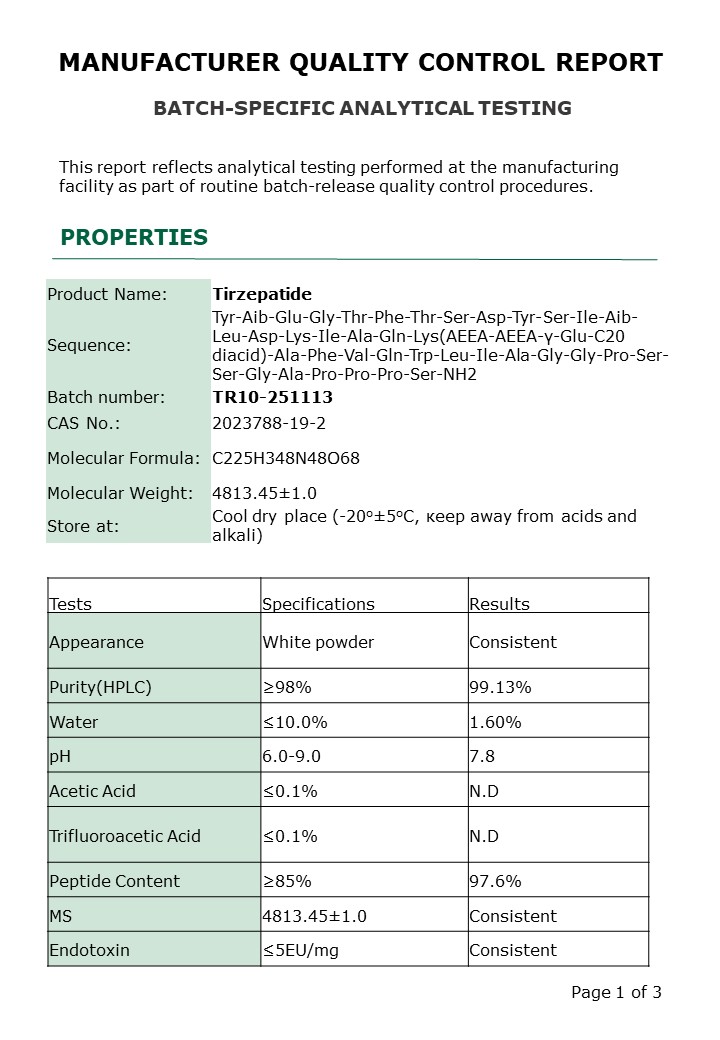
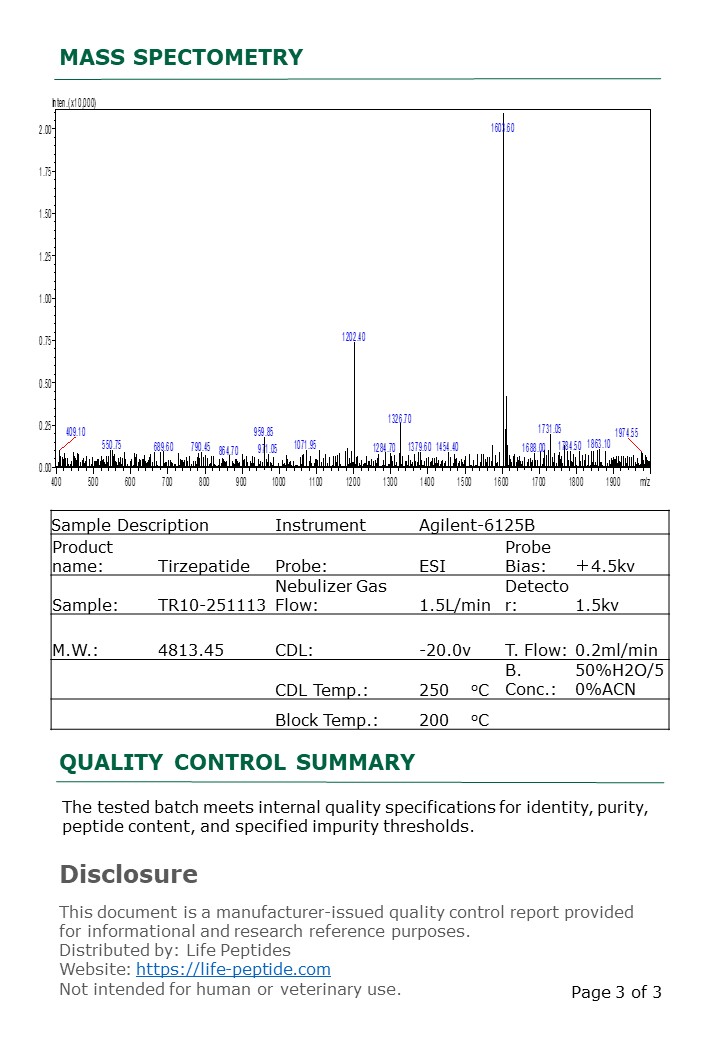
Κάθε παρτίδα ελέγχεται προσεκτικά στο εργαστήριο μετά την παραγωγή (μπορείτε να βρείτε το Πιστοποιητικό Ανάλυσης κάτω από τις εικόνες του προϊόντος).
Κατάψυξη-αποξήρανση (λυσόφιλη) για μέγιστη σταθερότητα και παρατεταμένη διάρκεια ζωής.
Σφραγισμένα σε αποστειρωμένες φιάλες, έτοιμα για ανασύσταση.
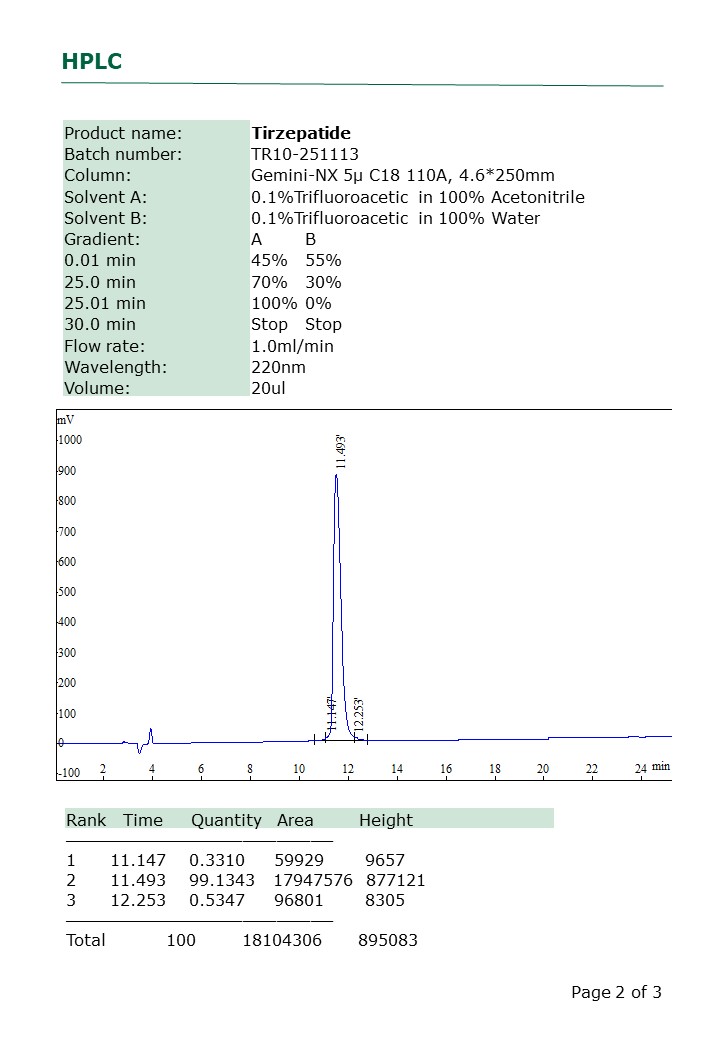
Καθαρότητα: ≥99% (ελέγχθηκε με HPLC)
Εμφάνιση: Λυοφιλοποιημένη λευκή/υπόλευκη σκόνη
Μοριακός τύπος: C225H348N48O68
Μριακό βάρος: 4813.45
Αλληλουχία: Tyr-Aib-Glu-Gly-Thr-Phe-Thr-Ser-Asp-Tyr-Ser-Ile-Aib-Leu-Asp-Lys-Ile-Ala-Gln-Lys(AEEA-AEEA-γ-Glu-C20 diacid)-Ala-Phe-Val-Gln-Trp-Leu-Ile-Ala-Gly-Gly-Pro-Ser-Ser-Gly-Ala-Pro-Pro-Pro-Ser-NH2
Αποθήκευση: τα αφυδατωμένα σε ξηρή ψύξη, σφραγισμένα φιαλίδια φυλάσσονται καλύτερα συντήρηση στους 2–8°C, η οποία είναι η μέθοδος αποθήκευσης που επιβεβαιώθηκε από τον συνεργάτη παραγωγής μας και είναι κατάλληλη για έως και 24 μήνες. Η ψύξη προτιμάται επειδή ελαχιστοποιεί τους περιττούς κύκλους ψύξης-απόψυξης κατά τον συνήθη χειρισμό. Εάν απαιτείται σημαντικά μακροχρόνια αποθήκευση, τα σφραγισμένα λυοφιλοποιημένα φιαλίδια μπορούν επίσης να διατηρηθούν κατεψυγμένα. Μόλις ανασυσταθεί, αποθηκεύετε πάντα σε 2–8°C και μην καταψύχετε.
Ανεξάρτητη επαλήθευση από τρίτο μέρος
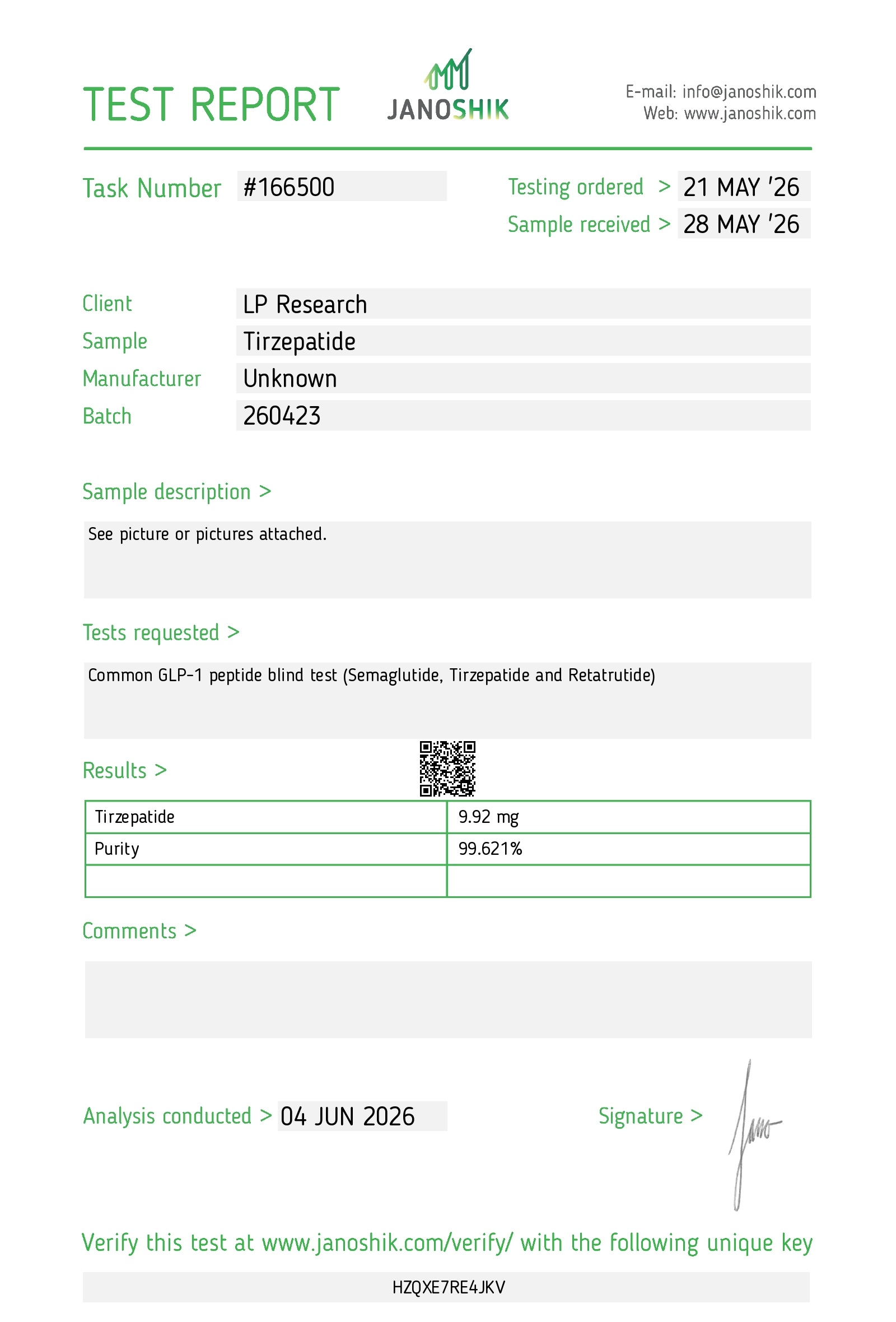
Αυτή η παρτίδα έχει υποβληθεί σε πρόσθετη αναλυτική επαλήθευση από τρίτους μέσω της Janoshik Analytical
Προυντόν: TR10-260423
Εσωτερική καθαρότητα HPLC: 99,13%
Επαλήθευση από τρίτο φορέα: Η εταιρεία 99.62% επιβεβαίωσε ανεξάρτητα την υψηλή καθαρότητα και τη συνέπεια της ταυτότητας του προϊόντος. Προβολή επαλήθευσης τρίτων.
Ανα
Η τριζεπατίδη παρέχεται ως λυοφιλοποιημένο φιαλίδιο και πρέπει να χειρίζεται σύμφωνα με τις τυπικές διαδικασίες ανασυστασης πεπτιδίων που είναι κατάλληλες για το ερευνητικό περιβάλλον. Πρέπει να ανασυσταθεί με Βακτηριοστατικό νερό πριν τη χρήση. Τα πεπτίδια της κλάσης GLP-1 μερικές φορές διαλύονται αργά και απαιτούν πολύ ήπια ανασύσταση για να αποφευχθεί ο αφρός ή να παραμείνει ελαφρώς θολό.
Για την επιλογή άλλων διαλυτών, σχεδιασμό συγκεντρώσεων και οδηγίες αποθήκευσης, δείτε το πλήρες Οδηγός Ανασύστασης Πεπτιδίων και Υπολογιστής Απεικόνισης.
Επιλεγμένες ερευνητικές αναφορές
- Jastreboff AM κ.ά. “Τιρζεπατίδη μία φορά την εβδομάδα για τη θεραπεία της παχυσαρκίας.” New England Journal of Medicine, 2022.
- Φρίας JP και συν. “Τιρζεπατίδη έναντι Σεμαγλουτίδης μία φορά την εβδομάδα σε ασθενείς με σακχαρώδη διαβήτη τύπου 2.” New England Journal of Medicine, 2021.
- Λούντβικ Μ. και συν. “Τιρζεπατίδη μία φορά την εβδομάδα έναντι ινσουλίνης degludec μία φορά την ημέρα ως προσθήκη στη μετφορμίνη.” The Lancet, 2021.
- Τσακίρ Τ. κ.ά. “Το LY3298176, ένας νέος διπλός αγωνιστής υποδοχέων GIP και GLP-1 για τη θεραπεία του σακχαρώδους διαβήτη τύπου 2.” Molecular Metabolism, 2018.
Συχνές Ερωτήσεις
Τι είδους πεπτίδιο είναι η Τιρζεπατίδη;
Η τιρζεπατίδη είναι ένας υπό έρευνα διπλός αγωνιστής ινκριτινών που έχει σχεδιαστεί για να ενεργοποιεί τους υποδοχείς GLP-1 και GIP.
Πώς διαφέρει η τιρζεπατίδη από τη σεμαγλουτίδη;
Η σεμαγλουτίδη στοχεύει κυρίως μόνο στον υποδοχέα GLP-1, ενώ η τιρζεπατίδη συνδυάζει τη δράση στους υποδοχείς GLP-1 και GIP, προσφέροντάς της ένα ευρύτερο προφίλ σηματοδότησης ινκρετινών.
Πώς διαφέρει η τιρζεπατίδη από τη ρετατρουτίδη;
Η ρετατρουτίδη είναι ένας τριπλός αγωνιστής που προσθέτει δράση υποδοχέα γλυκαγόνης στο προφίλ των GLP-1/GIP. Η τιρζεπατίδη παραμένει πιο εκλεκτική ως διπλός αγωνιστής GLP-1/GIP.
Σε ποιους τομείς έρευνας συνδέεται η τιρζεπατίδη;
Η τιρζεπατίδη έχει μελετηθεί στη βιβλιογραφία σε σχέση με τα αποτελέσματα στο σωματικό βάρος, τη ρύθμιση της όρεξης, τον γλυκαιμικό έλεγχο, τη σηματοδότηση της ινσουλίνης και τη βιολογία των ινκριτινών.
Πώς λειτουργεί η τιρζεπατίδη;
Η τιρζεπατίδη ενεργοποιεί ταυτόχρονα τους υποδοχείς GIP και GLP-1. Αυτές οι οδοί των ινκριτινών επηρεάζουν την εξαρτώμενη từ τη γλυκόζη έκκριση ινσουλίνης, τη ρύθμιση της όρεξης, τη διαχείριση των θρεπτικών συστατικών και το ενεργειακό ισοζύγιο. Η δράση της σε διπλούς υποδοχείς διαφοροποιεί την τιρζεπατίδη από τις ενώσεις αποκλειστικά GLP-1, όπως η σεμαγλουτίδη. Ο FDA περιγράφει την τιρζεπατίδη ως ουσία που συνδέεται επιλεκτικά και ενεργοποιεί τους υποδοχείς GIP και GLP-1.
Τι έδειξε η κλινική μελέτη SURMOUNT-1 για την τιρζεπατίδη;
Στη μελέτη SURMOUNT-1, η μέση μείωση του σωματικού βάρους μετά από 72 εβδομάδες ήταν 15,0%, 19,5% και 20,9% για τις ομάδες των 5 mg, 10 mg και 15 mg, αντίστοιχα, σε σύγκριση με 3,1% στην ομάδα του εικονικού φαρμάκου. Στη μελέτη συμμετείχαν ενήλικες με παχυσαρκία ή υπερβολικό βάρος χωρίς διαβήτη.
Έχει συγκριθεί η τιρζεπατίδη απευθείας με τη σεμαγλουτίδη;
Ναι. Η μελέτη Φάσης 3 SURPASS-2 συνέκρινε άμεσα την Τιρζεπατίδη με Semaglutide 1 mg σε ενηλίκους με διαβήτη τύπου 2. Η τιρζεπατίδη προκάλεσε μεγαλύτερες μειώσεις στην HbA1c και στο σωματικό βάρος σε όλες τις δόσεις που μελετήθηκαν κατά τη διάρκεια της μελέτης των 40 εβδομάδων.
Πώς πρέπει να αποθηκεύεται η λυοφιλοποιημένη Τιρζεπατίδη;
Για αυτό το ερευνητικό προϊόν, τα μη ανοιχγμένα λυοφιλοποιημένα φιαλίδια φυλάσσονται καλύτερα στο ψυγείο στους 2–8°C. Για ουσιαστικά μακροχρόνια αποθήκευση, τα μη ανοιχγμένα φιαλίδια μπορούν επίσης να διατηρηθούν στην κατάψυξη. Αποφύγετε περιττές εναλλαγές θερμοκρασίας.
Πώς πρέπει να φυλάσσεται η Τιρζεπατίδη μετά την ανασύσταση;
Μετά την ανασύσταση, το διάλυμα πρέπει να φυλάσσεται στο ψυγείο στους 2–8°C και να προστατεύεται από περιττές διακυμάνσεις της θερμοκρασίας. Θα πρέπει να αποφεύγονται οι επαναλαμβανόμενοι κύκλοι κατάψυξης-απόψυξης.
Πρέπει η τιρζεπατίδη να ανακινηθεί κατά την ανασύστασή της;
Δεν απαιτείται έντονη ανάδευση. Ο ήπιος χειρισμός είναι προτιμότερος κατά την ανασύσταση των πεπτιδίων, ιδίως εάν η διάλυση είναι σταδιακή, προκειμένου να ελαχιστοποιηθεί ο αφρισμός και η περιττή μηχανική καταπόνηση.
Γιατί η τιρζεπατίδη ονομάζεται διπλός αγωνιστής;
Η τιρζεπατίδη περιγράφεται ως διπλός αγωνιστής επειδή ένα μόνο μόριο ενεργοποιεί δύο συστήματα υποδοχέων ινκριτίνης—GIP και GLP-1. Αυτό έρχεται σε αντίθεση με Semaglutide‘δραστηριότητα υποδοχέα GLP-1 και Ρετατρουτίδη‘το ευρύτερο προφίλ τριπλής αγωνιστικής δράσης GLP-1/GIP/γλυκαγόνης του.
Μπορώ να αγοράσω Τιρζεπατίδη στην Ευρώπη;
Ναι. Αποστέλλουμε Τιρζεπατίδη στις περισσότερες ευρωπαϊκές χώρες χρησιμοποιώντας αξιόπιστες υπηρεσίες ταχυμεταφορών. Οι διαθέσιμες μέθοδοι αποστολής και οι χρόνοι παράδοσης εμφανίζονται κατά την ολοκλήρωση της παραγγελίας με βάση τον προορισμό σας.
Αυτό το προϊόν προορίζεται για ανθρώπινη χρήση;
Όχι. Αυτό το προϊόν παρέχεται αυστηρά για ερευνητικούς σκοπούς και δεν προορίζεται για ανθρώπινη κατανάλωση ή θεραπευτική χρήση.
Σχετικό ερευνητικό πλαίσιο
Η τιρζεπατίδη αποτελεί μέρος της μεταβολικής ερευνητικής κατηγορίας των διπλών αγωνιστών υποδοχέων ινκρετίνης (GLP-1/GIP). Για μηχανιστική σύγκριση με αγωνιστές GLP-1 μονοπατιού και ενώσεις τριπλού αγωνιστή, δείτε την Οδηγός μεταβολικής έρευνας GLP-1.
Περιηγηθείτε σε όλες τις ενώσεις στο Μεταβολική έρευνα.
Οι ερευνητές που συγκρίνουν την ενεργοποίηση πολλαπλών υποδοχέων μπορούν επίσης να εξετάσουν:
- Retatrutide (τριπłός αγonισtής υποδoχών GLP-1/GIP/γλυκαγόνης)
- Σεμαγλουτίδη (αγωνιστής υποδοχέων GLP-1)
Για μια λεπτομερή σύγκریزη της δραστηριότητας των υποδοχέων, των δημοσιευμένων κλινικών ευρημάτων και των ερευνητικών διαφορών, διαβάστε την Σύγκριση έρευνας Retatrutide και Tirzepatide.
ΣΗΜΕΙΩΣΗ: Αυτό γίνεται αποκλειστικά για εκπαιδευτικούς σκοπούς και δεν συνιστά ιατρική συμβουλή.
Αποποίηση ευθύνης:
Αυτό το προϊόν πωλείται αποκλειστικά για ερευνητικούς σκοπούς. Δεν προορίζεται για τη διάγνωση, θεραπεία, ίαση ή πρόληψη οποιασδήποτε ασθένειας. Ο αγοραστής αναλαμβάνει πλήρως την ευθύνη για τον σωστό χειρισμό και τη χρήση.