Description
MOTS-c (Mitochondrial Open Reading Frame of the 12S rRNA Type-c) est un peptide mitochondrial naturel de 16 acides aminés, codé par l'ADN mitochondrial plutôt que par le génome nucléaire. Cette origine unique le distingue de la plupart des autres peptides de recherche et en a fait une molécule importante pour étudier la manière dont les mitochondries communiquent avec le reste de la cellule.
Des recherches publiées suggèrent que le MOTS-c est libéré en réponse à stress métabolique et exercice, où il aide à coordonner l'adaptation cellulaire à une demande accrue d'énergie. En raison de ce rôle, le MOTS-c est devenu l'un des principaux peptides de recherche en recherche sur le métabolisme, la physiologie de l'exercice et le vieillissement en bonne santé.
Vous souhaitez acheter du MOTS-c en Europe ? Life Peptide fournit du MOTS-c de haute pureté destiné à la recherche en laboratoire, avec une livraison fiable dans toute l'Union européenne.
Pourquoi le MOTS-c est largement étudié
Des recherches publiées ont étudié le MOTS-c par rapport à :
- métabolisme énergétique cellulaire
- adaptation à l'exercice
- fonction mitochondriale
- flexibilité métabolique
- sensibilité à l'insuline
- métabolisme du glucose
- vieillissement en santé
- physiologie du muscle squelettique
- Signalisation de l'AMPK
Alors que la recherche sur les peptides dérivés des mitochondries s'est développée, le MOTS-c est devenu l'une des molécules les mieux caractérisées reliant la fonction mitochondriale au métabolisme de l'organisme entier.
Comment fonctionne le MOTS-c
Contrairement aux hormones peptidiques conventionnelles, le MOTS-c fonctionne comme un peptide de signalisation mitochondriale, aidant les cellules à s'adapter au stress métabolique.
Les recherches publiées ont exploré sa relation avec :
Métabolisme énergétique cellulaire
Le MOTS-c a fait l'objet de recherches pour sa capacité à réguler l'utilisation de l'énergie cellulaire lors du stress métabolique en influençant les voies impliquées dans l'utilisation du glucose et le métabolisme des acides gras.
Adaptation de l'exercice
L'exercice augmente l'expression endogène du MOTS-c, ce qui en fait l'un des peptides d'origine mitochondriale les plus étudiés en physiologie de l'exercice. Des chercheurs ont examiné si le MOTS-c contribue à certaines des adaptations métaboliques normalement associées à l'activité physique.
Signalisation de l'AMPK
L'un des principaux mécanismes étudiés pour le MOTS-c implique l'activation de la protéine kinase activée par l'AMP (AMPK), un régulateur clé de l'équilibre énergétique cellulaire et de l'adaptation métabolique.
Vieillir en santé
Comme la fonction mitochondriale change avec l'âge, le MOTS-c est devenu une cible de recherche importante dans les études portant sur la résilience métabolique et le vieillissement en bonne santé.
Pourquoi le MOTS-c est souvent décrit comme un “ peptide de l'exercice ”
L'une des observations les plus intéressantes de la littérature scientifique est que les taux endogènes de MOTS-c augmentent en réponse à l'exercice.
Plutôt que de remplacer l'activité physique, les chercheurs étudient si le MOTS-c active certaines des mêmes voies cellulaires impliquées dans adaptation métabolique induite par l'exercice, en particulier ceux liés à fonction mitochondriale et signalisation AMPK. Cela a conduit à sa description comme un peptide potentiel mimétique de l'exercice, bien qu'il s'agisse d'un domaine de recherche actif et qu'il ne faille pas l'interpréter comme étant équivalent aux effets physiologiques de l'exercice lui-même.
Recherche humaine et préclinique
La recherche sur le MOTS-c se développe rapidement, bien que la base de données probantes reste considérablement plus restreinte que pour les peptides métaboliques établis tels que le sémaglutide ou le tirzépatide.
Des études publiées ont examiné le MOTS-c dans des modèles de laboratoire du métabolisme, de la physiologie de l'exercice, de la sensibilité à l'insuline et du vieillissement, tandis que la recherche humaine s'est principalement concentrée sur les taux endogènes de MOTS-c et leur relation avec la santé métabolique. La recherche interventionnelle clinique reste limitée.
Comment le MOTS-c se distingue des peptides métaboliques apparentés
| peptide | Principal axe de recherche |
|---|---|
| MOTS-c | Métabolisme mitochondrial et adaptation à l'exercice |
| SS-31 (Élamiprétide) | Fonction de la membrane mitochondriale |
| Retatrutide | Signalisation métabolique par triple incrétine |
| Sémaglutide | Signalisation des récepteurs du GLP-1 |
| AOD-9604 | Recherche sur les fragments d'hormone de croissance |
Contrairement aux peptides incrétines, le MOTS-c est étudié principalement pour régulation de l'énergie cellulaire et signalisation mitochondriale, ce qui en fait l'un des rares peptides de recherche qui ciblent directement la biologie mitochondriale.
Observations de sécurité publiées
La plupart des données publiées sur le MOTS-c proviennent d'études précliniques, la recherche interventionnelle chez l'humain étant relativement limitée. Les recherches actuelles ont généralement rapporté une tolérabilité acceptable lors des premières études, mais l'efficacité et l'innocuité à long terme restent à l'étude. Les données cliniques étant encore émergentes, les résultats doivent être interprétés dans le contexte de la recherche en cours.
Caractéristiques du produit
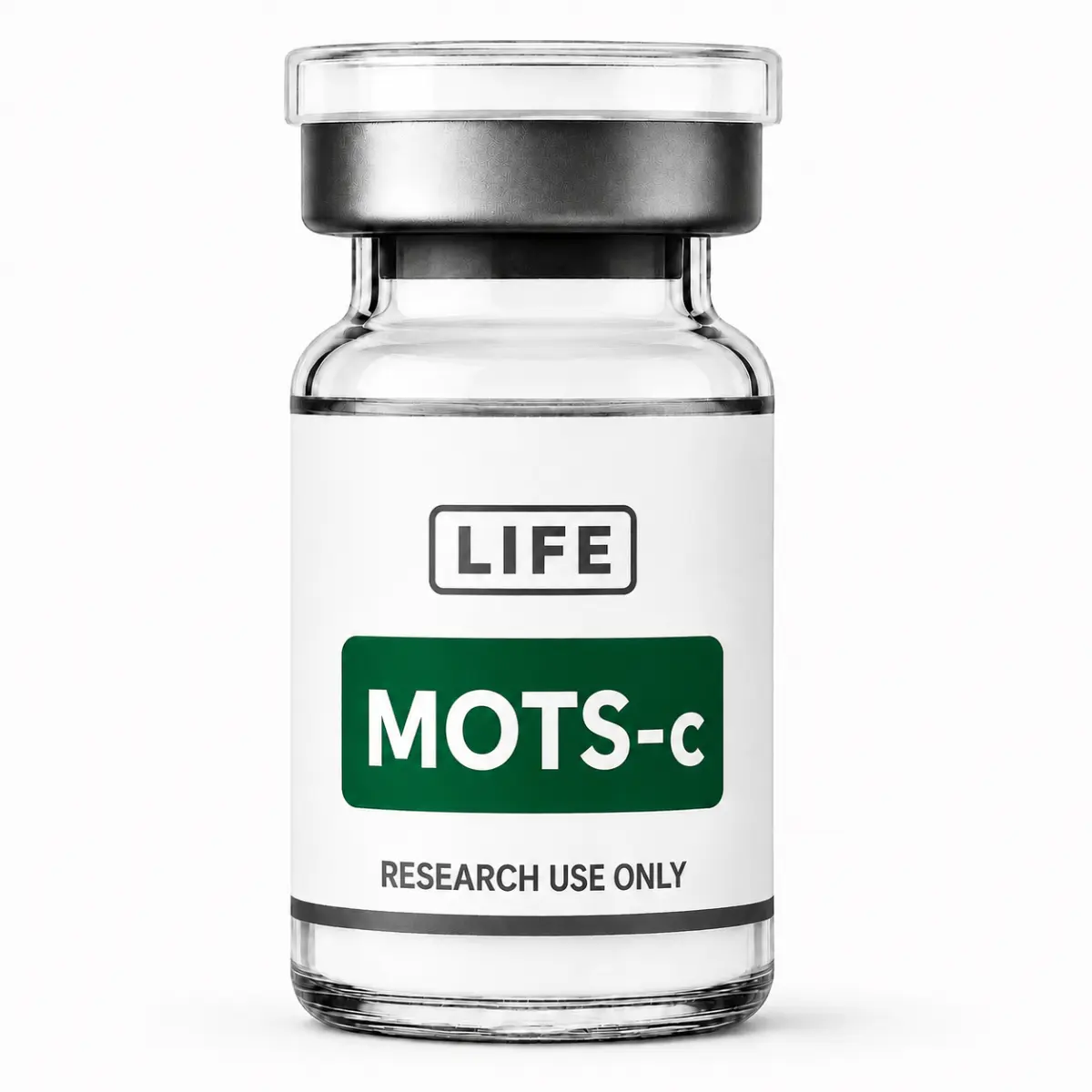
Application : recherche de laboratoire et analytique
Utilisation restreinte : non destiné à la consommation humaine ; non destiné à un usage médical, vétérinaire ou cosmétique
Produit dans des installations conformes aux BPF dans le cadre de protocoles de CQ stricts.
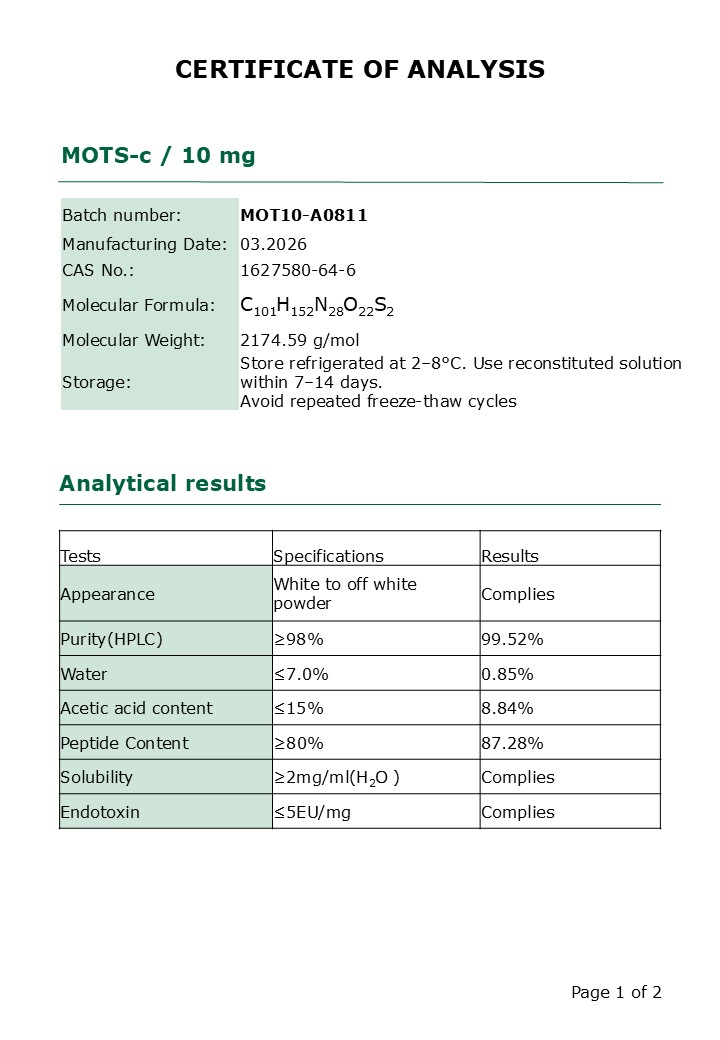
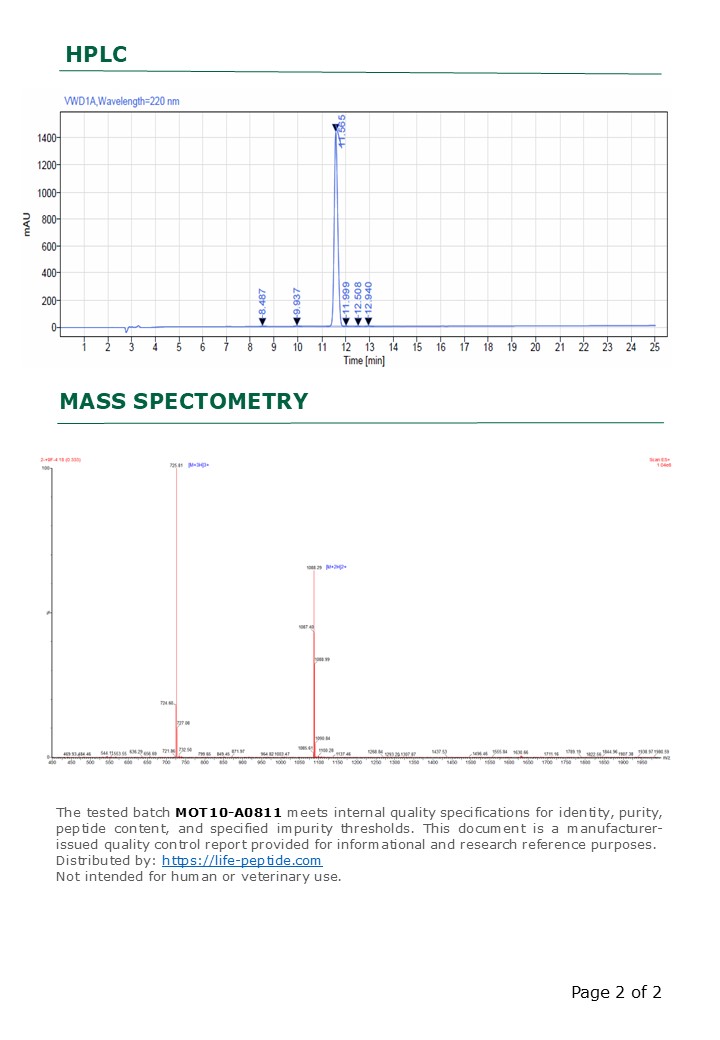
Chaque lot est soumis à des tests rigoureux en laboratoire après production (vous trouverez le certificat d'analyse sous les photos du produit).
Lyophilisé (séché par congélation) pour une stabilité et une durée de conservation maximales.
Scellés dans des flacons stériles, prêts à être reconstitués.
Pureté : ≥ 991 TP4T (testée par HPLC)
Aspect : Poudre blanche/blanc cassé lyophilisée
Formule moléculaire : C101H152N28O22S2
Poids moléculaire : 2174,6
Séquence : Met-Arg-Trp-Gln-Glu-Met-Gly-Tyr-Ile-Phe-Tyr-Pro-Arg-Lys-Leu-Arg
Stockage: les flacons lyophilisés non ouverts sont mieux conservés réfrigéré à 2–8 °C, qui est la méthode de stockage confirmée par notre partenaire de fabrication et adaptée jusqu'à 24 mois. La réfrigération est préférable car elle minimise les cycles de congélation-décongélation inutiles lors de la manipulation de routine. Si un stockage à plus long terme est nécessaire, les flacons lyophilisés non ouverts peuvent également être conservés congelés. Une fois reconstituées, toujours conserver à 2-8°C et ne pas congeler.
Reconstitution et manipulation
Le MOTS-c est fourni sous forme de flacon lyophilisé et doit être manipulé en utilisant les procédures standard de reconstitution des peptides adaptées au cadre de recherche. Doit être reconstitué avec eau bactériostatique avant utilisation. Pour aider à préserver l'intégrité structurelle, ajoutez le solvant choisi lentement contre la paroi intérieure du flacon plutôt que directement sur le précipité peptidique, et évitez les secousses vigoureuses. Un léger mouvement de rotation suffit généralement une fois que le peptide est complètement dissous. Les pratiques courantes de laboratoire comprennent également le fait de laisser les flacons réfrigérés atteindre la température ambiante avant la reconstitution afin de minimiser la condensation à l'intérieur du flacon.
Pour d'autres choix de solvant, une planification de la concentration et des conseils de stockage, consultez le guide complet Guide de reconstitution des peptides et Calculateur de reconstitution.
Références de recherche sélectionnées
- Lee C, et al. Le peptide dérivé des mitochondries MOTS-c favorise l'homéostasie métabolique et réduit l'obésité et la résistance à l'insuline, Cell Metabolism, 2015
L'article phare décrivant la découverte du MOTS-c et son rôle dans la régulation métabolique.
- Zhou H et al. Le peptide dérivé des mitochondries MOTS-c : effets et mécanismes liés au stress, au métabolisme et au vieillissement, Journal of Translational Medicine, 2023
Une revue exhaustive résumant les données actuelles sur la biologie, le métabolisme, l'adaptation au stress et le vieillissement du MOTS-c.
- Atakan MM, Bishop DJ. Petits peptides : pourraient-ils jouer un rôle majeur dans le métabolisme et la réponse à l'exercice ?, Journal of Physiology, 2024
Une revue moderne examinant les peptides dérivés des mitochondries, y compris le MOTS-c, avec un accent sur la physiologie de l'exercice et l'adaptation métabolique.
- Bobylev AG et al. Le peptide mitochondrial MOTS-c : régulation du métabolisme et perspectives d'applications en médecine clinique et du sport, Physiologie humaine, 2025
Une revue discutant des données émergentes sur le MOTS-c dans le métabolisme, la physiologie de l'exercice et le vieillissement en bonne santé.
Questions fréquemment posées
Qu'est-ce que le MOTS-c ?
Le MOTS-c est un peptide d'origine mitochondriale présent à l'état naturel et codé par l'ADN mitochondrial. Il fait l'objet de nombreuses recherches pour son rôle dans le métabolisme énergétique cellulaire, l'adaptation à l'exercice et le vieillissement en bonne santé.
Pourquoi le MOTS-c est-il associé à la recherche sur l'exercice ?
Des études publiées ont montré que les taux endogènes de MOTS-c augmentent en réponse à l'exercice. Les chercheurs étudient s'il contribue aux adaptations métaboliques associées à l'activité physique par le biais de voies telles que la signalisation de l'AMPK.
Qu'est-ce qui différencie le MOTS-c des peptides GLP-1 ?
Contrairement aux agonistes des récepteurs du GLP-1, qui étudient principalement la signalisation des incrétines, le MOTS-c se concentre sur la communication mitochondriale, la régulation de l'énergie cellulaire et l'adaptation métabolique. Ceux-ci représentent des domaines distincts de la recherche métabolique.
Quels domaines de recherche étudient couramment le MOTS-c ?
Les recherches actuelles portent sur le métabolisme cellulaire, la biologie mitochondriale, la sensibilité à l'insuline, la physiologie de l'exercice, la signalisation AMPK, l'adaptation du muscle squelettique et le vieillissement en bonne santé.
En quoi le MOTS-c diffère-t-il du SS-31 ?
Les deux sont des peptides mitochondriaux, mais ils étudient différents aspects de la biologie mitochondriale. Le MOTS-c est principalement associé à la signalisation métabolique et à l'adaptation à l'exercice, tandis que le SS-31 est étudié pour l'intégrité de la membrane mitochondriale et la bioénergétique.
Le MOTS-c est-il un substitut à l'exercice ?
Non. Bien que le MOTS-c ait été décrit comme un peptide mimétique de l'exercice en raison de son activation de certaines voies métaboliques liées à l'exercice, les recherches actuelles ne soutiennent pas la conclusion qu'il reproduit l'ensemble des effets physiologiques de l'exercice physique.
Puis-je acheter du MOTS-c en Europe ?
Oui. Nous expédions le MOTS-c vers la plupart des pays européens en utilisant des services de messagerie fiables. Les modes d'expédition disponibles et les délais de livraison sont indiqués lors du paiement en fonction de votre destination.
Ce produit est-il destiné à un usage humain ?
Non. Le MOTS-c fourni par Life Peptide est destiné exclusivement à la recherche en laboratoire et à des fins d'analyse. Il n'est pas destiné à la consommation humaine, ni au diagnostic, au traitement ou à la prévention de maladies. Toute référence à des études publiées résume la littérature scientifique relative à la molécule MOTS-c et non l'usage prévu de ce produit.
Contexte de recherche connexe
MOTS-c est fréquemment mentionné aux côtés d'autres peptides de recherche étudiant la fonction mitochondriale, le métabolisme et le vieillissement en bonne santé, bien que chacun cible différents aspects de la physiologie cellulaire.
SS-31 (Élamipretide) – étudié pour la réparation mitochondriale et la production d'énergie cellulaire.
Épitalon – étudié pour la biologie des télomères et la recherche sur le vieillissement en bonne santé.
CJC-1295 avec DAC – étudié pour une signalisation prolongée de la GH et de l'IGF-1.
CJC-1295 sans DAC – étudié pour la libération physiologique de l'hormone de croissance.
GHK-Cu – étudiés pour la régénération tissulaire et le remodelage de la matrice extracellulaire.
REMARQUE : Ces informations sont fournies à titre purement informatif et ne constituent en aucun cas un avis médical.
Avis de non-responsabilité :
Ce produit est vendu à des fins de recherche uniquement. Il n'est pas destiné à diagnostiquer, traiter, guérir ou prévenir une maladie. L'acheteur assume la pleine responsabilité de sa manipulation et de son utilisation appropriées.