Description
MOTS-c (Mitochondrial Open Reading Frame of the 12S rRNA Type-c) is a naturally occurring 16-amino-acid mitochondrial-derived peptide encoded by mitochondrial DNA rather than the nuclear genome. This unique origin distinguishes it from most other research peptides and has made it an important molecule for investigating how mitochondria communicate with the rest of the cell.
Published research suggests that MOTS-c is released in response to metabolic stress and exercise, where it helps coordinate cellular adaptation to increased energy demand. Because of this role, MOTS-c has become one of the leading investigational peptides in metabolism, exercise physiology and healthy aging research.
Looking to buy MOTS-c in Europe? LIFE Peptide supplies high-purity MOTS-c for laboratory research with reliable EU-wide shipping.
Why MOTS-c is widely investigated
Published research has investigated MOTS-c in relation to:
- cellular energy metabolism
- exercise adaptation
- mitochondrial function
- metabolic flexibility
- insulin sensitivity
- glucose metabolism
- healthy aging
- skeletal muscle physiology
- AMPK signalling
As research into mitochondrial-derived peptides has expanded, MOTS-c has become one of the best-characterised molecules linking mitochondrial function with whole-body metabolism.
How MOTS-c works
Unlike conventional peptide hormones, MOTS-c functions as a mitochondrial signalling peptide, helping cells adapt to metabolic stress.
Published research has explored its relationship with:
Cellular energy metabolism
MOTS-c has been investigated for its ability to regulate cellular energy use during metabolic stress by influencing pathways involved in glucose utilisation and fatty acid metabolism.
Exercise adaptation
Exercise increases endogenous MOTS-c expression, making it one of the most studied mitochondrial-derived peptides in exercise physiology. Researchers have investigated whether MOTS-c contributes to some of the metabolic adaptations normally associated with physical activity.
AMPK signalling
One of the principal mechanisms investigated for MOTS-c involves activation of AMP-activated protein kinase (AMPK), a key regulator of cellular energy balance and metabolic adaptation.
Healthy aging
Because mitochondrial function changes with age, MOTS-c has become an important research target in studies investigating metabolic resilience and healthy aging.
Why MOTS-c is often described as an “exercise peptide”
One of the most interesting observations in the scientific literature is that endogenous MOTS-c levels increase in response to exercise.
Rather than replacing physical activity, researchers are investigating whether MOTS-c activates some of the same cellular pathways involved in exercise-induced metabolic adaptation, particularly those related to mitochondrial function and AMPK signalling. This has led to its description as a potential exercise-mimetic peptide, although this remains an active area of research and should not be interpreted as equivalent to the physiological effects of exercise itself.
Human and preclinical research
Research on MOTS-c is growing rapidly, although the evidence base remains considerably smaller than for established metabolic peptides such as Semaglutide or Tirzepatide.
Published studies have investigated MOTS-c in laboratory models of metabolism, exercise physiology, insulin sensitivity and aging, while human research has primarily focused on endogenous MOTS-c levels and their relationship with metabolic health. Clinical interventional research remains limited.
How MOTS-c differs from related metabolic peptides
| Peptide | Primary research focus |
|---|---|
| MOTS-c | Mitochondrial metabolism & exercise adaptation |
| SS-31 (Elamipretide) | Mitochondrial membrane function |
| Retatrutide | Triple incretin metabolic signalling |
| Semaglutide | GLP-1 receptor signalling |
| AOD-9604 | Growth hormone fragment research |
Unlike incretin peptides, MOTS-c is investigated primarily for cellular energy regulation and mitochondrial signalling, making it one of the few research peptides that directly targets mitochondrial biology.
Published safety observations
Most published data on MOTS-c come from preclinical studies, with relatively limited human interventional research available. Current investigations have generally reported acceptable tolerability in early studies, but long-term efficacy and safety remain under investigation. Because clinical evidence is still emerging, findings should be interpreted within the context of ongoing research.
Product characteristics
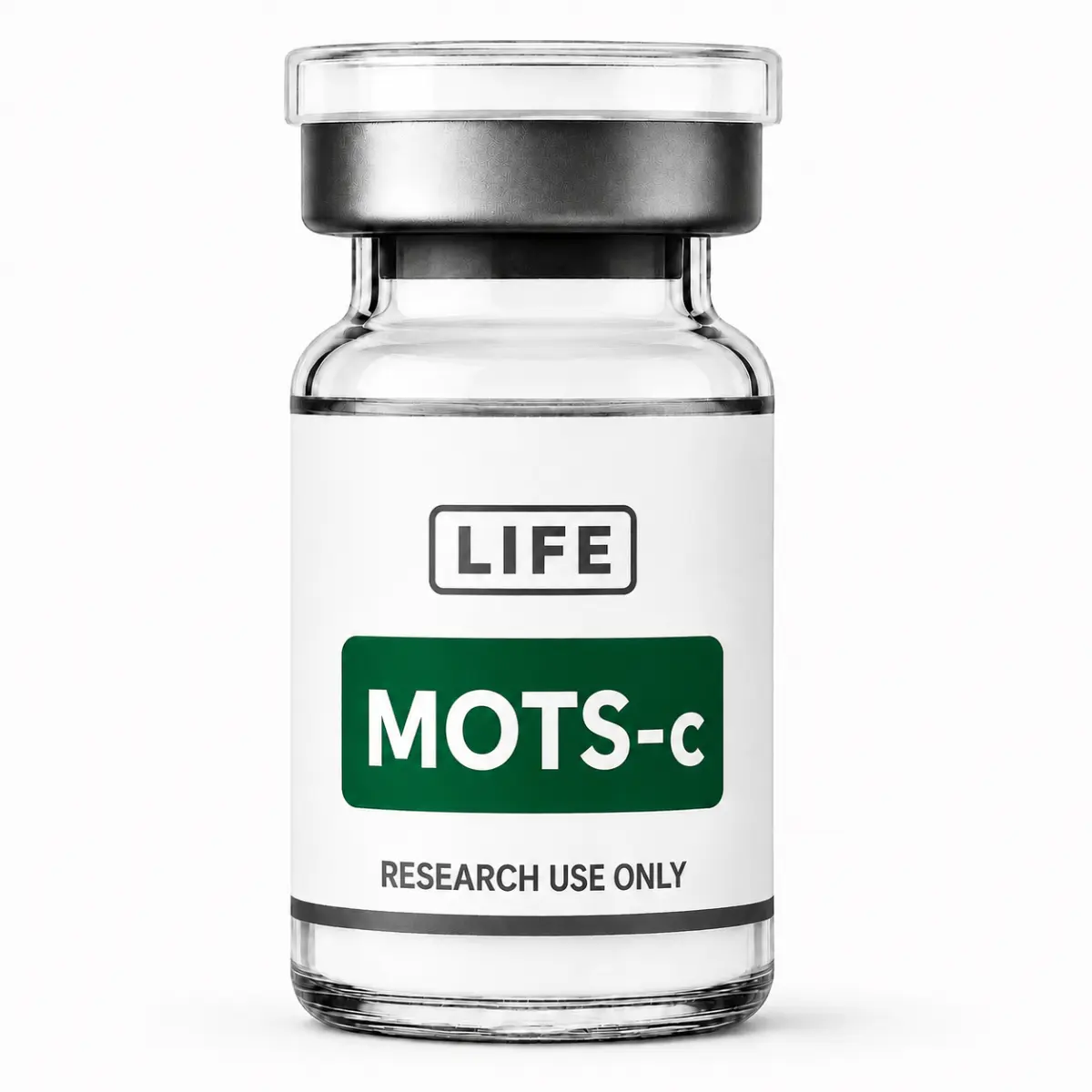
Application: laboratory and analytical research
Use restriction: not for human consumption; not for medical, veterinary or cosmetic use
Produced in GMP-compliant facilities under strict QC protocols.
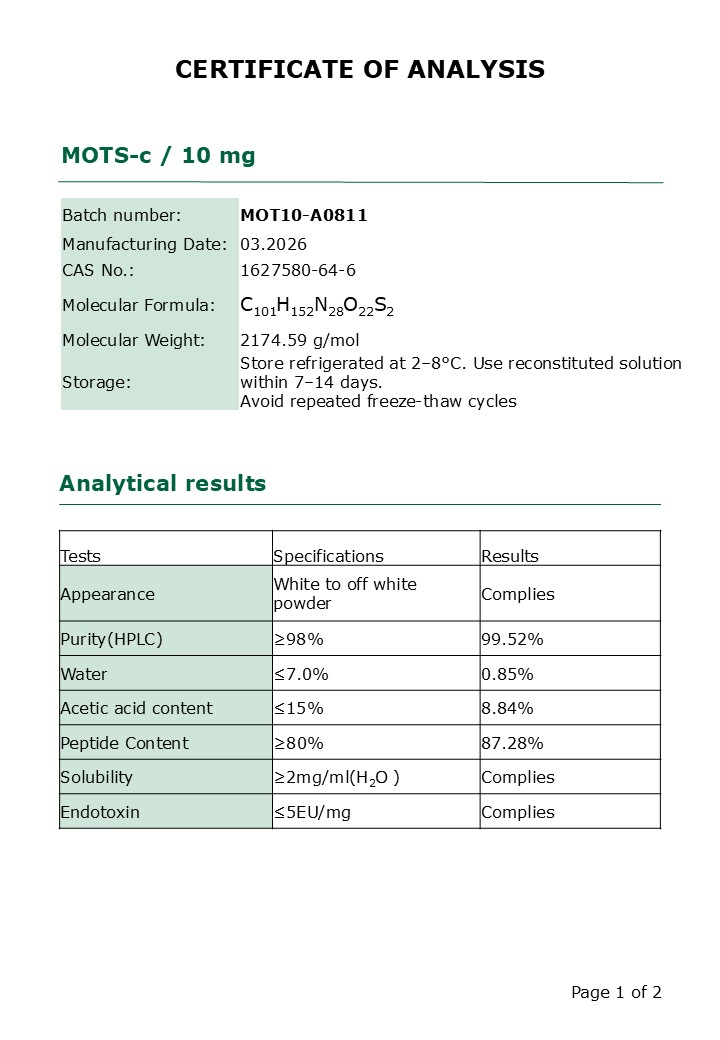
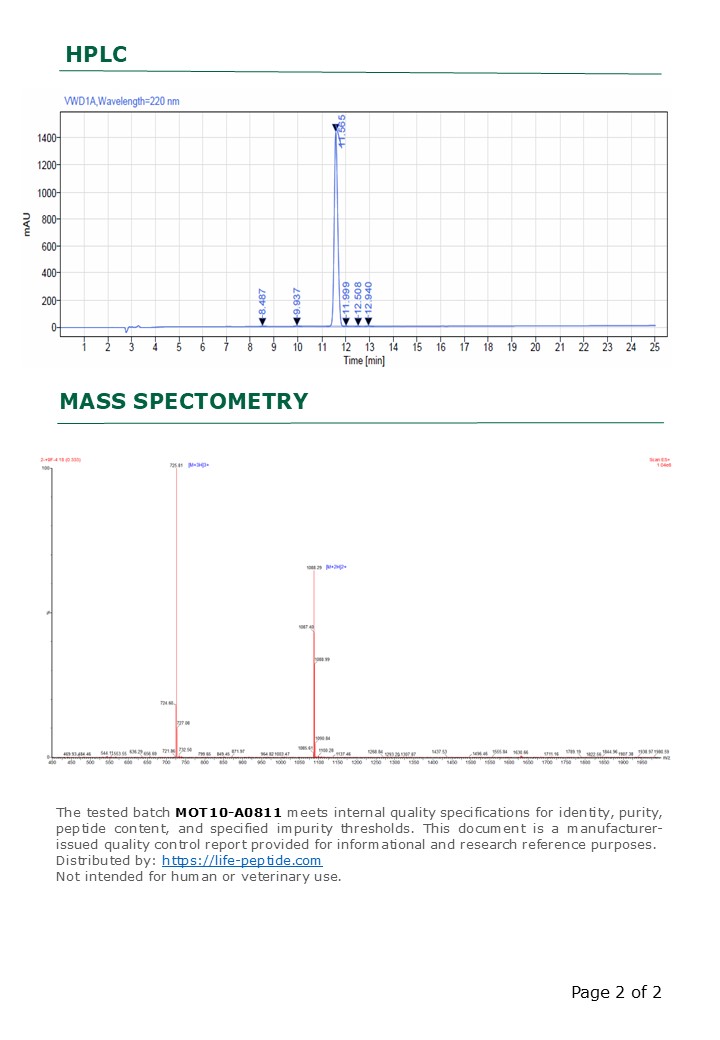
Each batch carefully lab tested after production (you can find Certificate of Analysis under product pictures).
Freeze-dried (lyophilized) for maximum stability and extended shelf life.
Sealed in sterile vials, ready for reconstitution.
Purity: ≥99% (HPLC-tested)
Appearance: Lyophilized white/off-white powder
Molecular formula: C101H152N28O22S2
Molecular weight: 2174.6
Sequence: Met-Arg-Trp-Gln-Glu-Met-Gly-Tyr-Ile-Phe-Tyr-Pro-Arg-Lys-Leu-Arg
Storage: unopened lyophilized vials are best stored refrigerated at 2–8°C, which is the storage method confirmed by our manufacturing partner and suitable for up to 24 months. Refrigeration is preferred because it minimizes unnecessary freeze–thaw cycles during routine handling. If substantially longer-term storage is required, unopened lyophilized vials may also be kept frozen. Once reconstituted, always store at 2–8°C and do not freeze.
Reconstitution and handling
MOTS-c is supplied as a lyophilised vial and should be handled using standard peptide reconstitution procedures appropriate to the research setting. Must be reconstituted with bacteriostatic water before use. To help preserve structural integrity, add the chosen solvent slowly against the inside wall of the vial rather than directly onto the peptide cake, and avoid vigorous shaking. Gentle swirling is generally sufficient once the peptide has fully dissolved. Standard laboratory practice also includes allowing refrigerated vials to reach room temperature before reconstitution to minimise condensation inside the vial.
For other solvent selection, concentration planning and storage guidance, see the full Peptide Reconstitution Guide and Reconstitution Calculator.
Selected research references
- Lee C, et al. The Mitochondrial-Derived Peptide MOTS-c Promotes Metabolic Homeostasis and Reduces Obesity and Insulin Resistance, Cell Metabolism, 2015
The landmark paper describing the discovery of MOTS-c and its role in metabolic regulation.
- Zhou H, et al. Mitochondria-derived Peptide MOTS-c: Effects and Mechanisms Related to Stress, Metabolism and Aging, Journal of Translational Medicine, 2023
A comprehensive review summarising current evidence on MOTS-c biology, metabolism, stress adaptation and aging.
- Atakan MM, Bishop DJ. Small Peptides: Could They Have a Big Role in Metabolism and the Response to Exercise?, Journal of Physiology, 2024
A modern review examining mitochondrial-derived peptides, including MOTS-c, with a focus on exercise physiology and metabolic adaptation.
- Bobylev AG, et al. Mitochondrial Peptide MOTS-c: Regulation of Metabolism and Prospects for Clinical and Sports Medicine Applications, Human Physiology, 2025
A review discussing emerging evidence for MOTS-c in metabolism, exercise physiology and healthy aging.
Frequently Asked Questions
What is MOTS-c?
MOTS-c is a naturally occurring mitochondrial-derived peptide encoded by mitochondrial DNA. It is widely investigated for its role in cellular energy metabolism, exercise adaptation and healthy aging.
Why is MOTS-c associated with exercise research?
Published studies have shown that endogenous MOTS-c levels increase in response to exercise. Researchers are investigating whether it contributes to metabolic adaptations associated with physical activity through pathways such as AMPK signalling.
What makes MOTS-c different from GLP-1 peptides?
Unlike GLP-1 receptor agonists, which primarily investigate incretin signalling, MOTS-c focuses on mitochondrial communication, cellular energy regulation and metabolic adaptation. These represent distinct areas of metabolic research.
What research areas commonly investigate MOTS-c?
Current research includes cellular metabolism, mitochondrial biology, insulin sensitivity, exercise physiology, AMPK signalling, skeletal muscle adaptation and healthy aging.
How does MOTS-c differ from SS-31?
Both are mitochondrial peptides, but they investigate different aspects of mitochondrial biology. MOTS-c is primarily associated with metabolic signalling and exercise adaptation, whereas SS-31 is investigated for mitochondrial membrane integrity and bioenergetics.
Is MOTS-c an exercise replacement?
No. Although MOTS-c has been described as an exercise-mimetic peptide because it activates some exercise-related metabolic pathways, current research does not support the conclusion that it reproduces the full physiological effects of physical exercise.
Can I buy MOTS-c in Europe?
Yes. We ship MOTS-c to most European countries using reliable courier services. Available shipping methods and delivery times are shown during checkout based on your destination.
Is this product intended for human use?
No. MOTS-c supplied by LIFE Peptide is provided strictly for laboratory and analytical research. It is not intended for human consumption, diagnosis, treatment or prevention of disease. Any discussion of published studies summarises the scientific literature relating to the MOTS-c molecule rather than the intended use of this product.
Related research context
MOTS-c is frequently discussed alongside other research peptides investigating mitochondrial function, metabolism and healthy aging, although each targets different aspects of cellular physiology.
SS-31 (Elamipretide) – investigated for mitochondrial repair and cellular energy production.
Epitalon – studied for telomere biology and healthy aging research.
CJC-1295 with DAC – investigated for sustained GH and IGF-1 signalling.
CJC-1295 No DAC – studied for physiological growth hormone release.
GHK-Cu – investigated for tissue regeneration and extracellular matrix remodelling.
NOTE: This is for educational reference only and does not constitute medical advice.
Disclaimer:
This product is sold for research purposes only. It is not intended to diagnose, treat, cure, or prevent any disease. Buyer assumes full responsibility for proper handling and use.