
Descrizione
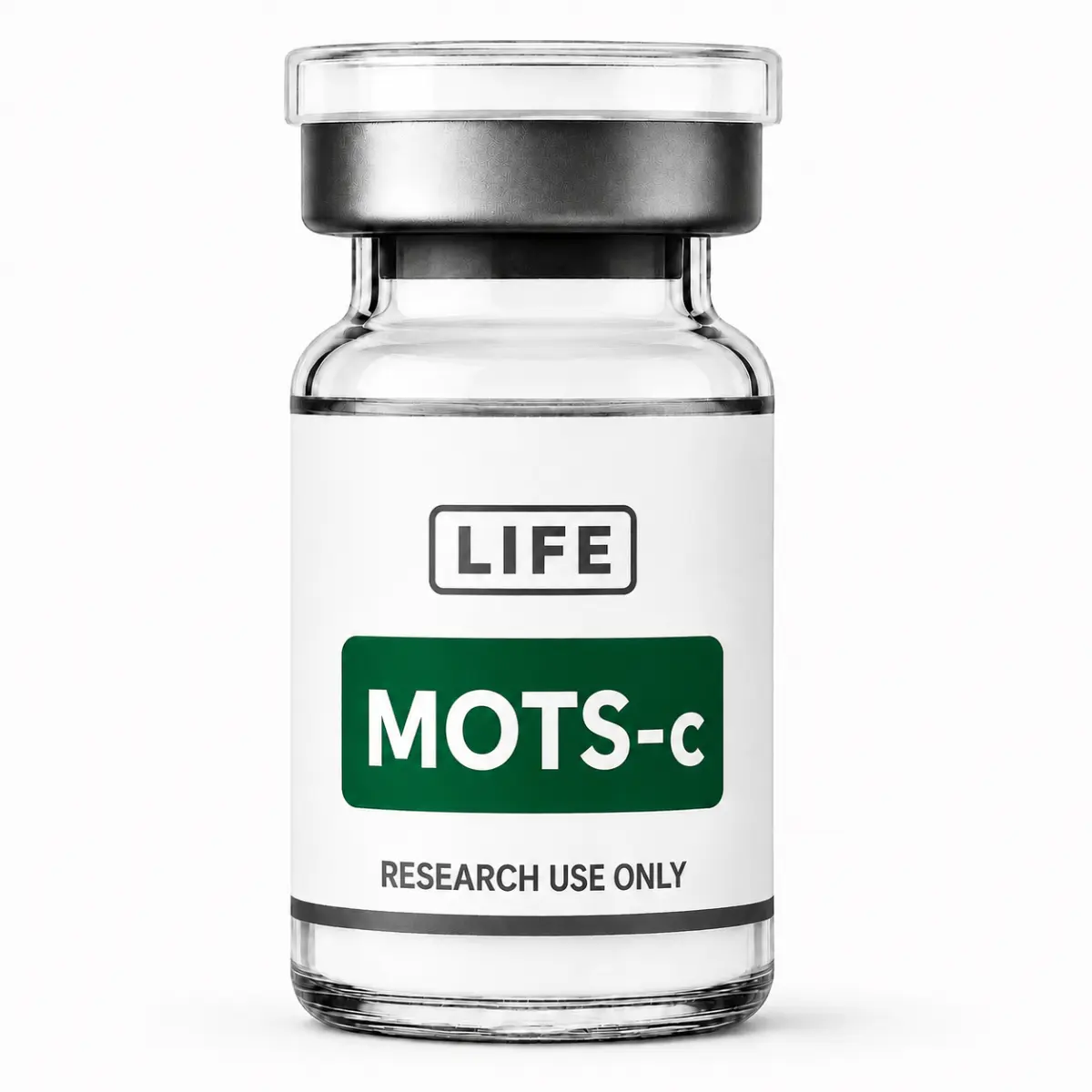
MOTS-c (Mitochondrial Open Reading Frame of the 12S rRNA Type-c) è un peptide derivato dai mitocondri, composto da 16 aminoacidi, che si trova in natura ed è codificato dal DNA mitocondriale anziché dal genoma nucleare. Questa origine unica lo distingue dalla maggior parte degli altri peptidi di ricerca e lo ha reso una molecola importante per studiare come i mitocondri comunicano con il resto della cellula.
La ricerca pubblicata suggerisce che MOTS-c venga rilasciato in risposta a stress metabolico ed esercizio fisico, dove aiuta a coordinare l'adattamento cellulare alla maggiore richiesta di energia. Per via di questo ruolo, il MOTS-c è diventato uno dei principali peptidi di ricerca in ricerca sul metabolismo, sulla fisiologia dell'esercizio fisico e sull'invecchiamento in salute.
Vuoi acquistare MOTS-c in Europa? Life Peptide fornisce MOTS-c ad alta purezza per la ricerca di laboratorio, con spedizioni affidabili in tutta l'Unione Europea.
Perché l'MOTS-c è ampiamente studiato
La ricerca pubblicata ha studiato il MOTS-c in relazione a:
- metabolismo energetico cellulare
- adattamento all'esercizio
- funzione mitocondriale
- flessibilità metabolica
- sensibilità all'insulina
- metabolismo del glucosio
- invecchiamento sano
- fisiologia del muscolo scheletrico
- Segnalazione di AMPK
Con l'espansione della ricerca sui peptidi di derivazione mitocondriale, il MOTS-c è diventato una delle molecole meglio caratterizzate che collegano la funzione mitocondriale con il metabolismo dell'intero organismo.
Come funziona MOTS-c
A differenza dei tradizionali ormoni peptidici, MOTS-c agisce come peptide di segnalazione mitocondriale, aiutando le cellule ad adattarsi allo stress metabolico.
La ricerca pubblicata ha esplorato la sua relazione con:
Metabolismo energetico cellulare
Il MOTS-c è stato studiato per la sua capacità di regolare l'uso dell'energia cellulare durante lo stress metabolico, influenzando le vie coinvolte nell'utilizzazione del glucosio e nel metabolismo degli acidi grassi.
Adattamento dell'esercizio
L'esercizio fisico aumenta l'espressione endogena di MOTS-c, rendendolo uno dei peptidi di origine mitocondriale più studiati nella fisiologia dell'esercizio. I ricercatori hanno studiato se MOTS-c contribuisca ad alcuni degli adattamenti metabolici normalmente associati all'attività fisica.
Segnalazione di AMPK
Uno dei principali meccanismi studiati per il MOTS-c prevede l'attivazione della protein chinasi attivata da AMP (AMPK), un regolatore chiave dell'equilibrio energetico cellulare e dell'adattamento metabolico.
Invecchiamento sano
Poiché la funzione mitocondriale cambia con l'età, il MOTS-c è diventato un importante bersaglio di ricerca negli studi che indagano la resilienza metabolica e l'invecchiamento in salute.
Perché il MOTS-c è spesso descritto come un “peptide dell'esercizio”
Una delle osservazioni più interessanti nella letteratura scientifica è che i livelli endogeni di MOTS-c aumentano in risposta all'esercizio fisico.
Invece di sostituire l'attività fisica, i ricercatori stanno studiando se MOTS-c attivi alcuni degli stessi percorsi cellulari coinvolti in adattamento metabolico indotto dall'esercizio, in particolare quelli legati a funzione mitocondriale e segnalazione AMPK. Ciò ha portato a descriverlo come un potenziale peptide mimetico dell'esercizio fisico, sebbene questa rimanga un'area di ricerca attiva e non debba essere interpretata come equivalente agli effetti fisiologici dell'esercizio stesso.
Ricerca umana e preclinica
La ricerca sul MOTS-c sta crescendo rapidamente, sebbene la base di prove rimanga notevolmente più piccola rispetto a quella dei peptidi metabolici consolidati come il Semaglutide o il Tirzepatide.
Studi pubblicati hanno indagato il MOTS-c in modelli di laboratorio di metabolismo, fisiologia dell'esercizio, sensibilità all'insulina e invecchiamento, mentre la ricerca umana si è concentrata principalmente sui livelli endogeni di MOTS-c e sulla loro relazione con la salute metabolica. La ricerca clinica interventistica rimane limitata.
In che modo il MOTS-c differisce dai peptidi metabolici correlati
| Peptide | Principale focus di ricerca |
|---|---|
| MOTS-c | Metabolismo mitocondriale e adattamento all'esercizio fisico |
| SS-31 (Elamipretide) | Funzione della membrana mitocondriale |
| Retatrutide | Segnalazione metabolica a tripla incretina |
| Semaglutide | Segnalazione del recettore del GLP-1 |
| AOD-9604 | Ricerca sui frammenti di ormone della crescita |
A differenza dei peptidi incretinici, il MOTS-c viene studiato principalmente per regolazione dell'energia cellulare e segnalazione mitocondriale, rendendolo uno dei pochi peptidi di ricerca che mirano direttamente alla biologia mitocondriale.
Osservazioni di sicurezza pubblicate
La maggior parte dei dati pubblicati su MOTS-c proviene da studi preclinici, con ricerche di intervento sull'uomo relativamente limitate. Le attuali indagini hanno generalmente riportato una tollerabilità accettabile nei primi studi, ma l'efficacia e la sicurezza a lungo termine rimangono in fase di studio. Poiché le prove cliniche stanno ancora emergendo, i risultati dovrebbero essere interpretati nel contesto della ricerca in corso.
Caratteristiche del prodotto
Applicazione: ricerca di laboratorio e analitica
Uso limitato: non per il consumo umano; non per uso medico, veterinario o cosmetico
Prodotto in stabilimenti conformi alle GMP secondo rigidi protocolli di controllo qualità.
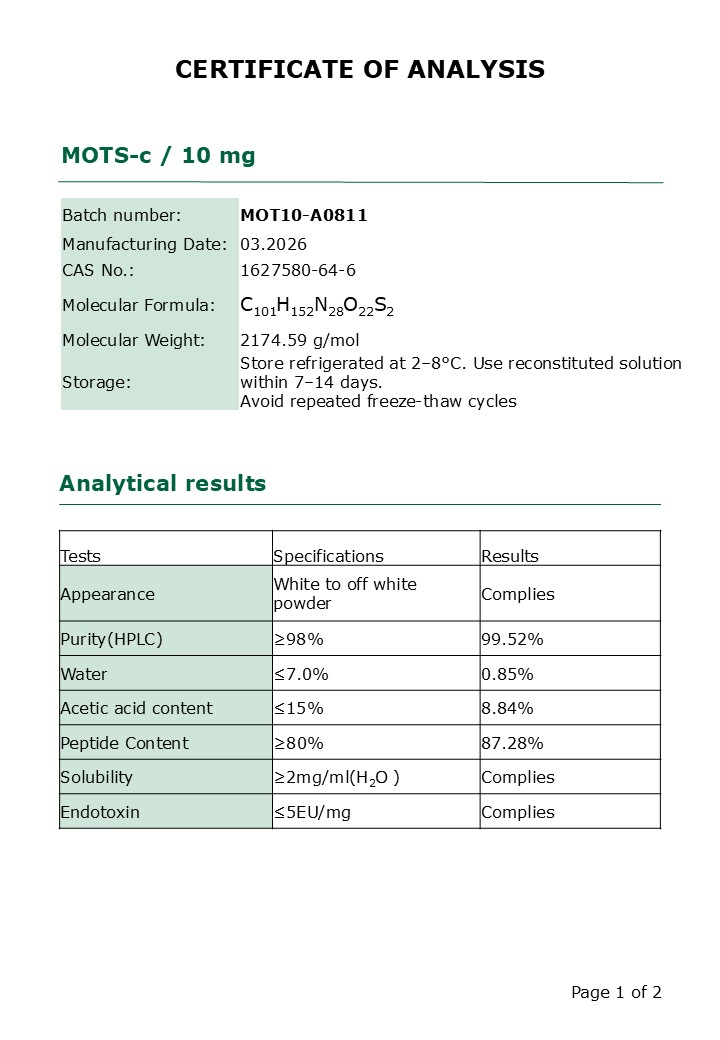
Ogni lotto viene accuratamente testato in laboratorio dopo la produzione (puoi trovare il Certificato di Analisi sotto le immagini del prodotto).
Liofilizzato (liofilizzato) per la massima stabilità e una lunga durata di conservazione.
Sigillato in fiale sterili, pronto per la ricostituzione.
Purezza: ≥99% (testato mediante HPLC)
Aspetto: polvere liofilizzata bianca/bianco sporco
Formula molecolare: C101H152N28O22S2
Peso molecolare: 2174,6
Sequenza: Met-Arg-Trp-Gln-Glu-Met-Gly-Tyr-Ile-Phe-Tyr-Pro-Arg-Lys-Leu-Arg
Archiviazioneflaconcini liofilizzati non aperti sono meglio conservati refrigerato a 2–8°C, che è il metodo di conservazione confermato dal nostro partner di produzione e adatto fino a 24 mesi. Si preferisce la refrigerazione perché minimizza inutili cicli di congelamento-scongelamento durante la manipolazione di routine. Se è necessaria una conservazione a termine sostanzialmente più lungo, i flaconcini liofilizzati non aperti possono anche essere conservati congelati. Una volta ricostituita, conservare sempre a 2-8°C e non congelare.
Ricostituzione e manipolazione
MOTS-c è fornito come flaconcino liofilizzato e deve essere manipolato utilizzando le procedure standard di ricostituzione dei peptidi appropriate per il contesto di ricerca. Deve essere ricostituito con acqua batteriostatica prima dell'uso. Per aiutare a preservare l'integrità strutturale, aggiungere il solvente scelto lentamente contro la parete interna del flaconcino piuttosto che direttamente sulla polvere del peptide, ed evitare agitazioni vigorose. Il delicato movimento rotatorio è generalmente sufficiente una volta che il peptide si è completamente sciolto. La pratica standard di laboratorio include anche il far raggiungere ai flaconcini refrigerati la temperatura ambiente prima della ricostituzione per minimizzare la condensa all'interno del flaconcino.
Per altre indicazioni sulla scelta del solvente, sulla pianificazione della concentrazione e sullo stoccaggio, consultare il pieno Guida alla Ricostituzione dei Peptidi e Calcolatore di Ricostituzione.
Riferimenti di ricerca selezionati
- Lee C, et al. Il peptide derivato dai mitocondri MOTS-c promuove l'omeostasi metabolica e riduce l'obesità e la resistenza all'insulina, Cell Metabolism, 2015
Il documento fondamentale che descrive la scoperta di MOTS-c e il suo ruolo nella regolazione metabolica.
- Zhou H, et al. Peptide derivato dai mitocondri MOTS-c: effetti e meccanismi correlati allo stress, al metabolismo e all'invecchiamento, Journal of Translational Medicine, 2023
Una rassegna completa che riassume le prove attuali sulla biologia, il metabolismo, l'adattamento allo stress e l'invecchiamento di MOTS-c.
- Atakan MM, Bishop DJ. Piccoli peptidi: potrebbero avere un ruolo importante nel metabolismo e nella risposta all'esercizio?, Journal of Physiology, 2024
Una revisione moderna che esamina i peptidi derivati dai mitocondri, incluso il MOTS-c, con particolare attenzione alla fisiologia dell'esercizio e all'adattamento metabolico.
- Bobylev AG, et al. Peptide mitocondriale MOTS-c: regolazione del metabolismo e prospettive di applicazione nella medicina clinica e sportiva, Fisiologia umana, 2025
Una rassegna che discute le prove emergenti sul MOTS-c nel metabolismo, nella fisiologia dell'esercizio e nell'invecchiamento in salute.
Domande Frequenti
Cos'è il MOTS-c?
MOTS-c è un peptide naturale derivato dai mitocondri e codificato dal DNA mitocondriale. È ampiamente studiato per il suo ruolo nel metabolismo energetico cellulare, nell'adattamento all'esercizio fisico e nell'invecchiamento in salute.
Perché il MOTS-c è associato alla ricerca sull'esercizio fisico?
Studi pubblicati hanno dimostrato che i livelli endogeni di MOTS-c aumentano in risposta all'esercizio fisico. I ricercatori stanno indagando se esso contribuisca agli adattamenti metabolici associati all'attività fisica attraverso vie di segnalazione come quella dell'AMPK.
Cosa rende il MOTS-c diverso dai peptidi GLP-1?
A differenza degli agonisti dei recettori del GLP-1, che studiano principalmente la segnalazione delle incretine, il MOTS-c si concentra sulla comunicazione mitocondriale, sulla regolazione dell'energia cellulare e sull'adattamento metabolico. Questi rappresentano distinti campi di ricerca metabolica.
Quali aree di ricerca investigano comunemente il MOTS-c?
La ricerca attuale comprende il metabolismo cellulare, la biologia mitocondriale, la sensibilità all'insulina, la fisiologia dell'esercizio fisico, la segnalazione dell'AMPK, l'adattamento del muscolo scheletrico e l'invecchiamento in salute.
In che modo il MOTS-c differisce dall'SS-31?
Entrambi sono peptidi mitocondriali, ma indagano diversi aspetti della biologia mitocondriale. Il MOTS-c è associato principalmente alla segnalazione metabolica e all'adattamento all'esercizio fisico, mentre l'SS-31 è studiato per l'integrità della membrana mitocondriale e la bioenergetica.
MOTS-c è un sostituto dell'esercizio fisico?
No. Sebbene il MOTS-c sia stato descritto come un peptide mimetico dell'esercizio fisico poiché attiva alcune vie metaboliche legate all'esercizio, la ricerca attuale non supporta la conclusione che esso riproduca tutti gli effetti fisiologici dell'esercizio fisico.
Posso acquistare MOTS-c in Europa?
Sì. Spediamo MOTS-c nella maggior parte dei paesi europei utilizzando servizi di corriere affidabili. I metodi di spedizione disponibili e i tempi di consegna vengono mostrati durante il pagamento in base alla destinazione.
Questo prodotto è destinato all'uso umano?
No. Il MOTS-c fornito da Life Peptide è destinato esclusivamente alla ricerca di laboratorio e analitica. Non è destinato al consumo umano, né alla diagnosi, al trattamento o alla prevenzione di malattie. Qualsiasi riferimento a studi pubblicati riporta una sintesi della letteratura scientifica relativa alla molecola MOTS-c e non riguarda l’uso previsto di questo prodotto.
Contesto di ricerca correlato
Il MOTS-c viene frequentemente discusso insieme ad altri peptidi di ricerca che indagano la funzione mitocondriale, il metabolismo e l'invecchiamento in salute, sebbene ciascuno si rivolga a diversi aspetti della fisiologia cellulare.
SS-31 (Elamipretide) – studiato per la riparazione mitocondriale e la produzione di energia cellulare.
Epitalon: studiato per la biologia dei telomeri e la ricerca sull'invecchiamento sano.
CJC-1295 con DAC – indagato per il segnalamento sostenuto di GH e IGF-1.
CJC-1295 Senza DAC – studiato per il rilascio fisiologico dell'ormone della crescita.
GHK-Cu – studiato per la rigenerazione tissutale e il rimodellamento della matrice extracellulare.
NOTA: Questo è solo a scopo didattico e non costituisce parere medico.
Dichiarazione di non responsabilità:
Questo prodotto è venduto esclusivamente a scopo di ricerca. Non è destinato a diagnosticare, trattare, curare o prevenire alcuna malattia. L'acquirente si assume la piena responsabilità per la corretta manipolazione e utilizzo.