Descrizione
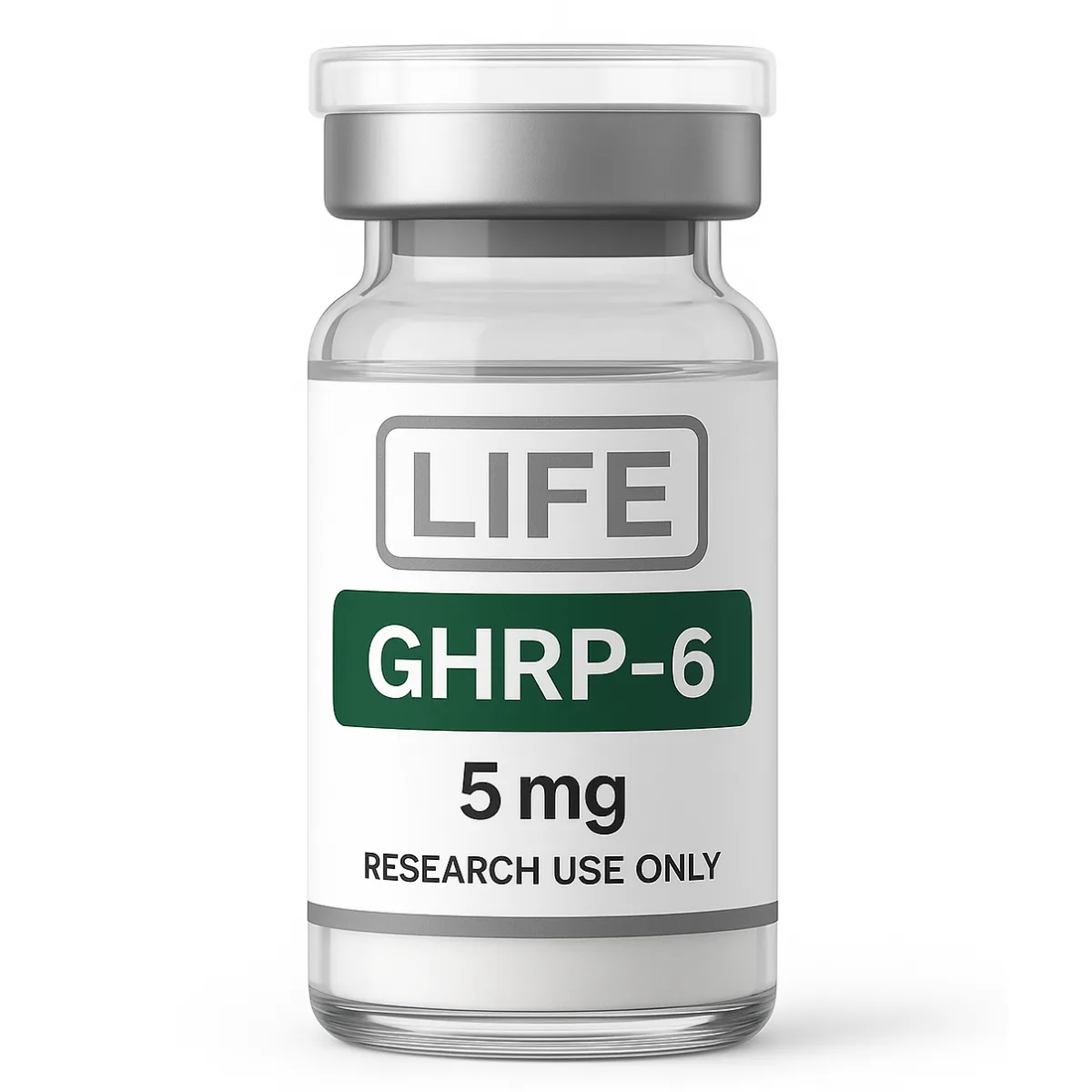
GHRP-6 (Growth Hormone Releasing Peptide-6) è un esapeptide sintetico e uno dei membri originali della famiglia dei secretagoghi dell'ormone della crescita (GHS). A differenza degli analoghi del GHRH come il CJC-1295, il GHRP-6 stimola l'ormone della crescita rilasciato da attivazione del recettore della grelina (GHSR-1a) anziché il recettore del GHRH.
Oltre ai suoi effetti endocrini, il GHRP-6 è diventato noto nella ricerca perché l'attivazione del recettore della grelina influenza anche appetito, fisiologia gastrointestinale e bilancio energetico. Questo profilo biologico più ampio lo distingue dai secretagoghi più recenti che si concentrano principalmente sul rilascio dell'ormone della crescita.
Vuoi acquistare GHRP-6 in Europa? Life Peptide fornisce GHRP-6 ad alta purezza per la ricerca di laboratorio, con spedizioni affidabili in tutta l'Unione Europea.
Perché il GHRP-6 è importante nella ricerca endocrina
Una delle caratteristiche distintive del GHRP-6 è che riproduce molti aspetti di naturale segnalazione della grelina.
La ricerca pubblicata ha studiato il GHRP-6 in relazione a:
- secrezione pulsatile dell'ormone della crescita
- biologia del recettore della grelina
- regolazione dell'appetito
- apporto di cibo
- fisiologia endocrina
- Segnalazione di IGF-1
- motilità gastrointestinale
- bilancio energetico
Poiché la grelina regola molto di più della sola secrezione dell'ormone della crescita, il GHRP-6 rimane un importante strumento di ricerca per studiare il più ampio sistema di segnalazione della grelina.
Come funziona il GHRP-6
A differenza degli analoghi del GHRH, il GHRP-6 agisce stimolando il recettore del secretagogo dell'ormone della crescita (GHSR-1a), ora riconosciuto come recettore della grelina.
La ricerca pubblicata ha esplorato la sua relazione con:
Secrezione dell'ormone della crescita
Stimolazione del rilascio pulsatile di GH attraverso l'attivazione del recettore della grelina.
Regolazione dell'appetito
Il GHRP-6 è uno dei secretagoghi più ampiamente studiati per la segnalazione oressigena e la ricerca sull'assunzione di cibo.
Fisiologia gastrointestinale
Studi sperimentali hanno investigato lo svuotamento gastrico, la motilità gastrointestinale e la regolazione digestiva.
Omeostasi energetica
La ricerca ha anche esaminato le interazioni tra la segnalazione della grelina, la composizione corporea e la regolazione metabolica.
Perché il GHRP-6 è ampiamente studiato nella ricerca sull'appetito
Tra i secretagogi dell'ormone della crescita classici, Il GHRP-6 è particolarmente noto per i suoi effetti sulla segnalazione correlata all'appetito..
Poiché la grelina è il principale ormone della fame dell'organismo, l'attivazione del recettore della grelina è diventata un'importante area di ricerca in:
- regolazione dell'appetito
- apporto di cibo
- fisiologia della nutrizione
- ricerca sulla cachessia
- bilancio energetico
Questo rende il GHRP-6 particolarmente interessante per i ricercatori che studiano la regolazione endocrina oltre alla sola secrezione dell'ormone della crescita.
Ricerca umana e preclinica
Il GHRP-6 è stato studiato per diversi decenni sia nella ricerca di laboratorio che in quella umana.
Studi pubblicati hanno esplorato:
- fisiologia endocrina
- rilascio dell'ormone della crescita
- regolazione dell'appetito
- funzione gastrointestinale
- segnalazione metabolica
Sebbene gran parte dell'attenzione odierna si sia spostata verso secretagoghi più recenti come l'Ipamorelin, il GHRP-6 rimane uno dei composti fondamentali nella ricerca sui recettori della grelina e continua a essere ampiamente citato negli studi sulla biologia del GHSR.
In che modo il GHRP-6 differisce dagli altri segretagoghi del GH
GHRP-6
- Forte agonista del recettore della ghrelina
- Rilascio GH robusto
- Segnalazione dell'appetito
- Ricerca gastrointestinale
- Potente secretagogo dell'ormone della crescita
- Minore stimolazione dell'appetito
- Fisiologia endocrina
- Ipamorelin
- Agonista del recettore della grelina altamente selettivo
- Effetti sull'appetito minimi
- Profilo endocrino più pulito
- Analogo del GHRH
- Percorso recettoriale diverso
- Spesso studiati insieme ai GHRP
Piuttosto che rimpiazzarsi a vicenda, questi peptidi rappresentano approcci diversi per studiare la fisiologia dell'ormone della crescita e la segnalazione della grelina.
Osservazioni di sicurezza pubblicate
Gli studi clinici pubblicati sull'uomo hanno generalmente descritto il GHRP-6 come un agente che produce aumenti transitori della secrezione dell'ormone della crescita, insieme a risposte endocrine misurabili coerenti con l'attivazione del recettore della grelina. Come per altri secretagoghi dell'ormone della crescita, stimolazione dell'appetito e aumenti della prolattina o del cortisolo sono stati segnalati anche in alcune impostazioni sperimentali.
Caratteristiche del prodotto
Applicazione: ricerca di laboratorio e analitica
Uso limitato: non per il consumo umano; non per uso medico, veterinario o cosmetico
Prodotto in stabilimenti conformi alle GMP secondo rigidi protocolli di controllo qualità.
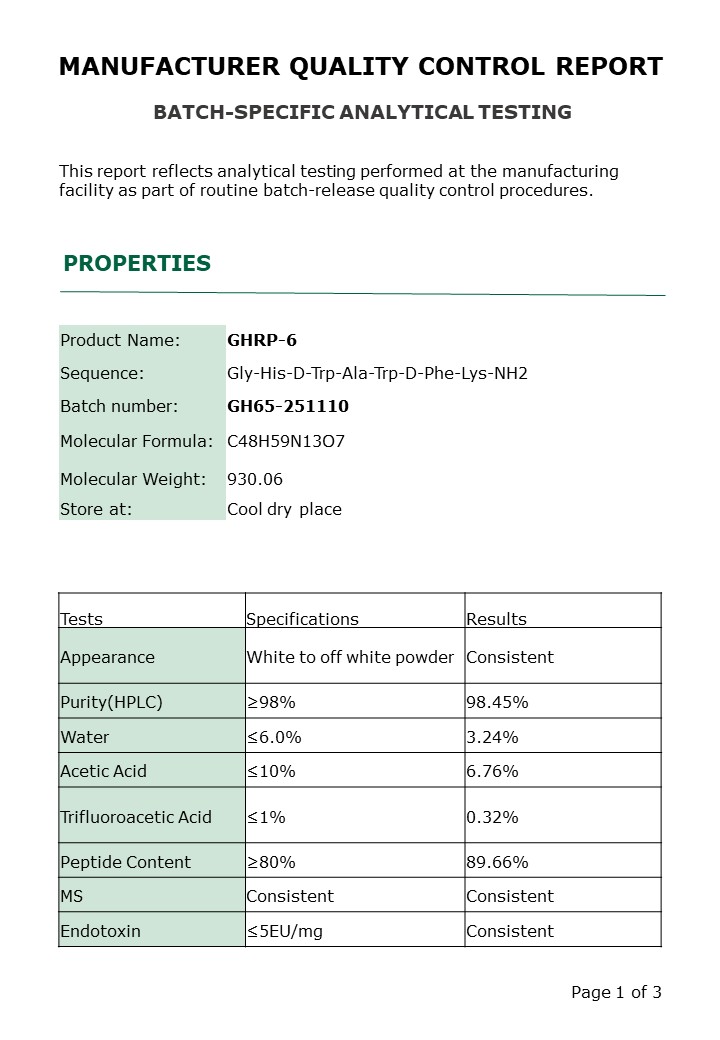
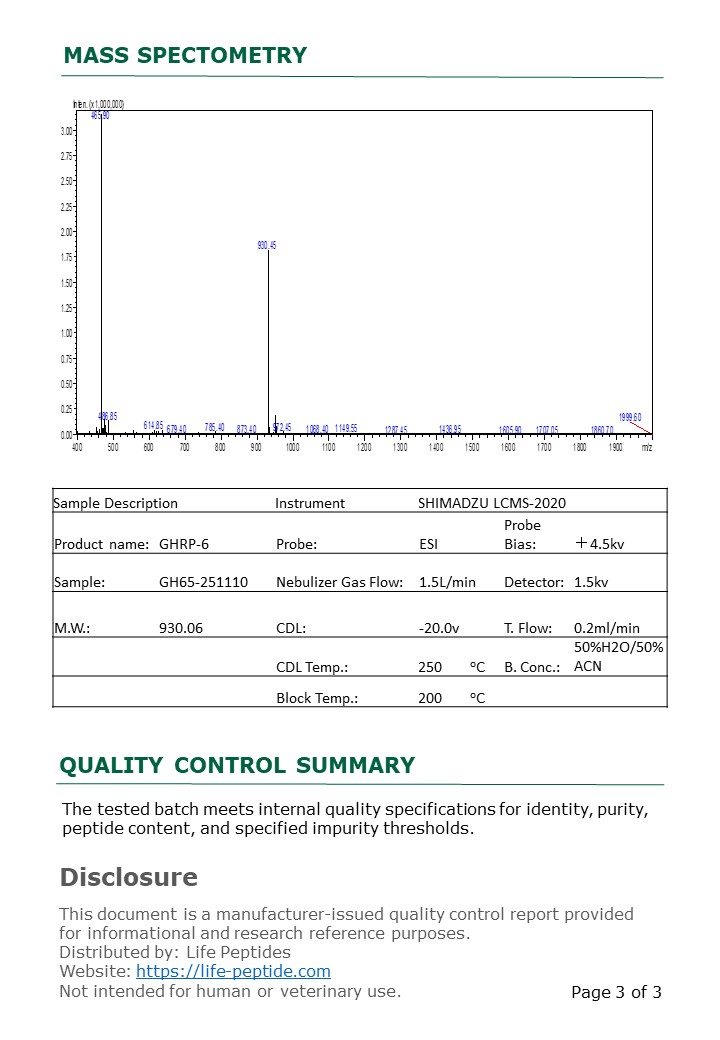
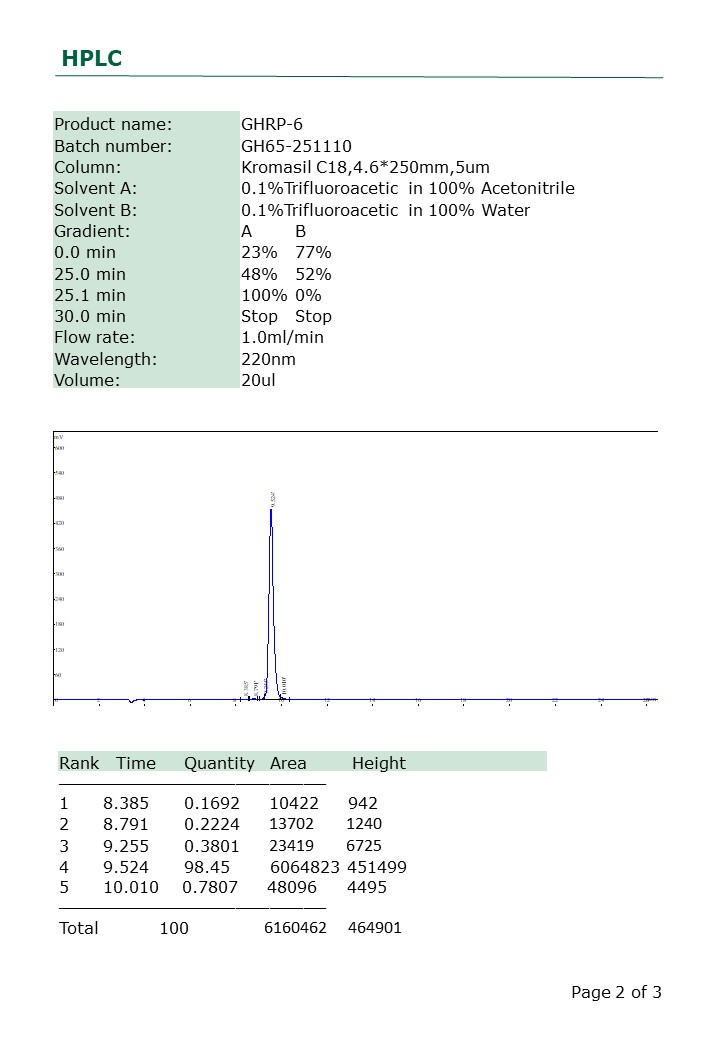
Ogni lotto viene accuratamente testato in laboratorio dopo la produzione (puoi trovare il Certificato di Analisi sotto le immagini del prodotto).
Liofilizzato (liofilizzato) per la massima stabilità e una lunga durata di conservazione.
Sigillato in fiale sterili, pronto per la ricostituzione.
Purezza: ≥98% (testata mediante HPLC)
Aspetto: polvere liofilizzata bianca/bianco sporco
Formula molecolare: C48H59N13O7
Peso molecolare: 930,06
Sequenza: Gly-His-D-Trp-Ala-Trp-D-Phe-Lys-NH2
Archiviazioneflaconcini liofilizzati non aperti sono meglio conservati refrigerato a 2–8°C, che è il metodo di conservazione confermato dal nostro partner di produzione e adatto fino a 24 mesi. Si preferisce la refrigerazione perché minimizza inutili cicli di congelamento-scongelamento durante la manipolazione di routine. Se è necessaria una conservazione a termine sostanzialmente più lungo, i flaconcini liofilizzati non aperti possono anche essere conservati congelati. Una volta ricostituita, conservare sempre a 2-8°C e non congelare.
Ricostituzione e manipolazione
GHRP-6 viene fornito come flaconcino liofilizzato e deve essere manipolato utilizzando procedure standard di ricostituzione dei peptidi appropriate per l'ambiente di ricerca. Deve essere ricostituito con acqua batteriostatica prima dell'uso. Per aiutare a preservare l'integrità strutturale, aggiungere il solvente scelto lentamente contro la parete interna del flaconcino piuttosto che direttamente sulla polvere del peptide, ed evitare agitazioni vigorose. Il delicato movimento rotatorio è generalmente sufficiente una volta che il peptide si è completamente sciolto. La pratica standard di laboratorio include anche il far raggiungere ai flaconcini refrigerati la temperatura ambiente prima della ricostituzione per minimizzare la condensa all'interno del flaconcino.
Per altre indicazioni sulla scelta del solvente, sulla pianificazione della concentrazione e sullo stoccaggio, consultare il pieno Guida alla Ricostituzione dei Peptidi e Calcolatore di Ricostituzione.
Studi chiave pubblicati
- Bowers CY, et al. Peptidi rilascianti l'ormone della crescita e i loro analoghi. Frontiers in Neuroendocrinology, 1998
Una revisione fondamentale che introduce la biologia dei GHRP e differenzia la via del GHS dal GHRH.
- Lengyel AMJ, et al. Peptidi che rilasciano l'ormone della crescita e grelina. Brazilian Journal of Medical and Biological Research, 2006
Una revisione completa del GHRP-6, della biologia del recettore della ghrelina e dei meccanismi endocrini.
- Berlanga-Acosta J, et al. Peptidi di rilascio dell'ormone della crescita sintetici (GHRP). Clinical Science, 2017
Una vasta revisione sulla farmacologia del GHRP-6, sullo sviluppo clinico e sulla ricerca terapeutica.
- Yin Y, Li Y, Zhang W. Il recettore dei secretagoghi dell'ormone della crescita: la sua segnalazione intracellulare e la funzione fisiologica. International Journal of Molecular Sciences, 2014
Una rassegna autorevole sulla segnalazione di GHSR, sulla biologia della grelina e sulla farmacologia dei secretagoghi.
Domande Frequenti
Cos'è il GHRP-6?
Il GHRP-6 è un esapeptide sintetico che attiva il recettore della grelina (GHSR-1a). È ampiamente studiato per la secrezione pulsatile dell'ormone della crescita, la regolazione dell'appetito e la fisiologia endocrina.
In che modo il GHRP-6 differisce dall'Ipamorelin?
Entrambi attivano il recettore della grelina, ma il GHRP-6 è molto più fortemente associato alla segnalazione dell'appetito, mentre l'Ipamorelin è generalmente studiato per un rilascio di GH più selettivo con minore attività oressigenica.
In che modo il GHRP-6 differisce dal GHRP-2?
Entrambi appartengono alla stessa famiglia di peptidi e stimolano il rilascio di GH tramite il GHSR-1a. Il GHRP-6 è generalmente riconosciuto per una maggiore stimolazione dell'appetito, mentre il GHRP-2 è spesso considerato il secretagogo endocrino più potente.
Perché il GHRP-6 è associato alla ricerca sull'appetito?
Il GHRP-6 imita la grelina, il principale ormone oressigenico del corpo. Ciò lo ha reso un importante strumento di ricerca per la regolazione dell'appetito, l'assunzione di cibo e l'omeostasi energetica.
Quali sono le aree di ricerca che comunemente studiano il GHRP-6?
Studi pubblicati investigano il GHRP-6 nella secrezione dell'ormone della crescita, nella biologia del recettore della grelina, nella regolazione dell'appetito, nella fisiologia gastrointestinale, nella segnalazione endocrina e nel bilancio energetico.
Posso comprare il GHRP-6 in Europa?
Sì. Spediamo GHRP-6 nella maggior parte dei paesi europei utilizzando servizi di corriere affidabili. I metodi di spedizione disponibili e i tempi di consegna vengono mostrati durante il pagamento in base alla destinazione.
Questo prodotto è destinato all'uso umano?
No. Il GHRP-6 fornito da Life Peptide è destinato esclusivamente alla ricerca di laboratorio e analitica. Non è destinato al consumo umano, né alla diagnosi, al trattamento o alla prevenzione di malattie. Qualsiasi riferimento a studi pubblicati riporta una sintesi della letteratura scientifica relativa alla molecola GHRP-6 e non all’uso previsto di questo prodotto.
Contesto di ricerca correlato
Il GHRP-6 appartiene alla classe dei secretagoghi dell'ormone della crescita, un gruppo di peptidi studiati per il loro ruolo nella segnalazione del GH, nella modulazione endocrina e nel rilascio pulsatile di ormoni.
I ricercatori che studiano la dinamica dell'asse GH possono anche esaminare:
Ipamorelin – peptide selettivo di rilascio dell'ormone della crescita
CJC-1295 (senza DAC) – analogo del GHRH a breve durata d'azione
Tesamorelin – Analogo peptidico basato sul GHRH
GHRP-2 – potente peptide rilasciante l'ormone della crescita
Sfoglia tutti i composti in Categoria dei secretagoghi dell'ormone della crescita o esplorare più ampi percorsi di segnalazione endocrina nel Guida alla ricerca sui peptidi dell'ormone della crescita.
NOTA: Questo è solo a scopo didattico e non costituisce parere medico.
Dichiarazione di non responsabilità:
Questo prodotto è venduto esclusivamente a scopo di ricerca. Non è destinato a diagnosticare, trattare, curare o prevenire alcuna malattia. L'acquirente si assume la piena responsabilità per la corretta manipolazione e utilizzo.