Popis
Tesamorelin is a synthetic analogue of human growth hormone-releasing hormone (GHRH) consisting of the full 44-amino-acid GHRH sequence with structural modifications that improve stability and resistance to enzymatic degradation.
Unlike GHRP peptides, which stimulate the ghrelin receptor (GHSR-1a), Tesamorelin acts directly on the GHRH receptor in the anterior pituitary, promoting physiological pulsatile secretion of endogenous growth hormone. This receptor selectivity has made Tesamorelin one of the most thoroughly investigated peptides in growth hormone physiology and metabolic research.
Looking to buy Tesamorelin in Europe? LIFE Peptide supplies high-purity Tesamorelin for laboratory research with reliable EU-wide shipping.
Why Tesamorelin matters in endocrine research
Tesamorelin differs from many secretagogues because it closely mimics the body’s natural GHRH signalling rather than activating ghrelin pathways.
Published research has investigated Tesamorelin in relation to:
- pulzatilní sekrece růstového hormonu
- Regulace IGF-1
- složení těla
- visceral adipose tissue
- hepatic fat
- fyziologie endokrinního systému
- metabolická regulace
- funkce hypofýzy
Its extensive human evidence base has established Tesamorelin as one of the best-characterised GHRH analogues available for metabolic and endocrine research.
How Tesamorelin works
Unlike GHRP peptides, Tesamorelin activates the growth hormone-releasing hormone receptor (GHRHR).
Publikovaný výzkum zkoumal jeho vztah s:
Sekrece růstového hormonu
Tesamorelin stimulates physiological pulsatile release of endogenous growth hormone through direct activation of pituitary GHRH receptors.
Regulace IGF-1
Clinical studies consistently demonstrate increased circulating IGF-1 following Tesamorelin administration, making it an important research tool for GH-axis physiology.
Body composition
A major area of investigation has been the relationship between endogenous GH stimulation and changes in visceral adipose tissue and lean body mass.
Metabolic physiology
Researchers have also investigated hepatic fat metabolism, lipid regulation and broader metabolic adaptations associated with physiological GH release.
Why Tesamorelin is widely investigated in metabolic research
Among growth hormone secretagogues, Tesamorelin occupies a unique position because much of its research has focused on metabolic health rather than growth hormone deficiency alone.
Publikované studie prozkoumaly:
- visceral adipose tissue
- hepatic fat
- složení těla
- metabolický syndrom
- Fyziologie IGF-1
- endokrinní regulace
- HIV-associated lipodystrophy
This broad clinical evidence has made Tesamorelin one of the most important peptides for studying the interaction between the growth hormone axis and metabolic physiology.
Lidský a preklinický výzkum
Tesamorelin has one of the strongest clinical evidence bases among all growth hormone secretagogues.
Multiple Phase III studies have investigated its effects on growth hormone secretion, visceral adipose tissue, lipid metabolism and hepatic fat. Unlike many research peptides, Tesamorelin has also received regulatory approval for one specific clinical indication, resulting in extensive long-term human safety and efficacy data.
How Tesamorelin differs from other GH secretagogues
Tesamorelin
- Analogon GHRH
- Direct GHRH receptor activation
- Strong clinical evidence
- Extensive metabolic research
- Analogon GHRH
- Longer research half-life
- Primarily experimental
- Agonista ghrelinového receptoru
- Selektivní sekretagog GH
- Minimální vliv na chuť k jídlu
- Potentní agonista ghrelinových receptorů
- Robust GH pulses
- Endokrinní fyziologie
- Agonista ghrelinového receptoru
- Chuť k jídlu a výzkum GH
- Gastrointestinální fyziologie
- Publikované bezpečnostní poznatky
Published clinical studies have generally reported Tesamorelin to be dobře snášený. The most commonly reported adverse events included injection-site reactions, arthralgia, peripheral oedema and transient increases in IGF-1, with gastrointestinal effects occurring less frequently than with many modern metabolic peptides. Safety findings are derived from controlled clinical trials conducted primarily in patients with HIV-associated lipodystrophy.
Vlastnosti produktu
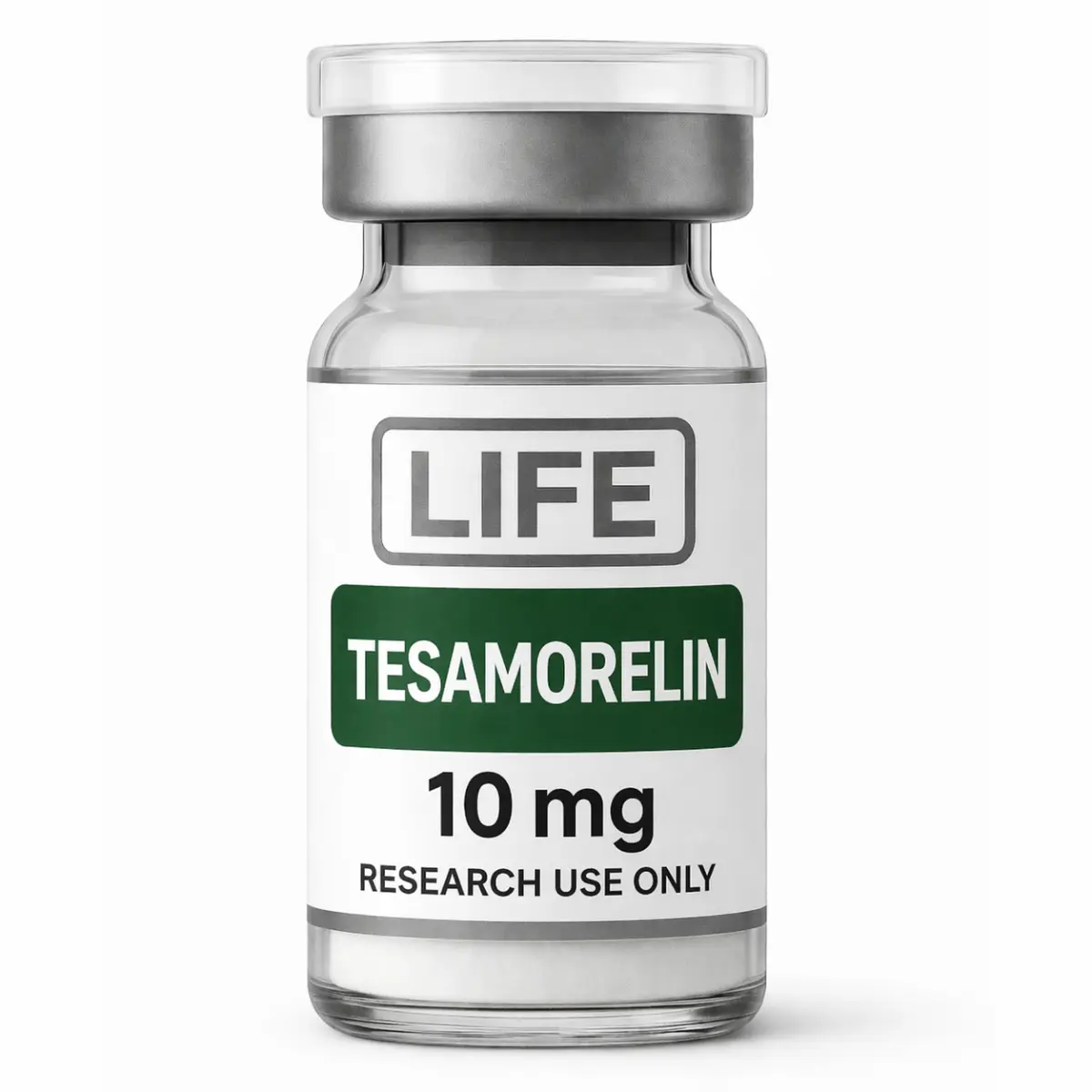
Aplikace: laboratorní a analytický výzkum
Použití omezené: není určeno k lidské spotřebě; pro lékařské, veterinární ani kosmetické použití
Vyrobeno v zařízeních splňujících správnou výrobní praxi (GMP) za přísných protokolů kontroly kvality.
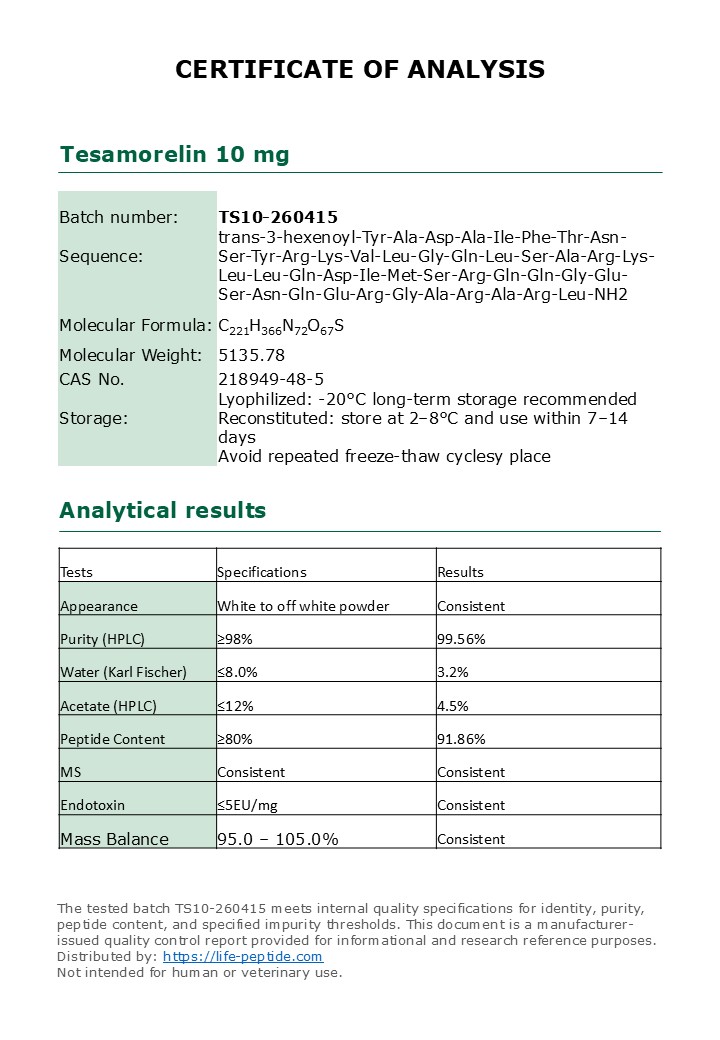
Každá šarže je po výrobě pečlivě laboratorně testována (Certifikát o analýze najdete pod obrázky produktů).
Lyofilizováno (sušeno mrazem) pro maximální stabilitu a prodlouženou trvanlivost.
Uzavřeno ve sterilních lahvičkách, připraveno k rekonstituci.
Čistota: ≥ 99% (HPLC)
Vzhled: bílý lyofilizovaný prášek
Molekulární vzorec: C221H366N72O67S
Molecular weight: 5135.78
CAS No: 218949-48-5
ÚložištěNeotevřené lyofilizované lahvičky jsou nejlépe skladovány chlazené při 2–8 °C, což je metoda skladování potvrzená naším výrobním partnerem a vhodná až po dobu 24 měsíců. Preferuje se chlazení, protože minimalizuje zbytečné cykly zmrazování a rozmrazování během běžné manipulace. Pokud je vyžadováno podstatně delší skladování, lze zmrazené uchovávat i neotevřené lyofilizované lahvičky. Po rekonstituci vždy skladujte při 2–8 °C a nezmrazujte.
Rekonstituce a manipulace
Tesamorelin is supplied as a lyophilised vial and should be handled using standard peptide reconstitution procedures appropriate to the research setting. Must be reconstituted with bakteriostatická voda před použitím. Pro zachování strukturální integrity přidejte zvolené rozpouštědlo pomalu po vnitřní stěně lahvičky namísto přímo na peptidový prášek a vyhněte se prudkému protřepávání. Jemné kroužení je obecně dostačující, jakmile se peptid zcela rozpustí. Standardní laboratorní postupy zahrnují také ponechání chlazených lahviček dosáhnout pokojové teploty před rekonstitucí, aby se minimalizovala kondenzace uvnitř lahvičky.
Pro další pokyny k výběru rozpouštědla, plánování koncentrací a skladování viz úplné Průvodce rekonstitucí peptidů a Kalkulačka rekonstituce.
Klíčové publikované studie
- Falutz J, Allas S, Blot K, et al. Metabolic Effects of a Growth Hormone-Releasing Factor in Patients with HIV. New England Journal of Medicine, 2007.
The pivotal Phase III study demonstrating reductions in visceral adipose tissue following Tesamorelin treatment while preserving lean body mass.
- Stanley TL, Feldpausch MN, Oh J, et al. Effect of Tesamorelin on Visceral Fat and Liver Fat in HIV-Infected Patients With Abdominal Fat Accumulation. JAMA, 2014.
A landmark study showing reductions in visceral and hepatic fat, expanding Tesamorelin research into metabolic liver physiology.
- Spooner LM, et al. Tesamorelin: A Growth Hormone-Releasing Factor Analogue for HIV-Associated Lipodystrophy. Drugs, 2012.
A comprehensive review covering pharmacology, mechanism of action and clinical development of Tesamorelin.
- Badran AS, et al. Body Composition, Hepatic Fat, Metabolic and Safety Outcomes of Tesamorelin: A Meta-analysis of Randomized Controlled Trials. Obesity Research & Clinical Practice, 2026.
A recent meta-analysis summarising clinical evidence for body composition, liver fat and metabolic outcomes across Tesamorelin trials.
Často kladené otázky
What is Tesamorelin?
Tesamorelin is a synthetic analogue of human growth hormone-releasing hormone (GHRH). It stimulates the pituitary gland through the GHRH receptor, promoting physiological pulsatile release of endogenous growth hormone. It is widely investigated in endocrine and metabolic research involving the GH/IGF-1 axis, body composition and visceral adipose tissue.
How does Tesamorelin differ from CJC-1295?
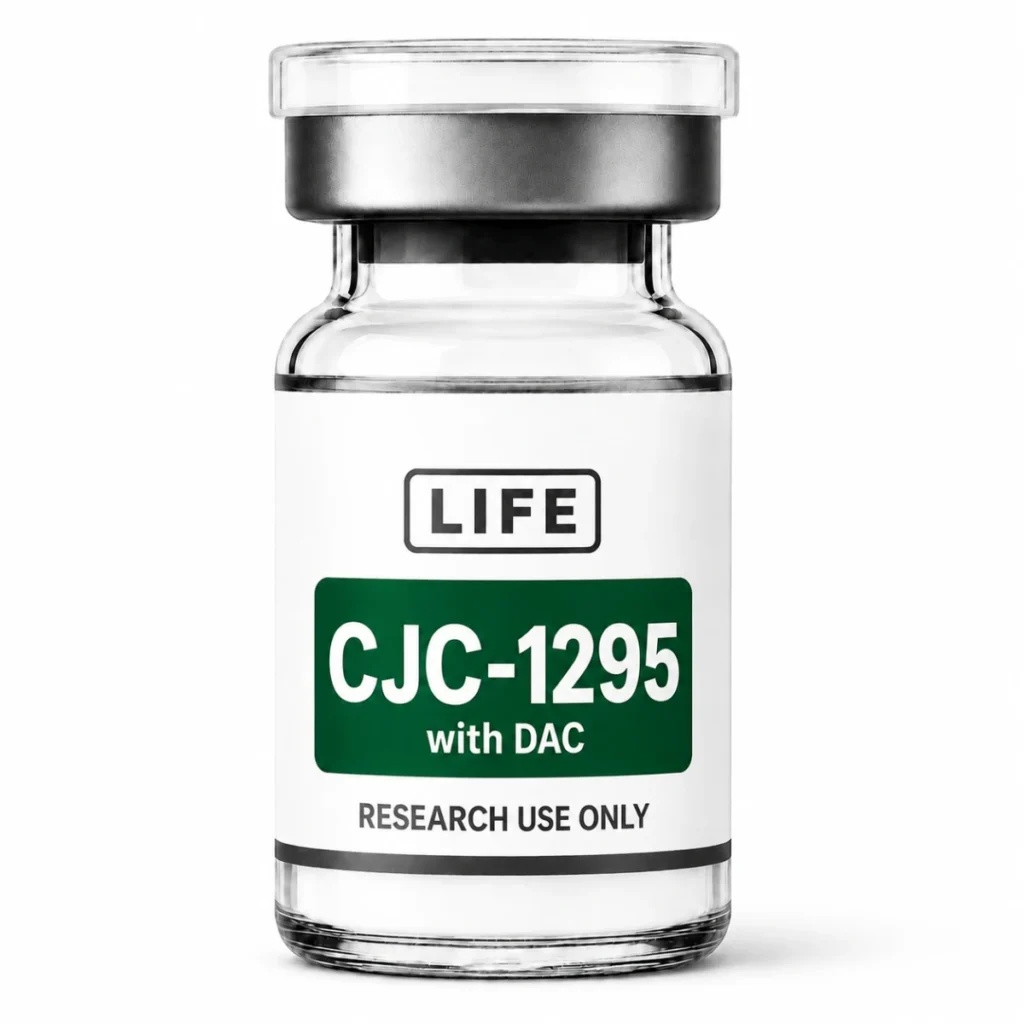
Both Tesamorelin and CJC-1295 are GHRH analogues that activate the same receptor pathway. Tesamorelin has an extensive clinical evidence base, including regulatory approval for HIV-associated lipodystrophy, whereas CJC-1295 remains primarily an experimental research peptide. Their receptor mechanism is similar, but their clinical development differs substantially.
How does Tesamorelin differ from Ipamorelin or GHRP peptides?
Tesamorelin stimulates growth hormone release through the GHRH receptor, while Ipamorelin, GHRP-2 and GHRP-6 activate the ghrelin receptor (GHSR-1a). These are complementary physiological pathways, which is why GHRH analogues and GHRP peptides are frequently investigated together in endocrine research.
Why is Tesamorelin widely investigated in metabolic research?
Beyond growth hormone physiology, Tesamorelin has been extensively studied for its effects on body composition, visceral adipose tissue, hepatic fat, lipid metabolism and IGF-1 regulation. This broad clinical evidence distinguishes it from many other growth hormone secretagogues.
What research areas commonly investigate Tesamorelin?
Published studies have investigated Tesamorelin in growth hormone secretion, IGF-1 regulation, pituitary physiology, body composition, visceral adipose tissue, hepatic fat, metabolic regulation and endocrine signalling.
Can Tesamorelin be combined with GHRP peptides in research?
Yes. Because Tesamorelin activates the GHRH receptor while GHRP peptides activate the ghrelin receptor, researchers frequently investigate these pathways together to study complementary mechanisms regulating pulsatile growth hormone secretion. Individual study designs vary, and findings should be interpreted within the context of the published research.
Can I buy Tesamorelin in Europe?
Yes. We ship Tesamorelin to most European countries using reliable courier services. Available shipping methods and delivery times are shown during checkout based on your destination.
Je tento produkt určen k lidskému použití?
No. Tesamorelin supplied by LIFE Peptide is provided strictly for laboratory and analytical research. It is not intended for human consumption, diagnosis, treatment or prevention of disease. Any discussion of published studies summarises the scientific literature relating to the Tesamorelin molecule rather than the intended use of this product.
Související výzkumný kontext
Tesamorelin belongs to the GHRH analogue and growth hormone signaling research class, which includes peptides investigated for endocrine regulation, GH-axis modulation, and pulsatile hormone release mechanisms.
Pro širší přehled signálních drah GH a srovnávacích mechanismů peptidů viz naše Průvodce výzkumem růstových hormonových peptidů.
Výzkumníci studující interakce osy GH se mohou také zabývat:
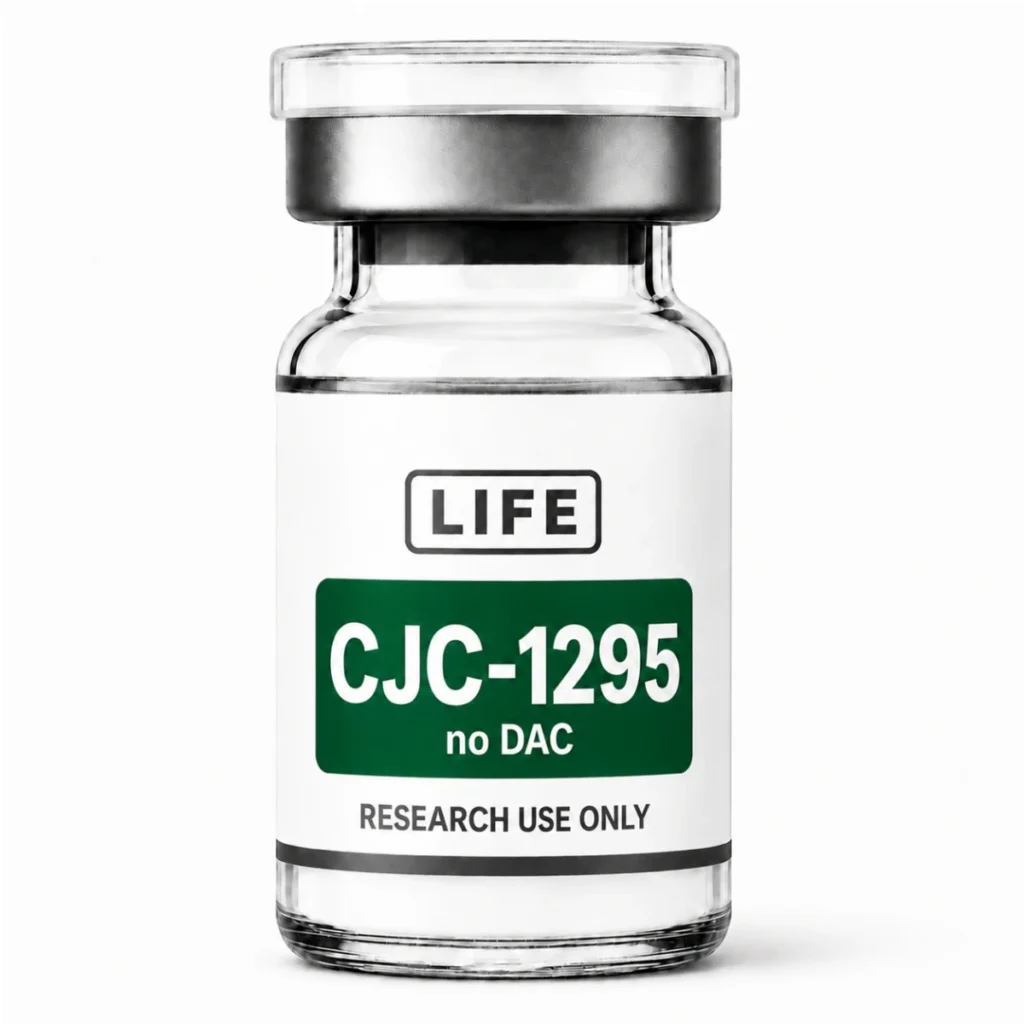
CJC-1295 (bez DAC)
Ipamorelin
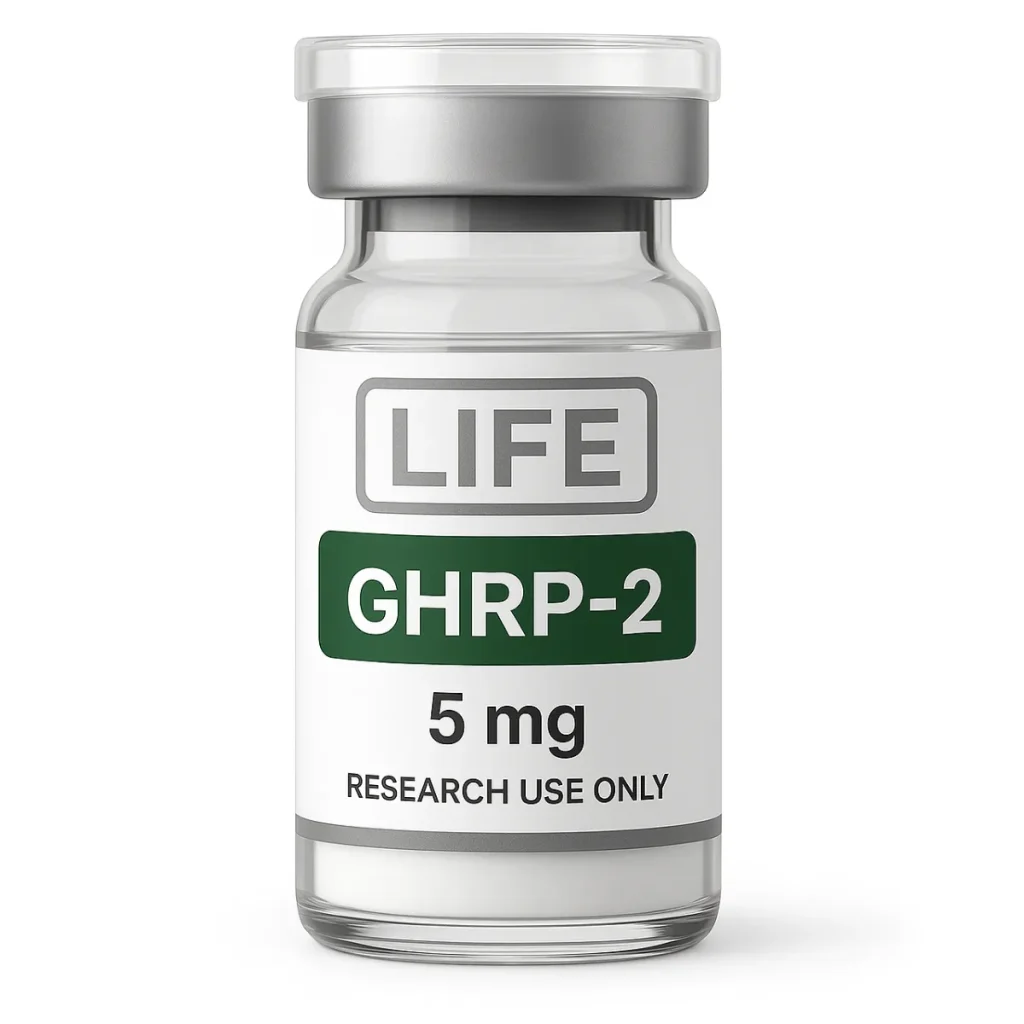
GHRP-2
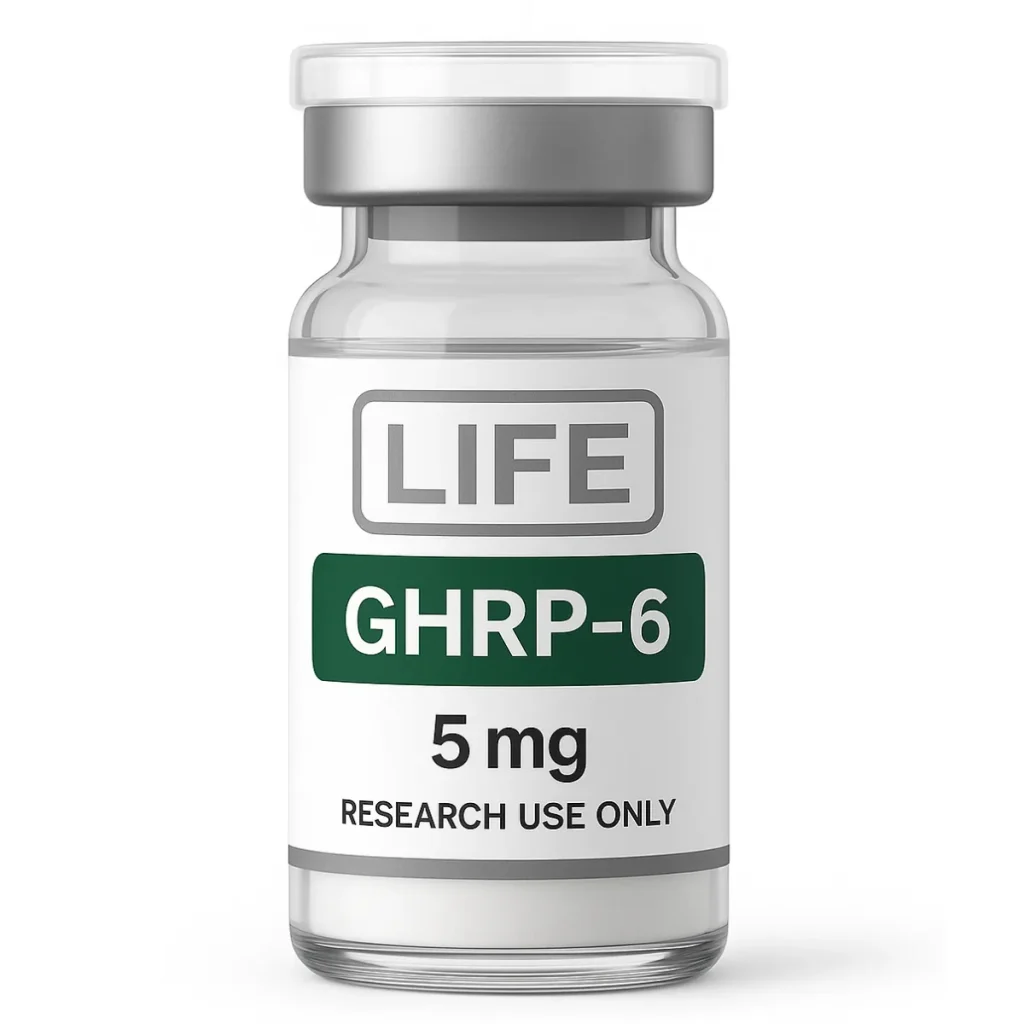
GHRP-6
Procházet všechny sloučeniny v Sekre pagy růstového hormonu.
Výzkumníci zkoumající endokrinní regulaci mohou také zkoumat sloučeniny v Metabolický výzkum, včetně GLP-1 a agonistů inkretinů s více dráhami.
POZNÁMKAToto je pouze pro vzdělávací účely a nepředstavuje lékařskou radu.
Zřeknutí se odpovědnosti
Tento produkt je prodáván pouze pro výzkumné účely. Není určen k diagnostice, léčbě, vyléčení nebo prevenci jakýchkoli onemocnění. Kupující přebírá plnou odpovědnost za řádnou manipulaci a použití.