Descripción
Tesamorelin es un análogo sintético de hormona liberadora de hormona del crecimiento (GHRH) que consiste en la secuencia completa de GHRH de 44 aminoácidos con modificaciones estructurales que mejoran la estabilidad y la resistencia a la degradación enzimática.
A diferencia de los péptidos GHRP, que estimulan el receptor de la grelina (GHSR-1a), la tesamorelina actúa directamente en el receptor de GHRH en la adenohipófisis, promoviendo la secreción pulsátil fisiológica de la hormona de crecimiento endógena. Esta selectividad de los receptores ha convertido a la Tesamorelin en uno de los péptidos más investigados exhaustivamente en la fisiología de la hormona del crecimiento y la investigación metabólica.
¿Quieres comprar tesamorelina en Europa? Life Peptide suministra tesamorelina de alta pureza para investigación de laboratorio, con envíos fiables a toda la UE.
Por qué la tesamorelin es importante en la investigación endocrina
El tesamorelin se diferencia de muchos secretagogos porque imita de cerca la señalización natural de GHRH del cuerpo en lugar de activar las vías de la grelina.
La investigación publicada ha investigado la tesamorelina en relación con:
- secreción pulsátil de hormona del crecimiento
- Regulación del IGF-1
- composición corporal
- tejido adiposo visceral
- grasa hepática
- fisiología endocrina
- regulación metabólica
- función pituitaria
Su extensa base de evidencia en humanos ha establecido a la tesamorelina como uno de los análogos de GHRH mejor caracterizados disponibles para la investigación metabólica y endocrina.
Cómo funciona el tesamorelina
A diferencia de los péptidos GHRP, la tesamorelin activa el receptor de la hormona liberadora de la hormona del crecimiento (GHRHR).
Las investigaciones publicadas han explorado su relación con:
Secreción de la hormona del crecimiento
Tesamorelin estimula la liberación pulsátil fisiológica de hormona de crecimiento endógena mediante la activación directa de los receptores de GHRH hipofisarios.
Regulación del IGF-1
Los estudios clínicos demuestran de manera consistente un aumento del IGF-1 circulante tras la administración de tesamorelin, lo que la convierte en una herramienta de investigación importante para la fisiología del eje de la GH.
Composición corporal
Un área importante de investigación ha sido la relación entre la estimulación endógena de la GH y los cambios en el tejido adiposo visceral y la masa corporal magra.
Fisiología metabólica
Los investigadores también han investigado el metabolismo de la grasa hepática, la regulación de los lípidos y las adaptaciones metabólicas más amplias asociadas con la liberación fisiológica de GH.
Por qué la tesamorelin es ampliamente investigada en la investigación metabólica
Entre los secretagogos de la hormona de crecimiento, la tesamorelina ocupa una posición única debido a que gran parte de su investigación se ha centrado en salud metabólica en lugar de deficiencia de hormona de crecimiento únicamente.
Estudios publicados han explorado:
- tejido adiposo visceral
- grasa hepática
- composición corporal
- síndrome metabólico
- Fisiología del IGF-1
- regulación endocrina
- lipodistrofia asociada al VIH
Esta amplia evidencia clínica ha convertido a la Tesamorelin en uno de los péptidos más importantes para estudiar la interacción entre el eje de la hormona del crecimiento y la fisiología metabólica.
Investigación humana y preclínica
Tesamorelin tiene uno de los evidencia clínica más sólida bases entre todos los secretagogos de la hormona del crecimiento.
Múltiples estudios de Fase III han investigado sus efectos sobre la secreción de la hormona del crecimiento, el tejido adiposo visceral, el metabolismo de los lípidos y la grasa hepática. A diferencia de muchos péptidos de investigación, la tesamorelina también ha recibido aprobación regulatoria para una indicación clínica específica, lo que ha dado lugar a amplios datos de seguridad y eficacia en humanos a largo plazo.
Cómo se diferencia el tesamorelina de otros secretagogos de la GH
Tesamorelin
- Análogo de la GHRH
- Activación directa del receptor de GHRH
- Sólida evidencia clínica
- Extensa investigación metabólica
- Análogo de la GHRH
- Mayor vida media de la investigación
- Principalmente experimental
- Agonista del receptor de grelina
- Secretagogo selectivo de GH
- Efectos mínimos en el apetito
- Agonista potente del receptor de grelina
- Robustos pulsos de GH
- Fisiología endocrina
- Agonista del receptor de grelina
- Apetito e investigación de la GH
- Fisiología gastrointestinal
- Observaciones de seguridad publicadas
Los estudios clínicos publicados generalmente han informado que la tesamorelin es bien tolerado. Los eventos adversos informados más comúnmente incluyeron los en el sitio de inyección reacciones, artralgia, edema periférico y aumentos transitorios de IGF-1, con efectos gastrointestinales que ocurren con menos frecuencia que con muchos péptidos metabólicos modernos. Los hallazgos de seguridad se derivan de ensayos clínicos controlados realizados principalmente en pacientes con lipodistrofia asociada al VIH.
Características del producto
Aplicación: investigación de laboratorio y análisis
Uso restringido: no apto para consumo humano; no apto para uso médico, veterinario o cosmético
Producido en instalaciones que cumplen con GMP bajo estrictos protocolos de control de calidad.
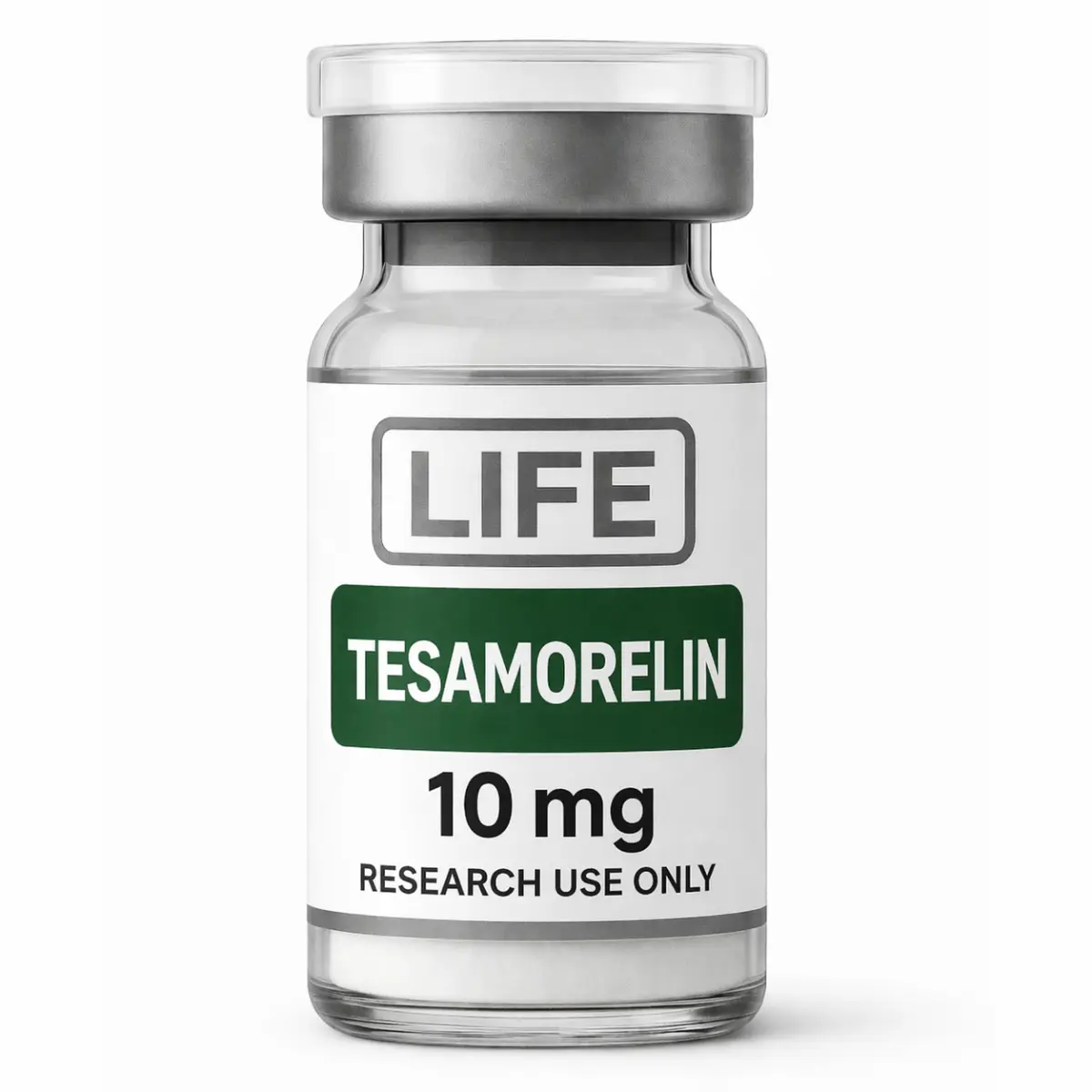
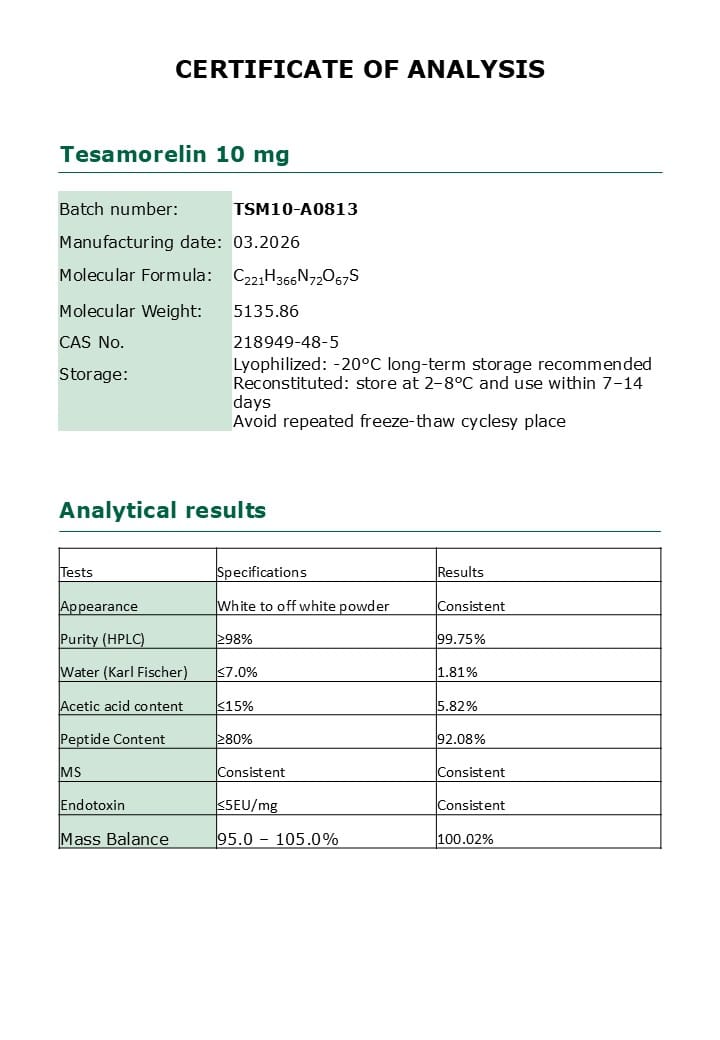
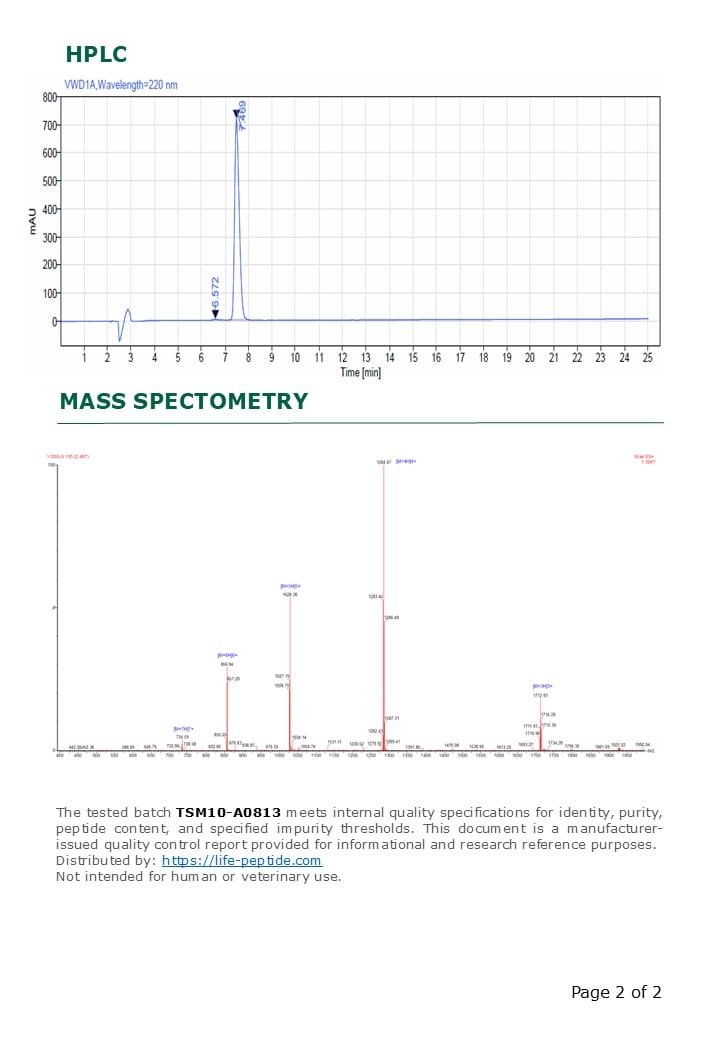
Cada lote se somete a pruebas de laboratorio exhaustivas después de la producción (puede encontrar el Certificado de Análisis debajo de las imágenes del producto).
Liofilizado (liofilizado) para máxima estabilidad y vida útil prolongada.
Sellado en viales estériles, listo para la reconstitución.
Pureza: ≥ 99% (HPLC)
Apariencia: polvo blanco liofilizado
Fórmula molecular: C221H366N72O67S
Peso molecular: 5135.78
Nº CAS: 218949-48-5
Almacenamiento: los viales liofilizados sin abrir se almacenan mejor refrigerar a 2–8 °C, que es el método de almacenamiento confirmado por nuestro socio de fabricación y adecuado para hasta 24 meses. Se prefiere la refrigeración porque minimiza los ciclos innecesarios de congelación y descongelación durante la manipulación rutinaria. Si se requiere un almacenamiento a más largo plazo, los viales liofilizados sin abrir también pueden mantenerse congelados. Una vez reconstituidos, almacene siempre a 2–8 °C y no congele.
Reconstitución y manipulación
Tesamorelin se suministra como un vial liofilizado y debe manipularse utilizando los procedimientos estándar de reconstitución de péptidos apropiados para el entorno de investigación. Debe reconstituirse con agua bacteriostática antes de usar. Para ayudar a preservar la integridad estructural, agregue el disolvente elegido lentamente contra la pared interior del vial en lugar de directamente sobre el péptido en polvo, y evite agitar vigorosamente. La agitación suave suele ser suficiente una vez que el péptido se ha disuelto por completo. La práctica estándar de laboratorio también incluye permitir que los viales refrigerados alcancen la temperatura ambiente antes de la reconstitución para minimizar la condensación dentro del vial.
Para otras guías sobre selección de solventes, planificación de concentraciones y almacenamiento, consulte el completo Guía de Reconstitución de Péptidos y Calculadora de Reconstitución.
Estudios clave publicados
- Falutz J, Allas S, Blot K, et al. Efectos metabólicos de un factor liberador de hormona de crecimiento en pacientes con VIH. New England Journal of Medicine, 2007.
El estudio fundamental de fase III que demuestra reducciones en el tejido adiposo visceral tras el tratamiento con tesamorelin, preservando al mismo tiempo la masa corporal magra.
- Stanley TL, Feldpausch MN, Oh J, et al. Efecto de la tesamorelin sobre la grasa visceral y la grasa hepática en pacientes infectados por el VIH con acumulación de grasa abdominal. JAMA, 2014.
Un estudio histórico que muestra reducciones en la grasa visceral y hepática, ampliando la investigación de la tesamorelin en la fisiología hepática metabólica.
- Spooner LM, et al. Tesamorelina: un análogo del factor liberador de la hormona del crecimiento para la lipodistrofia asociada al VIH. Drugs, 2012.
Una revisión exhaustiva que abarca la farmacología, el mecanismo de acción y el desarrollo clínico de la tesamorelina.
- Badran AS, et al. Composición corporal, grasa hepática, parámetros metabólicos y de seguridad de la tesamorelina: un metaanálisis de ensayos controlados aleatorizados. Obesity Research & Clinical Practice, 2026.
Un metaanálisis reciente que resume la evidencia clínica sobre la composición corporal, la grasa hepática y los resultados metabólicos en ensayos con tesamorelina.
Preguntas Frecuentes
¿Qué es la tesamorelina?
La tesamorelina es un análogo sintético de la hormona liberadora de la hormona del crecimiento humana (GHRH). Estimula la glándula pituitaria a través del receptor de la GHRH, lo que favorece la liberación pulsátil fisiológica de la hormona del crecimiento endógena. Es objeto de numerosas investigaciones en el ámbito de la endocrinología y el metabolismo relacionadas con el eje GH/IGF-1, la composición corporal y el tejido adiposo visceral.
¿En qué se diferencia el tesamorelin del CJC-1295?
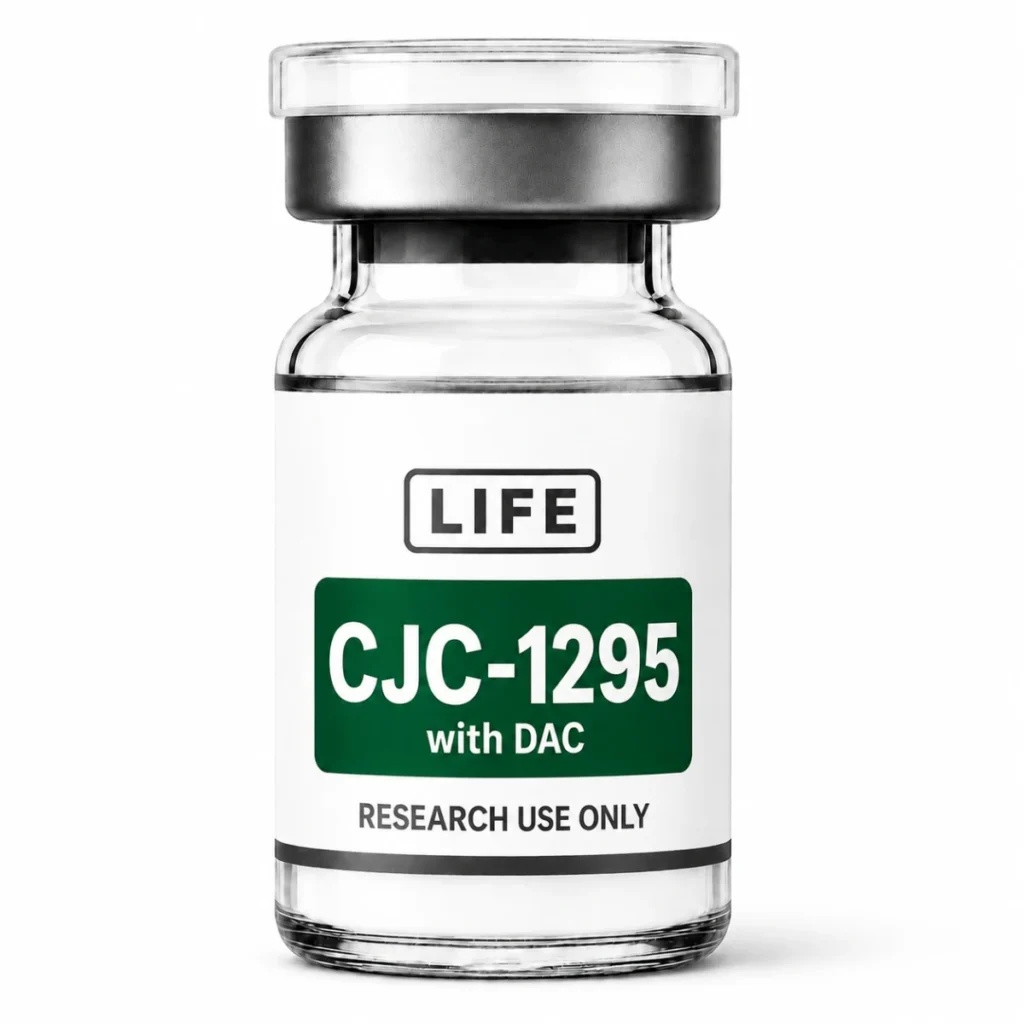
Tanto el tesamorelin como el CJC-1295 son análogos de la GHRH que activan la misma vía de receptores. El tesamorelin cuenta con una amplia base de evidencia clínica, que incluye la aprobación regulatoria para la lipodistrofia asociada al VIH, mientras que el CJC-1295 sigue siendo principalmente un péptido de investigación experimental. Su mecanismo de receptores es similar, pero su desarrollo clínico difiere sustancialmente.
¿En qué se diferencia la tesamorelin de la ipamorelin o de los péptidos GHRP?
La tesamorelina estimula la liberación de la hormona del crecimiento a través del receptor de la GHRH, mientras que la ipamorelina, el GHRP-2 y el GHRP-6 activan el receptor de la grelina (GHSR-1a). Se trata de vías fisiológicas complementarias, razón por la cual los análogos de la GHRH y los péptidos GHRP se estudian con frecuencia de forma conjunta en la investigación endocrina.
¿Por qué se investiga ampliamente la tesamorelina en la investigación metabólica?
Más allá de la fisiología de la hormona del crecimiento, la tesamorelina ha sido ampliamente estudiada por sus efectos sobre la composición corporal, el tejido adiposo visceral, la grasa hepática, el metabolismo de los lípidos y la regulación del IGF-1. Esta amplia evidencia clínica la distingue de muchos otros secretagogos de la hormona del crecimiento.
¿Qué áreas de investigación investigan comúnmente la tesamorelina?
Estudios publicados han investigado la tesamorelin en la secreción de la hormona del crecimiento, la regulación del IGF-1, la fisiología hipofisaria, la composición corporal, el tejido adiposo visceral, la grasa hepática, la regulación metabólica y la señalización endocrina.
¿Se puede combinar la tesamorelina con los péptidos GHRP en el ámbito de la investigación?
Sí. Dado que la tesamorelina activa el receptor de la GHRH, mientras que los péptidos GHRP activan el receptor de la grelina, los investigadores suelen analizar estas vías conjuntamente para estudiar los mecanismos complementarios que regulan la secreción pulsátil de la hormona del crecimiento. Los diseños de los estudios varían de uno a otro, por lo que los resultados deben interpretarse en el contexto de las investigaciones publicadas.
¿Puedo comprar tesamorelina en Europa?
Sí. Enviamos Tesamorelin a la mayoría de los países europeos utilizando servicios de mensajería confiables. Los métodos de envío disponibles y los tiempos de entrega se muestran durante el pago según su destino.
¿Está este producto destinado al uso humano?
No. La tesamorelina suministrada por Life Peptide se destina exclusivamente a la investigación de laboratorio y analítica. No está destinada al consumo humano, ni al diagnóstico, tratamiento o prevención de enfermedades. Cualquier referencia a estudios publicados resume la literatura científica relacionada con la molécula de tesamorelina, y no el uso previsto de este producto.
Contexto de investigación relacionado
La tesamorelina pertenece a la clase de análogos de la GHRH y a la investigación sobre la señalización de la hormona del crecimiento, que incluye péptidos objeto de estudio para la regulación endocrina, la modulación del eje de la GH y los mecanismos de liberación pulsátil de hormonas.
Para una visión más amplia de las vías de señalización de la GH y los mecanismos peptídicos comparativos, consulte nuestra Guía de investigación de péptidos de hormona de crecimiento.
Los investigadores que estudian la interacción del eje GH también pueden examinar:
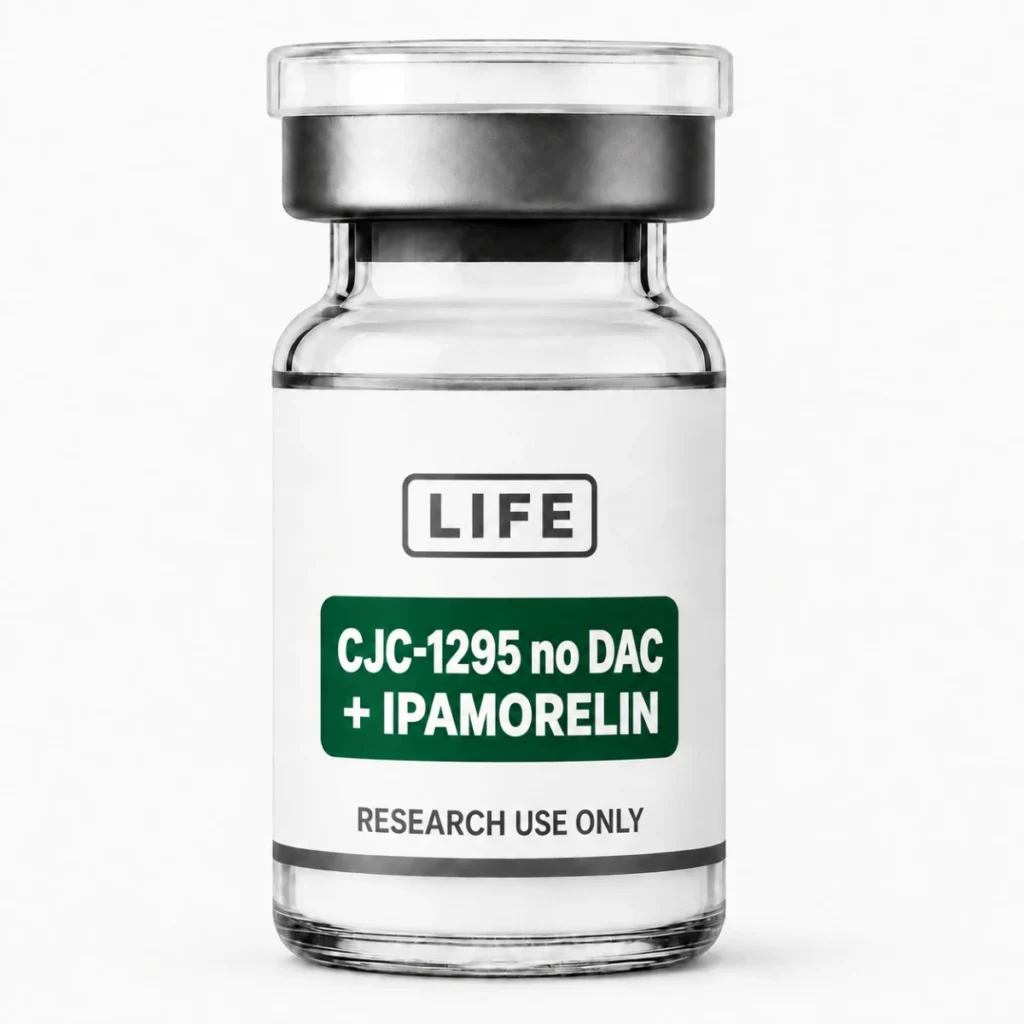
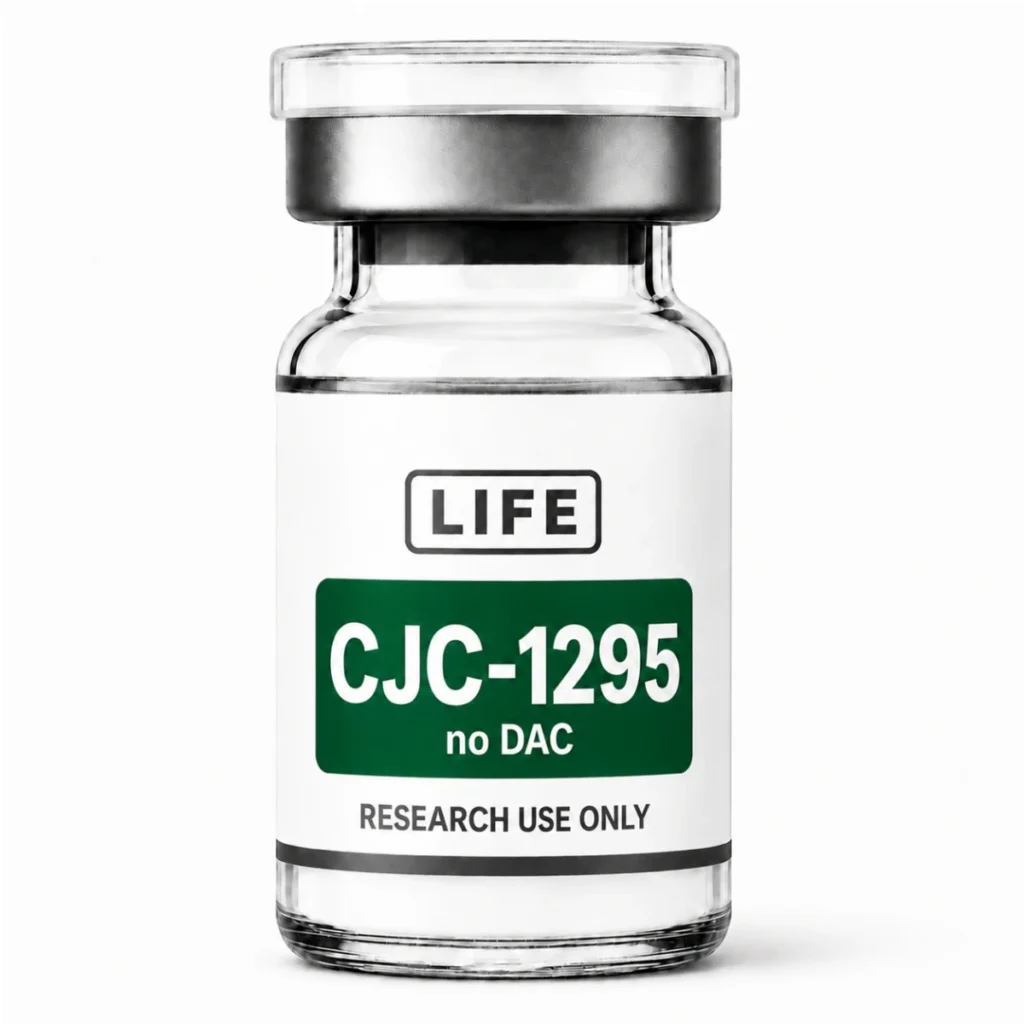
CJC-1295 (sin DAC)
Ipamorelin
GHRP-2
GHRP-6
Explorar todos los compuestos en el Categoría de secretagogos de la hormona del crecimiento.
Investigadores que investigan la regulación endocrina también pueden explorar compuestos en el Categoría de investigación metabólica, incluyendo GLP-1 y agonistas de incretina de múltiples vías.
NOTA: Esto es solo para fines de referencia educativa y no constituye asesoramiento médico.
Descargo de responsabilidad
Este producto se vende únicamente para fines de investigación. No está destinado a diagnosticar, tratar, curar ni prevenir ninguna enfermedad. El comprador asume toda la responsabilidad por su manipulación y uso adecuados.