
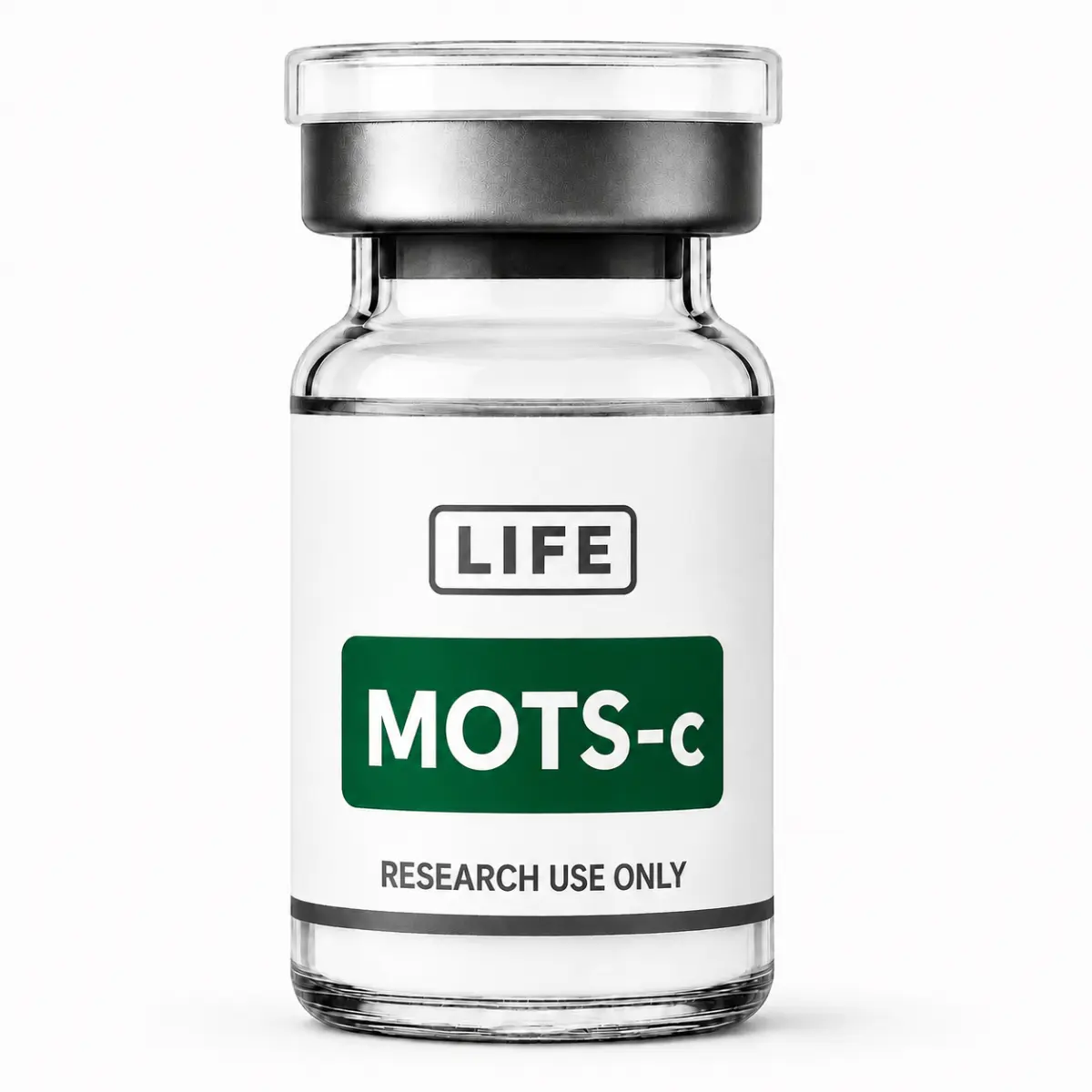
Περιγραφή
Το MOTS-c (Mitochondrial Open Reading Frame of the 12S rRNA Type-c) είναι ένα φυσικώς απαντώμενο πεπτίδιο 16 αμινοξέων που προέρχεται από τα μιτοχόνδρια και κωδικοποιείται από το μιτοχondριακό DNA και όχι από το πυρηνικό γονιδίωμα. Αυτή η μοναδική προέλευση το διαφοροποιεί από τα περισσότερα άλλα ερευνητικά πεπτίδια και το έχει καταστήσει σημαντικό μόριο για τη διερεύνηση του τρόπου με τον οποίο τα μιτοχόνδρια επικοινωνούν με το υπόλοιπο κύτταρο.
Η δημοσιευμένη έρευνα δείχνει ότι το MOTS-c απελευθερώνεται ως απόκριση σε μεταβολικό στρες και άσκηση, όπου συμβάλλει στον συντονισμό της κυτταρικής προσαρμογής στην αυξημένη ενεργειακή ζήτηση. Λόγω αυτού του ρόλου, το MOTS-c έχει γίνει ένα από τα κορυφαία υπό διερεύνηση πεπτίδια στο έρευνα για τον μεταβολισμό, τη φυσιολογία της άσκησης και την υγιή γήρανση.
Θέλετε να αγοράσετε MOTS-c στην Ευρώπη; Η Life Peptide προμηθεύει MOTS-c υψηλής καθαρότητας για εργαστηριακή έρευνα, με αξιόπιστη αποστολή σε όλη την ΕΕ.
Γιατί το MOTS-c μελετάται ευרύτερα
Η δημοσιευμένη έρευνα έχει διερευνήσει το MOTS-c σε σχέση με:
- κυτταρικός ενεργειακός μεταβολισμός
- προσαρμογή στην άσκηση
- μιτοχondριακή λειτουργία
- μεταβολική ευελιξία
- ευαισθησία στην ινσουλίνη
- μεταβολισμός της γλυκόζης
- υγιής γήρανση
- φυσιολογία των σκελετικών μυών
- Σήμανση AMPK
Καθώς η έρευνα για τα πεπτίδια που προέρχονται από τα μιτοχόνδρια έχει επεκταθεί, το MOTS-c έχει γίνει ένα από τα καλύτερα χαρακτηρισμένα μόρια που συνδέουν τη μιτοχondριακή λειτουργία με το μεταβολισμό ολόκληρου του σώματος.
Πώς λειτουργεί το MOTS-c
Σε αντίθεση με τις συμβατικές πεπτιδικές ορμόνες, το MOTS-c λειτουργεί ως μιτοχονδριακό πεπτίδιο σήμανσης, βοηθώντας τα κύτταρα να προσαρμοστούν στο μεταβολικό στρες.
Η δημοσιευμένη έρευνα έχει εξερευνήσει τη σχέση του με:
Κυτταρικός ενεργειακός μεταβολισμός
Το MOTS-c έχει μελετηθεί για την ικανότητά του να ρυθμίζει τη χρήση της κυτταρικής ενέργειας κατά τη διάρκεια του μεταβολικού στρες, επηρεάζοντας οδούς που εμπλέκονται στην αξιοποίηση της γλυκόζης και στον μεταβολισμό των λιπαρών οξέων.
Προσαρμογή άσκησης
Η άσκηση αυξάνει την ενδογενή έκφραση του MOTS-c, καθιστώντας το ένα από τα πιο μελετημένα μιτοχονδριακής προέλευσης πεπτίδια στη φυσιολογία της άσκησης. Οι ερευνητές έχουν διερευνήσει κατά πόσον το MOTS-c συμβάλλει σε ορισμένες από τις μεταβολικές προσαρμογές που συνήθως σχετίζονται με τη σωματική δραστηριότητα.
Σήμανση AMPK
Ένας από τους βασικούς μηχανισμούς που διερευνώνται για το MOTS-c περιλαμβάνει την ενεργοποίηση της πρωτεϊνικής κινάσης που ενεργοποιείται από το AMP (AMPK), έναν βασικό ρυθμιστή της κυτταρικής ενεργειακής ισορροπίας και της μεταβολικής προσαρμογής.
Υγιής γήρανση
Καθώς η μιτοχondριακή λειτουργία αλλάζει με την ηλικία, το MOTS-c έχει γίνει ένας σημαντικός ερευνητικός στόχος σε μελέτες που διερευνούν τη μεταβολική ανθεκτικότητα και την υγιή γήρανση.
Γιατί το MOTS-c περιγράφεται συχνά ως “πεπτίδιο της άσκησης”
Μία από τις πιο ενδιαφέρουσες παρατηρήσεις στη επιστημονική βιβλιογραφία είναι ότι τα ενδογενή επίπεδα MOTS-c αυξάνονται ως απόκριση στην άσκηση.
Αν να αντικαταστήσουν τη σωματική δραστηριότητα, οι ερευνητές εξετάζουν το ενδεχόμενο το MOTS-c να ενεργοποιεί μερικές από τις ίδιες κυτταρικές οδούς που εμπλέκονται σε μεταβολική προσαρμογή λόγω άσκησης, ιδίως εκείνα που σχετίζονται με μιτοχονδριακή λειτουργία και σηματοδότηση AMPK. Αυτό οδήγησε στον χαρακτηρισμό του ως δυνητικού πεπτιδίου μίμησης της άσκησης, αν και αυτό παραμένει ένας ενεργός τομέας έρευνας και δεν πρέπει να ερμηνεύεται ως ισodύναμο με τα φυσιολογικά αποτελέσματα της ίδιας της άσκησης.
Ανθρώπινη και προκλινική έρευνα
Η έρευνα για το MOTS-c αναπτύσσεται ραγδαία, αν και η βάση δεδομένων παραμένει σημαντικά μικρότερη από εκείνη για καθιερωμένα μεταβολικά πεπτίδια όπως η Σεμαγλουτίδη ή η Τιρζεπατίδη.
Δημοisευμένες μελέτες έχουν διερευνήσει το MOTS-c σε εργαστηριακά μοντέλα του μεταβολισμού, της φυσιολογίας της άσκησης, της ευαισθησίας στην ινσulinη και της γήρανσης, ενώ η έρευνα σε ανθρώπους έχει επικεντρωθεί κυρίως στα ενδογενή επίπεδα του MOTS-c και τη σχέση τους με τη μεταβολική υγεία. Η κλινική επεμβατική έρευνα παραμένει περιορισμένη.
Πώς το MOTS-c διαφέρει από τα συγγενικά μεταβολικά πεπτίδια
| Πεπτίδιο | Κύριος ερευνητικός στόχος |
|---|---|
| MOTS-c | Μιτοχondριακός μεταβολισμός & προσαρμογή στην άσκηση |
| SS-31 (Ελαμιπρετίδη) | Λειτουργία μιτοχondριακής μεμβράνης |
| Ρετατρουτίδη | Τριπλός ινκριτινικός μεταβολικός σηματοδοτικός μηχανισμός |
| Semaglutide | Σήμανση υποδοχέα GLP-1 |
| AOD-9604 | Έρευνα για το θραύσμα αυξητικής ορμόνης |
Σε αντίθεση με τα πεπτίδια ινκρετίνης, το MOTS-c μελετάται κυρίως για ρύθμιση της κυτταρικής ενέργειας και μιτοχondριακή σηματοδότηση, καθιστώντας το ένα από τα λίγα ερευνητικά πεπτί.
Δημοσιευθείσες παρατηρήσεις ασφαλείας
Τα περισσότερα δημοσιευμένα δεδομένα για το MOTS-c προέρχονται από προκλινικές μελέτες, με σχετικά περιορισμένη διαθέσιμη ανθρώπινη επεμβατική έρευνα. Οι τρέχουσες έρευνες έχουν γενικά αναφέρει αποδεκτή ανεκτικότητα σε πρώιμες μελέτες, αλλά η μακροπρόθεσμη αποτελεσματικότητα και ασφάλεια παραμένουν υπό διερεύνηση. Επειδή τα κλινικά στοιχεία εξακολουθούν να αναδύονται, τα ευρήματα θα πρέπει να ερμηνεύονται στο πλαίσιο της συνεχιζόμενης έρευνας.
Χαρακτηριστικά προϊόντος
Εφαρμογή: εργαστηριακή και αναλυτική έρευνα
Χρήση περιορισμού: όχι για ανθρώπινη κατανάλωση· όχι για ιατρική, κτηνιατρική ή καλλυντική χρήση
Παράγεται σε εγκαταστάσεις που συμμορφώνονται με τις ΟGMP υπό αυστηρά πρωτόκολλα ΠΚ.
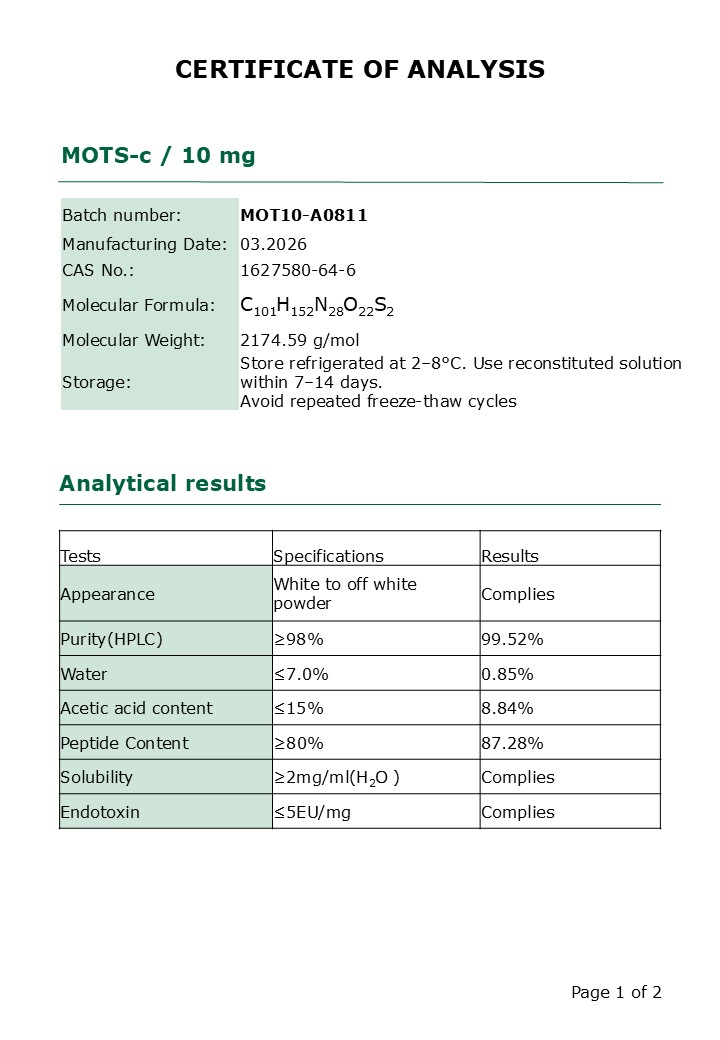
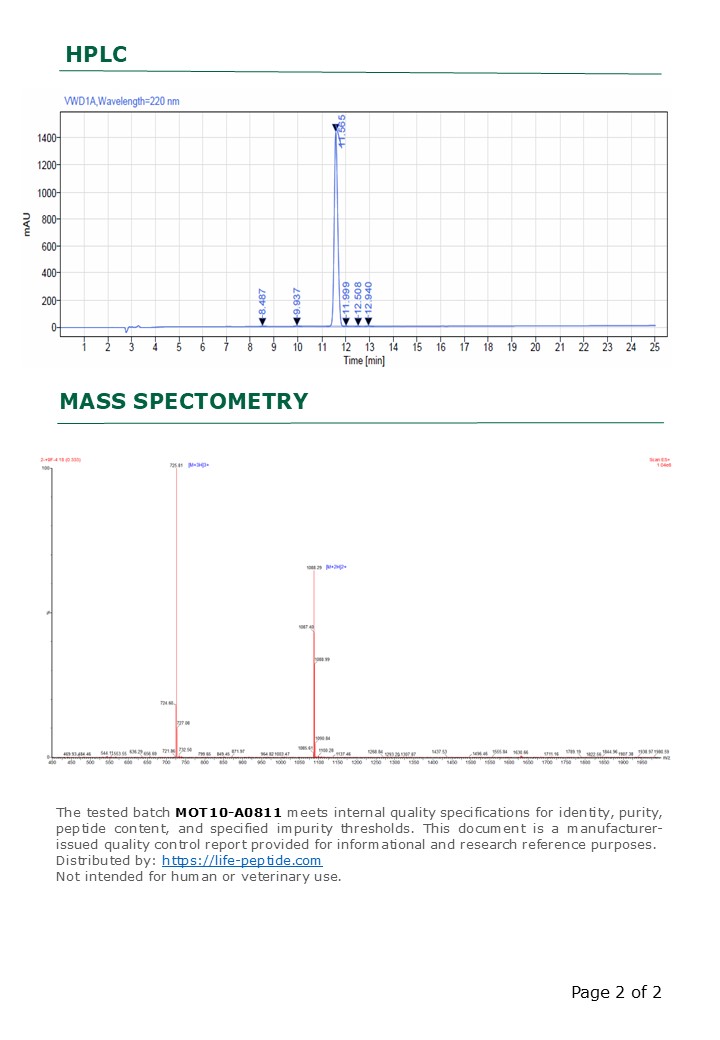
Κάθε παρτίδα ελέγχεται προσεκτικά στο εργαστήριο μετά την παραγωγή (μπορείτε να βρείτε το Πιστοποιητικό Ανάλυσης κάτω από τις εικόνες του προϊόντος).
Κατάψυξη-αποξήρανση (λυσόφιλη) για μέγιστη σταθερότητα και παρατεταμένη διάρκεια ζωής.
Σφραγισμένα σε αποστειρωμένες φιάλες, έτοιμα για ανασύσταση.
Καθαρότητα: ≥98% (ελέγχθηκε με HPLC)
Εμφάνιση: Λυοφιλοποιημένη λευκή/υπόλευκη σκόνη
Μοριακός τύπος: C101H152N28O22S2
Μριακό βάρος: 2174.6
Αλληλουχία: Met-Arg-Trp-Gln-Glu-Met-Gly-Tyr-Ile-Phe-Tyr-Pro-Arg-Lys-Leu-Arg
Αποθήκευση: τα αφυδατωμένα σε ξηρή ψύξη, σφραγισμένα φιαλίδια φυλάσσονται καλύτερα συντήρηση στους 2–8°C, η οποία είναι η μέθοδος αποθήκευσης που επιβεβαιώθηκε από τον συνεργάτη παραγωγής μας και είναι κατάλληλη για έως και 24 μήνες. Η ψύξη προτιμάται επειδή ελαχιστοποιεί τους περιττούς κύκλους ψύξης-απόψυξης κατά τον συνήθη χειρισμό. Εάν απαιτείται σημαντικά μακροχρόνια αποθήκευση, τα σφραγισμένα λυοφιλοποιημένα φιαλίδια μπορούν επίσης να διατηρηθούν κατεψυγμένα. Μόλις ανασυσταθεί, αποθηκεύετε πάντα σε 2–8°C και μην καταψύχετε.
Ανα
Το MOTS-c παρέχεται ως λυοφιλοποιημένο φιαλίδιο και θα πρέπει να χειρίζεται σύμφωνα με τις τυπικές διαδικασίες ανασύστασης πεπτιδίων που είναι κατάλληλες για το ερευνητικό περιβάλλον. Πρέπει να ανασυσταθεί με Βακτηριοστατικό νερό πριν τη χρήση. Για να διατηρηθεί η δομική ακεραιότητα, προσθέστε το επιλεγμένο διαλύτη αργά στο εσωτερικό τοίχωμα του φιαλιδίου αντί απευθείας στη μάζα του πεπτιδίου, και αποφύγετε το έντονο ανακίνημα. Η απαλή περιστροφή είναι γενικά επαρκής μόλις το πεπτίδιο διαλυθεί πλήρως. Η τυπική εργαστηριακή πρακτική περιλαμβάνει επίσης την αναμονή των ψυχόμενων φιαλιδίων να φτάσουν σε θερμοκρασία δωματίου πριν από την ανασύσταση για να ελαχιστοποιηθεί η συμπύκνωση στο εσωτερικό του φιαλιδίου.
Για την επιλογή άλλων διαλυτών, σχεδιασμό συγκεντρώσεων και οδηγίες αποθήκευσης, δείτε το πλήρες Οδηγός Ανασύστασης Πεπτιδίων και Υπολογιστής Απεικόνισης.
Επιλεγμένες ερευνητικές αναφορές
- Λι Σ, κ.ά. Το μιτοχονδριακής προέλευσης πεπτίδιο MOTS-c προάγει τη μεταβολική ομοιοσταση και μειώνει την παχυσαρκία και την ινσουλινοαντίσταση, Cell Metabolism, 2015
Η ορόσηmo εργασία που περιγράφει την ανακάλυψη του MOTS-c και τον ρόλο του στη μεταβολική ρύθμιση.
- Ζου Χ, κ.ά. Μιτοχονδριακώς προερχόμενο πεπτίδιο MOTS-c: Επιπτώσεις και μηχανισμοί που σχετίζονται με το στρες, τον μεταβολισμό και τη γήρανση, Journal of Translational Medicine, 2023
Μια εμπεριστατωμένη ανασκόπηση που συνοψίζει τα τρέχοντα στοιχεία σχετικά με τη βιολογία, τον μεταβολισμό, την προσαρμογή στο στρες και τη γήρανση του MOTS-c.
- Atakan MM, Bishop DJ. Μικρά πεπτίδια: Θα μπορούσαν να έχουν σημαντικό ρόλο στον μεταβολισμό και στην απόκριση στην άσκηση;, Journal of Physiology, 2024
Μια σύγχρονη ανασκόπηση που εξετάζει τα πεπτίδια που προέρχονται από τα μιτοχόνδρια, συμπεριλαμβανομένου του MOTS-c, με έμφαση στη φυσιολογία της άσκησης και τη μεταβολική προσαρμογή.
- Μπομπίλεφ ΑΓ, κ.ά. Μιτοχονδριακό πεπτίδιο MOTS-c: Ρύθμιση του μεταβολισμού και προοπτικές για εφαρμογές στην κλινική και αθλητική ιατρική, Ανθρώπινη φυσιολογία, 2025
Μια ανασκόπηση που συζητά τα αναδυόμενα στοιχεία για το MOTS-c στον μεταβολισμό, τη φυσιολογία της άσκησης και την υγιή γήρανση.
Συχνές Ερωτήσεις
Τι είναι το MOTS-c;
Το MOTS-c είναι ένα φυσικά απαντώμενο μιτοχονδριακής προέλευσης πεπτίδιο που κωδικοποιείται από το μιτοχονδριακό DNA. Μελετάται ευρέως για τον ρόλο του στον κυτταρικό ενεργειακό μεταβολισμό, την προσαρμογή στην άσκηση και την υγιή γήρανση.
Γιατί το MOTS-c συνδέεται με την έρευνα για την άσκηση;
Δημοσιευμένες μελέτες έχουν δείξει ότι τα ενδογενή επίπεδα MOTS-c αυξάνονται ως απόκριση στην άσκηση. Οι ερευνητές διερευνούν εάν συμβάλλει στις μεταβολικές προσαρμογές που σχετίζονται με τη σωματική δραστηριότητα μέσω οδών όπως η σηματοδότηση AMPK.
Τι κάνει το MOTS-c διαφορετικό από τα πεπτίδια GLP-1;
Σε αντίθεση με τους αγωνιστές υποδοχέων GLP-1, οι οποίοι διερευνούν κυρίως τη σηματοδότηση της ινκρετίνης, το MOTS-c επικεντρώνεται στη μιτοχondριακή επικοινωνία, τη ρύθμιση της κυτταρικής ενέργειας και τη μεταβολική προσαρμογή. Αυτές αντιπροσωπεύουν ξεχωριστούς τομείς μεταβολικής έρευνας.
Ποιες ερευνητικές περιοχές μελετούν συνήθως το MOTS-c;
Η τρέχουσα έρευνα περιλαμβάνει τον κυτταρικό μεταβολισμό, τη μιτοχondριακή βιολογία, την ευαισθησία στην ινσουλίνη, τη φυσιολογία της άσκησης, τη σηματοδότηση AMPK, την προσαρμογή των σκελετικών μυών και την υγιή γήρανση.
Πώς διαφέρει το MOTS-c από το SS-31;
Και τα δύο είναι μιτοχονδριακά πεπτίδια, αλλά ερευνούν διαφορετικές πτυχές της μιτοχονδριακής βιολογίας. Το MOTS-c συνδέεται πρωτίστως με τη μεταβολική σηματοδότηση και την προσαρμογή στην άσκηση, ενώ το SS-31 ερευνάται για την ακεραιότητα της μιτοχονδριακής μεμβράνης και τη βιοενεργετική.
Είναι το MOTS-c υποκατάστατρο άσκησης;
Όχι. Αν και το MOTS-c έχει περιγραφεί ως ένα πεπτίδιο-μιμητικό της άσκησης επειδή ενεργοποιεί ορισμένα μεταβολικά μονοπάτια που σχετίζονται με την άσκηση, η τρέχουσα έρευνα δεν στηρίζει το συμπέρασμα ότι αναπαράγει τα πλήρη φυσιολογικά αποτελέσματα της σωματικής άσκησης.
Μπορώ να αγοράσω MOTS-c στην Ευρώπη;
Ναι. Στέλνουμε το MOTS-c στις περισσότερες ευρωπαϊκές χώρες χρησιμοποιώντας αξιόπιστες υπηρεσίες ταχυμεταφορών. Οι διαθέσιμες μέθοδοι αποστολής και οι χρόνοι παράδοσης εμφανίζονται κατά την ολοκλήρωση της παραγγελίας με βάση τον προορισμό σας.
Αυτό το προϊόν προορίζεται για ανθρώπινη χρήση;
Το προϊόν MOTS-c που διατίθεται από την Life Peptide προορίζεται αποκλειστικά για εργαστηριακή και αναλυτική έρευνα. Δεν προορίζεται για ανθρώπινη κατανάλωση, διάγνωση, θεραπεία ή πρόληψη ασθενειών. Οποιαδήποτε αναφορά σε δημοσιευμένες μελέτες αποτελεί σύνοψη της επιστημονικής βιβλιογραφίας που αφορά το μόριο MOTS-c και όχι την προβλεπόμενη χρήση του παρόντος προϊόντος.
Σχετικό ερευνητικό πλαίσιο
Το MOTS-c συζητάται συχνά παράλληλα με άλλα ερευνητικά πεπτίδια που διερευνούν τη μιτοχondριακή λειτουργία, τον μεταβολισμό και την υγιή γήρανση, αν και το καθένα στοχεύει σε διαφορετικές πτυχές της κυτταρικής φυσιολογίας.
ΣΣ-31 (Ελαμιπρετίδη) – εξετάζεται για την αποκατάσταση των μιτοχονδρίων και την παραγωγή κυτταρικής ενέργειας.
Επιταλόν – μελετάται για τη βιολογία των τελομερών και την έρευνα για την υγιή γήρανση.
CJC-1295 με DAC – διερευνήθηκε για παρατεταμένη σηματοδότηση GH και IGF-1.
CJC-1295 Χωρίς DAC – μελετήθηκε για τη φυσιολογική απελευθέρωση της αυξητικής ορμόνης.
GHK-Cu – διερευνήθηκε για την αναγέννηση ιστών και την αναμόρφωση της εξωτellυλάριας μήτρας.
ΣΗΜΕΙΩΣΗ: Αυτό γίνεται αποκλειστικά για εκπαιδευτικούς σκοπούς και δεν συνιστά ιατρική συμβουλή.
Αποποίηση ευθύνης:
Αυτό το προϊόν πωλείται αποκλειστικά για ερευνητικούς σκοπούς. Δεν προορίζεται για τη διάγνωση, θεραπεία, ίαση ή πρόληψη οποιασδήποτε ασθένειας. Ο αγοραστής αναλαμβάνει πλήρως την ευθύνη για τον σωστό χειρισμό και τη χρήση.