Descripción
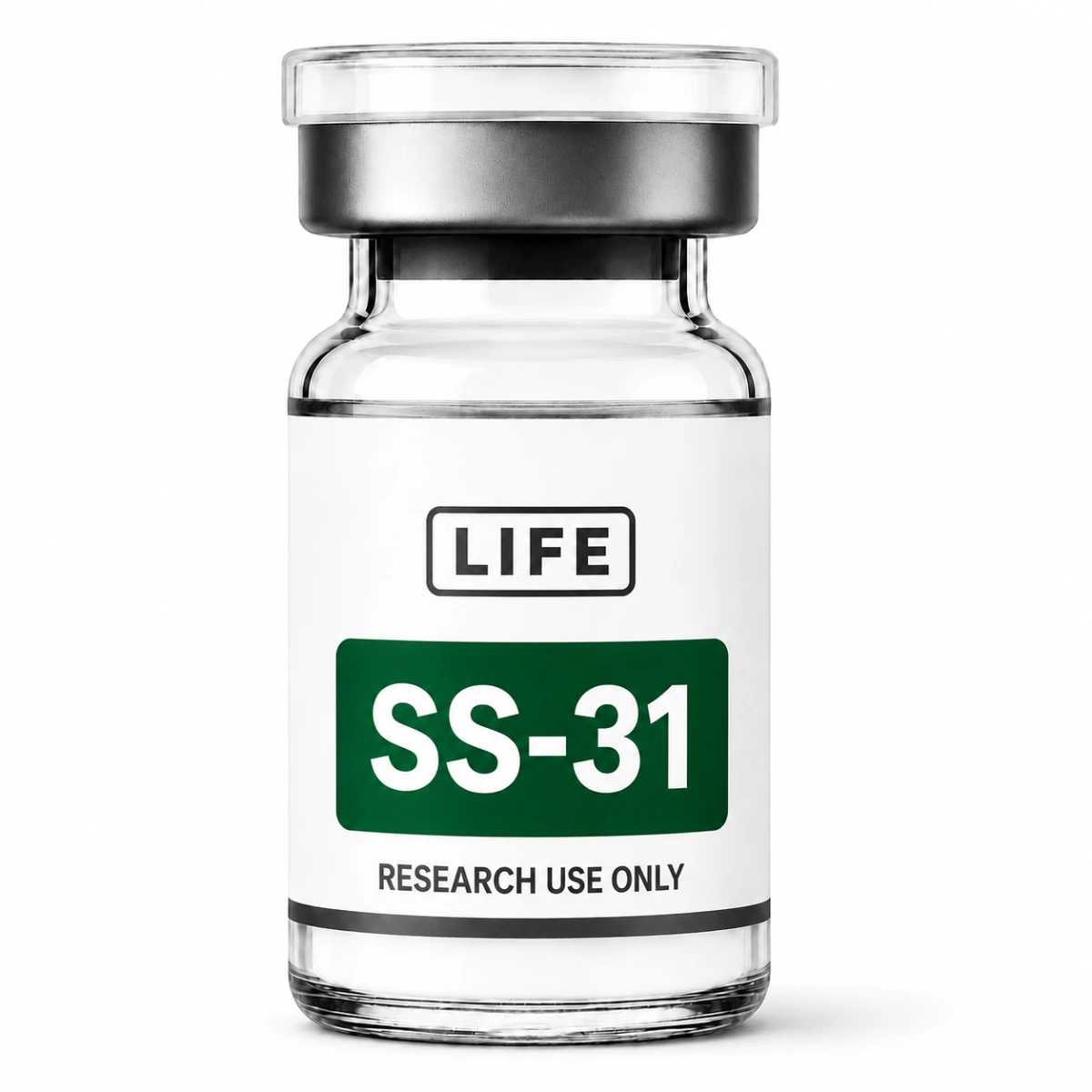
SS-31, también conocido como Elamipretida, MTP-131 o Bendavia, es una sintética tetrapéptido dirigido a mitocondrias.
A diferencia de la mayoría de los péptidos, el SS-31 no interactúa principalmente con un receptor de superficie celular. En cambio, entra rápidamente en las células y se acumula selectivamente dentro de las mitocondrias, donde se une a la cardiolipina, un fosfolípido único de la membrana mitocondrial interna.
Debido a que la cardiolipina es esencial para mantener la arquitectura mitocondrial y la producción eficiente de ATP, el SS-31 se ha convertido en uno de los péptidos de investigación líderes para la investigación sobre Disfunción mitocondrial, estrés oxidativo y metabolismo energético celular.
¿Quieres comprar SS-31 en Europa? Life Peptide suministra SS-31 de alta pureza para investigación de laboratorio, con un servicio de envío fiable a toda la UE.
¿Por qué se investiga ampliamente el SS-31?
La investigación publicada ha examinado la SS-31 en relación con:
- reparación mitocondrial
- producción de energía celular
- Síntesis de ATP
- estrés oxidativo
- fisiología muscular
- envejecimiento saludable
- investigación cardiovascular
- neurodegeneración
- enfermedad mitocondrial
A diferencia de los péptidos metabólicos que regulan la señalización celular, el SS-31 se dirige directamente a la estructura física de las mitocondrias, lo que lo hace único entre los péptidos de investigación modernos.
Cómo funciona SS-31
Estabilización de la cardiolipina
SS-31 se une selectivamente a la cardiolipina, un fosfolípido esencial situado en la membrana mitocondrial interna.
La cardiolipina juega un papel fundamental en el mantenimiento de la estructura de las crestas mitocondriales y en el soporte de la cadena de transporte de electrones. Bajo condiciones de estrés oxidativo, la cardiolipina se daña, reduciendo la eficiencia mitocondrial. Investigaciones publicadas sugieren que el SS-31 ayuda a estabilizar este entorno de membrana y a preservar la función mitocondrial.
Producción de energía celular
Al preservar la estructura mitocondrial, se ha investigado el SS-31 para mejorar la eficiencia de la fosforilación oxidativa y la generación de ATP. En lugar de estimular las mitocondrias para que produzcan más energía, el SS-31 parece ayudar a las mitocondrias disfuncionales a producir energía de manera más eficiente.
Estrés oxidativo
Numerosos estudios preclínicos han investigado el SS-31 para reducir las especies reactivas de oxígeno mitocondrial (ROS) y limitar el daño oxidativo asociado con la disfunción mitocondrial.
Protección de tejidos
Debido a que las mitocondrias influyen en prácticamente todos los sistemas orgánicos, el SS-31 ha sido investigado en la investigación cardiovascular, neurológica, renal y muscular esquelética, lo que lo convierte en uno de los péptidos mitocondriales más amplios disponibles en la actualidad.
¿Por qué el SS-31 es diferente de otros péptidos mitocondriales?
No todos los péptidos mitocondriales investigan la misma biología.
MOTS-c investiga cómo las células regulan el metabolismo energético activando vías de señalización metabólica adaptativa.
SS-31 investiga cómo las mitocondrias producen energía físicamente al estabilizar la membrana mitocondrial interna y preservar la función de la cadena de transporte de electrones.
En lugar de cambiar la señalización metabólica, SS-31 se enfoca en mantener la maquinaria mitocondrial en sí.
Esta distinción ha convertido al SS-31 en uno de los péptidos investigacionales más importantes para la biología mitocondrial y la investigación sobre el envejecimiento saludable.
Investigación humana y preclínica
El SS-31 ha avanzado más en el desarrollo clínico que muchos péptidos de investigación.
Estudios en humanos han investigado el SS-31 en Enfermedad mitocondrial primaria, síndrome de Barth, insuficiencia cardíaca, lesión renal y trastornos oftálmicos, si bien la investigación preclínica exhaustiva ha explorado sus efectos sobre el músculo esquelético, la neurodegeneración, la lesión por isquemia-reperfusión y la disfunción mitocondrial relacionada con la edad.
Aunque los resultados clínicos han variado según la indicación, el SS-31 sigue siendo uno de los péptidos dirigidos a las mitocondrias mejor caracterizados que se investigan actualmente.
Observaciones de seguridad publicadas
SS-31 ha sido objeto de múltiples estudios clínicos en diversas áreas de enfermedades.
Los ensayos publicados generalmente han informado de una tolerabilidad favorable, y los eventos adversos suelen ser de leves a moderados. La eficacia clínica ha variado según la enfermedad en investigación, lo que pone de relieve la complejidad de las enfermedades mitocondriales y la necesidad de investigación continua.
Características del producto
Aplicación: investigación de laboratorio y análisis
Uso restringido: no apto para consumo humano; no apto para uso médico, veterinario o cosmético
Producido en instalaciones que cumplen con GMP bajo estrictos protocolos de control de calidad.
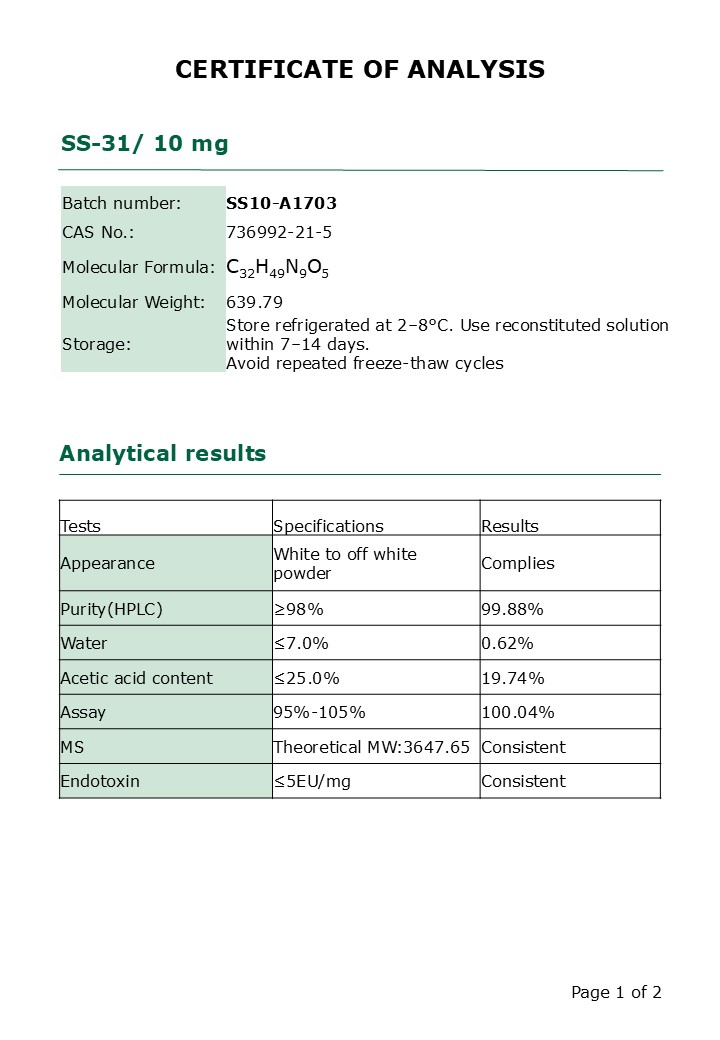
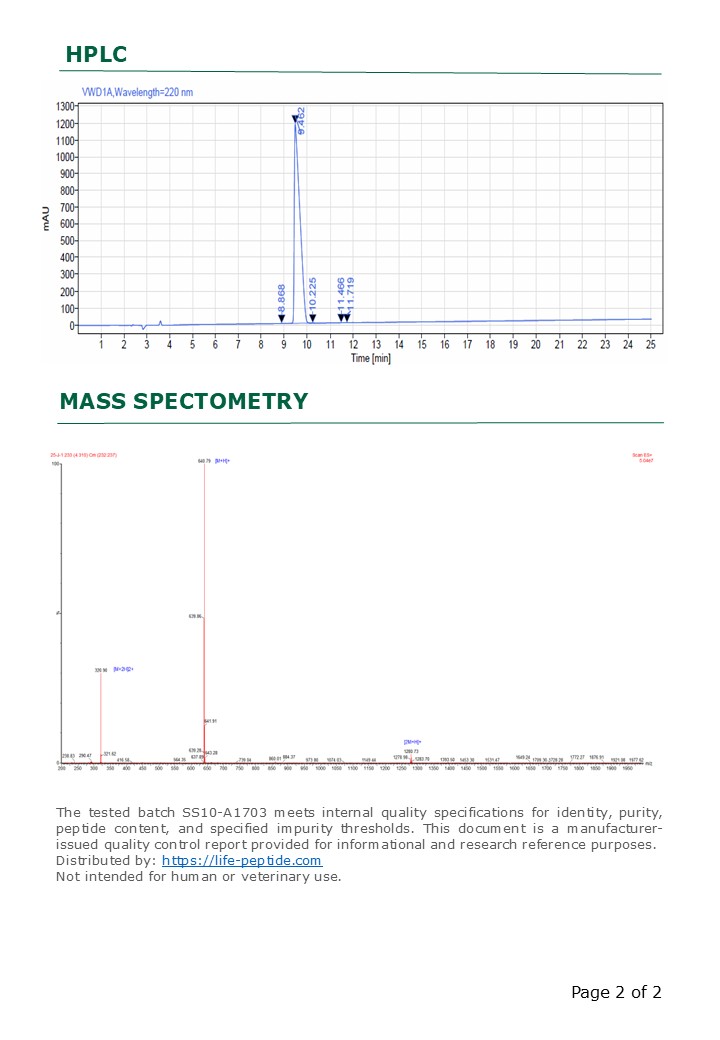
Cada lote se somete a pruebas de laboratorio exhaustivas después de la producción (puede encontrar el Certificado de Análisis debajo de las imágenes del producto).
Liofilizado (liofilizado) para máxima estabilidad y vida útil prolongada.
Sellado en viales estériles, listo para la reconstitución.
Pureza: ≥ 99,881 TP5T, analizada mediante HPLC.
Apariencia: polvo blanco liofilizado
Fórmula molecular: C32H49N9O5
Peso molecular: 639.79
Almacenamiento: los viales liofilizados sin abrir se almacenan mejor refrigerar a 2–8 °C, que es el método de almacenamiento confirmado por nuestro socio de fabricación y adecuado para hasta 24 meses. Se prefiere la refrigeración porque minimiza los ciclos innecesarios de congelación y descongelación durante la manipulación rutinaria. Si se requiere un almacenamiento a más largo plazo, los viales liofilizados sin abrir también pueden mantenerse congelados. Una vez reconstituidos, almacene siempre a 2–8 °C y no congele.
Reconstitución y manipulación
El SS-31 se suministra en un vial liofilizado y debe manipularse utilizando procedimientos estándar de reconstitución de péptidos apropiados para el entorno de investigación. Debe reconstituirse con agua bacteriostática antes de usar. Para ayudar a preservar la integridad estructural, agregue el disolvente elegido lentamente contra la pared interior del vial en lugar de directamente sobre el péptido en polvo, y evite agitar vigorosamente. La agitación suave suele ser suficiente una vez que el péptido se ha disuelto por completo. La práctica estándar de laboratorio también incluye permitir que los viales refrigerados alcancen la temperatura ambiente antes de la reconstitución para minimizar la condensación dentro del vial.
Para otras guías sobre selección de solventes, planificación de concentraciones y almacenamiento, consulte el completo Guía de Reconstitución de Péptidos y Calculadora de Reconstitución.
Referencias de investigación seleccionadas
- Wang Y, y col. Elamipretida: Revisión de su estructura, mecanismo de acción y potencial terapéutico, Life, 2025
Una revisión exhaustiva que cubre el mecanismo del SS-31, la unión a la cardiolipina, la bioenergética mitocondrial y el desarrollo clínico.
- Liu Y, et al. Investigación de la Aplicación del Novedoso Péptido Antioxidante Dirigido a las Mitocondrias SS-31 en la Mitigación de la Disfunción Mitocondrial, Redox Report, 2024
Una revisión detallada de los mecanismos del SS-31 y el análisis de 18 ensayos clínicos en trastornos mitocondriales y enfermedades relacionadas.
- Chatfield KC, et al. Elamipretida Mejora la Función Mitocondrial en el Corazón Humano Fallido, JACC: De la Ciencia Básica a la Traslacional, 2019
Demuestra mejoras en la función mitocondrial en tejido cardíaco humano y respalda el mecanismo de SS-31 dirigido a la cardiolipina.
Preguntas Frecuentes
¿Qué es el SS-31?
El SS-31 (elamipretida) es un tetrapéptido sintético que actúa de forma selectiva sobre las mitocondrias al unirse a la cardiolipina presente en la membrana mitocondrial interna. Es objeto de numerosas investigaciones en el ámbito de la reparación mitocondrial, la producción de energía celular y el envejecimiento saludable.
¿Por qué se llama al SS-31 un péptido reparador mitocondrial?
A diferencia de la mayoría de los péptidos que activan receptores de la superficie celular, SS-31 se dirige directamente a la membrana mitocondrial interna. Las investigaciones sugieren que ayuda a preservar la estructura mitocondrial, mejorar la bioenergética y reducir el estrés oxidativo en mitocondrias disfuncionales.
¿En qué se diferencia el SS-31 del MOTS-c?
Ambos investigan la biología mitocondrial, pero MOTS-c regula principalmente la señalización metabólica, mientras que SS-31 se enfoca en la integridad física y eficiencia de la maquinaria mitocondrial productora de energía. Investigan aspectos complementarios de la función mitocondrial.
Las áreas de investigación que comúnmente investigan el SS-31 incluyen:
La investigación actual incluye enfermedades mitocondriales, fisiología cardiovascular, función del músculo esquelético, neurodegeneración, lesión renal, trastornos metabólicos y envejecimiento saludable.
¿Es el SS-31 uno de los péptidos más estudiados clínicamente?
Sí. En comparación con muchos péptidos de investigación, el SS-31 ha avanzado a múltiples programas clínicos de Fase 2 y Fase 3 en varias enfermedades relacionadas con las mitocondrias, lo que lo convierte en uno de los péptidos mitocondriales más estudiados disponibles en la actualidad.
¿Puedo comprar SS-31 en Europa?
Sí. Enviamos SS-31 a la mayoría de los países europeos utilizando servicios de mensajería fiables. Los métodos de envío y los plazos de entrega disponibles se muestran durante el proceso de pago según su destino.
¿Está este producto destinado al uso humano?
El producto n.º SS-31 suministrado por Life Peptide está destinado exclusivamente a la investigación analítica y de laboratorio. No está destinado al consumo humano, ni al diagnóstico, tratamiento o prevención de enfermedades.
Contexto de investigación relacionado
El SS-31 se discute frecuentemente junto con otros péptidos de investigación que investigan la energía celular, la recuperación y el envejecimiento saludable, aunque cada uno se dirige a un nivel diferente de la fisiología celular.
MOTS-c – investigado para señalización metabólica, adaptación al ejercicio y comunicación mitocondrial.
Epitalón - estudió biología de telómeros, regulación circadiana y envejecimiento saludable.
GHK-Cu – investigado para la reparación de tejidos, la remodelación de la matriz extracelular y la biología regenerativa.
ARA-290 – se centra en la reparación innata de tejidos, la señalización inflamatoria y la regeneración nerviosa.
CJC-1295 con DAC – investigado por la señalización sostenida de la hormona del crecimiento y el IGF-1 que apoya la fisiología anabólica.
Aunque estos péptidos se asocian frecuentemente con la investigación sobre longevidad y recuperación, el SS-31 se distingue por su acción directa sobre la estructura mitocondrial y la bioenergética, en lugar de la señalización hormonal o metabólica.
NOTA: Esto es solo para fines de referencia educativa y no constituye asesoramiento médico.
Descargo de responsabilidad
Este producto se vende únicamente para fines de investigación. No está destinado a diagnosticar, tratar, curar ni prevenir ninguna enfermedad. El comprador asume toda la responsabilidad por su manipulación y uso adecuados.