Descripción
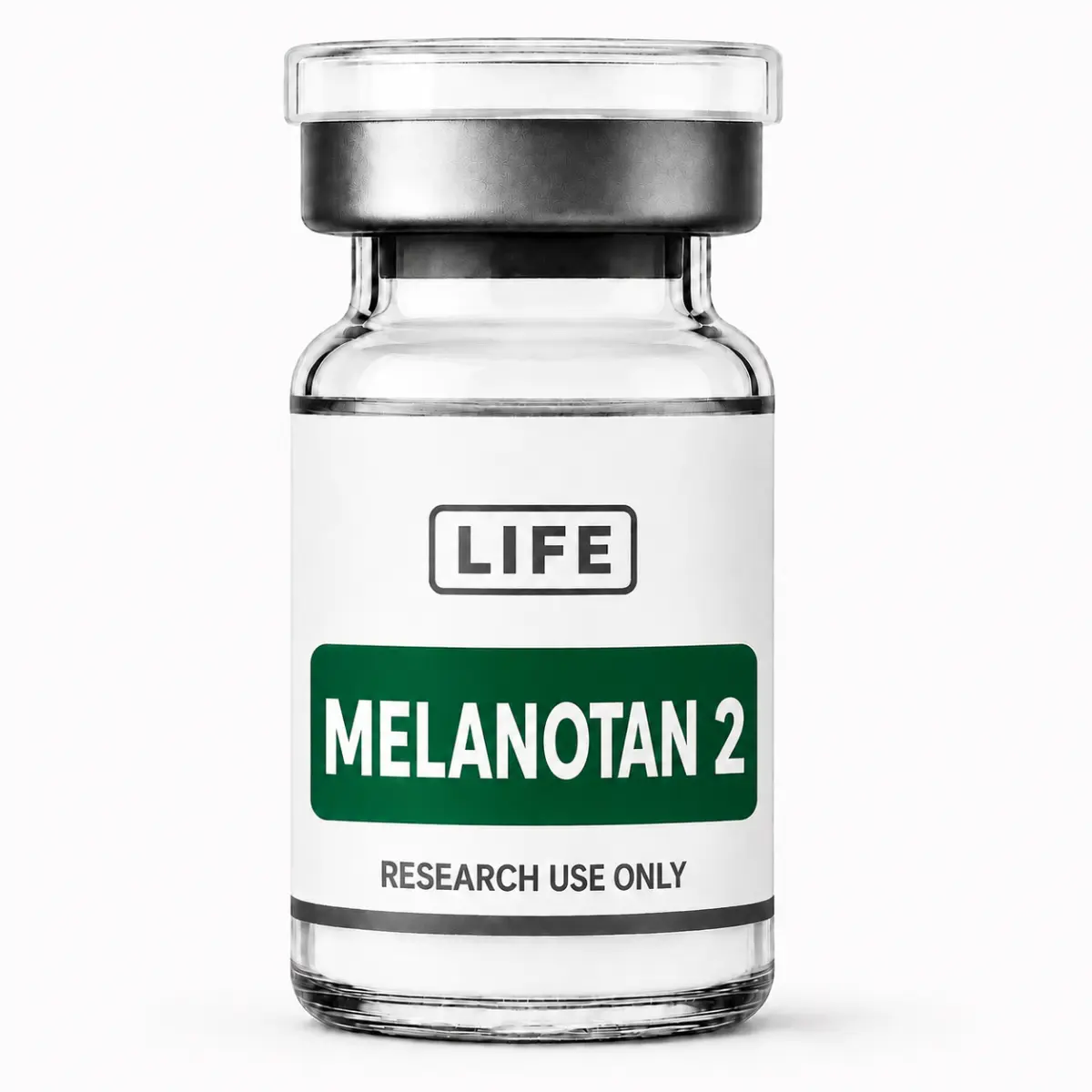
Melanotan 2 (también conocido como Melanotan II o MT2) es uno de los péptidos de investigación más conocidos para estudios de bronceado y pigmentación. Es un sintético análogo de la hormona alfa estimulante de melanocitos (α-MSH), desarrollado para investigar cómo la señalización de melanocortina regula la producción de melanina y la respuesta fisiológica de la piel a la exposición ultravioleta (UV).
Más allá de la investigación sobre la pigmentación, la Melanotan 2 ha desempeñado un papel importante en el avance de nuestra comprensión del sistema de melanocortina. Durante las primeras investigaciones clínicas, los investigadores observaron efectos más allá de la pigmentación de la piel, lo que llevó al desarrollo posterior de PT-141 (Bremelanotida), un péptido de melanocortina más selectivo diseñado específicamente para la investigación de la función sexual.
Hoy, Melanotan 2 sigue siendo uno de los péptidos más investigados en biología de la pigmentación, señalización del receptor de melanocortina y fisiología neuroendocrina.
¿Quieres comprar Melanotan 2 en Europa? Life Peptide suministra Melanotan 2 de alta pureza para investigación de laboratorio, con envíos fiables a toda la UE.
Por qué Melanotan 2 es ampliamente investigado
La investigación publicada ha investigado el Melanotan 2 en relación con:
- investigación sobre el bronceado
- pigmentación de la piel
- producción de melanina
- melanogénesis
- Pigmentación independiente de UV
- biología de los melanocitos
- la señalización del receptor de melanocortina
- regulación del apetito
- Fisiología neuroendocrina
Su amplia actividad en receptores ha convertido a Melanotan 2 en uno de los péptidos de investigación fundamentales para comprender el sistema de melanocortina.
Cómo Melanotan 2 promueve la pigmentación
Investigaciones publicadas demuestran que Melanotan 2 principalmente activa el receptor de melanocortina MC1, que regula la producción de melanina en los melanocitos.
La investigación ha explorado su relación con:
Producción de melanina
Activación de melanocitos y aumento de la síntesis de melanina, lo que convierte a Melanotan 2 en uno de los péptidos más conocidos en la investigación de la pigmentación.
Respuesta UV
Investigación de la relación entre la señalización de melanocortina, la producción de melanina y la respuesta fisiológica de la piel a la exposición ultravioleta.
Biología de la pigmentación
Estudios que examinan cómo los receptores de melanocortinas regulan la pigmentación en diferentes tipos de piel y modelos experimentales.
Dado que Melanotan 2 también activa otros receptores de melanocortina, los investigadores han investigado vías fisiológicas adicionales relacionadas con la regulación del apetito, el balance energético y la señalización del sistema nervioso central.
¿Por qué Melanotan 2 se volvió importante más allá de la investigación sobre el bronceado?
Aunque Melanotan 2 fue desarrollado originalmente para investigación de pigmentación, los investigadores descubrieron más tarde que la activación del receptor de melanocortina también influía en las vías del sistema nervioso central implicadas en el comportamiento sexual.
Estos hallazgos finalmente llevaron al desarrollo de PT-141 (Bremelanotida), un péptido melanocortina más selectivo que se centra en la investigación del deseo y la excitación sexual en lugar de la pigmentación.
Esto hace que Melanotan 2 sea uno de los péptidos más influyentes en la historia de la investigación de melanocortina.
Investigación humana y preclínica
Melanotan 2 ha sido investigado exhaustivamente tanto en estudios de laboratorio como en humanos.
Investigación publicada incluye:
- fisiología del bronceado
- biología de la pigmentación
- melanogénesis
- Respuesta UV
- farmacología del receptor de melanocortina
- regulación del apetito
- señalización neuroendocrina
Aunque desde entonces se han desarrollado análogos de melanocortina más nuevos para aplicaciones más específicas, Melanotan 2 sigue siendo uno de los principales compuestos de investigación para el estudio de la familia de receptores de melanocortina.
Cómo Melanotan 2 se diferencia de péptidos relacionados
| Objetivo de la investigación | Péptido recomendado |
|---|---|
| Investigación sobre bronceado y pigmentación | Melanotan 2 |
| Investigación sobre el deseo sexual y la excitación | PT-141 (Bremelanotida) |
| Regulación hormonal reproductiva | Kisspeptina-10 |
| Vínculos sociales y comportamiento neuroendocrino | Oxitocina |
Aunque Melanotan 2 y PT-141 comparten una historia de desarrollo común, ahora se investigan para diferentes objetivos de investigación. Melanotan 2 se enfoca principalmente en la pigmentación y la biología de los melanocortinos, mientras que PT-141 investiga las vías centrales involucradas en el deseo y la excitación sexual.
Observaciones de seguridad publicadas
Los estudios humanos publicados han informado más comúnmente náuseas, enrojecimiento facial, bostezos y aumentos transitorios de la pigmentación de la piel. Los investigadores también han observado un aumento de la pigmentación de las pecas y lunares existentes, lo que se ha convertido en un área de continua investigación. El conocimiento actual se basa principalmente en estudios clínicos controlados e investigación experimental, y la seguridad a largo plazo sigue siendo un tema activo dentro de la literatura científica.
Características del producto
Aplicación: investigación de laboratorio y análisis
Uso restringido: no apto para consumo humano; no apto para uso médico, veterinario o cosmético
Producido en instalaciones que cumplen con GMP bajo estrictos protocolos de control de calidad.
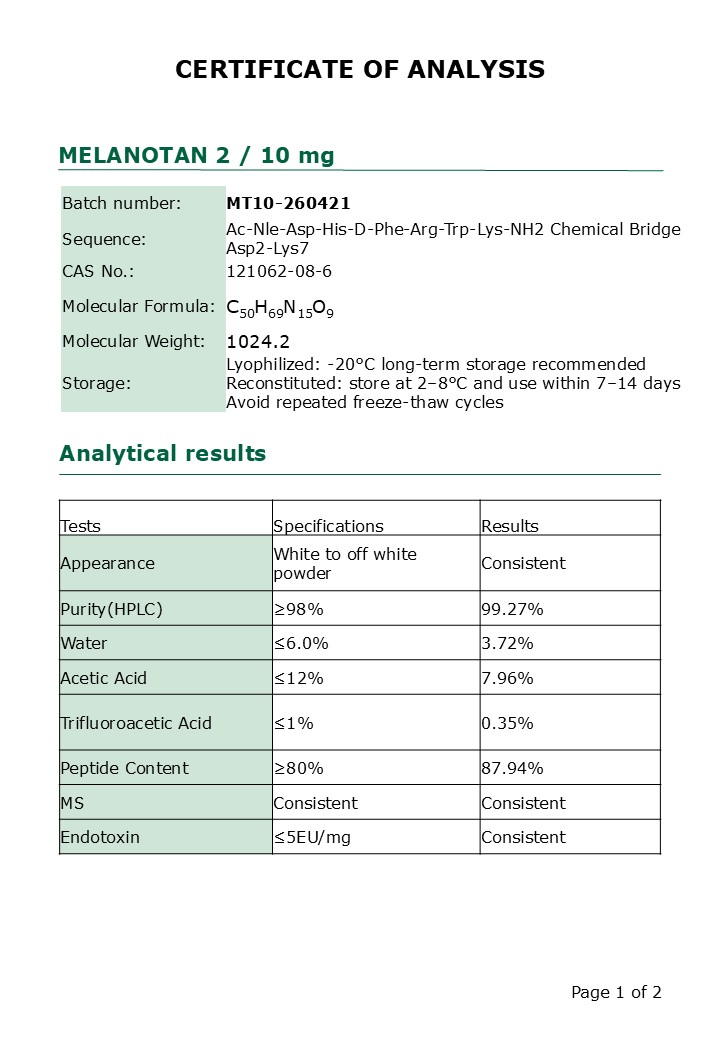
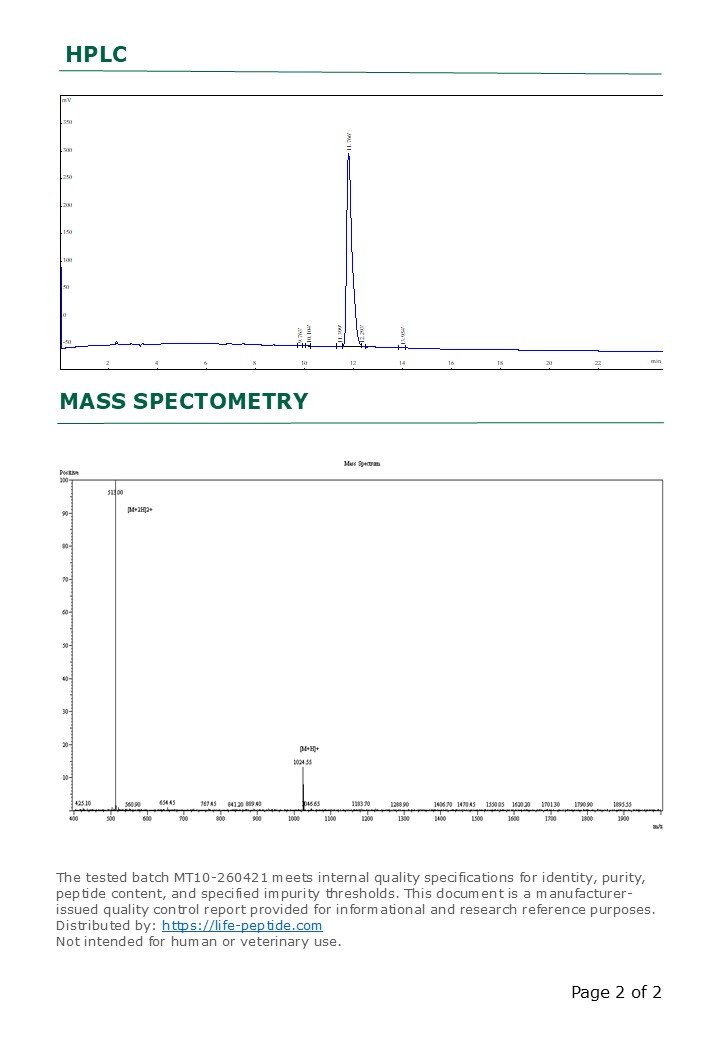
Cada lote se somete a pruebas de laboratorio exhaustivas después de la producción (puede encontrar el Certificado de Análisis debajo de las imágenes del producto).
Liofilizado (liofilizado) para máxima estabilidad y vida útil prolongada.
Sellado en viales estériles, listo para la reconstitución.
Pureza: ≥ 99% (HPLC)
Apariencia: polvo blanco liofilizado
Fórmula molecular: C50H69N15O9
Peso molecular: 1024.2
Nº CAS: 121062-08-6
Almacenamiento: los viales liofilizados sin abrir se almacenan mejor refrigerar a 2–8 °C, que es el método de almacenamiento confirmado por nuestro socio de fabricación y adecuado para hasta 24 meses. Se prefiere la refrigeración porque minimiza los ciclos innecesarios de congelación y descongelación durante la manipulación rutinaria. Si se requiere un almacenamiento a más largo plazo, los viales liofilizados sin abrir también pueden mantenerse congelados. Una vez reconstituidos, almacene siempre a 2–8 °C y no congele.
Reconstitución y manipulación
Melanotan 2 se suministra en un vial liofilizado y debe manipularse utilizando los procedimientos estándar de reconstitución de péptidos apropiados para el entorno de investigación. Debe reconstituirse con agua bacteriostática antes de usar. Para ayudar a preservar la integridad estructural, agregue el disolvente elegido lentamente contra la pared interior del vial en lugar de directamente sobre el péptido en polvo, y evite agitar vigorosamente. La agitación suave suele ser suficiente una vez que el péptido se ha disuelto por completo. La práctica estándar de laboratorio también incluye permitir que los viales refrigerados alcancen la temperatura ambiente antes de la reconstitución para minimizar la condensación dentro del vial.
Para otras guías sobre selección de solventes, planificación de concentraciones y almacenamiento, consulte el completo Guía de Reconstitución de Péptidos y Calculadora de Reconstitución.
Referencias de investigación seleccionadas
- Hadley, Maine. Terapias con Péptidos de Melanocortina: Hitos Históricos, Estudios Clínicos y Comercialización, Péptidos, 2006
Una revisión exhaustiva que describe el desarrollo de los péptidos Melanotan, la investigación sobre la pigmentación y la posterior evolución del PT-141 a partir del Melanotan 2.
- Dorr RT, et al. Evaluación del Melanotan-II, un Péptido Melanotrópico Cíclico Superpotente en un Estudio Clínico Piloto de Fase I, Ciencias de la Vida, 1996
El primer estudio clínico en humanos que evalúa el Melanotan 2 y sus efectos sobre la pigmentación.
- Habbema L, Halk AB, Neumann M, Bergman W. Riesgos del uso no regulado de análogos de la hormona alfa-melanocito-estimulante: una revisión, International Journal of Dermatology, 2017
Una revisión que resume la evidencia publicada sobre análogos de Melanotan, efectos de pigmentación y consideraciones de seguridad reportadas.
- Wessells H, et al. Agonistas de receptores de melanocortina y la función sexual humana, International Journal of Impotence Research, 2000
Uno de los primeros estudios en humanos que mostró efectos del sistema nervioso central más allá de la pigmentación, contribuyendo al desarrollo posterior del PT-141.
Preguntas Frecuentes
¿Qué es la Melanotan 2?
Melanotan 2 es un análogo sintético de la hormona estimulante de melanocitos alfa (α-MSH). Es uno de los péptidos de investigación más investigados del mundo para el bronceado, la pigmentación y la biología de los receptores de melanocortina.
Melanotan 2 promueve la pigmentación estimulando la producción de melanina en la piel. Lo hace imitando la acción de una hormona natural llamada hormona estimulante de melanocitos (MSH).
Melanotan 2 activa principalmente el receptor de melanocortina MC1, que regula la producción de melanina dentro de los melanocitos. Esto lo ha convertido en uno de los péptidos de investigación líderes para estudios de pigmentación y bronceado.
¿En qué se diferencia Melanotan 2 de PT-141?
Aunque el PT-141 se desarrolló a partir del Melanotan 2, ambos péptidos se investigan con fines diferentes. El Melanotan 2 se centra principalmente en la pigmentación y la biología de los melanocortinos, mientras que el PT-141 es un péptido melanocortino más selectivo que se investiga principalmente para la investigación del deseo y la excitación sexual.
¿Por qué está el Melanotan 2 asociado con la investigación del apetito y la función sexual?
Melanotan 2 activa varios subtipos de receptores de melanocortina además del MC1R, incluidos receptores involucrados en la regulación del apetito y la señalización del sistema nervioso central. Los primeros estudios observaron inesperadamente efectos sobre la función sexual, lo que contribuyó al desarrollo posterior del PT-141.
Las áreas de investigación que comúnmente investigan la Melanotan II incluyen:
La investigación publicada incluye fisiología del bronceado, pigmentación de la piel, melanogénesis, respuesta a los rayos UV, señalización del receptor de melanocortina, regulación del apetito y fisiología neuroendocrina.
¿En qué se diferencia Melanotan 2 de Melanotan 1 (Afamelanotida)?
Ambos péptidos derivan de la α-MSH, pero la Melanotan 2 activa múltiples subtipos de receptores de melanocortina, mientras que la Afamelanotida es considerablemente más selectiva para el MC1R. Esta actividad más amplia en los receptores ha hecho que la Melanotan 2 sea útil en una gama más amplia de temas de investigación sobre melanocortinas.
¿Puedo comprar Melanotan 2 en Europa?
Sí. Enviamos Melanotan 2 a la mayoría de los países europeos utilizando servicios de mensajería fiables. Los métodos de envío disponibles y los tiempos de entrega se muestran durante el proceso de pago según su destino.
¿Está este producto destinado al uso humano?
No. El Melanotan 2 suministrado por Life Peptide se destina exclusivamente a la investigación de laboratorio y analítica. No está destinado al consumo humano, ni al diagnóstico, tratamiento o prevención de enfermedades. Cualquier referencia a estudios publicados resume la bibliografía científica actual relacionada con la molécula de Melanotan 2, y no el uso previsto de este producto.
Contexto de investigación relacionado
Melanotan 2 pertenece al grupo más amplio Categoría de investigación sobre melanocortina y péptidos neuroendocrinos, centrándose en las vías de pigmentación y los mecanismos centrales de señalización por melanocortina.
Los investigadores que exploran modelos relacionados con la vía de la melanocortina también pueden examinar:
• PT-141 (Bremelanotida) — investigación sobre la señalización de los receptores de melanocortina selectivos
• Péptidos de investigación cognitiva y neurológica — Modelos de señalización de péptidos en el SNC
NOTA: Esto es solo para fines de referencia educativa y no constituye asesoramiento médico.
Descargo de responsabilidad
Este producto se vende únicamente para fines de investigación. No está destinado a diagnosticar, tratar, curar ni prevenir ninguna enfermedad. El comprador asume toda la responsabilidad por su manipulación y uso adecuados.