Descripción
La kisspeptina-10 es el fragmento biológicamente activo más corto de la familia de péptidos endógenos de la kisspeptina y una de las moléculas de señalización más importantes en endocrinología reproductiva.
En lugar de actuar directamente sobre los testículos u ovarios, la Kisspeptina-10 estimula la Receptor KISS1 (GPR54) en neuronas hipotalámicas, iniciando la liberación de hormona liberadora de gonadotropina (GnRH). Esto activa todo el eje hipotalámico-hipofisario-gonadal (HPG), regulando la hormona luteinizante (LH), la hormona foliculoestimulante (FSH) y la producción de hormonas reproductivas posteriores.
Debido a este papel central, la kisspeptina se ha convertido en uno de los péptidos más investigados en la investigación de la fertilidad, la endocrinología reproductiva y la fisiología neuroendocrina.
¿Quieres comprar kisspeptina en Europa? Life Peptide suministra kisspeptina de alta pureza para investigación de laboratorio, con envíos fiables a toda la UE.
Por qué la Kisspeptina-10 es importante en la investigación de la fertilidad
A diferencia de los compuestos que reemplazan directamente a las hormonas, la Kisspeptina-10 funciona activando el cuerpo señalización hormonal reproductiva natural vía.
En los estudios publicados se ha investigado la kisspeptina-10 en relación con:
- investigación de fertilidad
- regulación hormonal reproductiva
- Señalización de GnRH
- Secreción de LH y FSH
- fisiología de la ovulación
- endocrinología reproductiva masculina
- endocrinología reproductiva femenina
- regulación de la pubertad
- función del eje hipotálamo-hipófisis-gonadal (HPG)
Debido a que la kisspeptina se encuentra en la cima de la cascada hormonal reproductiva, se ha convertido en un péptido fundamental en la investigación reproductiva moderna.
Cómo funciona la Kisspeptina-10
A diferencia de los péptidos que actúan directamente sobre las glándulas endocrinas, la kisspeptina-10 funciona a través del receptor KISS1, activando las neuronas hipotalámicas GnRH.
Las investigaciones publicadas han explorado su relación con:
Secreción de GnRH
La kisspeptina es reconocida como el principal desencadenante fisiológico de la liberación de GnRH y la posterior señalización hormonal reproductiva.
Regulación de LH y FSH
La activación de las neuronas GnRH conduce a la secreción pulsátil de hormona luteinizante y hormona foliculoestimulante desde la hipófisis.
Pubertad y maduración reproductiva
Las investigaciones han demostrado que la señalización de la kisspeptina desempeña un papel fundamental en el inicio de la pubertad y en el mantenimiento de la función reproductiva.
Integración neuroendocrina
Los estudios han investigado cómo la kisspeptina integra el estado nutricional, las señales metabólicas y la fisiología reproductiva dentro del hipotálamo.
Por qué la Kisspeptina-10 es ampliamente investigada en la investigación de la fertilidad
La kisspeptina ocupa una posición única porque regula el eje hormonal reproductivo al nivel fisiológico más alto.
Estudios publicados han explorado:
- fertilidad
- reproducción asistida (FIV)
- secreción de hormonas reproductivas
- inducción de la ovulación
- fisiología de la fertilidad
- hormonas reproductivas masculinas
- hormonas reproductivas femeninas
- amenorrea hipotalámica
- pubertad tardía
- neuroendocrinología reproductiva
Más recientemente, los investigadores también han investigado la relación entre la señalización de la kisspeptina, el comportamiento sexual y el procesamiento emocional, ampliando su papel más allá de la endocrinología reproductiva clásica.
Investigación humana y preclínica
La kisspeptina tiene una de las bases de evidencia humana más sólidas entre los péptidos neuroendocrinos.
Las investigaciones clínicas han demostrado la estimulación predecible de las hormonas reproductivas mediante la activación fisiológica del eje HPG, mientras que estudios más recientes han examinado sus efectos sobre el procesamiento neural relacionado con la atracción, las respuestas emocionales y el comportamiento sexual. La investigación continúa explorando aplicaciones potenciales en trastornos reproductivos, infertilidad y regulación neuroendocrina.
Cómo la Kisspeptina-10 difiere de otros péptidos reproductivos
Kisspeptina-10
- Fertilidad y regulación hormonal reproductiva
- Regulación de la GnRH
- Investigación del eje HPG
- Agonista del receptor de melanocortina
- Investigación sobre la excitación sexual
- Señalización del sistema nervioso central
- Vínculo social
- Vínculo de pareja
- Comportamiento maternal
- Señalización neuroendocrina
Aunque a menudo se habla de estos péptidos en conjunto, regulan diferentes aspectos de la biología reproductiva. La kisspeptina controla principalmente señalización hormonal reproductiva, mientras que el PT-141 influye motivación sexual, La oxitocina regula comportamiento social, y Melanotan II afecta principalmente a pigmentación.
Observaciones de seguridad publicadas
Los estudios en humanos publicados generalmente han reportado que la administración de kisspeptina es bien tolerada en entornos de investigación controlados. Dado que estimula la cascada fisiológica de hormonas reproductivas en lugar de reemplazar directamente las hormonas, las investigaciones actuales se han centrado en respuestas endocrinas transitorias y la regulación neuroendocrina. La investigación en curso continúa evaluando su potencial terapéutico más amplio.
Características del producto
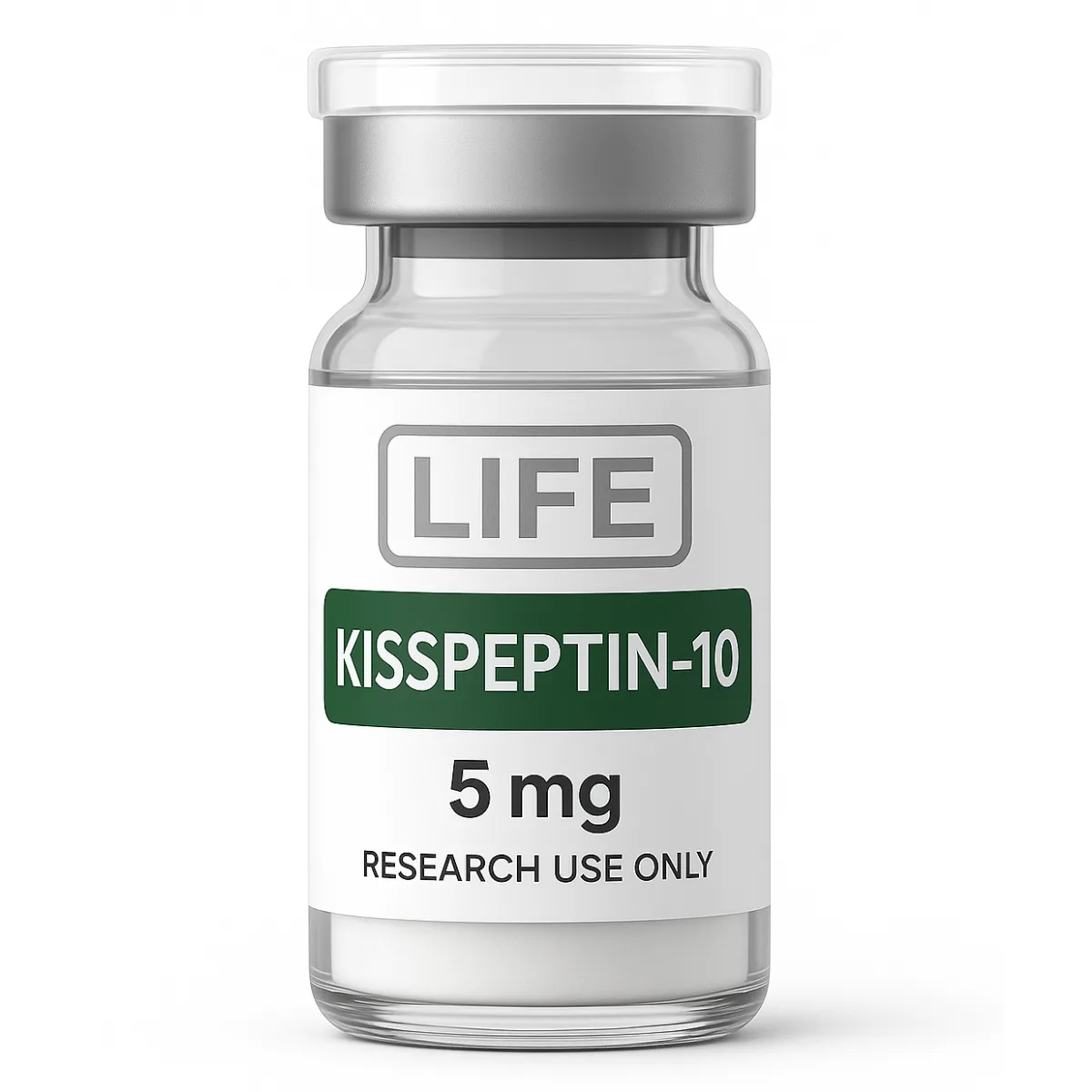
Aplicación: investigación de laboratorio y análisis
Uso restringido: no apto para consumo humano; no apto para uso médico, veterinario o cosmético
Producido en instalaciones que cumplen con GMP bajo estrictos protocolos de control de calidad.
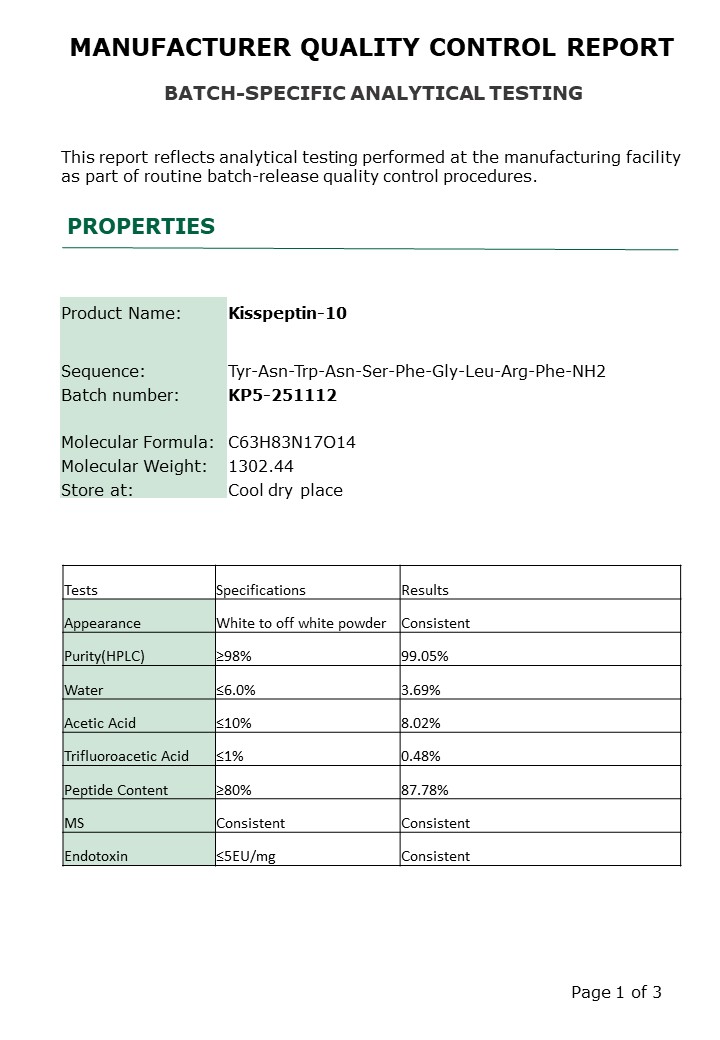
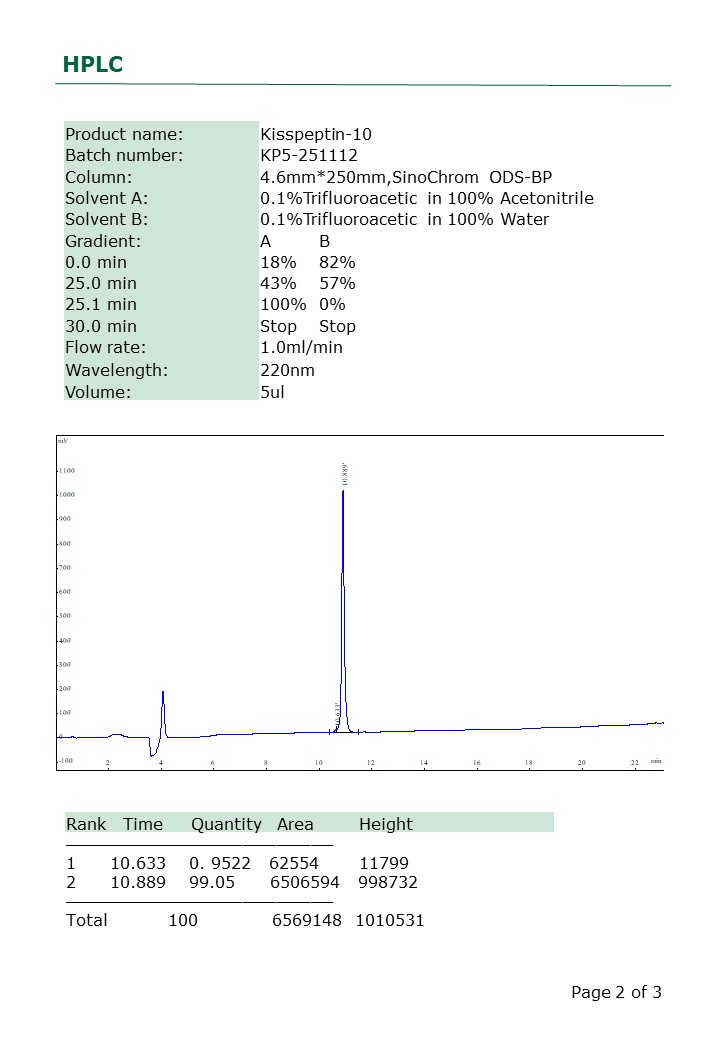
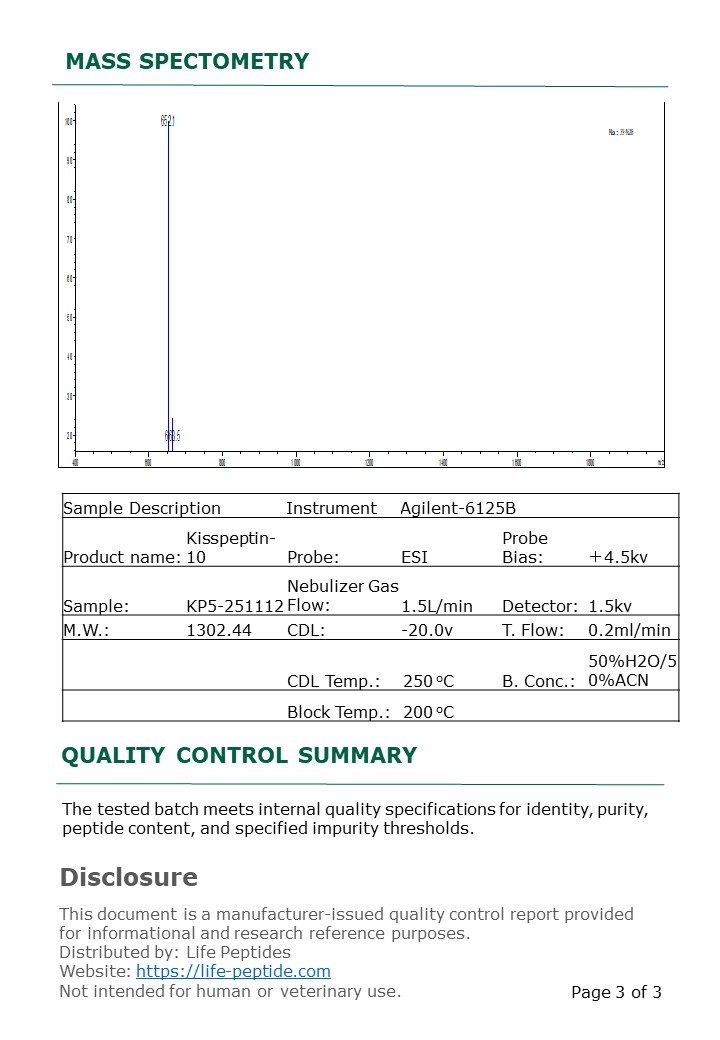
Cada lote se somete a pruebas de laboratorio exhaustivas después de la producción (puede encontrar el Certificado de Análisis debajo de las imágenes del producto).
Liofilizado (liofilizado) para máxima estabilidad y vida útil prolongada.
Sellado en viales estériles, listo para la reconstitución.
Pureza: ≥99% (analizada mediante HPLC)
Apariencia: Polvo blanco/blanquecino liofilizado
Fórmula molecular: C63H83N17O14
Peso molecular: 1302.44
Tir-Asn-Trp-Asn-Ser-Phe-Gly-Leu-Arg-Phe-NH2
Almacenamiento: los viales liofilizados sin abrir se almacenan mejor refrigerar a 2–8 °C, que es el método de almacenamiento confirmado por nuestro socio de fabricación y adecuado para hasta 24 meses. Se prefiere la refrigeración porque minimiza los ciclos innecesarios de congelación y descongelación durante la manipulación rutinaria. Si se requiere un almacenamiento a más largo plazo, los viales liofilizados sin abrir también pueden mantenerse congelados. Una vez reconstituidos, almacene siempre a 2–8 °C y no congele.
Reconstitución y manipulación
La kisspeptina se suministra en un vial liofilizado y debe manipularse utilizando los procedimientos estándar de reconstitución de péptidos apropiados para el entorno de investigación. Debe reconstituirse con agua bacteriostática antes de usar. Para ayudar a preservar la integridad estructural, agregue el disolvente elegido lentamente contra la pared interior del vial en lugar de directamente sobre el péptido en polvo, y evite agitar vigorosamente. La agitación suave suele ser suficiente una vez que el péptido se ha disuelto por completo. La práctica estándar de laboratorio también incluye permitir que los viales refrigerados alcancen la temperatura ambiente antes de la reconstitución para minimizar la condensación dentro del vial.
Para otras guías sobre selección de solventes, planificación de concentraciones y almacenamiento, consulte el completo Guía de Reconstitución de Péptidos y Calculadora de Reconstitución.
Estudios clave publicados
- Dhillo WS, Comninos AN y otros. Regulación Neuroendocrina del Comportamiento Reproductivo y Control Emocional por la Kisspeptina. Journal of Clinical Endocrinology & Metabolism, 2025.
Una revisión exhaustiva que cubre el papel de la kisspeptina en la endocrinología reproductiva, el procesamiento emocional y el comportamiento sexual.
- Stoynev N, Kumanov P. El sistema de la kisspeptina: fisiología y perspectivas clínicas. Annales d’Endocrinologie, 2025.
Una revisión moderna de la fisiología de la kisspeptina, la endocrinología reproductiva y las aplicaciones clínicas emergentes.
- Chakraborty AP, Banerjee A. Isoformas de Kisspeptina: Jugadores Versátiles en la Reproducción y Más Allá. Journal of Molecular Endocrinology, 2025.
Una revisión detallada en la que se explican las isoformas de la kisspeptina, la biología de sus receptores y la regulación del eje HPG.
- Comninos AN y otros. La administración de kisspeptina estimula las hormonas reproductivas pero no afecta la ansiedad en humanos. Journal of Clinical Endocrinology & Metabolism, 2025.
Investigación en seres humanos que analiza las respuestas endocrinas y los resultados conductuales tras la administración de kisspeptina.
Preguntas Frecuentes
¿Qué es la kisspeptina-10?
La kisspeptina-10 es el fragmento biológicamente activo más corto de la familia de péptidos de la kisspeptina. Activa el receptor KISS1 (GPR54) y actúa como el desencadenante natural del cuerpo para la liberación de GnRH, lo que la convierte en uno de los péptidos más importantes en la investigación de hormonas reproductivas.
¿Por qué es importante la kisspeptina-10 en la investigación de la fertilidad?
La kisspeptina regula la cascada hormonal reproductiva al estimular la secreción de GnRH. Esto, a su vez, controla la liberación de LH y FSH, lo que convierte a la kisspeptina en un péptido fundamental en los estudios sobre fertilidad, ovulación y endocrinología reproductiva.
¿En qué se diferencia la kisspeptina-10 del PT-141?
Aunque ambos péptidos son objeto de estudio en el ámbito de la investigación reproductiva, tienen fines distintos. La kisspeptina-10 regula la señalización de las hormonas reproductivas a través del eje HPG, mientras que el PT-141 actúa principalmente sobre los receptores de melanocortina implicados en el deseo y la excitación sexuales.
¿Puede la kisspeptina-10 influir en la testosterona o el estrógeno?
La kisspeptina no estimula directamente la producción de testosterona o estrógeno. En su lugar, activa la liberación de GnRH, que posteriormente regula la secreción de LH y FSH y la producción posterior de hormonas sexuales a través de las vías endocrinas naturales del cuerpo.
¿En qué áreas de investigación se suele estudiar la kisspeptina-10?
La investigación publicada incluye fertilidad, regulación hormonal reproductiva, señalización de GnRH, secreción de LH y FSH, ovulación, pubertad, endocrinología reproductiva, amenorrea hipotalámica y fisiología neuroendocrina.
¿Puede la kisspeptina-10 influir en la función cerebral además de en las hormonas reproductivas?
Sí. Estudios recientes han investigado la relación entre la señalización de la kisspeptina y el procesamiento emocional, la atracción, el estado de ánimo y la conducta reproductiva, ampliando su investigación más allá de la endocrinología reproductiva clásica.
¿Puedo comprar Kisspeptin en Europa?
Sí. Realizamos envíos de Kisspeptin a la mayoría de los países europeos utilizando servicios de mensajería confiables. Los métodos de envío disponibles y los plazos de entrega se muestran durante el pago según su destino.
¿Está este producto destinado al uso humano?
No. La kisspeptina-10 suministrada por Life Peptide se destina exclusivamente a la investigación de laboratorio y analítica. No está destinada al consumo humano, ni al diagnóstico, tratamiento o prevención de enfermedades. Cualquier referencia a estudios publicados resume la bibliografía científica actual relacionada con la molécula de kisspeptina-10, y no el uso previsto de este producto.
Contexto de investigación relacionado
Kisspeptin-10 pertenece a la más amplia categoría de investigación en señalización neuroendocrina y de péptidos, centrándose en la regulación hipotalámica y las vías de comunicación endocrina reproductiva.
Los investigadores que exploran modelos de señalización neuroendocrina relacionados también pueden examinar:
- PT-141 — investigación de señalización neuroendocrina mediada por melanocortina
- Secretagogos de la hormona del crecimiento — interacción de la vía hipotalámica e hipofisaria
- Péptidos de investigación cognitiva y neurológica — Modelos de señalización de péptidos en el SNC
NOTA: Esto es solo para fines de referencia educativa y no constituye asesoramiento médico.
Descargo de responsabilidad:
Este producto se vende únicamente para fines de investigación. No está destinado a diagnosticar, tratar, curar ni prevenir ninguna enfermedad. El comprador asume toda la responsabilidad por su manipulación y uso adecuados.