Descripción
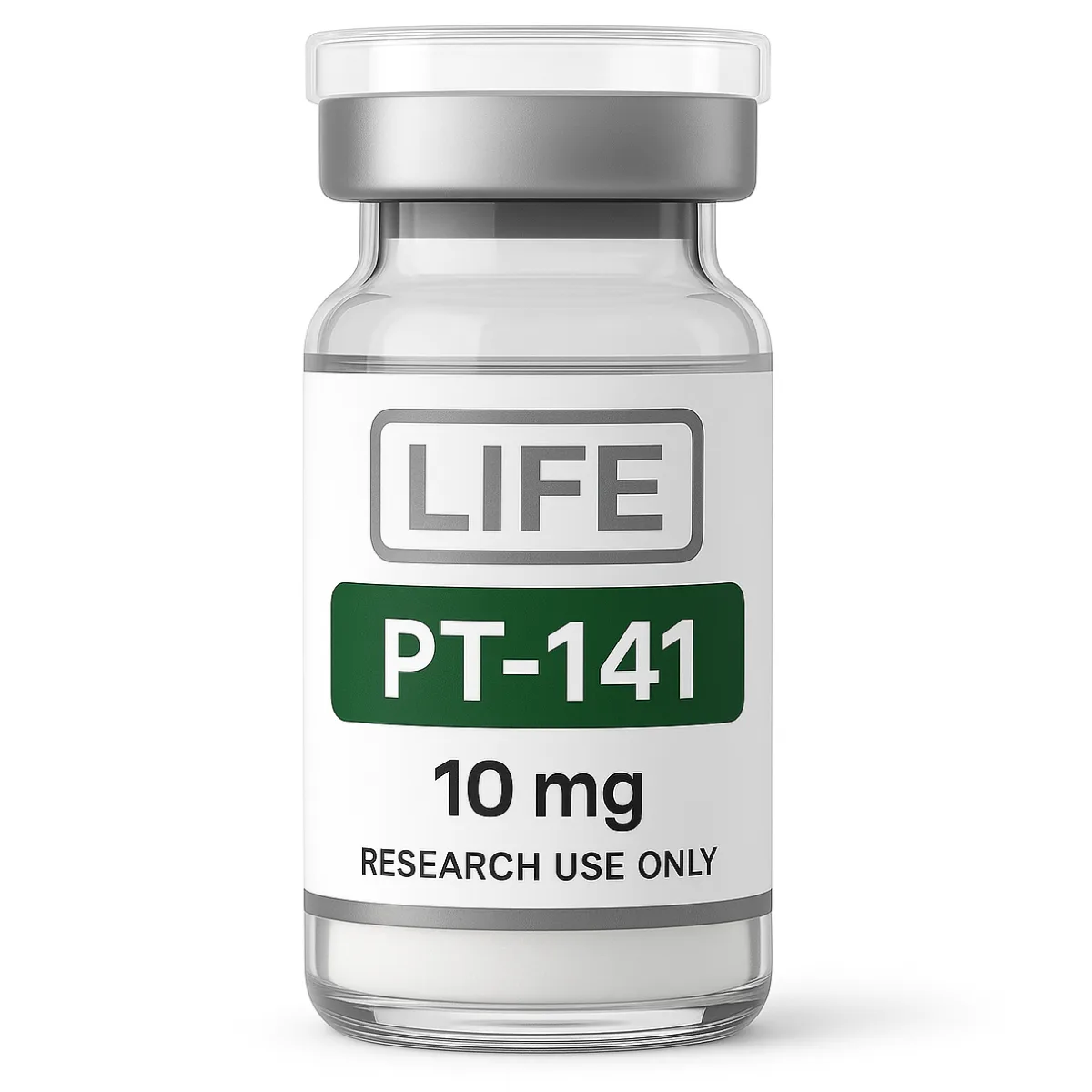
PT-141 (Bremelanotide) es uno de los péptidos de investigación más investigados en Investigación sobre la función y la excitación sexual.
Originalmente desarrollado a partir del péptido melanocortina Melanotan II, el PT-141 fue diseñado para investigar selectivamente las vías de melanocortinas involucradas en la motivación sexual, minimizando al mismo tiempo los efectos de pigmentación asociados con análogos de melanocortinas anteriores.
A diferencia de compuestos como el sildenafilo o el tadalafilo, el PT-141 no investiga principalmente el flujo sanguíneo o la función vascular. En cambio, la investigación publicada se centra en vías del sistema nervioso central que regulan el deseo sexual, la motivación y la excitación, convirtiendo al PT-141 en uno de los péptidos más distintivos en la investigación de la medicina sexual.
¿Quieres comprar PT-141 en Europa? Life Peptide suministra PT-141 de alta pureza para investigación de laboratorio, con un servicio de envío fiable a toda la UE.
Por qué PT-141 es ampliamente investigado
El PT-141 se ha convertido en un péptido de investigación clave porque se dirige señalización melanocortínica central, una vía que difiere fundamentalmente de los enfoques vasculares para la función sexual.
Estudios publicados han investigado el PT-141 en relación con:
- deseo sexual
- excitación sexual
- función sexual femenina
- función sexual masculina
- biología de los receptores de melanocortina
- señalización del sistema nervioso central
- regulación neuroendocrina
Porque estas vías se originan dentro del cerebro en lugar del sistema vascular, el PT-141 ha atraído una atención significativa en la investigación en neurociencia y medicina sexual.
Cómo funciona el PT-141
A diferencia de los inhibidores de la PDE5, el PT-141 se investiga principalmente por sus efectos sobre los receptores de melanocortina, en particular el MC4R y, en menor medida, el MC3R.
Las investigaciones publicadas han explorado su relación con:
Señalización de melanocortinas
Activación de las vías de melanocortina involucradas en la motivación sexual y las respuestas conductuales.
Vías de activación centrales
Investigación de circuitos hipotalámicos asociados con el deseo y la excitación sexual.
Señalización dopaminérgica
La investigación sugiere que la activación de melanocortina influye en vías neuroquímicas posteriores involucradas en la motivación y la recompensa.
Regulación neuroendocrina
El trabajo experimental ha examinado cómo el PT-141 interactúa con las redes del sistema nervioso central involucradas en el comportamiento sexual.
Por qué el PT-141 está siendo ampliamente investigado en medicina sexual
PT-141 difiere de muchos compuestos investigados en medicina sexual porque su mecanismo principal es central en lugar de periférico.
La investigación clínica publicada ha investigado:
- Trastorno del deseo sexual hipoactivo (TDSH)
- excitación sexual femenina
- función eréctil masculina
- motivación sexual
- señalización melanocortínica central
Esta distinción ha convertido a PT-141 en una importante herramienta de investigación para el estudio de la neurobiología de la función sexual en lugar de solo la fisiología vascular.
Investigación humana y preclínica
En comparación con muchos péptidos de investigación, el PT-141 tiene un sólida base de evidencia clínica.
Múltiples estudios de Fase II y Fase III han investigado la bremelanotida en mujeres con trastorno de deseo sexual hipoactivo, mientras que programas clínicos anteriores exploraron sus efectos en hombres con disfunción eréctil. En conjunto, estos estudios establecieron el PT-141 como uno de los péptidos más investigados clínicamente dirigido a las vías de melanocortina.
Por qué PT-141 se diferencia de Viagra® y Cialis®
Una de las características definitorias del PT-141 es que investiga las vías centrales del deseo sexual en lugar de la fisiología vascular.
| PT-141 | Inhibidores de la PDE-5 |
|---|---|
| Señalización de melanocortinas | Vía del óxido nítrico |
| Investigación sobre el deseo sexual | Fisiología de la erección |
| Sistema nervioso central | Flujo sanguíneo periférico |
| Investigado/a en hombres y mujeres | Investigado principalmente en la función eréctil masculina |
Dado que estos mecanismos difieren, el PT-141 representa un área completamente diferente de la investigación en medicina sexual en lugar de otro enfoque vascular.
Observaciones de seguridad publicadas
Entre los estudios clínicos publicados, los eventos adversos reportados con mayor frecuencia incluyeron náuseas, enrojecimiento de cara y dolor de cabeza, particularmente durante administración temprana. La mayoría de los eventos se describieron como de gravedad leve a moderada, aunque la tolerabilidad varió entre estudios y poblaciones, y tendió a desaparecer por completo con el uso repetido.
Características del producto
Aplicación: investigación de laboratorio y análisis
Uso restringido: no apto para consumo humano; no apto para uso médico, veterinario o cosmético
Producido en instalaciones que cumplen con GMP bajo estrictos protocolos de control de calidad.
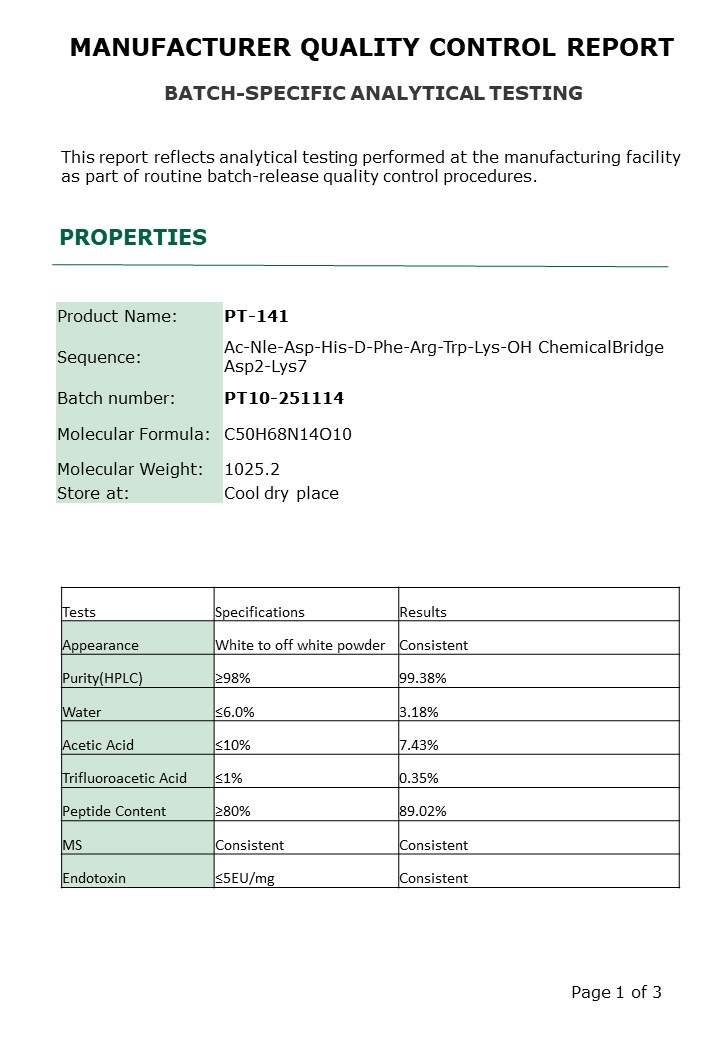
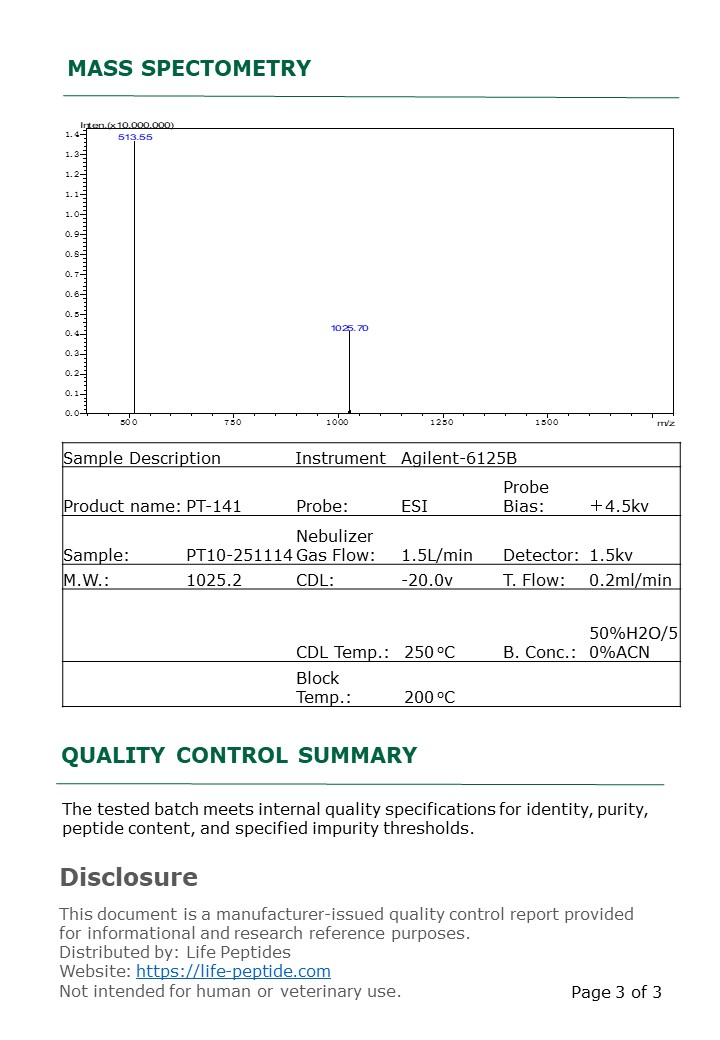
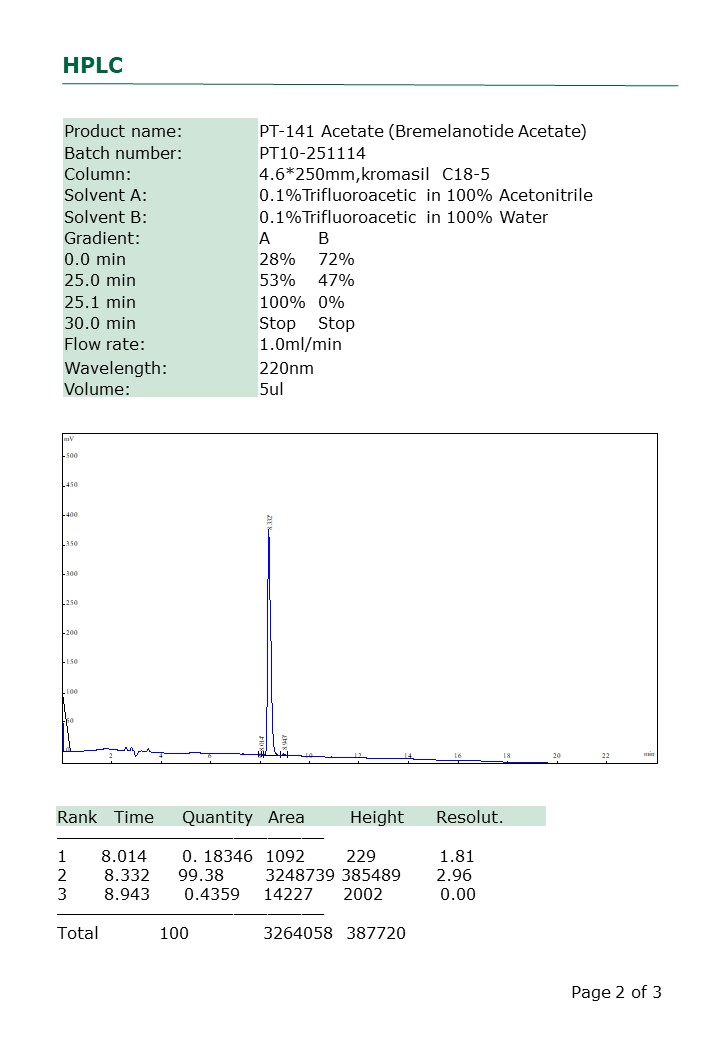
Cada lote se somete a pruebas de laboratorio exhaustivas después de la producción (puede encontrar el Certificado de Análisis debajo de las imágenes del producto).
Liofilizado (liofilizado) para máxima estabilidad y vida útil prolongada.
Sellado en viales estériles, listo para la reconstitución.
Pureza: ≥99% (analizada mediante HPLC)
Apariencia: Polvo blanco/blanquecino liofilizado
Fórmula molecular: C50H68N14O10
Peso molecular: 1025.2
Secuencia: Ac-Nle-Asp-His-D-Phe-Arg-Trp-Lys-OH Puente Química Asp2-Lys7
Almacenamiento: los viales liofilizados sin abrir se almacenan mejor refrigerar a 2–8 °C, que es el método de almacenamiento confirmado por nuestro socio de fabricación y adecuado para hasta 24 meses. Se prefiere la refrigeración porque minimiza los ciclos innecesarios de congelación y descongelación durante la manipulación rutinaria. Si se requiere un almacenamiento a más largo plazo, los viales liofilizados sin abrir también pueden mantenerse congelados. Una vez reconstituidos, almacene siempre a 2–8 °C y no congele.
Reconstitución y manipulación
PT-141 se suministra como un vial liofilizado y debe manipularse utilizando los procedimientos estándar de reconstitución de péptidos apropiados para el entorno de investigación. Debe reconstituirse con agua bacteriostática antes de usar. Para ayudar a preservar la integridad estructural, agregue el disolvente elegido lentamente contra la pared interior del vial en lugar de directamente sobre el péptido en polvo, y evite agitar vigorosamente. La agitación suave suele ser suficiente una vez que el péptido se ha disuelto por completo. La práctica estándar de laboratorio también incluye permitir que los viales refrigerados alcancen la temperatura ambiente antes de la reconstitución para minimizar la condensación dentro del vial.
Para otras guías sobre selección de solventes, planificación de concentraciones y almacenamiento, consulte el completo Guía de Reconstitución de Péptidos y Calculadora de Reconstitución.
Estudios clave publicados
- Molinoff PB, Shadiack AM, Earle D, et al. PT-141: Un Agonista de Melanocortina para el Tratamiento de la Disfunción Sexual. Anales de la Academia de Ciencias de Nueva York, 2003.
El artículo fundacional que introduce el PT-141 y describe su mecanismo como agonista de los receptores de melanocortina de acción central para la investigación de la función sexual.
- Diamond LE, Earle DC, Heiman JR, et al. Un efecto en la respuesta sexual subjetiva en mujeres premenopáusicas con trastorno de excitación sexual femenina por bremelanotida (PT-141). Journal of Sexual Medicine, 2006.
Un estudio clínico emblemático que investiga el PT-141 en mujeres con trastorno del deseo sexual femenino.
- Kingsberg SA, Clayton AH, Portman D, et al. Bremelanotida para el tratamiento del trastorno del deseo sexual hipoactivo. Obstetricia y Ginecología, 2019.
Uno de los estudios clínicos clave de Fase III que respaldan la base de evidencia moderna para la Bremelanotida en el HSDD.
- Edinoff AN, et al. Bremelanotide para el tratamiento del trastorno del deseo sexual hipoactivo en mujeres. Neurology International, 2022.
Una revisión exhaustiva que abarca la farmacología, el mecanismo de acción, la eficacia clínica y la seguridad de PT-141.
Preguntas Frecuentes
¿Qué es PT-141?
PT-141 (Bremelanotida) es un agonista sintético del receptor de melanocortina derivado de la α-MSH. Se investiga ampliamente en el estudio del deseo sexual, la excitación y la señalización del sistema nervioso central.
¿Por qué el PT-141 a veces se llama Bremelanotide?
Bremelanotida es el nombre de dominio internacional (DCI) para PT-141. La mayoría de los estudios clínicos publicados utilizan el nombre Bremelanotida, mientras que los investigadores y proveedores de péptidos se refieren comúnmente a la misma molécula como PT-141.
¿Es PT-141 lo mismo que Melanotan II?
No. El PT-141 se desarrolló a partir del Melanotan II, pero está diseñado para investigar de manera más selectiva las vías de melanocortina involucradas en la función sexual, al tiempo que reduce la actividad relacionada con la pigmentación. Aunque los dos péptidos comparten una historia de desarrollo común, ahora se utilizan para diferentes áreas de investigación.
PT-141 se diferencia de Viagra® o Cialis® en varios aspectos clave. Mientras que Viagra y Cialis son inhibidores de la PDE5 y actúan mejorando el flujo sanguíneo hacia el pene, PT-141 es un agonista del receptor de melanocortina. Su mecanismo de acción es diferente, ya que se cree que actúa sobre el sistema nervioso central para aumentar la libido y la excitación sexual. Además, PT-141 se administra típicamente por vía nasal o subcutánea, mientras que Viagra y Cialis se toman por vía oral.
El PT-141 actúa principalmente a través de las vías centrales de melanocortina, mientras que los inhibidores de la PDE-5 funcionan mejorando el flujo sanguíneo a través de mecanismos vasculares. Estos representan diferentes enfoques biológicos para la investigación de la función sexual.
¿Por qué a PT-141 también se le llama Bremelanotida?
Bremelanotida es el nombre que recibe internacionalmente (INN) el PT-141. La mayoría de los estudios clínicos publicados utilizan el nombre Bremelanotida, mientras que la comunidad de investigación de péptidos se refiere a menudo a la molécula como PT-141.
Las áreas de investigación que comúnmente investigan el PT-141 incluyen:* **Disfunción sexual:** Principalmente la disfunción eréctil en hombres y la disfunción sexual femenina. * **Libido y deseo sexual:** Su impacto en el aumento del deseo sexual y la libido tanto en hombres como en mujeres. * **Neurología y neurociencia:** Se investiga su mecanismo de acción a nivel cerebral y su potencial en trastornos neurológicos relacionados con la regulación sexual. * **Endocrinología:** Se estudia su interacción con hormonas y neurotransmisores relacionados con la función sexual. * **Farmacología:** Investigación de sus efectos, seguridad, dosificación y posibles interacciones con otros fármacos. * **Psicofarmacología:** Se explora su efecto en el estado de ánimo y la ansiedad en relación con la función sexual.
Estudios publicados han investigado el PT-141 en el deseo sexual, la excitación sexual, el trastorno del deseo sexual hipoactivo, la función sexual masculina, la biología de los receptores de melanocortina y la señalización neuroendocrina.
¿Funciona el PT-141 a través del óxido nítrico como los inhibidores de la PDE5?
No. La evidencia actual indica que el PT-141 actúa principalmente a través de la activación del receptor de melanocortina central en lugar de potenciar directamente la vía vascular mediada por óxido nítrico a la que se dirigen los inhibidores de la PDE-5.
¿Puedo comprar PT-141 en Europa?
Sí. Realizamos envíos de PT-141 a la mayoría de los países europeos utilizando servicios de mensajería confiables. Los métodos de envío disponibles y los tiempos de entrega se muestran durante el pago según su destino.
¿Está este producto destinado al uso humano?
El PT-141 suministrado por Life Peptide está destinado exclusivamente a la investigación analítica y de laboratorio. No está destinado al consumo humano, ni al diagnóstico, tratamiento o prevención de enfermedades. Cualquier referencia a estudios publicados resume la literatura científica relacionada con la molécula PT-141, y no el uso previsto de este producto.
Contexto de investigación relacionado
PT-141 pertenece al grupo más amplio categoría de investigación de melanocortina y neuropéptidos neuroendocrinos, centrándose en la señalización del sistema nervioso central y las vías conductuales mediadas por receptores.
Los investigadores que exploran modelos relacionados con la vía de la melanocortina también pueden examinar:
Melanotán II — investigación sobre agonistas de los receptores de melanocortina
Péptidos de investigación cognitiva y neurológica — Modelos de señalización de péptidos en el SNC
Secretagogos de la hormona del crecimiento — investigación sobre la interacción de vías neuroendocrinas
NOTA: Esto es solo para fines de referencia educativa y no constituye asesoramiento médico.
Descargo de responsabilidad:
Este producto se vende únicamente para fines de investigación. No está destinado a diagnosticar, tratar, curar ni prevenir ninguna enfermedad. El comprador asume toda la responsabilidad por su manipulación y uso adecuados.