Descripción
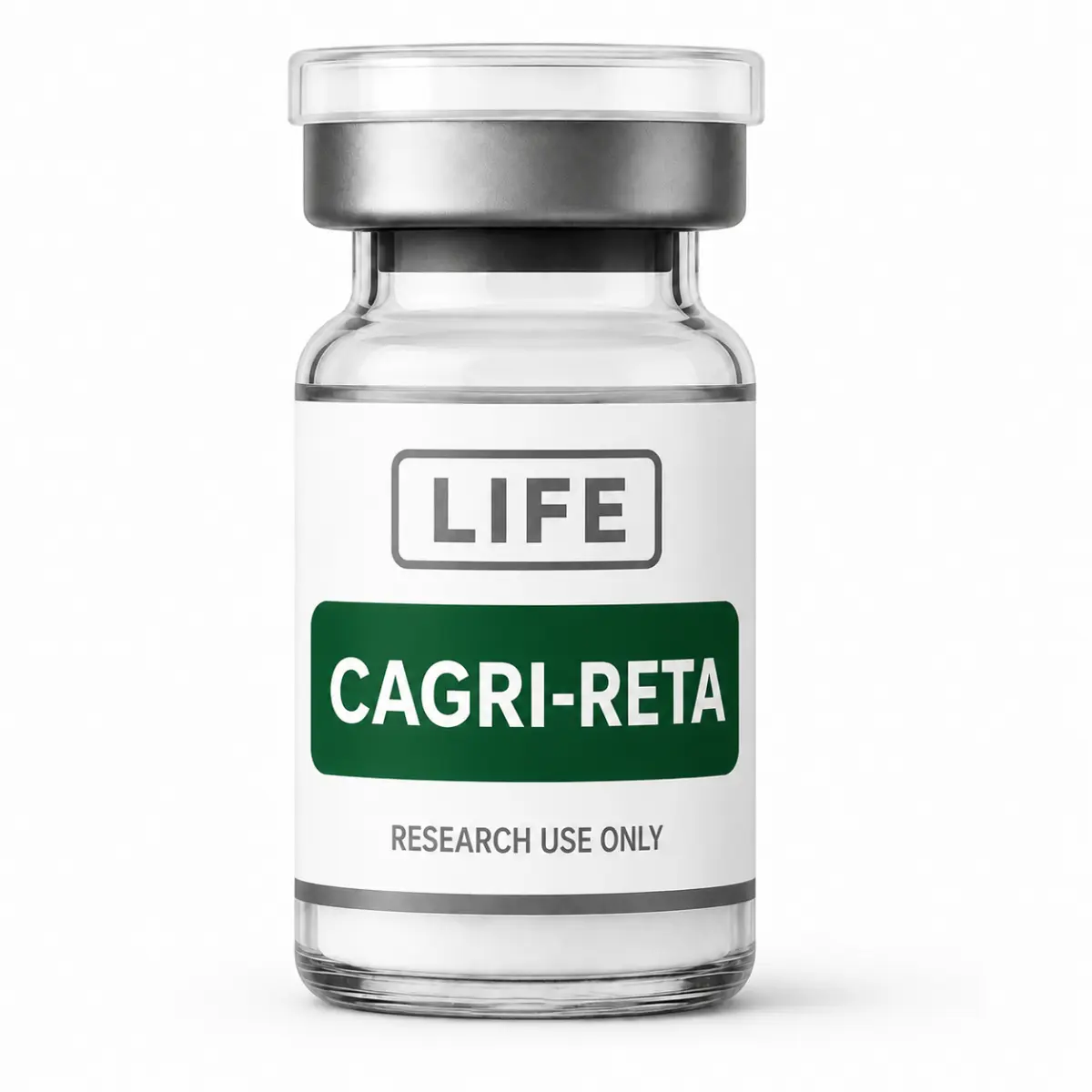
CagriReta Blend combina:
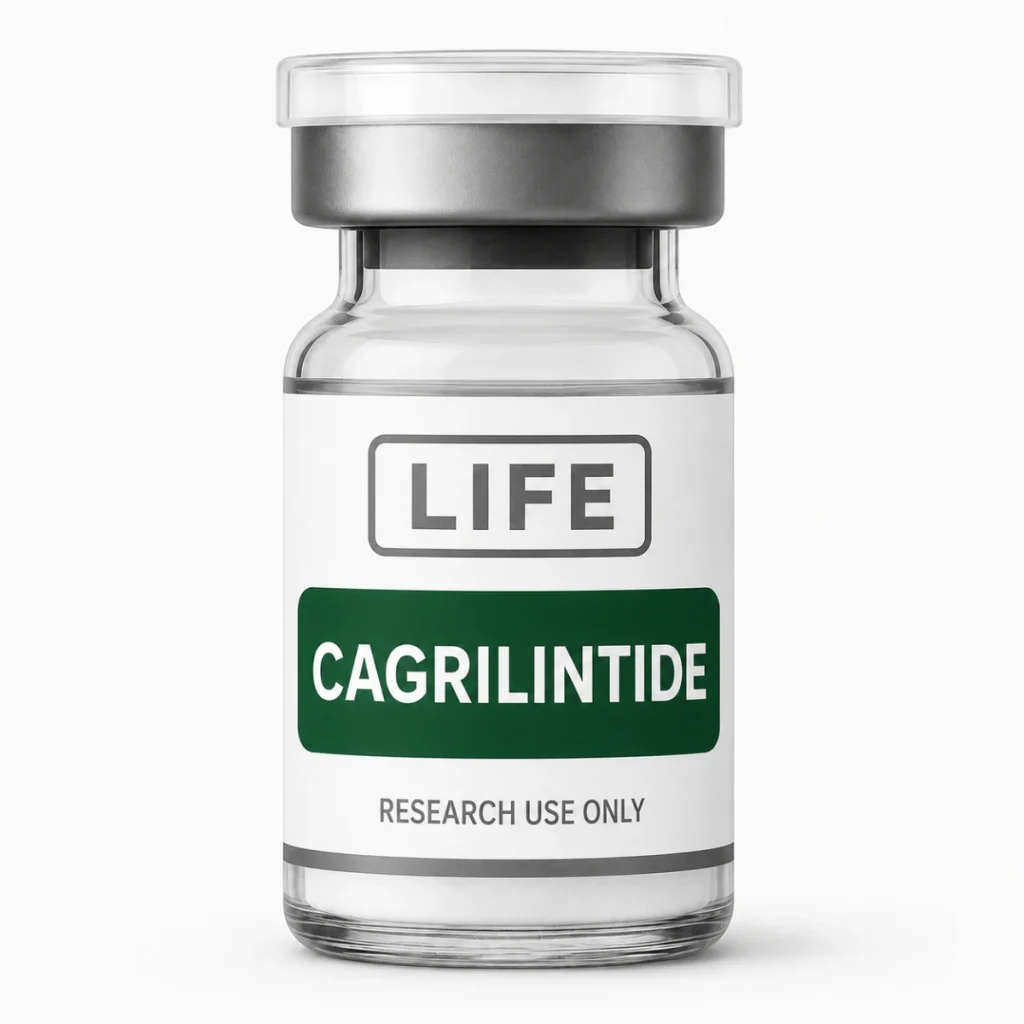
- Cagrilintida – 5 mg
- Retatrutida – 10 mg
En lugar de representar un nuevo péptido, CagriReta combina dos compuestos metabólicos en investigación con diferentes dianas biológicas.
Retatrutide es un agonista de triple receptor que actúa sobre los receptores de GLP-1, GIP y glucagón, mientras que el cagrilintido es un Análogo de amilina de acción prolongada. En conjunto, permiten a los investigadores estudiar cuatro vías de señalización metabólica complementarias dentro de una formulación experimental única.
¿Quieres comprar CagriReta en Europa? Life Peptide suministra CagriReta de alta pureza para investigación de laboratorio, con un servicio de envío fiable a toda la UE.
Por qué CagriReta es importante en la investigación metabólica
La investigación actual sobre la obesidad se centra cada vez más en que interviene en múltiples vías hormonales en lugar de basarse en un único mecanismo.
Los dos componentes de CagriReta investigan una biología complementaria:
- Agonismo del receptor GLP-1
- Agonismo del receptor GIP
- agonismo del receptor de glucagón
- gasto energético
- regulación metabólica
- señalización del receptor de amilina
- saciedad biología
- vaciamiento gástrico
- regulación del apetito
Juntas, estas vías representan cuatro sistemas hormonales distintos implicados en la regulación metabólica. Sin embargo, la evidencia publicada actual se refiere a los péptidos individuales y aún no se dispone de estudios específicos que evalúen la formulación combinada.
Los dos componentes de CagriReta
Retatrutida (10 mg)
Un agonista triple que se está investigando para la activación simultánea de los receptores de GLP-1, GIP y glucagón. Las investigaciones clínicas publicadas han demostrado que efectos significativos sobre la regulación del peso corporal y los parámetros metabólicos, lo que lo convierte en uno de los péptidos incretínicos de última generación más avanzados que se están investigando.
Cagrilíntida (5 mg)
Un análogo de amilina de acción prolongada investigado para regulación del apetito, señales de saciedad y vaciamiento gástrico. Dado que actúa a través de los receptores de amilina en lugar de los receptores de incretinas, ofrece una vía de investigación complementaria a las terapias basadas en el GLP-1.
¿Por qué los investigadores combinan el cagrilintide con el retatrutide?
Uno de los ámbitos más activos de la investigación metabólica es la combinación de péptidos que atacar diferentes vías fisiológicas en lugar de aumentar la actividad en el mismo receptor.
El retatrutido ya activa tres receptores metabólicos. El cagrilintido añade la señalización de la amilina, una vía que el retatrutido no actúa directamente sobre ella. Este perfil complementario de receptores ha hecho que la combinación sea cada vez más popular en la investigación metabólica experimental, aunque actualmente no se dispone de evidencia clínica directa sobre la propia combinación.
Investigación humana y preclínica
En la actualidad no hay ensayos clínicos publicados de Fase II o Fase III que evalúen la combinación de CagriReta.
En cambio, la base científica se fundamenta en:
- investigación clínica exhaustiva sobre el retatrutide
- Desarrollo de la fase II y la fase III de cagrilintida
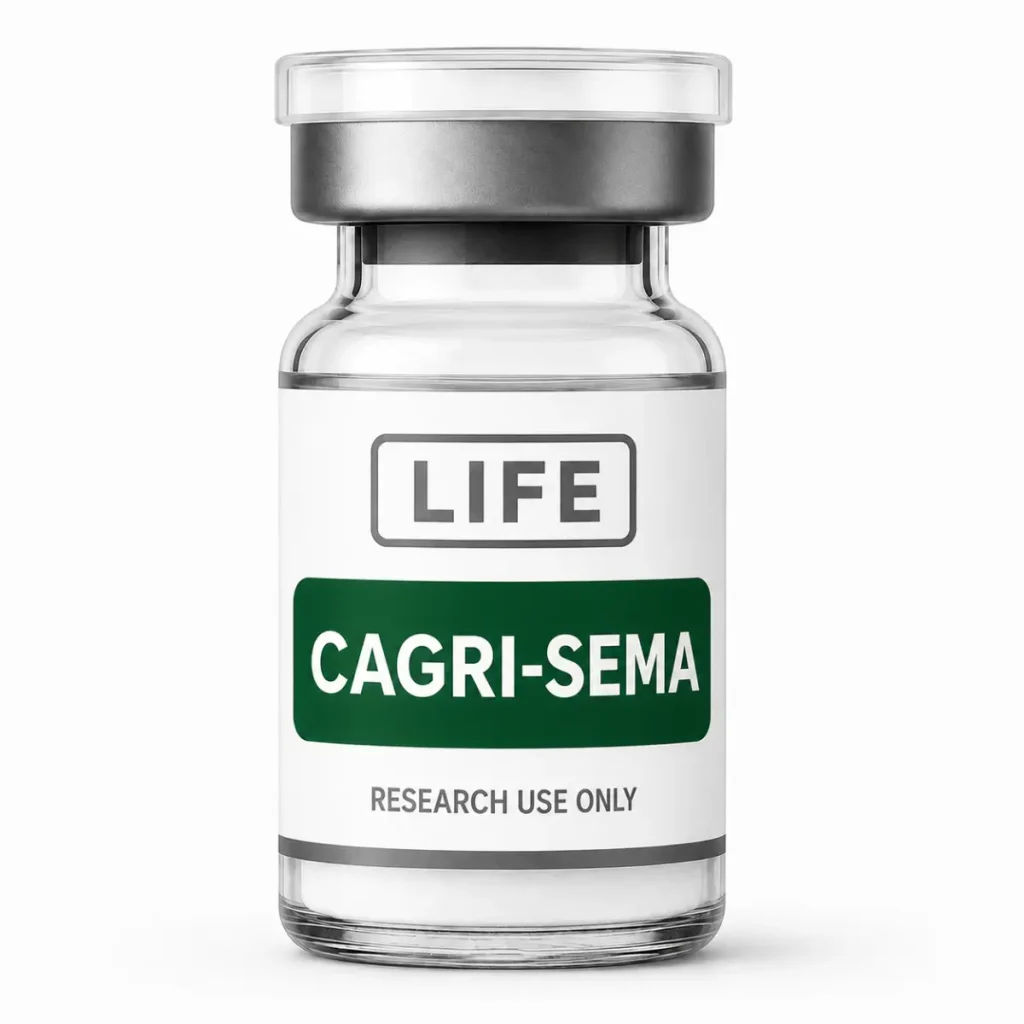
- investigación exitosa de combinaciones de amilina y GLP-1 como CagriSema
Por esta razón, CagriReta debe considerarse como una mezcla de investigación basada en mecanismos metabólicos complementarios en lugar de como una formulación con su propia base de evidencia clínica.
Cómo se diferencia CagriReta de otras mezclas metabólicas
CagriReta
- Cagrilintida
- Retatrutida
- Cuatro vías metabólicas
- Amilina + GLP-1 + GIP + glucagón
- Cagrilintida
- Semaglutida
- Amilina + GLP-1
- Cagrilintida
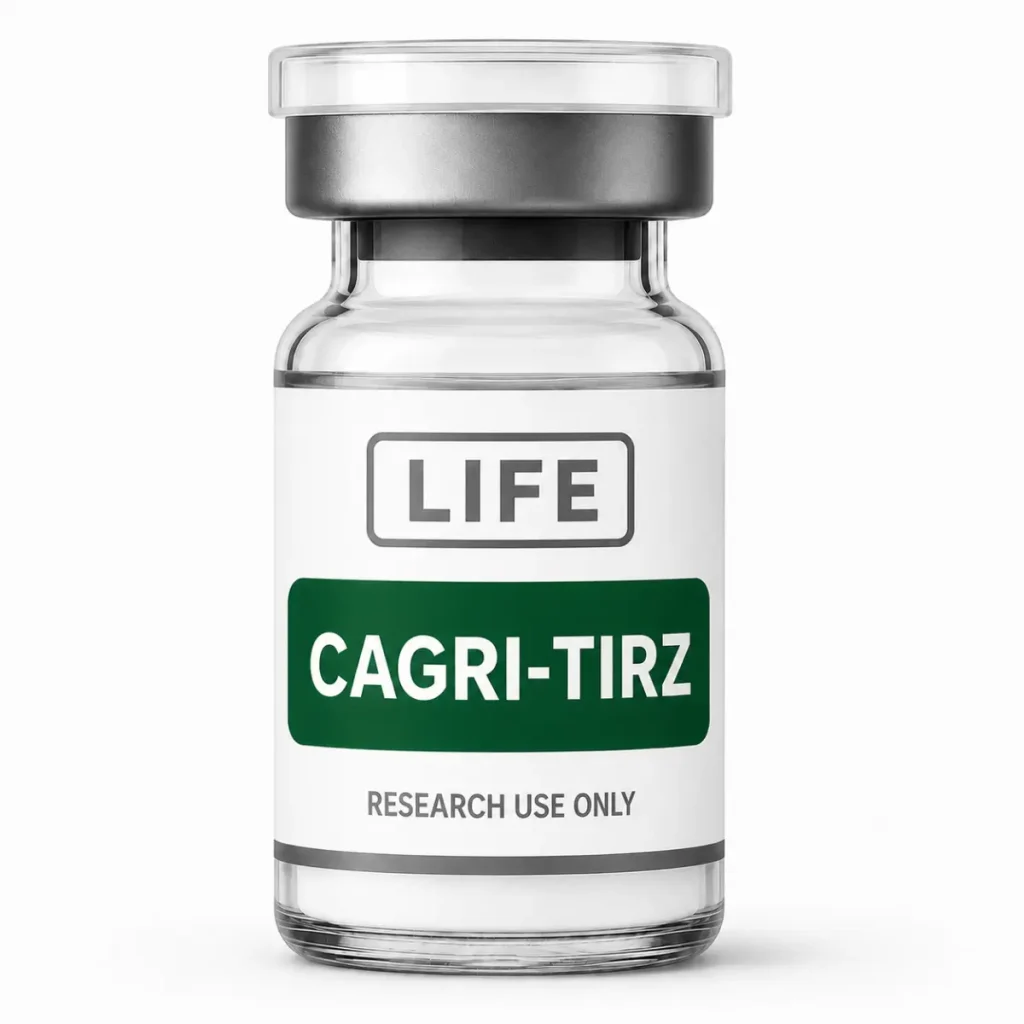
- Tirzepatida
- Amilina + GLP-1 + GIP
Cada formulación investiga una combinación diferente de vías de señalización metabólica, en lugar de constituir versiones sucesivas de un mismo concepto.
Características del producto
Aplicación: investigación de laboratorio y análisis
Uso restringido: no apto para consumo humano; no apto para uso médico, veterinario o cosmético
Producido en instalaciones que cumplen con GMP bajo estrictos protocolos de control de calidad.
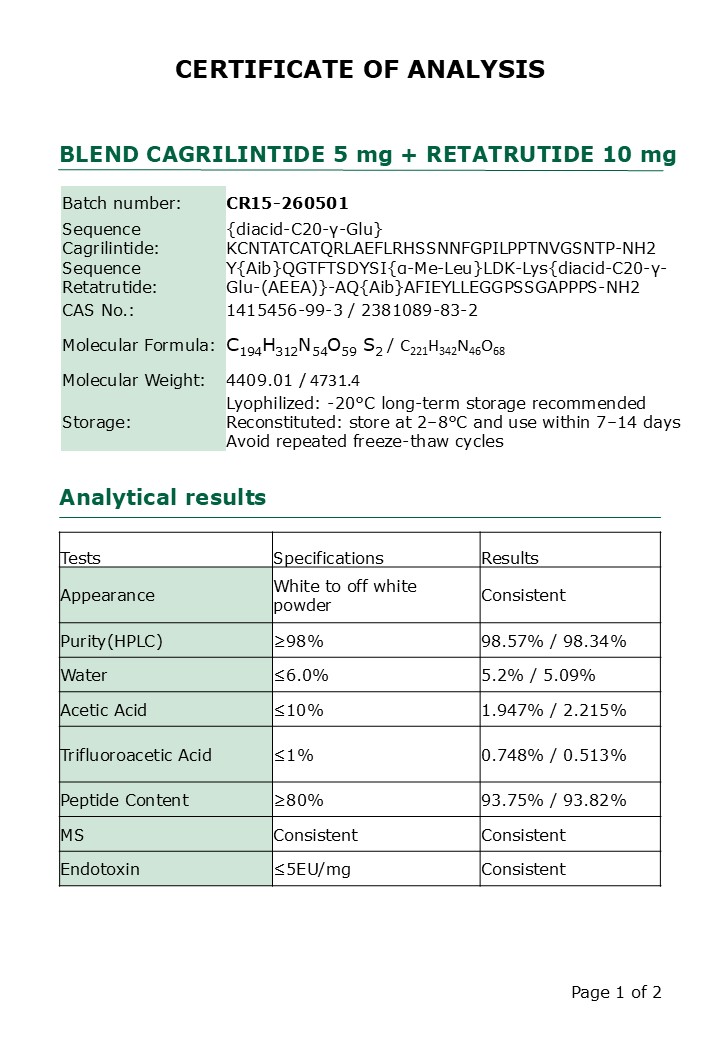
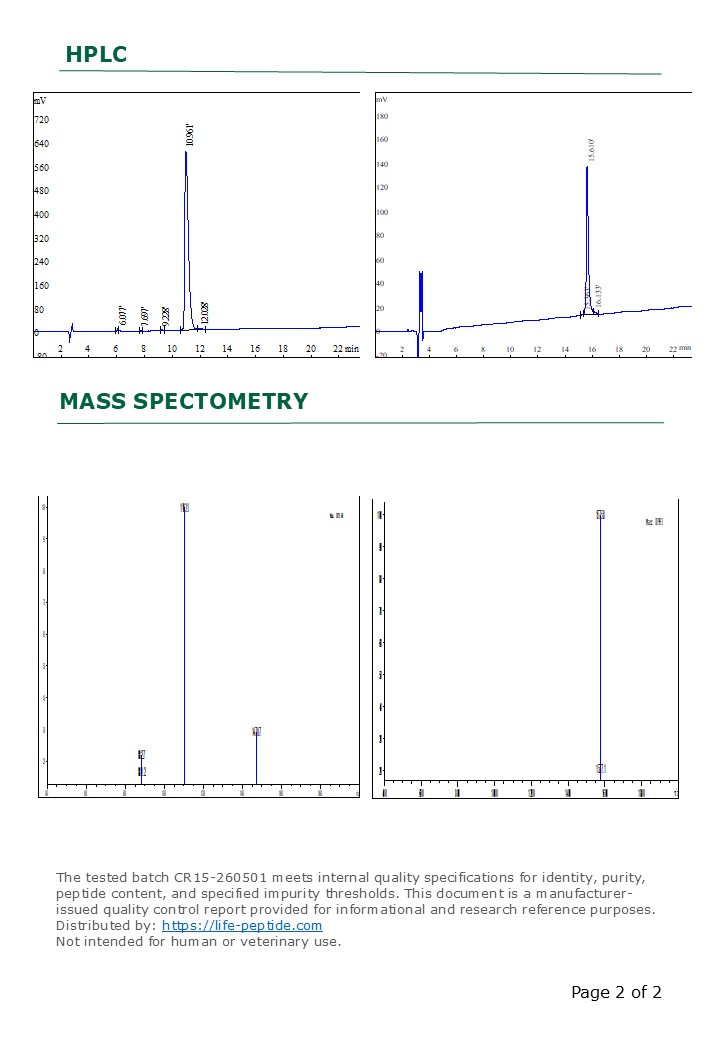
Cada lote se somete a pruebas de laboratorio exhaustivas después de la producción (puede encontrar el Certificado de Análisis debajo de las imágenes del producto).
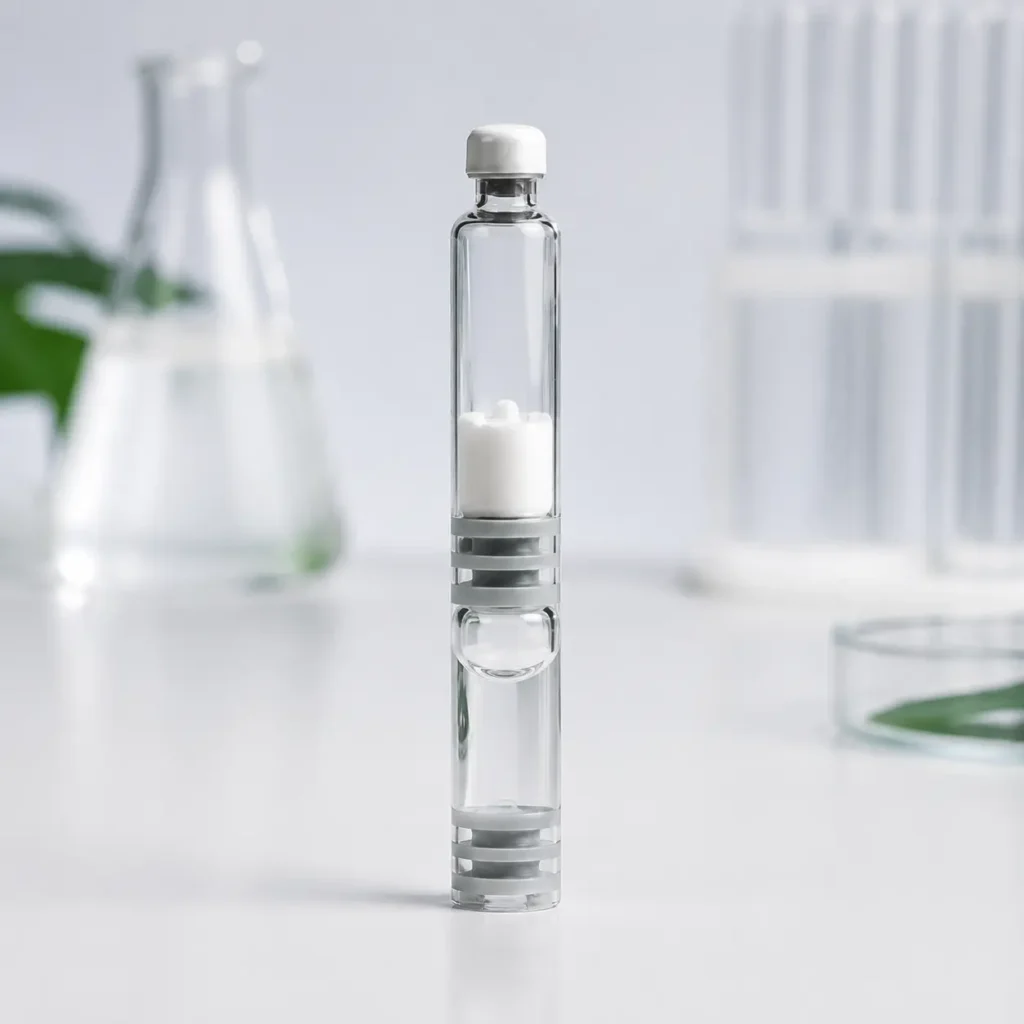
Liofilizado (liofilizado) para máxima estabilidad y vida útil prolongada.
Sellado en viales estériles, listo para la reconstitución.
Pureza: ≥ 98% (HPLC)
Apariencia: polvo blanco liofilizado
Composición: 5 mg de cagrilintida + 10 mg de retatrutida
Fórmula molecular de cagrilintida / retatrutida: C194H312N54O59 S2 / C221H342N46O68
Peso molecular Cagrilintide / Retatrutide: 4409.01 / 4731.4
Secuencia de cagrilintida: {diácido-C20-γ-Glu} KCNTATCATQRLAEFLRHSSNNFGPILPPTNVGSNTP-NH2
Secuencia de retatrutida: Y{Aib}QGTFTSDYSI{α-Me-Leu}LDK-Lys{diácido-C20-γ-Glu-(AEEA)}-AQ{Aib}AFIEYLLEGGPSSGAPPPS-NH2
Almacenamiento: los viales liofilizados sin abrir se almacenan mejor refrigerar a 2–8 °C, que es el método de almacenamiento confirmado por nuestro socio de fabricación y adecuado para hasta 24 meses. Se prefiere la refrigeración porque minimiza los ciclos innecesarios de congelación y descongelación durante la manipulación rutinaria. Si se requiere un almacenamiento a más largo plazo, los viales liofilizados sin abrir también pueden mantenerse congelados. Una vez reconstituidos, almacene siempre a 2–8 °C y no congele.
Reconstitución y manipulación
CagriReta se suministra en un vial liofilizado y debe manipularse utilizando los procedimientos estándar de reconstitución de péptidos apropiados para el entorno de investigación. Debe reconstituirse con agua bacteriostática antes de usar. Para ayudar a preservar la integridad estructural, agregue el disolvente elegido lentamente contra la pared interior del vial en lugar de directamente sobre el péptido en polvo, y evite agitar vigorosamente. La agitación suave suele ser suficiente una vez que el péptido se ha disuelto por completo. La práctica estándar de laboratorio también incluye permitir que los viales refrigerados alcancen la temperatura ambiente antes de la reconstitución para minimizar la condensación dentro del vial.
Para otras guías sobre selección de solventes, planificación de concentraciones y almacenamiento, consulte el completo Guía de Reconstitución de Péptidos y Calculadora de Reconstitución.
Estudios clave publicados
- Lau DCW, et al. Cagrilintida semanal para el control del peso en personas con sobrepeso u obesidad. The Lancet, 2021
Ensayos clínicos históricos de Fase II que establecen a la cagrilintide como un análogo de amilina de acción prolongada líder.
- Jastreboff AM y otros. Agonista de receptores triples de hormonas, retatrutida, para la obesidad. New England Journal of Medicine, 2023
Ensayos clínicos de fase II fundamentales que demuestran una reducción sustancial de peso con el agonismo de triple receptor.
- D’Ascanio AM, Mullally JA, Frishman WH. Cagrilintida: Un análogo de la amilina de acción prolongada para el tratamiento de la obesidad. Cardiology in Review, 2024
Revisión exhaustiva de la biología de la amilina y el desarrollo de cagrilintida.
- Katsi V, et al. Retatrutide: Un cambio de juego en la farmacoterapia de la obesidad. 2025
Revisión de la farmacología, el perfil de receptores y el desarrollo clínico de la retatrutida.
Preguntas Frecuentes
¿Qué es la mezcla CagriReta?
CagriReta Blend combina cagrilintida (5 mg) y retatrutida (10 mg) en un solo vial liofilizado. Está diseñado para la investigación de laboratorio que investiga vías metabólicas complementarias que involucran la señalización de amilina, GLP-1, GIP y glucagón.
¿Qué péptidos se incluyen en CagriReta?
Cada vial contiene:
- Cagrilintida – 5 mg
- Retatrutida – 10 mg
Juntos, estos péptidos proporcionan cuatro vías hormonales complementarias que se investigan comúnmente en la investigación metabólica.
¿Por qué se combinan Cagrilintide y Retatrutide??
Retatrutide activa los receptores de GLP-1, GIP y glucagón, mientras que Cagrilintide es un análogo de la amilina de acción prolongada. Debido a que estos péptidos se dirigen a diferentes sistemas fisiológicos, los investigadores investigan la combinación para explorar una señalización metabólica más amplia que la de cualquier compuesto por sí solo. La evidencia publicada actual, sin embargo, se relaciona con los péptidos individuales en lugar de con la mezcla en sí.
¿Qué áreas de investigación investigan comúnmente la mezcla CagriReta?
Según la literatura publicada sobre sus componentes individuales, CagriReta es relevante para la investigación relacionada con la regulación del apetito, la señalización de la saciedad, el balance energético, la regulación del peso corporal, el vaciamiento gástrico, la biología de las incretinas y la señalización del receptor de amilina.
¿En qué se diferencia CagriReta de CagriSema?
Ambas mezclas contienen Cagrilintide, pero CagriSema lo combina con Semaglutide, mientras que CagriReta lo combina con Retatrutide. Retatrutide añade agonismo de los receptores de GIP y glucagón además de la actividad de GLP-1, lo que le otorga a CagriReta un perfil de receptores más amplio para la investigación metabólica.
¿Se puede aplicar directamente a la mezcla la investigación sobre Cagrilintide y Retatrutide?
No necesariamente. Ambos péptidos cuentan con una sólida bibliografía clínica independiente, pero actualmente no existen grandes estudios clínicos específicos que evalúen la formulación de CagriReta. Por lo tanto, los hallazgos deben interpretarse de acuerdo con la evidencia disponible para cada componente individual.
¿Puedo comprar CagriReta en Europa?
Sí. Realizamos envíos de CagriReta a la mayoría de los países europeos utilizando servicios de mensajería confiables. Los métodos de envío disponibles y los tiempos de entrega se muestran durante el proceso de compra según su destino.
¿Está este producto destinado al uso humano?
La mezcla CagriReta suministrada por Life Peptide se destina exclusivamente a la investigación de laboratorio y analítica. No está destinada al consumo humano, ni al diagnóstico, tratamiento o prevención de enfermedades. Cualquier referencia a estudios publicados resume la bibliografía científica relacionada con los componentes peptídicos individuales, y no con el uso previsto de la fórmula combinada.
Contexto de investigación relacionado
Cagrilintide / Retatrutide representa un modelo de investigación avanzado de múltiples vías que combina la señalización del receptor de amilina con el agonismo de incretinas de triple receptor (GLP-1, GIP, glucagón).
Para una comparación estructurada y un contexto más profundo, los investigadores también pueden examinar:
• Retatrutida — agonista de triple receptor (GLP-1/GIP/glucagón)
• Cagrilintida — análogo de amilina (vía de señalización de la saciedad)
• Tirzepatida — agonista dual de las incretinas (GLP-1/GIP)
• Semaglutida Agonista del receptor de GLP-1
Para una comparación de mecanismos más amplia, consulte la Guía de investigación metabólica de GLP-1 y explora el Categoría de investigación metabólica.
Esta mezcla es más relevante en estudios que investigan la señalización hormonal en capas y los marcos de interacción metabólica multireceptor.
NOTA: Esto es solo para fines de referencia educativa y no constituye asesoramiento médico.
Descargo de responsabilidad
Este producto se vende únicamente para fines de investigación. No está destinado a diagnosticar, tratar, curar ni prevenir ninguna enfermedad. El comprador asume toda la responsabilidad por su manipulación y uso adecuados.