

Descripción
Semax es un heptapéptido sintético desarrollado originalmente a partir del fragmento ACTH(4–7) y modificado con una extensión Pro-Gly-Pro para mejorar la estabilidad y eliminar la actividad hormonal asociada con la hormona principal. A diferencia de la propia ACTH, Semax se investiga principalmente por sus efectos sobre función cognitiva, neuroplasticidad y señalización neuroprotectora en lugar de actividad endocrina.
En las últimas dos décadas, el Semax se ha convertido uno de los péptidos de investigación más conocidos en neurociencia cognitiva. Estudios publicados han investigado su papel en aprendizaje, atención, memoria, regulación de neurotrofinas y recuperación tras una lesión neurológica. En comparación con el Selank, que se asocia principalmente con la regulación de la ansiedad y el estrés, el Semax se investiga más comúnmente para rendimiento cognitivo y plasticidad neuronal.
¿Quieres comprar Semax en Europa? Life Peptide suministra Semax de alta pureza para investigación de laboratorio, con envíos fiables a toda la UE.
Por qué Semax es importante en la neurociencia cognitiva
Una de las características distintivas de Semax es su relación con la señalización neurotrófica, en particular las vías que involucran al factor neurotrófico derivado del cerebro (BDNF). Los estudios experimentales han informado mayor expresión de BDNF tras la administración de Semax, lo que lo convierte en un modelo de investigación importante para comprender la plasticidad sináptica, la adaptación neuronal y el aprendizaje.
En los estudios publicados se ha investigado el Semax en relación con:
- aprendizaje y memoria
- atención
- neuroplasticidad
- Señalización del BDNF
- Regulación del NGF
- neuroprotección
- investigación sobre la recuperación tras un ictus
- rendimiento cognitivo
- expresión génica neuronal
Debido a que estas vías son fundamentales para la forma en que el cerebro se adapta y forma nuevas conexiones, el Semax se ha convertido en uno de los péptidos cognitivos más reconocidos en la investigación neurocientífica.
Cómo actúa el Semax
A diferencia de los estimulantes clásicos, No parece que el Semax ejerza sus efectos a través de un único sistema neurotransmisor. Por el contrario, los estudios publicados sugieren que influye en varias vías interconectadas que intervienen en la función cognitiva y la adaptación neuronal.
- Señalización de neurotrofinas
Uno de los mecanismos más estudiados es la regulación al alza del BDNF y las vías neurotróficas relacionadas involucradas en la supervivencia neuronal, la plasticidad sináptica y la formación de memoria. El trabajo experimental también ha reportado una mayor activación de TrkB tras la exposición a Semax.
- Expresión génica
Los estudios de laboratorio han demostrado cambios en la expresión de genes asociados con la comunicación neuronal, las respuestas al estrés y la neuroplasticidad, lo que sugiere que el Semax actúa como un regulador de una adaptación neuronal más amplia en lugar de un simple agonista de receptores.
- Modulación de neurotransmisores
La investigación publicada también ha explorado las interacciones con los sistemas dopaminérgico, serotoninérgico y glutamatérgico, lo que puede contribuir a su investigación en el aprendizaje, la atención y la función ejecutiva.
Por qué se investiga ampliamente el Semax para la investigación del aprendizaje y la memoria
El semax se ha convertido en uno de los péptidos más conocidos en el ámbito de la neurociencia cognitiva, ya que muchos de los estudios publicados se centran en el aprendizaje, la formación de la memoria y la neuroplasticidad, más que en la estimulación general.
La investigación experimental ha explorado:
- adquisición de memoria
- rendimiento de aprendizaje
- atención
- función ejecutiva
- adaptación neuronal
- plasticidad sináptica
- recuperación después de una lesión neurológica
A diferencia de los estimulantes convencionales, el Semax se investiga principalmente por su capacidad para influir en los procesos biológicos subyacentes a la cognición en lugar de simplemente aumentar el estado de alerta. Esta distinción la ha convertido en una importante herramienta de investigación en neurobiología y ciencia cognitiva.
Investigación humana y preclínica
En comparación con muchos péptidos de investigación, el Semax tiene un base de evidencia relativamente amplia que incluye investigaciones de laboratorio junto con la investigación clínica, gran parte de ella originada en Rusia. Los estudios publicados han explorado sus efectos en la neurociencia cognitiva, la neuroprotección y la rehabilitación de accidentes cerebrovasculares, mientras que el trabajo mecanístico se ha centrado en la señalización de neurotrofinas, la expresión génica y la plasticidad sináptica.
Aunque estos hallazgos han generado un gran interés científico, gran parte de la literatura clínica sigue siendo regional y se beneficiaría de nuevos y amplios estudios internacionales.
¿Qué diferencia a Semax de otros péptidos cognitivos?
Semax
- Investigación sobre el aprendizaje y la memoria
- BDNF y neuroplasticidad
- Atención
- Señalización neuroprotectora
- Rendimiento cognitivo
- Investigación sobre la ansiedad
- Adaptación al estrés
- Regulación emocional
- señalización relacionada con GABA
- Fisiología del sueño
- Biología circadiana
- Regulación neuroendocrina
Aunque estos péptidos se agrupan a menudo dentro de la investigación cognitiva, representan diferentes áreas de la neurociencia en lugar de compuestos intercambiables.
Observaciones de seguridad publicadas
Las investigaciones clínicas publicadas han informado en general tolerabilidad favorable dentro de las poblaciones estudiadas. La investigación en humanos se ha centrado principalmente en los trastornos neurológicos y la rehabilitación cognitiva, mientras que los estudios de laboratorio continúan investigando los mecanismos moleculares subyacentes a los efectos neuroprotectores y neuroplásticos del Semax.
Características del producto
Aplicación: investigación de laboratorio y análisis
Uso restringido: no apto para consumo humano; no apto para uso médico, veterinario o cosmético
Producido en instalaciones que cumplen con GMP bajo estrictos protocolos de control de calidad.
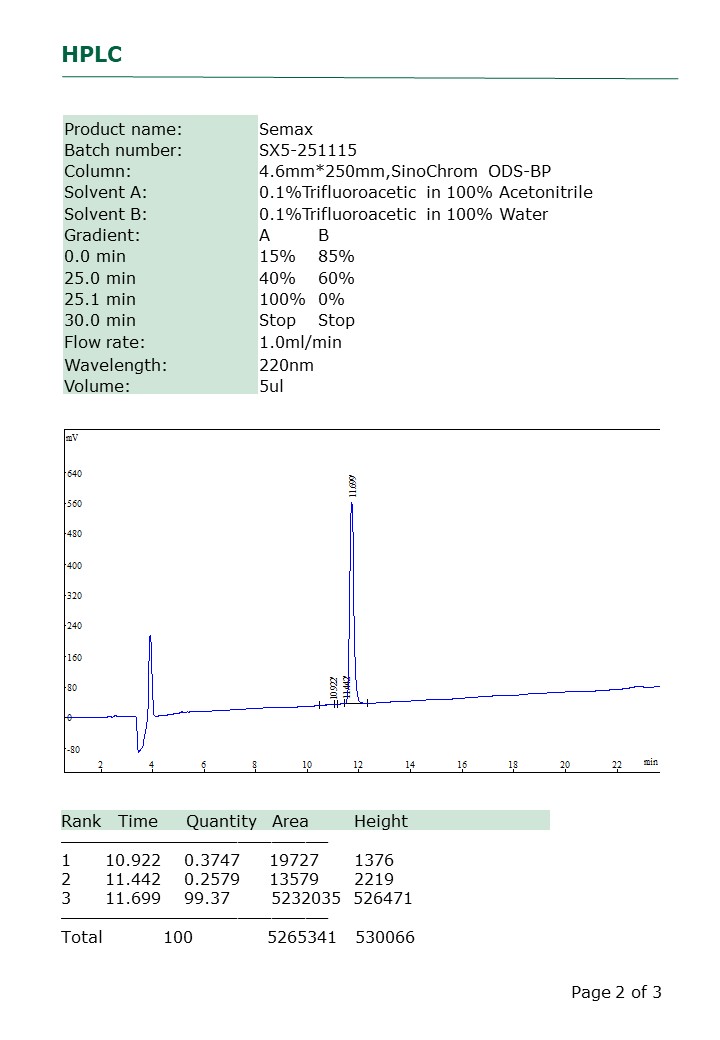
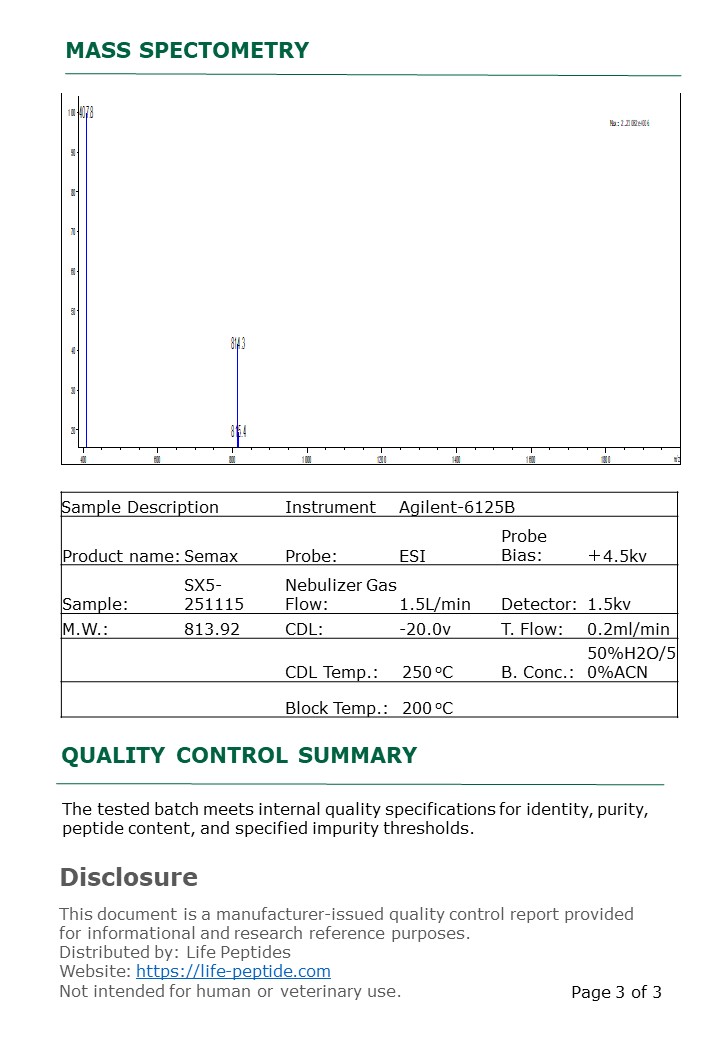
Cada lote se somete a pruebas de laboratorio exhaustivas después de la producción (puede encontrar el Certificado de Análisis debajo de las imágenes del producto).
Liofilizado (liofilizado) para máxima estabilidad y vida útil prolongada.
Sellado en viales estériles, listo para la reconstitución.
Pureza: ≥99% (analizada mediante HPLC)
Apariencia: Polvo blanco/blanquecino liofilizado
Fórmula molecular: C37H51N9O10S1
Peso molecular: 813.92
Secuencia: Met-Glu-His-Phe-Pro-Gly-Pro
Almacenamiento: los viales liofilizados sin abrir se almacenan mejor refrigerar a 2–8 °C, que es el método de almacenamiento confirmado por nuestro socio de fabricación y adecuado para hasta 24 meses. Se prefiere la refrigeración porque minimiza los ciclos innecesarios de congelación y descongelación durante la manipulación rutinaria. Si se requiere un almacenamiento a más largo plazo, los viales liofilizados sin abrir también pueden mantenerse congelados. Una vez reconstituidos, almacene siempre a 2–8 °C y no congele.
Reconstitución y manipulación
Semax se suministra en un vial liofilizado y debe manipularse utilizando los procedimientos estándar de reconstitución de péptidos apropiados para el entorno de investigación. Debe reconstituirse con agua bacteriostática o salina estéril antes de su uso. Para ayudar a preservar la integridad estructural, agregue el disolvente elegido lentamente contra la pared interior del vial en lugar de directamente sobre el pellet de péptido, y evite la agitación vigorosa. Generalmente, un suave movimiento circular es suficiente una vez que el péptido se ha disuelto por completo. La práctica estándar de laboratorio también incluye permitir que los viales refrigerados alcancen la temperatura ambiente antes de la reconstitución para minimizar la condensación dentro del vial.
Para otras guías sobre selección de solventes, planificación de concentraciones y almacenamiento, consulte el completo Guía de Reconstitución de Péptidos y Calculadora de Reconstitución.
Estudios clave publicados
- Dolotov OV, et al. Semax, un análogo de ACTH(4–10) con efectos cognitivos, regula la expresión de BDNF y TrkB en el hipocampo de rata. Brain Research, 2006.
Un estudio mecanístico histórico que demuestra el aumento de la expresión de BDNF y la activación de TrkB tras la administración de Semax, proporcionando una de las explicaciones experimentales más sólidas de sus efectos sobre el aprendizaje y la neuroplasticidad.
- Medvedeva EV, et al. El péptido Semax afecta a la expresión de genes relacionados con los sistemas inmunitario y nervioso tras la isquemia cerebral. BMC Genomics, 2014.
Un estudio clave que investiga cómo el Semax altera la expresión génica después de la isquemia cerebral, respaldando su papel en la neuroprotección y la adaptación neuronal.
- Filippenkov IB, et al. Nuevos conocimientos sobre las propiedades protectoras de la ACTH(4–7)PGP (Semax). Genes, 2020.
Una revisión exhaustiva que resume los mecanismos neuroprotectores, la regulación génica, la investigación experimental sobre el accidente cerebrovascular y la comprensión actual de la biología del Semax.
- Radchenko AI, et al. El potencial del fármaco peptídico Semax y sus derivados para los trastornos neurodegenerativos. International Journal of Molecular Sciences, 2025.
Una revisión moderna que analiza el Semax en el contexto de la neuroplasticidad, la señalización del BDNF, la función cognitiva y las futuras direcciones de la investigación en neurociencia.
Preguntas Frecuentes
¿Qué es Semax?
Semax es un heptapéptido sintético derivado del fragmento ACTH(4–7) y modificado para mejorar la estabilidad sin retener actividad hormonal. Se investiga principalmente en neurociencia cognitiva para el aprendizaje, la memoria, la neuroplasticidade y la señalización neuroprotectora.
¿En qué se diferencia el Semax del Selank?
Aunque ambos son péptidos de investigación cognitiva, sus principales áreas de investigación difieren. El Semax se estudia principalmente para el aprendizaje, la memoria, la atención y la neuroplasticidad, mientras que el Selank está más estrechamente asociado con la ansiedad, la regulación del estrés y el procesamiento emocional. A menudo se consideran neuropéptidos complementarios más que competidores.
¿Por qué se asocia Semax con el BDNF?
Estudios experimentales han demostrado que el Semax puede aumentar la expresión del factor neurotrófico derivado del cerebro (BDNF) y las vías de señalización neurotrófica relacionadas. Debido a que el BDNF desempeña un papel central en la supervivencia neuronal, la plasticidad sináptica y el aprendizaje, este mecanismo se ha convertido en una de las características definitorias de la investigación sobre el Semax.
¿Qué áreas de investigación investigan comúnmente el Semax?
La investigación publicada ha investigado el Semax en el aprendizaje, la memoria, la atención, la neuroplasticidad, la señalización de BDNF, la investigación sobre la recuperación de accidentes cerebrovasculares, la neuroprotección y la regulación genética neuronal. Estas áreas forman el núcleo de la literatura actual sobre el Semax.
¿Puedo comprar Semax en Europa?
Sí. Realizamos envíos de Semax a la mayoría de los países europeos utilizando servicios de mensajería confiables. Los métodos de envío disponibles y los tiempos de entrega se muestran durante el pago según su destino.
¿Está diseñado el Semax para uso humano?
No. El Semax suministrado por Life Peptide se destina exclusivamente a la investigación de laboratorio y analítica. No está destinado al consumo humano, ni al diagnóstico, tratamiento o prevención de enfermedades. Cualquier referencia a estudios publicados resume la literatura científica relacionada con la molécula de Semax, y no el uso previsto de este producto.
Contexto de investigación relacionado
Semax pertenece a la categoría más amplia de péptidos de investigación neurocognitiva y científica, centrándose en la señalización de neuropéptidos y la investigación de vías reguladoras del SNC.
Los investigadores que exploran modelos relacionados de neurorregulación y neuroplasticidad también pueden examinar:
Selank — investigación de péptidos ansiolíticos y neurorreguladores
DSIP — investigación sobre el estrés y el sueño
Para un contexto más amplio, véase categoría de investigación cognitiva y neurológicaguías de investigación sobre señalización de péptidos e Y.
NOTA: Esto es solo para fines de referencia educativa y no constituye asesoramiento médico.
Descargo de responsabilidad:
Este producto se vende únicamente para fines de investigación. No está destinado a diagnosticar, tratar, curar ni prevenir ninguna enfermedad. El comprador asume toda la responsabilidad por su manipulación y uso adecuados.