Description
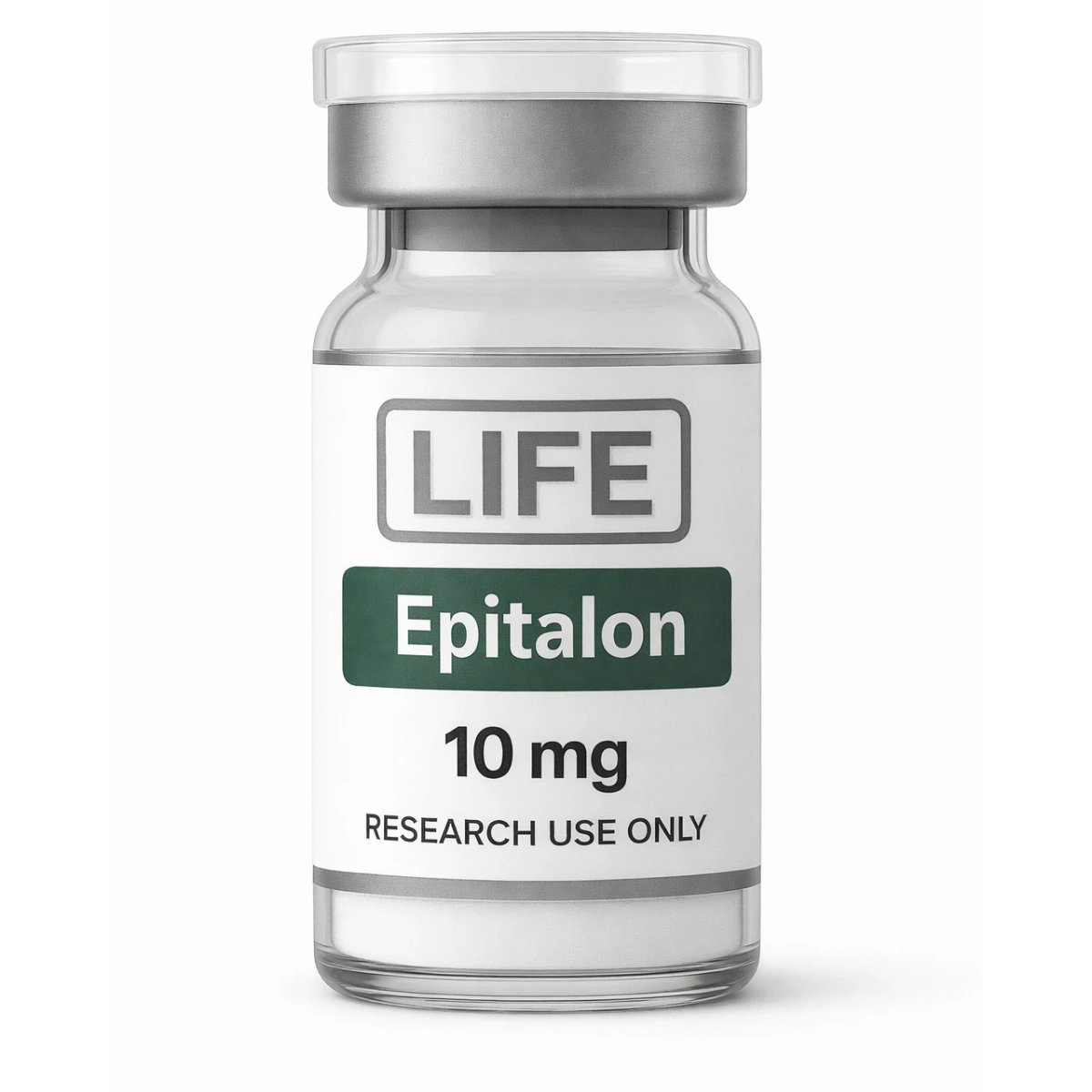
L'épitalon (également connu sous le nom d'épithalon) est un tétrapeptide synthétique (Ala-Glu-Asp-Gly; AEDG) dérivé de l'épithalamine, un complexe peptidique initialement isolé de la glande pinéale.
C'est devenu l'un des peptides de recherche les plus reconnus en sciences de la longévité car des études publiées ont examiné sa relation avec activation de la télomérase, maintien des télomères, rythme circadien et vieillissement en bonne santé. Bien que le peptide soit fréquemment discuté dans la recherche sur la longévité, une grande partie des preuves provient d'études en laboratoire et précliniques, avec des recherches humaines indépendantes relativement limitées.
Vous souhaitez acheter de l'Epitalon en Europe ? Life Peptide propose de l'Epitalon de haute pureté destiné à la recherche en laboratoire, avec une livraison fiable dans toute l'Union européenne.
Pourquoi l'Épithalon fait l'objet de nombreuses recherches
Des recherches publiées ont étudié l'Épithalon en relation avec :
- vieillissement en santé
- activation de la télomérase
- biologie des télomères
- sénescence cellulaire
- Rythme circadien
- régulation de la mélatonine
- fonction de la glande pinéale
- stress oxydatif
- recherche sur la longévité
L'Épithalon reste l'un des rares peptides de recherche spécifiquement développés pour étudier le vieillissement biologique plutôt que le métabolisme, l'hormone de croissance ou la réparation tissulaire.
Comment fonctionne l'Épitalon
Les recherches actuelles ont exploré plusieurs mécanismes potentiels.
Activité télomérase
Les études les plus connues ont examiné si l'Épithalon pouvait augmenter l'expression de la télomérase (hTERT) et influencer le maintien des télomères dans des cellules humaines en culture. Des travaux de laboratoire indépendants publiés en 2025 ont apporté un soutien supplémentaire à ces observations, bien que la signification clinique reste incertaine.
Recherche sur la glande pinéale
L'épithalon a également été étudié pour sa relation avec la biologie de la glande pinéale et la synthèse de la mélatonine, ce qui le rend pertinent pour la recherche sur le rythme circadien et les changements liés à l'âge de la fonction endocrinienne.
Vieillir en santé
Des études animales ont exploré la relation entre l'Épitalon, le vieillissement cellulaire et la durée de vie, tandis que la recherche humaine est restée relativement limitée. Les preuves actuelles soutiennent la poursuite des investigations mais n'établissent pas d'effets cliniques sur la longévité.
Stress oxydatif
Des chercheurs ont également étudié l'interaction de l'Épithalon avec le stress oxydatif et la régulation cellulaire liée à l'âge dans le cadre de recherches plus larges sur la longévité.
Pourquoi l'Épitalon est devenu l'un des peptides de longévité les plus connus
Peu de peptides de recherche ont suscité autant de discussions dans la science de la longévité qu'Épitalon.
L'intérêt découle en grande partie des premières publications rapportant l'activation de la télomérase et ses effets possibles sur le vieillissement cellulaire. Cependant, une limite importante doit être reconnue : la plupart des publications sur la longévité proviennent d'un seul groupe de recherche, et des confirmations indépendantes n'ont que récemment commencé à émerger au niveau cellulaire. Des études humaines à grande échelle contrôlées par placebo restent indisponibles.
C'est pourquoi l'Épitalon est mieux considéré comme l'un des plus des peptides prometteurs à l'étude pour la longévité plutôt qu'une intervention établie contre le vieillissement.
Recherche humaine et préclinique
Recherches publiées incluent :
- biologie de la télomérase
- entretien des télomères
- physiologie de la glande pinéale
- régulation de la mélatonine
- Rythme circadien
- vieillissement en santé
- recherche sur la durée de vie
- stress oxydatif
Les résultats de laboratoire sont encourageants, mais les preuves cliniques restent limitées par rapport aux peptides de recherche plus établis.
Observations de sécurité publiées
La plupart des données humaines publiées impliquent des études relativement petites. Les premières investigations ont généralement rapporté bonne tolérance, mais des données complètes sur la sécurité à long terme font défaut. Les chercheurs notent également que, comme l'épitalon a été étudié pour son activation de la télomérase, des recherches supplémentaires sont nécessaires pour mieux comprendre ses effets biologiques à long terme avant de pouvoir tirer des conclusions fermes.
Caractéristiques du produit
Application : recherche de laboratoire et analytique
Utilisation restreinte : non destiné à la consommation humaine ; non destiné à un usage médical, vétérinaire ou cosmétique
Produit dans des installations conformes aux BPF dans le cadre de protocoles de CQ stricts.
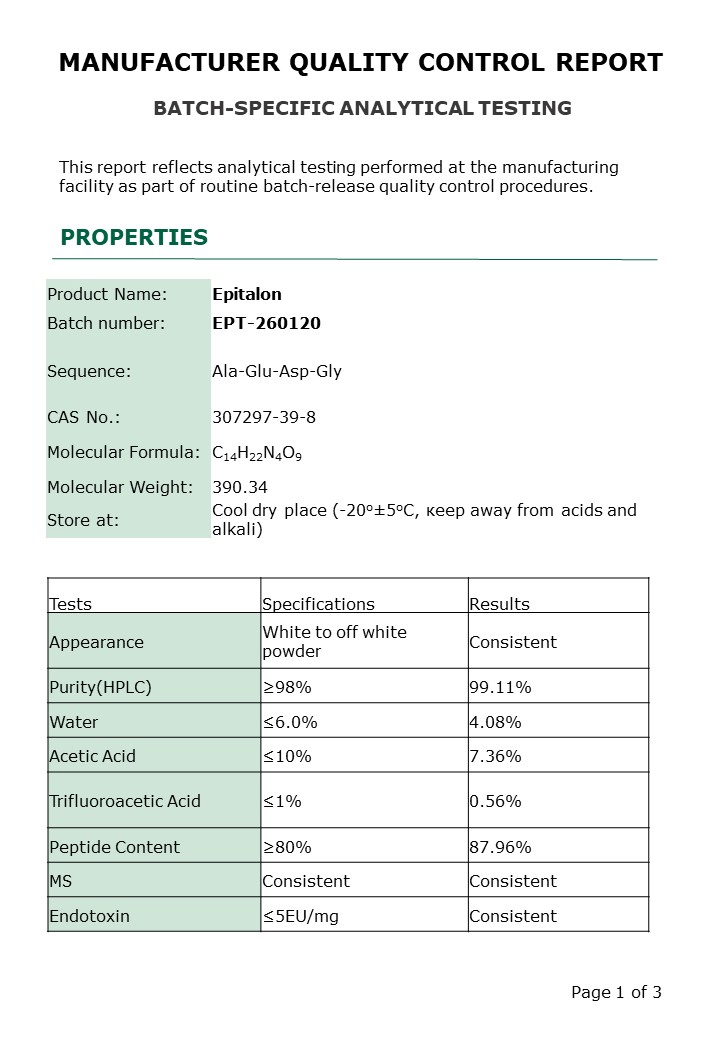
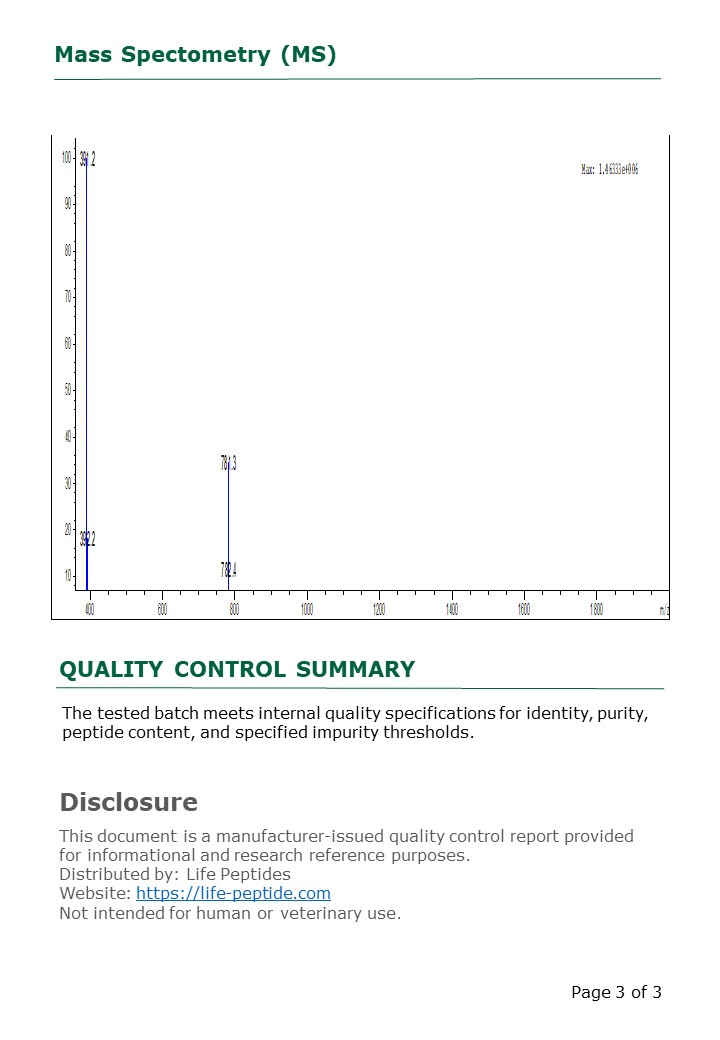
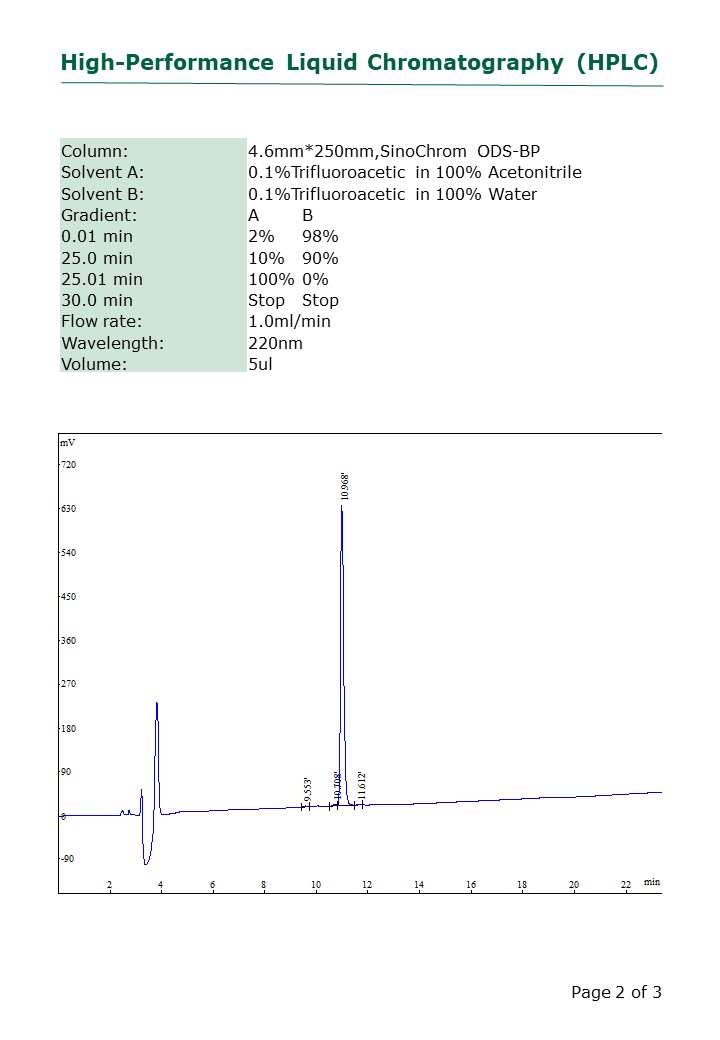
Chaque lot est soumis à des tests rigoureux en laboratoire après production (vous trouverez le certificat d'analyse sous les photos du produit).
Lyophilisé (séché par congélation) pour une stabilité et une durée de conservation maximales.
Scellés dans des flacons stériles, prêts à être reconstitués.
Pureté : ≥ 99,111 TP4T (testé par HPLC)
Aspect : Poudre blanche/blanc cassé lyophilisée
Formule moléculaire : C14H22N4O9
Masse moléculaire : 390,34
Ala-Glu-Asp-Gly
Stockage: les flacons lyophilisés non ouverts sont mieux conservés réfrigéré à 2–8 °C, qui est la méthode de stockage confirmée par notre partenaire de fabrication et adaptée jusqu'à 24 mois. La réfrigération est préférable car elle minimise les cycles de congélation-décongélation inutiles lors de la manipulation de routine. Si un stockage à plus long terme est nécessaire, les flacons lyophilisés non ouverts peuvent également être conservés congelés. Une fois reconstituées, toujours conserver à 2-8°C et ne pas congeler.
Reconstitution et manipulation
L'Épitalon est fourni sous forme de flacon lyophilisé et doit être manipulé en utilisant des procédures standard de reconstitution de peptides appropriées au contexte de recherche. Doit être reconstitué avec eau bactériostatique avant utilisation. Pour aider à préserver l'intégrité structurelle, ajoutez le solvant choisi lentement contre la paroi intérieure du flacon plutôt que directement sur le précipité peptidique, et évitez les secousses vigoureuses. Un léger mouvement de rotation suffit généralement une fois que le peptide est complètement dissous. Les pratiques courantes de laboratoire comprennent également le fait de laisser les flacons réfrigérés atteindre la température ambiante avant la reconstitution afin de minimiser la condensation à l'intérieur du flacon.
Pour d'autres choix de solvant, une planification de la concentration et des conseils de stockage, consultez le guide complet Guide de reconstitution des peptides et Calculateur de reconstitution.
Références de recherche sélectionnées
- Khavinson V, Bondarev I, Butyugov A. L'Épitalon induit l'activité de la télomérase et l'allongement des télomères dans les cellules somatiques humaines, Bulletin de biologie expérimentale et de médecine, 2003
La publication historique rapportant l'activation de la télomérase et l'allongement des télomères dans des cellules humaines cultivées.
- Al-Dulaimi A, Thomas R, Matta C, Roberts T. Investigation indépendante de l'extension des télomères induite par l'épitalon dans des lignées cellulaires humaines, 2025
L'une des premières études indépendantes hors du programme de recherche russe d'origine confirmant l'allongement des télomères dans des modèles cellulaires humains et explorant les mécanismes sous-jacents.
- Khavinson V, Anisimov V. Peptides Pinéaux et Vieillissement
Une série de publications étudiant la relation de l'Épitalon avec la fonction pinéale, la régulation de la mélatonine et le vieillissement en bonne santé.
- Zhou et al. Perspectives récentes sur l'Épitalon et le vieillissement en bonne santé : revues 2025-2026
Des revues scientifiques récentes traitant des données actuelles, des limites et des perspectives d'avenir de la recherche sur l'Epitalon.
Questions fréquemment posées
Qu'est-ce que l'Epitalon ?
L'épitalon est un tétrapeptide synthétique dérivé de l'épithalamine. Il fait l'objet de nombreuses recherches dans les domaines du vieillissement en bonne santé, de l'activité de la télomérase, de la biologie des télomères et de la glande pinéale.
Pourquoi l'Epitalon est-il associé à la recherche sur la longévité ?
Les premières études en laboratoire ont suggéré que l'Epitalon pourrait influencer l'activité de la télomérase et le maintien des télomères. Ces résultats en ont fait l'un des peptides les plus connus dans le domaine de la recherche sur la longévité, bien qu'aucun essai clinique indépendant à grande échelle n'ait encore été mené chez l'homme.
Le TL-peptide Epitalon allonge-t-il les télomères ?
Des études menées sur des cultures cellulaires ont mis en évidence une activation de la télomérase et un allongement des télomères, et des travaux récents menés par des laboratoires indépendants ont confirmé ces observations. Toutefois, il n'a pas encore été établi si ces résultats se traduisent par des bénéfices cliniques significatifs chez l'homme.
Pourquoi l'Epitalon est-il associé à la mélatonine ?
Des recherches ont étudié les effets de l'Épithalon sur la glande pinéale et la synthèse de mélatonine, ce qui le rend pertinent pour les études sur le rythme circadien et les changements endocriniens liés à l'âge.
Quels sont les domaines de recherche dans lesquels l'Epitalon fait généralement l'objet d'études ?
Ses travaux de recherche portent notamment sur le vieillissement en bonne santé, la biologie de la télomérase, le maintien des télomères, la physiologie de la glande pinéale, la régulation de la mélatonine, le rythme circadien et le stress oxydatif.
Pourquoi l'Epitalon est-il considéré comme controversé ?
Ce peptide présente des données mécanistiques et précliniques prometteuses, mais la plupart des publications à l'appui proviennent d'un seul et même programme de recherche. Des résultats indépendants ont commencé à être obtenus dans des modèles de laboratoire, mais il manque encore des essais cliniques randomisés solides menés chez l'homme.
Puis-je acheter de l'Épithalon en Europe ?
Oui. Nous expédions l'Épitalon dans la plupart des pays européens en utilisant des services de courrier fiables. Les méthodes d'expédition et les délais de livraison disponibles s'affichent lors du paiement en fonction de votre destination.
Ce produit est-il destiné à un usage humain ?
Non. L'Epitalon fourni par Life Peptide est destiné exclusivement à la recherche en laboratoire et à des fins d'analyse. Il n'est pas destiné à la consommation humaine, ni au diagnostic, au traitement ou à la prévention de maladies. Toute référence à des études publiées vise à résumer la littérature scientifique relative à la molécule d'Epitalon et non à l'usage prévu de ce produit.
Contexte de recherche connexe
L'épitalon est fréquemment discuté aux côtés d'autres peptides de recherche explorant le vieillissement sain, la biologie mitochondriale et la résilience cellulaire.
MOTS-c – étudié pour le métabolisme mitochondrial, l'adaptation à l'exercice et le vieillissement en bonne santé.
GHK-Cu – étudiée en relation avec la réparation tissulaire, le remodelage de la matrice extracellulaire et la biologie cutanée liée à l'âge.
DSIP – faisant l'objet de recherches dans les domaines de la physiologie du sommeil, de la biologie circadienne et de la régulation neuroendocrinienne.
Semax – faisant l'objet de recherches dans le domaine de la neuroprotection et des fonctions cognitives.
Selank – étudiées dans le cadre de l'adaptation au stress et de la régulation neuroendocrinienne.
SS-31 – étudié pour la fonction mitochondriale et la production d'énergie cellulaire.
Bien que ces peptides soient souvent regroupés dans le cadre de la recherche sur la longévité, chacun d'entre eux agit sur des voies biologiques différentes et ne doit pas être considéré comme interchangeable.
REMARQUE : Ces informations sont fournies à titre purement informatif et ne constituent en aucun cas un avis médical.
Avis de non-responsabilité :
Ce produit est vendu à des fins de recherche uniquement. Il n'est pas destiné à diagnostiquer, traiter, guérir ou prévenir une maladie. L'acheteur assume la pleine responsabilité de sa manipulation et de son utilisation appropriées.