Description
LL-37 5 mg in Europe | LIFE supplies LL-37 in a lyophilized vial for laboratory research. Order online with secure card payments, EU-based dispatch and Economy, Standard Courier or Air Express delivery options, depending on your destination.
LL-37: antimicrobial and skin-repair research
LL-37 brings together several closely connected areas of peptide research: antimicrobial defence, biofilms, immune responses and wound healing. It is a human cathelicidin peptide—a small protein fragment associated with the body’s natural defence system.
Interest in LL-37 comes from its activity against microorganisms in laboratory studies and its interactions with the cells surrounding them. Researchers have examined how it affects bacterial behaviour, skin-cell movement and inflammatory signals. This gives LL-37 a distinct place in a research peptide catalogue. Its central focus is the relationship between microorganisms, host defences and tissue responses. For anyone comparing peptides associated with skin and repair research, that focus helps explain why LL-37 is studied and how it differs from other compounds.
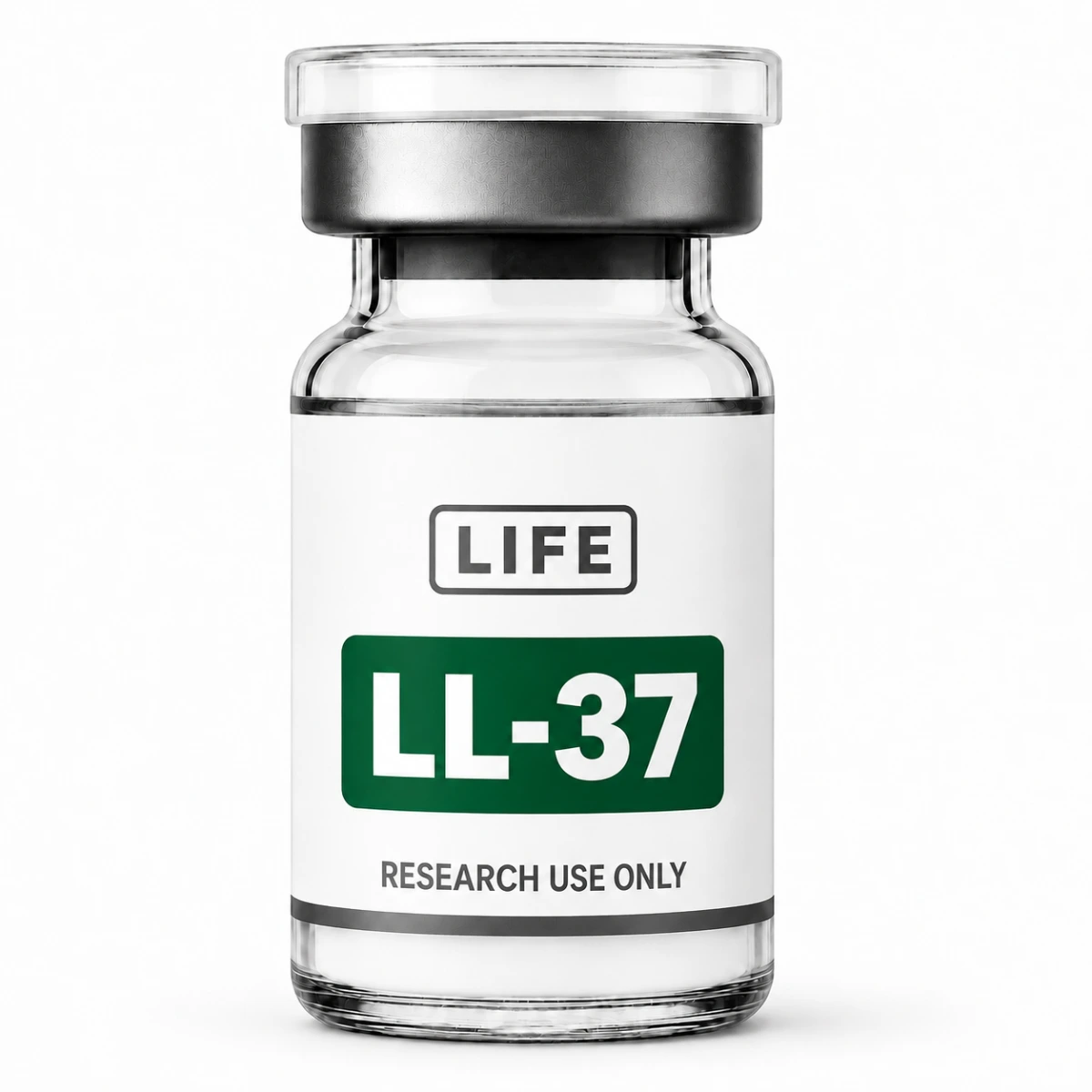
LIFE RESEARCH offers LL-37 as a 5 mg freeze-dried preparation, allowing laboratories to prepare solutions suited to their research requirements.
What is LL-37?
LL-37 is a peptide consisting of 37 amino acids. Its name comes from the two leucine amino acids at the beginning of its sequence, followed by its total length.
In the body, LL-37 is released from a larger precursor protein called hCAP18. It belongs to the cathelicidin family of host-defence peptides and is associated with immune cells and tissues such as the skin. The term “host defence” covers more than direct antimicrobial activity. LL-37 also interacts with host cells, which is why its research literature spans microbiology, immunity and tissue repair.
Synthetic LL-37 makes it possible to study the peptide in controlled laboratory conditions. The product offered here is a research preparation, rather than a medicine or a finished skin-care formulation.
Why LL-37 attracts research interest
LL-37 is relevant to situations where microbial activity and the surrounding tissue environment affect one another. A chronic wound, for example, involves more than skin closure: bacterial communities, inflammatory signals and the behaviour of repair cells can all influence the process.
LL-37 has therefore been investigated across several research areas:
- Antimicrobial activity: interactions with microorganisms and their membranes.
- Biofilm development: effects on how bacteria attach and form communities.
- Skin repair: movement of cells involved in rebuilding an epithelial surface.
- Innate immunity: the body’s early responses to microbial signals.
- Inflammation: how defence signals influence surrounding cells.
These areas explain the interest in LL-37 without reducing it to a single purpose. They also help researchers select it according to the question they want to investigate.
How LL-37 works
Antimicrobial activity
LL-37 can interact with microbial membranes—the outer structures that help maintain a microorganism’s integrity. Laboratory studies have investigated its ability to make these membranes more permeable, contributing to antimicrobial effects.
The response varies with the microorganism and experimental conditions. LL-37 is therefore studied as a host-defence peptide with a range of activities, rather than as a compound that acts identically against every bacterial species.
Biofilm interactions
Bacteria can attach to surfaces and develop organized communities called biofilms. These communities behave differently from freely floating bacteria and are an important subject in microbiology research.
In a study of Pseudomonas aeruginosa, LL-37 reduced biofilm formation at concentrations below those needed to inhibit bacterial growth. Researchers observed changes in attachment, movement and bacterial communication. This makes LL-37 relevant to investigations of bacterial behaviour as well as direct antimicrobial activity. Preventing a biofilm from forming, however, is a different outcome from removing an established one.
Skin-cell movement
Repairing a skin surface requires cells to move into the affected area. Experimental research has shown that LL-37 can encourage the movement of keratinocytes, the main cells of the outer skin layer. These findings helped build the scientific rationale for investigating LL-37 in wound-related research, including later topical clinical studies.
Immune responses
LL-37 also influences immune signalling. Its effects depend on the setting, so describing it simply as an “immune booster” or an exclusively anti-inflammatory peptide would be misleading.
For example, psoriasis-related research has shown that LL-37 can help the immune system recognize the body’s own DNA in ways that promote inflammation. This broader activity is part of what makes LL-37 scientifically interesting—and why its effects need to be assessed in context.
Published clinical findings
The principal wound studies discussed below used topical LL-37 preparations. They provide human research context, with encouraging early findings followed by mixed results.
| Published study | Study population | Main findings |
| Grönberg et al., 2014 | 34 participants with hard-to-heal venous leg ulcers | The 0.5 mg/mL group showed a significantly improved healing-rate measure compared with placebo. The corresponding 1.6 mg/mL result was not statistically significant; the highest concentration showed no benefit. |
| Mahlapuu et al., 2021 | 148 treated patients with hard-to-heal venous leg ulcers | No significant healing improvement in the overall population. An exploratory analysis suggested a benefit in larger wounds, requiring further confirmation. |
| Miranda et al., 2023 | Small randomized diabetic-foot-ulcer trial | Improved formation of granulation tissue, but no significant advantage in wound-area reduction, measured inflammatory markers or aerobic bacterial counts. |
The clinical picture is therefore promising in some measures but not consistently positive. The larger venous-ulcer trial did not confirm a general healing benefit across all participants. These studies concern their specific formulations and do not establish equivalent results for a research vial.
Published safety and tolerability findings
The 2014 trial reported no local or systemic safety concerns during the study. The 2021 trial also described the tested topical formulations as well tolerated. These observations apply to the study conditions and periods assessed. They do not establish safety for other administration routes or long-term systemic exposure.
Laboratory findings also show that the surrounding environment can change LL-37’s activity. Research by Johansson and colleagues found that human serum reduced both antibacterial and cell-damaging effects in their experimental system.
Together with its involvement in inflammatory pathways, this means that LL-37 should not be described as harmless simply because its sequence occurs naturally in humans. Published tolerability findings are useful context, but they remain specific to the preparation and setting studied.
Published dosing schedules
Published wound studies used topical formulations at defined concentrations, alongside the wound-care procedures specified in each trial.
| Study | Published preparation | Frequency | Treatment period |
| Grönberg et al., 2014 | LL-37 at 0.5, 1.6 or 3.2 mg/mL | Twice weekly | 4 weeks |
| Mahlapuu et al., 2021 | LL-37 at 0.5 or 1.6 mg/mL, with compression therapy | Twice weekly | Up to 13 weeks |
| Miranda et al., 2023 | LL-37 cream, reported in the published methods as 0.5 mg/g | Twice weekly | 4 weeks |
Concentration describes the study formulation; it does not represent a universal dose. These trials do not establish a subcutaneous schedule or a preparation method for this product. These schedules summarize published research and are not instructions for use of this product.
What makes LL-37 different?
LL-37’s defining feature is the connection between microbial defence and host-cell responses. It can be investigated from either side: what happens to the microorganism, and what happens to the surrounding cells. That distinction is useful when comparing research peptides. Products may appear together under a broad healing or recovery category while addressing different biological questions.
For LL-37, the most relevant questions involve cathelicidin activity, microbial interactions and the response of epithelial or immune cells. A study focused on these areas has a clearer reason to select LL-37 than one based only on a general association with “repair.” It also helps explain why one finding cannot stand in for another. Reduced biofilm formation, increased skin-cell movement and faster clinical wound closure are separate outcomes.
Product characteristics
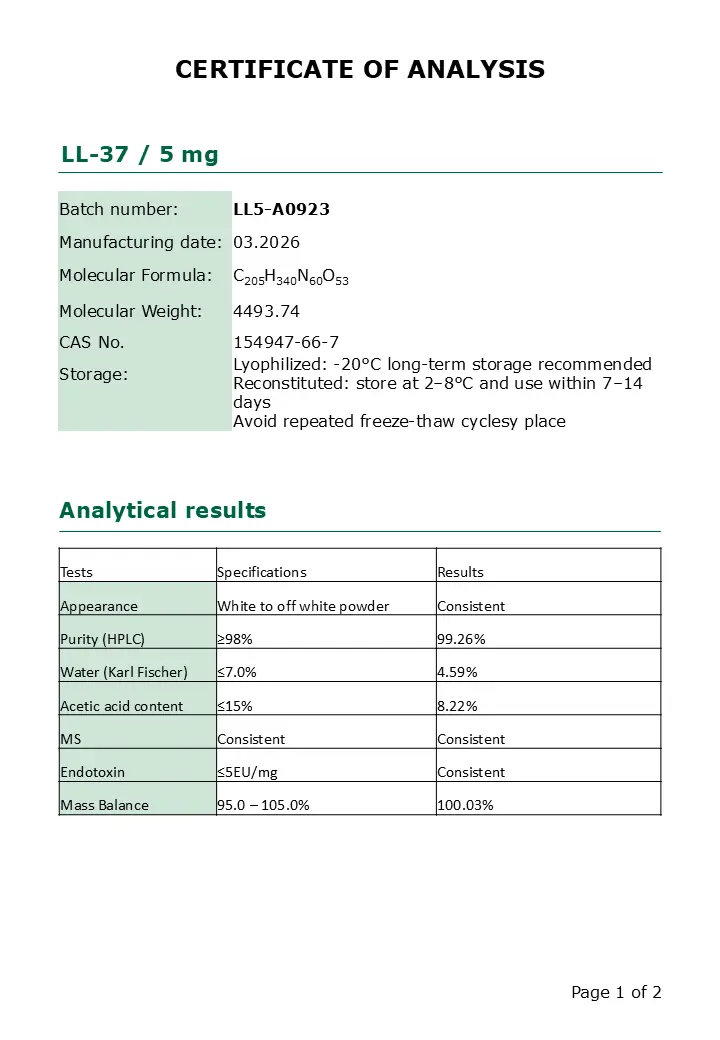
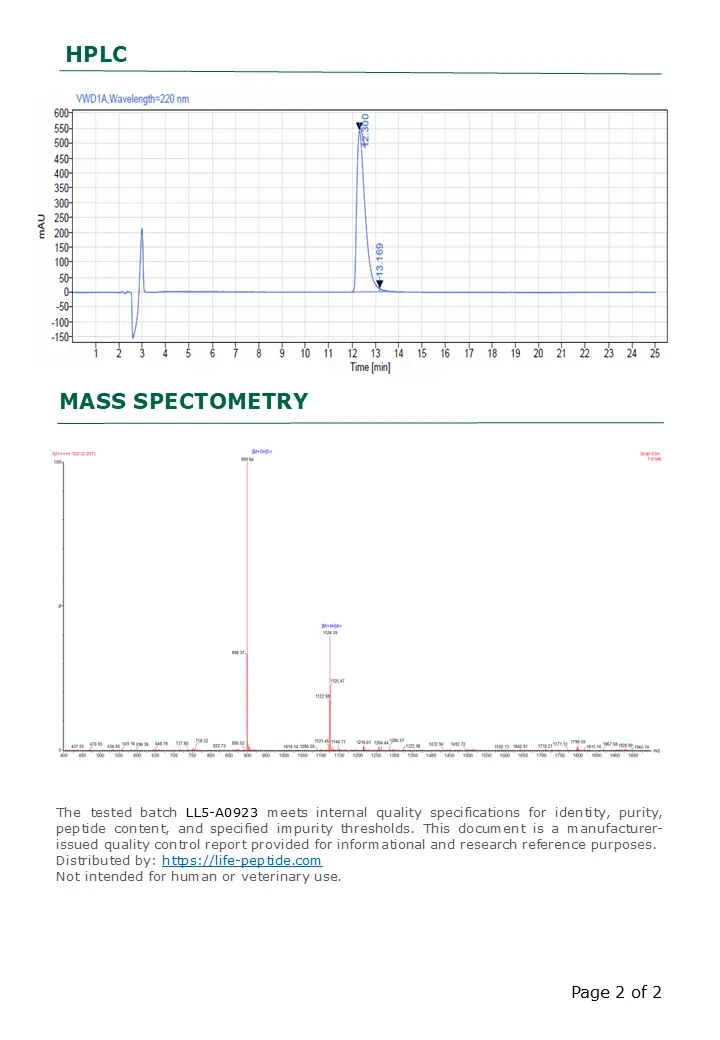
Purity: ≥ 99% (HPLC) with batch-specific COA
Appearance: white lyophilized powder
Molecular formula: C205H340N60O53
Molecular weight: 4493.74±1.0
Produced in GMP-compliant facilities under strict QC protocols.
Each batch carefully lab tested after production (you can find Certificate of Analysis under product pictures).
Freeze-dried (lyophilized) for maximum stability and extended shelf life.
Sealed in sterile vials, ready for reconstitution.
Application: laboratory and analytical research
Storage: unopened lyophilized vials are best stored refrigerated at 2–8°C, which is the storage method confirmed by our manufacturing partner and suitable for up to 24 months. Refrigeration is preferred because it minimizes unnecessary freeze–thaw cycles during routine handling. If substantially longer-term storage is required, unopened lyophilized vials may also be kept frozen. Once reconstituted, always store at 2–8°C and do not freeze.
Reconstitution and handling
LL-37 is supplied as a lyophilised vial and should be handled using standard peptide reconstitution procedures appropriate to the research setting. It must be reconstituted with bacteriostatic water before use.
For other solvent selection, concentration planning and storage guidance, see the full Peptide Reconstitution Guide and Reconstitution Calculator
Selected research references
- Grönberg et al.2014 Randomized study of topical LL-37 in venous leg ulcers. Wound Repair and Regeneration.
- Mahlapuu et al., 2021. HEAL LL-37 phase IIb trial in hard-to-heal venous leg ulcers. Wound Repair and Regeneration.
- Miranda et al., 2023. Randomized evaluation of LL-37 cream in diabetic foot ulcers. Archives of Dermatological Research.
- Overhage et al., 2008. Laboratory investigation of LL-37 and bacterial biofilm formation. Infection and Immunity.
- Lande et al., 2007. LL-37, self-DNA recognition and immune-cell activation. Nature.
Frequently Asked Questions
What is LL-37 mainly studied for?
LL-37 is associated with antimicrobial activity, biofilm interactions, immune signalling and epithelial repair. These areas connect the behaviour of microorganisms with the response of surrounding tissue.
What does the name LL-37 mean?
“LL” refers to the two leucine amino acids at the start of the peptide, and “37” refers to its sequence length.
Is LL-37 the same as hCAP18?
No. hCAP18 is the larger precursor protein from which LL-37 is released.
Is LL-37 an antibiotic?
LL-37 is an antimicrobial host-defence peptide studied in laboratory and clinical research. This product is supplied as a research reagent, not as an antibiotic medicine.
Does LL-37 have biofilm research behind it?
Yes. Laboratory research has investigated its effects on bacterial attachment and biofilm development. Those findings do not establish treatment of a biofilm-associated infection.
Has LL-37 been studied in humans?
Yes. Published wound studies have evaluated topical formulations. Their results are mixed, as described in the clinical findings section.
How much LL-37 is supplied?
Each vial has a declared LL-37 content of 5 mg and is supplied in lyophilized form.
Is the product already dissolved?
No. It is supplied as freeze-dried material for preparation according to the intended laboratory application.
Is this a cream or skin-care product?
No. The product is a lyophilized research peptide. The creams and topical preparations discussed above were specific clinical-study formulations.
Can I buy LL-37 in Europe?
Yes. LIFE RESEARCH offers LL-37 5 mg with EU-based dispatch. Delivery availability and shipping options are displayed at checkout.
Which shipping service should I select?
Compare the services and estimated delivery times available for your destination at checkout. Courier and express options may suit orders where faster arrival is a priority.
Is this product intended for human use?
No. LL-37 5 mg is supplied strictly for laboratory and analytical research and is not intended for human or veterinary use.
Related research context
LL-37 belongs to the host-defence peptide research field, connecting antimicrobial investigations with questions about skin cells and immune responses.
For broader catalogue comparisons, explore GHK-Cu and the Healing and recovery research category.
NOTE: This is for educational reference only and does not constitute medical advice.
Disclaimer
This product is sold for research purposes only. It is not intended to diagnose, treat, cure, or prevent any disease. Buyer assumes full responsibility for proper handling and use.