Descrizione
Il PT-141 (Bremelanotide) è uno dei peptidi di ricerca più ampiamente studiati in ricerca sulla funzione sessuale e sull'eccitazione.
Originariamente sviluppato dal peptide melanocortinico Melanotan II, il PT-141 è stato progettato per studiare selettivamente le vie della melanocortina coinvolte nella motivazione sessuale, riducendo al minimo gli effetti di pigmentazione associati ai precedenti analoghi della melanocortina.
A differenza di composti come il sildenafil o il tadalafil, il PT-141 non studia principalmente il flusso sanguigno o la funzione vascolare. Al contrario, la ricerca pubblicata si concentra su vie del sistema nervoso centrale che regolano il desiderio, la motivazione e l'eccitazione sessuale, rendendo il PT-141 uno dei peptidi più caratteristici nella ricerca nel campo della medicina sessuale.
Vuoi acquistare il PT-141 in Europa? Life Peptide fornisce PT-141 ad alta purezza per la ricerca di laboratorio, con spedizioni affidabili in tutta l'Unione Europea.
Perché il PT-141 è ampiamente studiato
Il PT-141 è diventato un peptide di ricerca chiave perché prende di mira segnalazione melanocortinica centrale, un percorso che differisce fondamentalmente dagli approcci vascolari alla funzione sessuale.
Studi pubblicati hanno indagato il PT-141 in relazione a:
- desiderio sessuale
- eccitazione sessuale
- funzione sessuale femminile
- funzione sessuale maschile
- biologia dei recettori della melanocortina
- segnalazione del sistema nervoso centrale
- regolazione neuroendocrina
Poiché queste vie hanno origine all'interno del cervello piuttosto che sul sistema vascolare, il PT-141 ha attirato un'attenzione significativa nella ricerca neuroscientifica e della medicina sessuale.
Come funziona il PT-141
A differenza degli inibitori della PDE-5, il PT-141 è oggetto di studio principalmente per i suoi effetti sui recettori della melanocortina, in particolare l’MC4R e, in misura minore, l’MC3R.
La ricerca pubblicata ha esplorato la sua relazione con:
Segnalazione della melanocortina
Attivazione delle vie della melanocortina coinvolte nella motivazione sessuale e nelle risposte comportamentali.
Vie di attivazione centrale
Studio dei circuiti ipotalamici associati al desiderio sessuale e all'eccitazione.
Segnalazione dopaminergica
La ricerca suggerisce che l'attivazione della melanocortina influenza le vie neurochimiche a valle coinvolte nella motivazione e nella ricompensa.
Regolazione neuroendocrina
Il lavoro sperimentale ha esaminato come il PT-141 interagisca con le reti del sistema nervoso centrale coinvolte nel comportamento sessuale.
Perché il PT-141 è oggetto di numerose ricerche nel campo della medicina sessuale
Il PT-141 differisce da molti composti studiati nella medicina sessuale perché il suo meccanismo primario è centrale anziché periferico.
La ricerca clinica pubblicata ha indagato:
- disturbo da desiderio sessuale ipoattivo (HSDD)
- eccitazione sessuale femminile
- funzione erettile maschile
- motivazione sessuale
- segnalazione melanocortinica centrale
Questa distinzione ha reso il PT-141 un importante strumento di ricerca per lo studio della neurobiologia della funzione sessuale, piuttosto che della sola fisiologia vascolare.
Ricerca umana e preclinica
Rispetto a molti peptidi di ricerca, il PT-141 ha un una solida base di evidenze cliniche.
Numerosi studi di fase II e fase III hanno valutato il bremelanotide in donne affette da disturbo da desiderio sessuale ipoattivo, mentre programmi clinici precedenti ne hanno esaminato gli effetti in uomini con disfunzione erettile. Nel loro insieme, questi studi hanno dimostrato che il PT-141 è uno dei peptidi più studiati clinicamente mirare alle vie della melanocortina.
Perché il PT-141 differisce da Viagra® e Cialis®
Una delle caratteristiche distintive del PT-141 è che studia i percorsi centrali del desiderio sessuale piuttosto che la fisiologia vascolare.
| PT-141 | Inibitori della PDE-5 |
|---|---|
| Segnalazione della melanocortina | Via dell'ossido nitrico |
| Ricerca sul desiderio sessuale | Fisiologia dell'erezione |
| Sistema nervoso centrale | Flusso sanguigno periferico |
| Studiato sia negli uomini che nelle donne | Studiato principalmente nella funzione erettile maschile |
Poiché questi meccanismi differiscono, il PT-141 rappresenta un'area della ricerca sulla medicina sessuale completamente diversa anziché un altro approccio vascolare.
Osservazioni di sicurezza pubblicate
Negli studi clinici pubblicati, gli eventi avversi segnalati più frequentemente includevano nausea, vampate di calore e mal di testa, in particolare durante somministrazione precoce. La maggior parte degli eventi è stata descritta come di gravità da lieve a moderata, sebbene la tollerabilità sia variata tra gli studi e le popolazioni, e tendano a scomparire completamente con l'uso ripetuto.
Caratteristiche del prodotto
Applicazione: ricerca di laboratorio e analitica
Uso limitato: non per il consumo umano; non per uso medico, veterinario o cosmetico
Prodotto in stabilimenti conformi alle GMP secondo rigidi protocolli di controllo qualità.
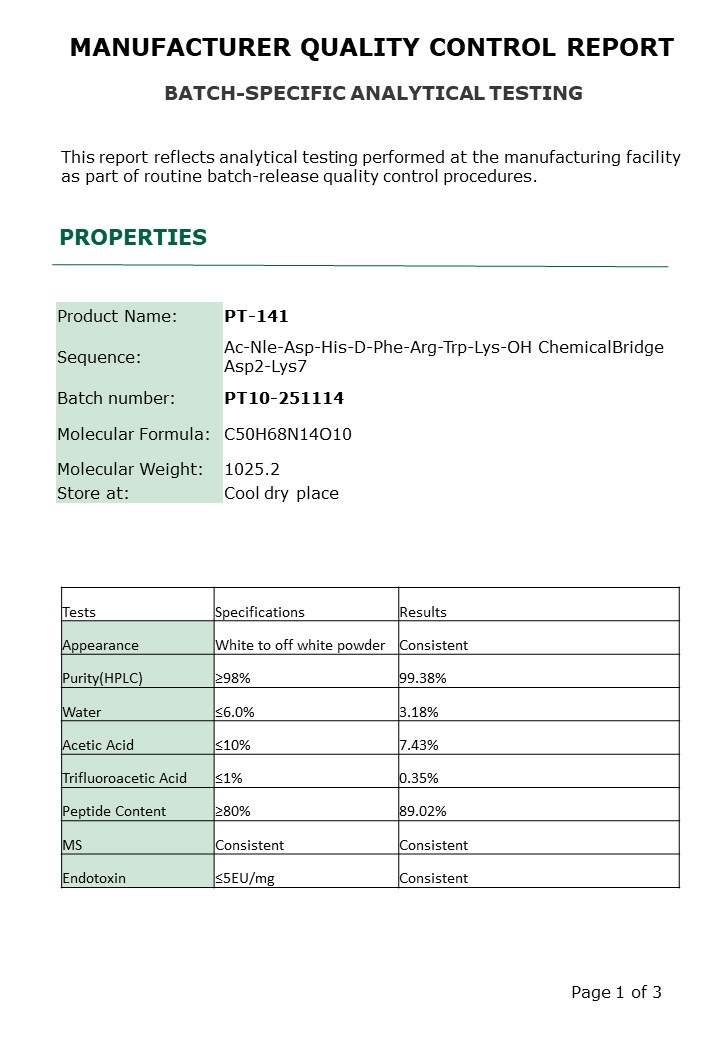
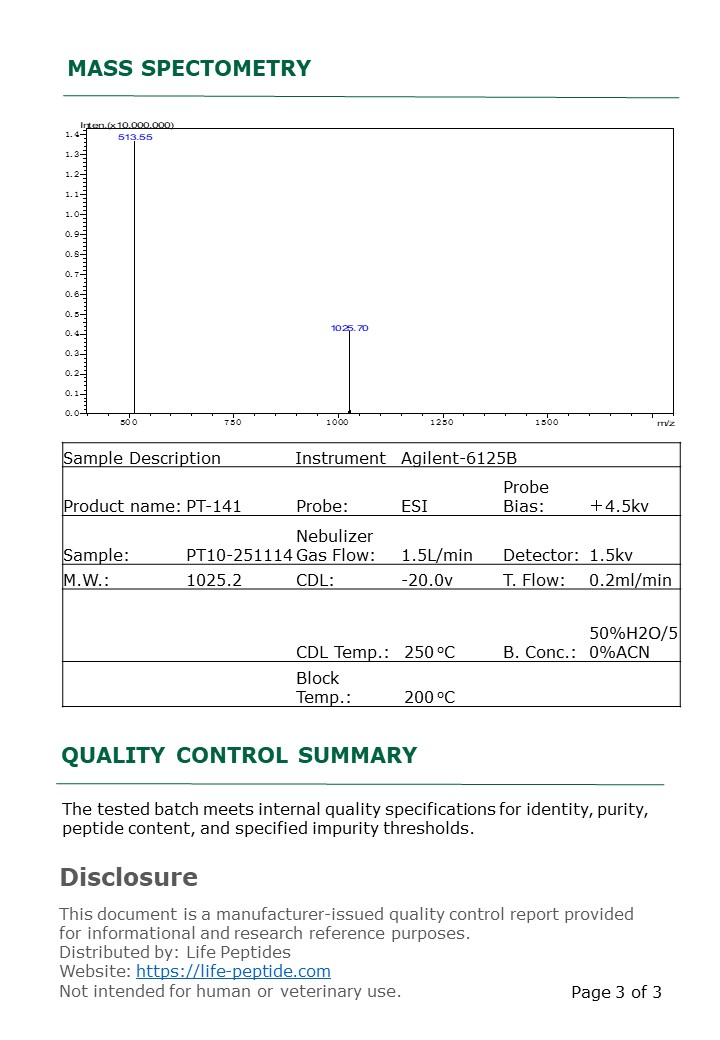
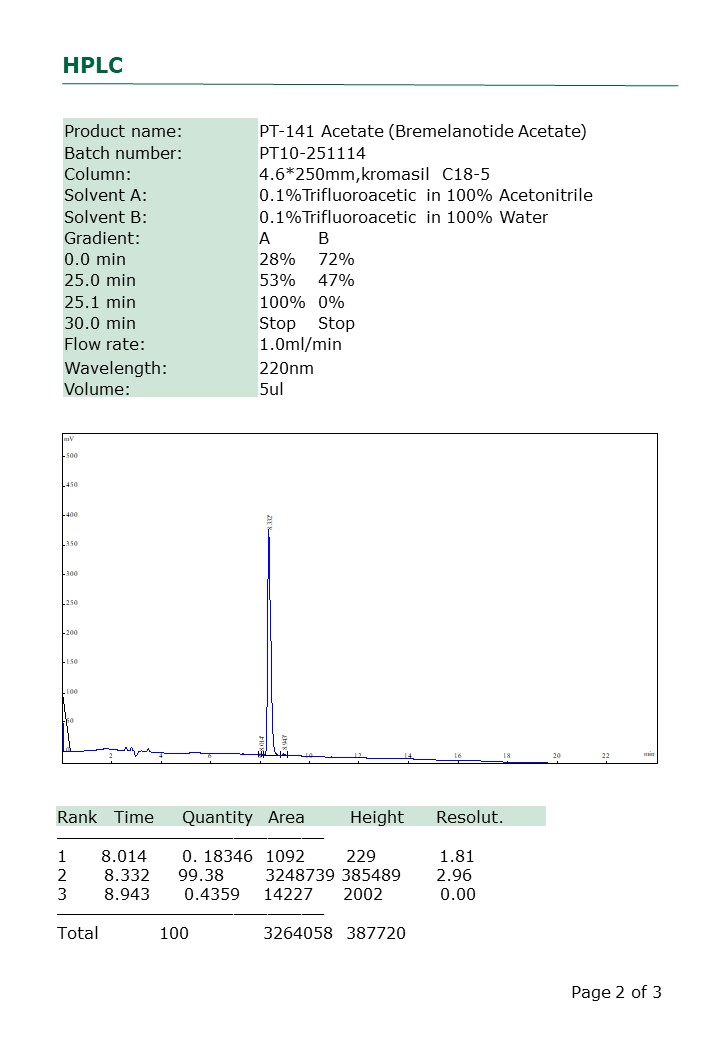
Ogni lotto viene accuratamente testato in laboratorio dopo la produzione (puoi trovare il Certificato di Analisi sotto le immagini del prodotto).
Liofilizzato (liofilizzato) per la massima stabilità e una lunga durata di conservazione.
Sigillato in fiale sterili, pronto per la ricostituzione.
Purezza: ≥99% (testato mediante HPLC)
Aspetto: polvere liofilizzata bianca/bianco sporco
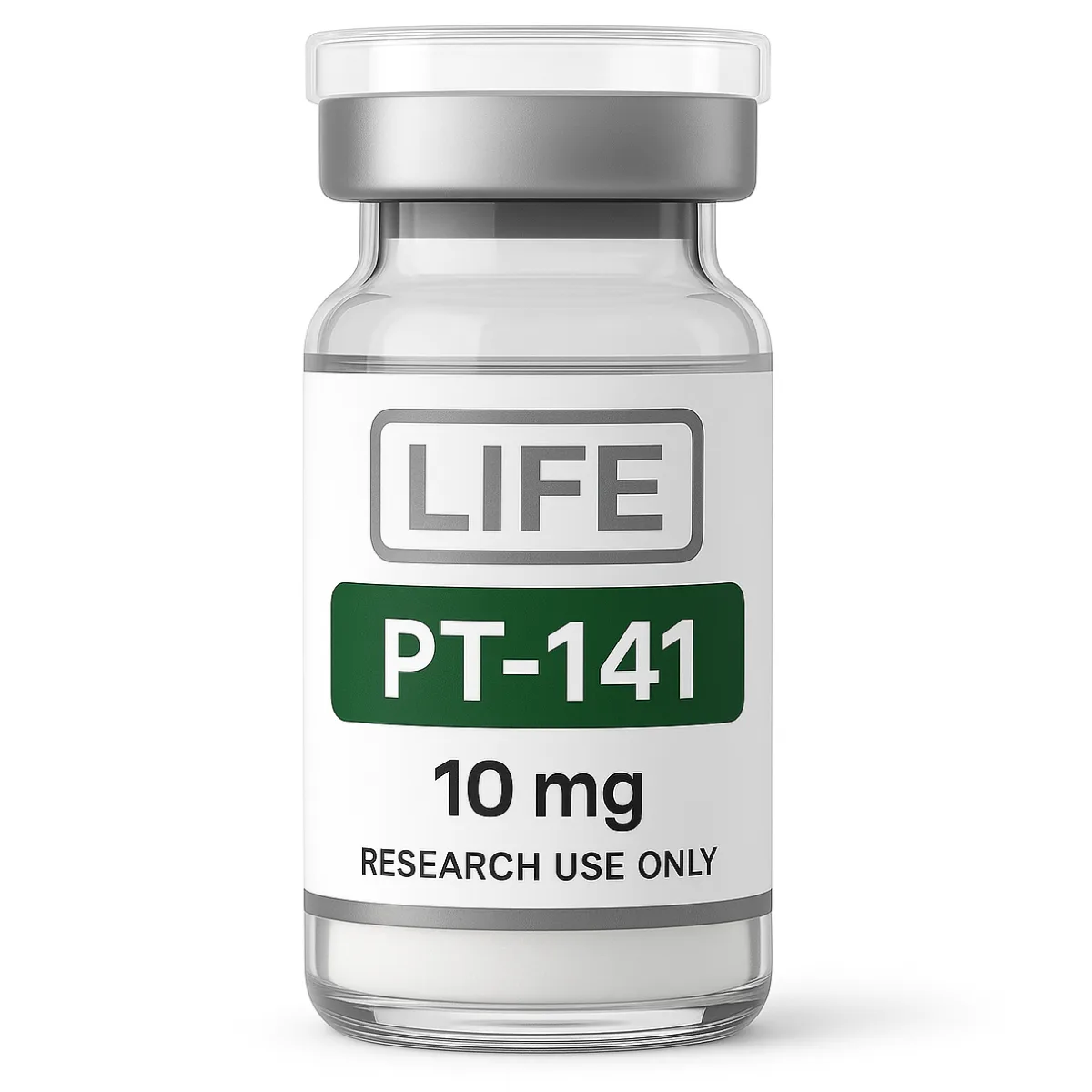
Formula molecolare: C50H68N14O10
Peso molecolare: 1025,2
Sequenza: Ac-Nle-Asp-His-D-Phe-Arg-Trp-Lys-OH Ponte chimico Asp2-Lys7
Archiviazioneflaconcini liofilizzati non aperti sono meglio conservati refrigerato a 2–8°C, che è il metodo di conservazione confermato dal nostro partner di produzione e adatto fino a 24 mesi. Si preferisce la refrigerazione perché minimizza inutili cicli di congelamento-scongelamento durante la manipolazione di routine. Se è necessaria una conservazione a termine sostanzialmente più lungo, i flaconcini liofilizzati non aperti possono anche essere conservati congelati. Una volta ricostituita, conservare sempre a 2-8°C e non congelare.
Ricostituzione e manipolazione
Il PT-141 viene fornito in fiale liofilizzate e deve essere manipolato seguendo le procedure standard di ricostituzione dei peptidi adeguate al contesto di ricerca. Deve essere ricostituito con acqua batteriostatica prima dell'uso. Per aiutare a preservare l'integrità strutturale, aggiungere il solvente scelto lentamente contro la parete interna del flaconcino piuttosto che direttamente sulla polvere del peptide, ed evitare agitazioni vigorose. Il delicato movimento rotatorio è generalmente sufficiente una volta che il peptide si è completamente sciolto. La pratica standard di laboratorio include anche il far raggiungere ai flaconcini refrigerati la temperatura ambiente prima della ricostituzione per minimizzare la condensa all'interno del flaconcino.
Per altre indicazioni sulla scelta del solvente, sulla pianificazione della concentrazione e sullo stoccaggio, consultare il pieno Guida alla Ricostituzione dei Peptidi e Calcolatore di Ricostituzione.
Studi chiave pubblicati
- Molinoff PB, Shadiack AM, Earle D, et al. PT-141: un agonista della melanocortina per il trattamento della disfunzione sessuale. Annali dell’Accademia delle Scienze di New York, 2003.
L'articolo fondamentale che introduce il PT-141 e ne descrive il meccanismo d'azione come agonista dei recettori della melanocortina ad azione centrale nell'ambito della ricerca sulla funzione sessuale.
- Diamond LE, Earle DC, Heiman JR, et al. Effetti del bremelanotide (PT-141) sulla risposta sessuale soggettiva nelle donne in premenopausa affette da disturbo dell’eccitazione sessuale femminile. Journal of Sexual Medicine, 2006.
Uno studio clinico di riferimento sul PT-141 in donne affette da disturbo dell'eccitazione sessuale femminile.
- Kingsberg SA, Clayton AH, Portman D, et al. Bremelanotide per il trattamento del disturbo da desiderio sessuale ipoattivo. Ostetricia e Ginecologia, 2019.
Uno degli studi clinici di fase III fondamentali a sostegno delle attuali evidenze scientifiche relative al bremelanotide nel trattamento dell’HSDD.
- Edinoff AN, et al. Bremelanotide per il trattamento del disturbo da desiderio sessuale ipoattivo femminile. Neurology International, 2022.
Una revisione completa che copre la farmacologia, il meccanismo d'azione, l'efficacia clinica e la sicurezza del PT-141.
Domande Frequenti
Che cos'è il PT-141?
Il PT-141 (bremelanotide) è un agonista sintetico del recettore della melanocortina derivato dall’α-MSH. È oggetto di numerose ricerche nel campo del desiderio sessuale, dell’eccitazione e della segnalazione nel sistema nervoso centrale.
Perché il PT-141 viene talvolta chiamato Bremelanotide?
Bremelanotide è la denominazione comune internazionale (INN) del PT-141. La maggior parte degli studi clinici pubblicati utilizza il nome Bremelanotide, mentre i ricercatori e i fornitori di peptidi si riferiscono comunemente alla stessa molecola come PT-141.
Il PT-141 è uguale al Melanotan II?
No. Il PT-141 è stato sviluppato a partire dal Melanotan II, ma è stato progettato per studiare in modo più selettivo le vie della melanocortina coinvolte nella funzione sessuale, riducendo al contempo l'attività correlata alla pigmentazione. Sebbene i due peptidi abbiano una storia di sviluppo comune, oggi vengono utilizzati in ambiti di ricerca diversi.
In che modo il PT-141 si differenzia dal Viagra® o dal Cialis®?
Il PT-141 agisce principalmente attraverso i percorsi melanocortinici centrali, mentre gli inibitori della PDE-5 agiscono migliorando il flusso sanguigno attraverso meccanismi vascolari. Questi rappresentano diversi approcci biologici alla ricerca sulla funzione sessuale.
Perché il PT-141 è chiamato anche Bremelanotide?
Bremelanotide è la denominazione comune internazionale (INN) del PT-141. La maggior parte degli studi clinici pubblicati utilizza il nome Bremelanotide, mentre la comunità scientifica che si occupa di peptidi si riferisce spesso alla molecola come PT-141.
Quali aree di ricerca investigano comunemente il PT-141?
Gli studi pubblicati hanno esaminato il PT-141 in relazione al desiderio sessuale, all'eccitazione sessuale, al disturbo da desiderio sessuale ipoattivo, alla funzione sessuale maschile, alla biologia dei recettori della melanocortina e alla segnalazione neuroendocrina.
Il PT-141 agisce attraverso l'ossido nitrico come gli inibitori della PDE-5?
No. I dati attualmente disponibili indicano che il PT-141 agisce principalmente attraverso l’attivazione del recettore centrale della melanocortina, piuttosto che potenziando direttamente la via vascolare mediata dall’ossido nitrico su cui agiscono gli inibitori della PDE-5.
Posso acquistare il PT-141 in Europa?
Sì. Spediamo il PT-141 nella maggior parte dei paesi europei tramite corrieri affidabili. I metodi di spedizione disponibili e i tempi di consegna vengono indicati durante la procedura di pagamento in base alla destinazione scelta.
Questo prodotto è destinato all'uso umano?
Il PT-141 fornito da Life Peptide è destinato esclusivamente alla ricerca di laboratorio e analitica. Non è destinato al consumo umano, né alla diagnosi, al trattamento o alla prevenzione di malattie. Qualsiasi riferimento a studi pubblicati costituisce una sintesi della letteratura scientifica relativa alla molecola PT-141 e non riguarda l’uso previsto di questo prodotto.
Contesto di ricerca correlato
Il PT-141 appartiene alla più ampia Categoria di ricerca sulla melanocortina e sui peptidi neuroendocrini, concentrandosi sulla segnalazione nel sistema nervoso centrale e sui percorsi comportamentali mediati dai recettori.
I ricercatori che esplorano modelli correlati della via della melanocortina possono anche esaminare:
Melanotan II — ricerca sugli agonisti dei recettori della melanocortina
Peptidi per la ricerca cognitiva e neuroscientifica — Modelli di segnalazione peptidica del SNC
Secretagoghi dell'ormone della crescita — ricerca sulle interazioni delle vie neuroendocrine
NOTA: Questo è solo a scopo didattico e non costituisce parere medico.
Dichiarazione di non responsabilità:
Questo prodotto è venduto esclusivamente a scopo di ricerca. Non è destinato a diagnosticare, trattare, curare o prevenire alcuna malattia. L'acquirente si assume la piena responsabilità per la corretta manipolazione e utilizzo.