Description
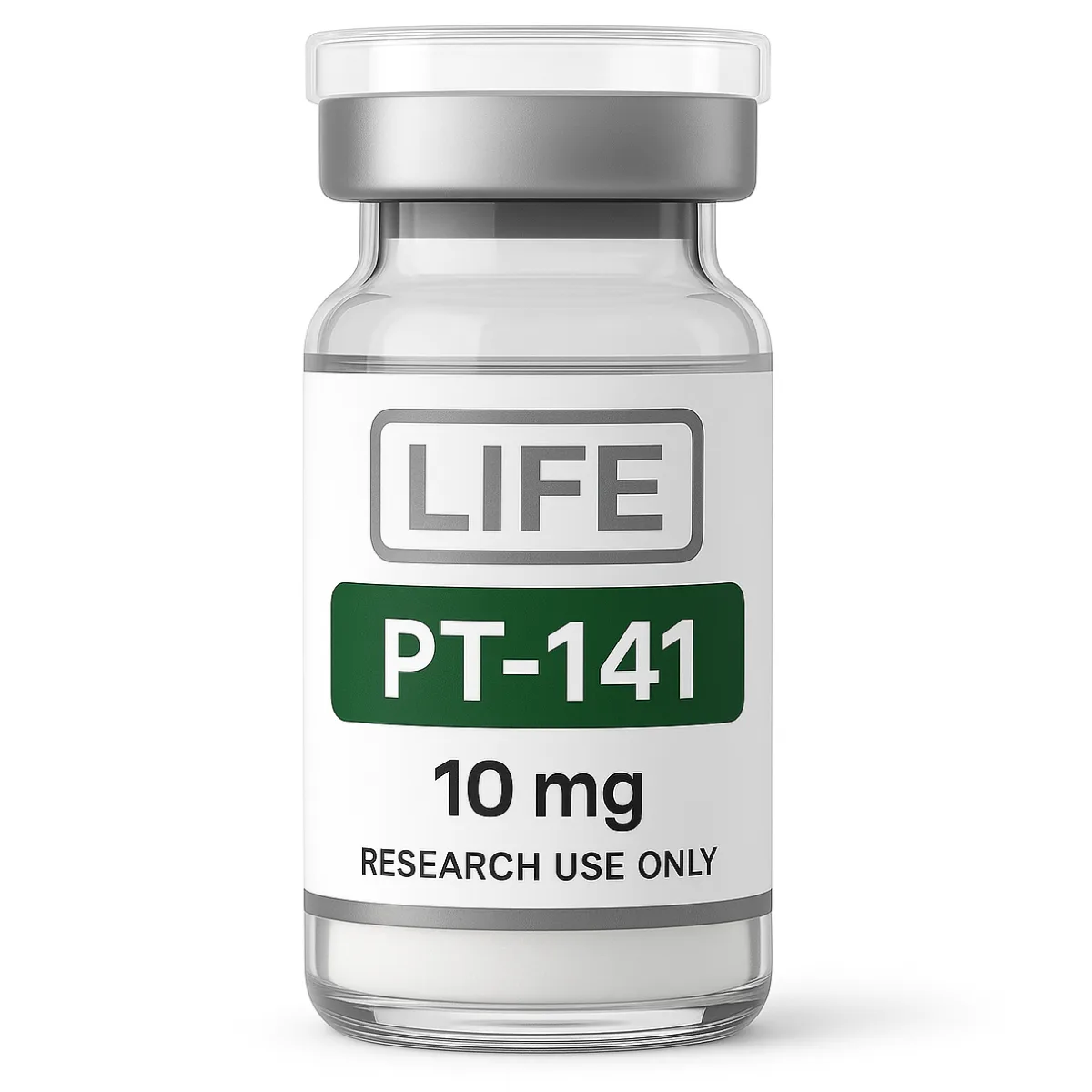
Le PT-141 (Brémélanotide) est l'un des peptides de recherche les plus étudiés dans recherche sur la fonction sexuelle et l'excitation sexuelle.
Développé à l'origine à partir du peptide mélanocortine Melanotan II, le PT-141 a été conçu pour étudier sélectivement les voies mélanocortines impliquées dans la motivation sexuelle tout en minimisant les effets de pigmentation associés aux analogues de mélanocortine antérieurs.
Contrairement à des composés tels que le sildénafil ou le tadalafil, le PT-141 n'étudie pas principalement le flux sanguin ou la fonction vasculaire. Au lieu de cela, la recherche publiée se concentre sur voies du système nerveux central régulant le désir sexuel, la motivation et l'excitation, faisant du PT-141 l'un des peptides les plus distinctifs dans la recherche en médecine sexuelle.
Vous souhaitez acheter du PT-141 en Europe ? Life Peptide propose du PT-141 de haute pureté destiné à la recherche en laboratoire, avec une livraison fiable dans toute l'Union européenne.
Pourquoi le PT-141 fait l'objet de recherches approfondies
Le PT-141 est devenu un peptide de recherche clé car il cible signalisation mélanocortinergique centrale, une voie qui diffère fondamentalement des approches vasculaires de la fonction sexuelle.
Des études publiées ont examiné le PT-141 en relation avec :
- désir sexuel
- excitation sexuelle
- fonction sexuelle féminine
- la fonction sexuelle masculine
- Biologie des récepteurs de la mélanocortine
- signalisation du système nerveux central
- régulation neuroendocrinienne
Parce que ces voies proviennent dans le cerveau plutôt que le système vasculaire, le PT-141 a suscité un intérêt considérable dans la recherche en neurosciences et en médecine sexuelle.
Comment fonctionne le PT-141
Contrairement aux inhibiteurs de la PDE-5, le PT-141 est principalement étudié pour ses effets sur les récepteurs de la mélanocortine, en particulier les récepteurs MC4R et, dans une moindre mesure, les récepteurs MC3R.
Les recherches publiées ont exploré sa relation avec :
Signalisation mélanocortinique
Activation des voies mélanocortines impliquées dans la motivation sexuelle et les réponses comportementales.
Voies de l'éveil central
Investigation des circuits hypothalamiques associés au désir sexuel et à l'excitation.
Signalisation dopaminergique
La recherche suggère que l'activation des mélanocortines influence les voies neurochimiques en aval impliquées dans la motivation et la récompense.
Régulation neuroendocrinienne
Les travaux expérimentaux ont étudié comment le PT-141 interagit avec les réseaux du système nerveux central impliqués dans le comportement sexuel.
Pourquoi le PT-141 est largement étudié en médecine sexuelle
Le PT-141 diffère de nombreux composés étudiés en médecine sexuelle car son mécanisme principal est central plutôt que périphérique.
La recherche clinique publiée a étudié :
- trouble du désir sexuel hypoactif (TDSH)
- excitation sexuelle féminine
- fonction érectile masculine
- Motivation sexuelle
- signalisation mélanocortinergique centrale
Cette distinction a fait du PT-141 un outil de recherche important pour étudier la neurobiologie de la fonction sexuelle plutôt que la seule physiologie vasculaire.
Recherche humaine et préclinique
Comparé à de nombreux peptides de recherche, le PT-141 a un base de preuves cliniques substantielle.
Plusieurs études de phase II et de phase III ont étudié la br Mélanotide chez les femmes atteintes de trouble du désir sexuel hypoactif, tandis que des programmes cliniques antérieurs ont exploré ses effets chez les hommes souffrant de dysfonction érectile. Ensemble, ces études ont établi le PT-141 comme l'un des peptides les plus étudiés cliniquement ciblant les voies mélanocortines.
Pourquoi le PT-141 diffère du Viagra® et du Cialis®
L'une des caractéristiques déterminantes du PT-141 est qu'il étudie les voies centrales du désir sexuel plutôt que la physiologie vasculaire.
| PT-141 | Inhibiteurs de la PDE-5 |
|---|---|
| Signalisation mélanocortinique | Voie de l'oxyde nitrique |
| Recherche sur le désir sexuel | Physiologie de l'érection |
| Système nerveux central | Flux sanguin périphérique |
| Étudié chez les hommes et les femmes | Principalement étudié dans la fonction érectile masculine |
Parce que ces mécanismes diffèrent, le PT-141 représente un domaine de recherche en médecine sexuelle entièrement différent plutôt qu'une autre approche vasculaire.
Observations de sécurité publiées
Dans les études cliniques publiées, les événements indésirables les plus fréquemment rapportés comprenaient nausées, rougeur et maux de tête, particulièrement pendant administration précoce. La plupart des événements ont été décrits comme étant d'une gravité légère à modérée, bien que la tolérabilité ait varié entre les études et les populations, et qu'ils aient eu tendance à disparaître complètement avec une utilisation répétée.
Caractéristiques du produit
Application : recherche de laboratoire et analytique
Utilisation restreinte : non destiné à la consommation humaine ; non destiné à un usage médical, vétérinaire ou cosmétique
Produit dans des installations conformes aux BPF dans le cadre de protocoles de CQ stricts.
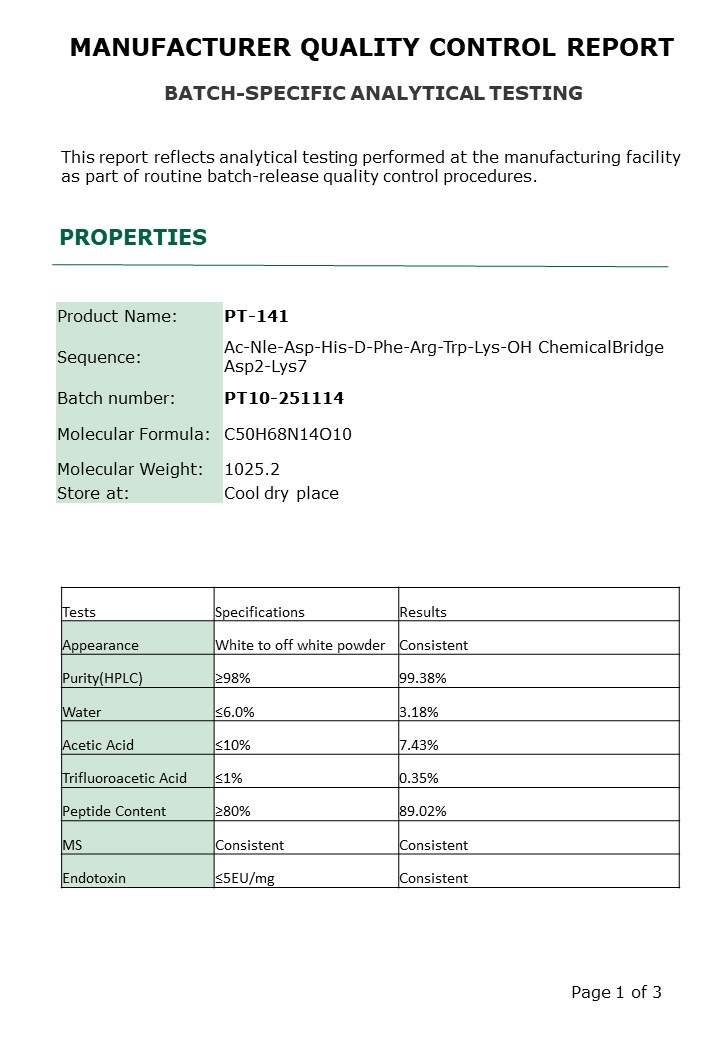
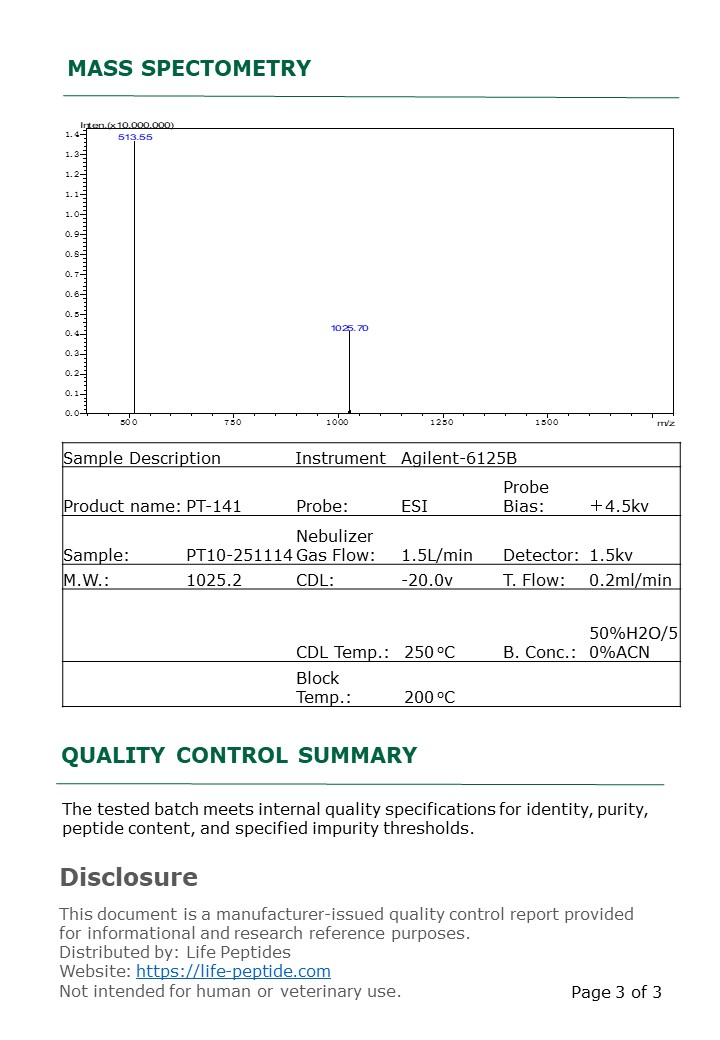
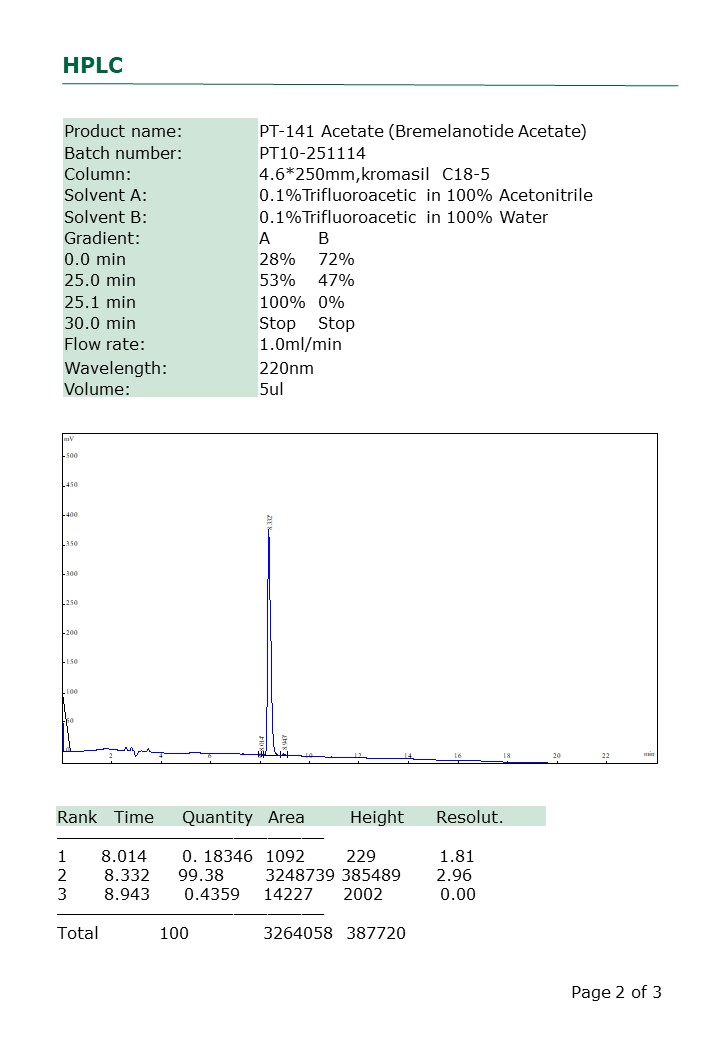
Chaque lot est soumis à des tests rigoureux en laboratoire après production (vous trouverez le certificat d'analyse sous les photos du produit).
Lyophilisé (séché par congélation) pour une stabilité et une durée de conservation maximales.
Scellés dans des flacons stériles, prêts à être reconstitués.
Pureté : ≥ 991 TP4T (testée par HPLC)
Aspect : Poudre blanche/blanc cassé lyophilisée
Formule moléculaire : C50H68N14O10
Masse moléculaire : 1025,2
Séquence : Ac-Nle-Asp-His-D-Phe-Arg-Trp-Lys-OH Pont Asp2-Lys7
Stockage: les flacons lyophilisés non ouverts sont mieux conservés réfrigéré à 2–8 °C, qui est la méthode de stockage confirmée par notre partenaire de fabrication et adaptée jusqu'à 24 mois. La réfrigération est préférable car elle minimise les cycles de congélation-décongélation inutiles lors de la manipulation de routine. Si un stockage à plus long terme est nécessaire, les flacons lyophilisés non ouverts peuvent également être conservés congelés. Une fois reconstituées, toujours conserver à 2-8°C et ne pas congeler.
Reconstitution et manipulation
Le PT-141 est fourni sous forme de flacon lyophilisé et doit être manipulé selon les procédures de reconstitution standards des peptides appropriées au contexte de recherche. Doit être reconstitué avec eau bactériostatique avant utilisation. Pour aider à préserver l'intégrité structurelle, ajoutez le solvant choisi lentement contre la paroi intérieure du flacon plutôt que directement sur le précipité peptidique, et évitez les secousses vigoureuses. Un léger mouvement de rotation suffit généralement une fois que le peptide est complètement dissous. Les pratiques courantes de laboratoire comprennent également le fait de laisser les flacons réfrigérés atteindre la température ambiante avant la reconstitution afin de minimiser la condensation à l'intérieur du flacon.
Pour d'autres choix de solvant, une planification de la concentration et des conseils de stockage, consultez le guide complet Guide de reconstitution des peptides et Calculateur de reconstitution.
Études clés publiées
- Molinoff PB, Shadiack AM, Earle D, et al. PT-141 : un agoniste de la mélanocortine pour le traitement de la dysfonction sexuelle. Annales de la New York Academy of Sciences, 2003.
L'article fondamental présentant le PT-141 et décrivant son mécanisme en tant qu'agoniste des récepteurs de la mélanocortine à action centrale pour la recherche sur la fonction sexuelle.
- Diamond LE, Earle DC, Heiman JR, et al. Effet sur la réponse sexuelle subjective chez les femmes préménopausées atteintes de trouble de l'excitation sexuelle féminine par la br Mélanotide (PT-141). Journal de Médecine Sexuelle, 2006.
Une étude clinique historique portant sur le PT-141 chez les femmes souffrant de dysfonctionnement de l'excitation sexuelle féminine.
- Kingsberg SA, Clayton AH, Portman D, et al. Bremelanotide pour le traitement du trouble du désir sexuel hypoactif. Obstétrique & Gynécologie, 2019.
L'une des études cliniques pivot de phase III soutenant la base de preuves moderne pour la brémélanotide dans le HSDD.
- Edinoff AN, et al. Brémélanotide pour le traitement du trouble du désir sexuel hypoactif chez la femme. Neurology International, 2022.
Une revue complète couvrant la pharmacologie, le mécanisme d'action, l'efficacité clinique et la sécurité du PT-141.
Questions fréquemment posées
Qu'est-ce que le PT-141 ?
Le PT-141 (Bremelanotide) est un agoniste synthétique des récepteurs de la mélanocortine dérivé de l'α-MSH. Il fait l'objet de nombreuses recherches sur le désir sexuel, l'excitation et la signalisation du système nerveux central.
Pourquoi le PT-141 est-il parfois appelé Bremelanotide ?
La br Mélanotide est le nom international non protégé (DCI) du PT-141. La plupart des études cliniques publiées utilisent le nom Br Mélanotide, tandis que les chercheurs et les fournisseurs de peptides font couramment référence à la même molécule sous le nom de PT-141.
Le PT-141 est-il identique au Melanotan II ?
Non. Le PT-141 a été développé à partir du Mélanotan II, mais il est conçu pour étudier plus sélectivement les voies de la mélanocortine impliquées dans la fonction sexuelle, tout en réduisant l'activité liée à la pigmentation. Bien que les deux peptides partagent une histoire de développement commune, ils sont maintenant utilisés dans différents domaines de recherche.
Le PT-141 diffère du Viagra® ou du Cialis® de plusieurs manières :* **Mécanisme d'action :** Le Viagra® et le Cialis® sont des inhibiteurs de la phosphodiestérase de type 5 (PDE5). Ils agissent en augmentant le flux sanguin vers le pénis, ce qui aide à obtenir et à maintenir une érection. Le PT-141, en revanche, est un peptide synthétique qui agit sur les récepteurs de la mélanocortine dans le cerveau, en particulier le récepteur MC4R. Cette action module l'activité neuronale impliquée dans la réponse sexuelle, plutôt que de cibler directement le flux sanguin. * **Administration :** Le Viagra® et le Cialis® sont pris par voie orale (comprimés). Le PT-141 est administré par injection sous-cutanée (dans la graisse sous la peau), généralement dans l'abdomen. * **Indication :** Le Viagra® et le Cialis® sont approuvés pour le traitement de la dysfonction érectile (DE) chez les hommes. Le PT-141 est approuvé pour le traitement de la dysfonction sexuelle chez les femmes (hypoactive sexual desire disorder - HSDD) et est également utilisé hors AMM (off-label) pour la DE chez les hommes, en particulier lorsque les inhibiteurs de la PDE5 ne sont pas efficaces ou bien tolérés. * **Effets :** Les effets du Viagra® et du Cialis® sont principalement centrés sur la réponse physique de l'érection. Le PT-141 est censé influencer le désir et l'excitation sexuels, en agissant sur des voies neurologiques plus centrales. * **Délai d'action :** Le Viagra® commence généralement à agir dans les 30 à 60 minutes suivant la prise, tandis que le Cialis® peut agir plus rapidement (dès 15 à 30 minutes) et a une durée d'action plus longue. Le PT-141, administré par injection, peut commencer à agir plus rapidement, souvent dans les 15 à 30 minutes, et ses effets peuvent durer plusieurs heures. * **Effets secondaires :** Les effets secondaires courants du Viagra® et du Cialis® incluent les maux de tête, les bouffées de chaleur, les indigestions, les douleurs dorsales et les courbatures. Les effets secondaires courants du PT-141 peuvent inclure les nausées (qui peuvent être significatives), les vomissements, les maux de tête, les rougeurs et les réactions au site d'injection.En résumé, le Viagra® et le Cialis® sont des médicaments qui facilitent l'érection en augmentant le flux sanguin, tandis que le PT-141 agit sur le cerveau pour influencer le désir et l'excitation sexuels, et est administré par injection.
Le PT-141 agit principalement par le biais des voies mélanocortines centrales, tandis que les inhibiteurs de la PDE-5 agissent en améliorant le flux sanguin par des mécanismes vasculaires. Celles-ci représentent différentes approches biologiques de la recherche sur la fonction sexuelle.
Pourquoi le PT-141 est-il aussi appelé Bremelanotide ?
La br mélanotide est le nom de domaine international (DCI) pour le PT-141. La plupart des études cliniques publiées utilisent le nom br mélanotide, tandis que la communauté de recherche sur les peptides fait souvent référence à la molécule sous le nom de PT-141.
Les domaines de recherche qui étudient couramment le PT-141 sont les suivants :* **Dysfonction érectile (DE)** : C'est l'une des principales indications pour lesquelles le PT-141 a été étudié et développé. * **Troubles du désir sexuel chez la femme (HSDD)** : Le PT-141 a également fait l'objet de recherches pour son potentiel à traiter la baisse de la libido chez les femmes. * **Physiologie sexuelle** : La recherche fondamentale sur les mécanismes du désir sexuel, de l'excitation et de la fonction sexuelle, tant chez les hommes que chez les femmes, peut impliquer le PT-141. * **Neurosciences** : Comme le PT-141 agit sur le système nerveux central (en particulier sur les récepteurs de la mélanocortine), les neurosciences sont un domaine pertinent pour son étude. * **Pharmacologie** : La recherche pharmacologique se concentre sur le mode d'action du médicament, sa pharmacocinétique (comment le corps absorbe, distribue, métabolise et élimine le médicament) et sa pharmacodynamique (comment le médicament affecte le corps). * **Endocrinologie** : Les études peuvent examiner comment le PT-141 interagit avec les hormones et les voies hormonales impliquées dans la fonction sexuelle. * **Urologie et Gynécologie** : Ces spécialités médicales sont directement concernées par les conditions traitées par le PT-141.
Des études publiées ont étudié le PT-141 en ce qui concerne le désir sexuel, l'excitation sexuelle, le trouble du désir sexuel hypoactif, la fonction sexuelle masculine, la biologie des récepteurs de la mélanocortine et la signalisation neuroendocrine.
Le PT-141 agit-il par le biais de l'oxyde nitrique comme les inhibiteurs de la PDE-5 ?
Non. Les preuves actuelles indiquent que le PT-141 agit principalement par l'activation des récepteurs mélanocortines centraux plutôt qu'en améliorant directement la voie vasculaire médiée par le monoxyde d'azote ciblée par les inhibiteurs de la PDE-5.
Puis-je acheter du PT-141 en Europe ?
Oui. Nous expédions le PT-141 dans la plupart des pays européens en utilisant des services de messagerie fiables. Les méthodes d'expédition disponibles et les délais de livraison sont indiqués lors du paiement en fonction de votre destination.
Ce produit est-il destiné à un usage humain ?
Le PT-141 fourni par Life Peptide est destiné exclusivement à la recherche en laboratoire et à des fins d'analyse. Il n'est pas destiné à la consommation humaine, ni au diagnostic, au traitement ou à la prévention de maladies. Toute référence à des études publiées vise à résumer la littérature scientifique relative à la molécule PT-141 et non à l'usage prévu de ce produit.
Contexte de recherche connexe
Le PT-141 appartient à la catégorie plus large mélanocortine et peptide neuroendocrinien recherche catégorie, axée sur la signalisation du système nerveux central et les voies comportementales médiatisées par les récepteurs.
Les chercheurs explorant des modèles connexes de la voie des mélanocortines peuvent également examiner :
Melanotan II — recherche sur les agonistes des récepteurs de la mélanocortine
Peptides de recherche cognitive et neuroscientifique — Modèles de signalisation peptidique du SNC
Sécrétagogues de l'hormone de croissance — recherche sur l'interaction des voies neuroendocriniennes
REMARQUE : Ces informations sont fournies à titre purement informatif et ne constituent en aucun cas un avis médical.
Avis de non-responsabilité :
Ce produit est vendu à des fins de recherche uniquement. Il n'est pas destiné à diagnostiquer, traiter, guérir ou prévenir une maladie. L'acheteur assume la pleine responsabilité de sa manipulation et de son utilisation appropriées.